
How Does Stale CRM Data Hurt Mid-Market Sales Team Productivity and Pipeline Quality in 2026?
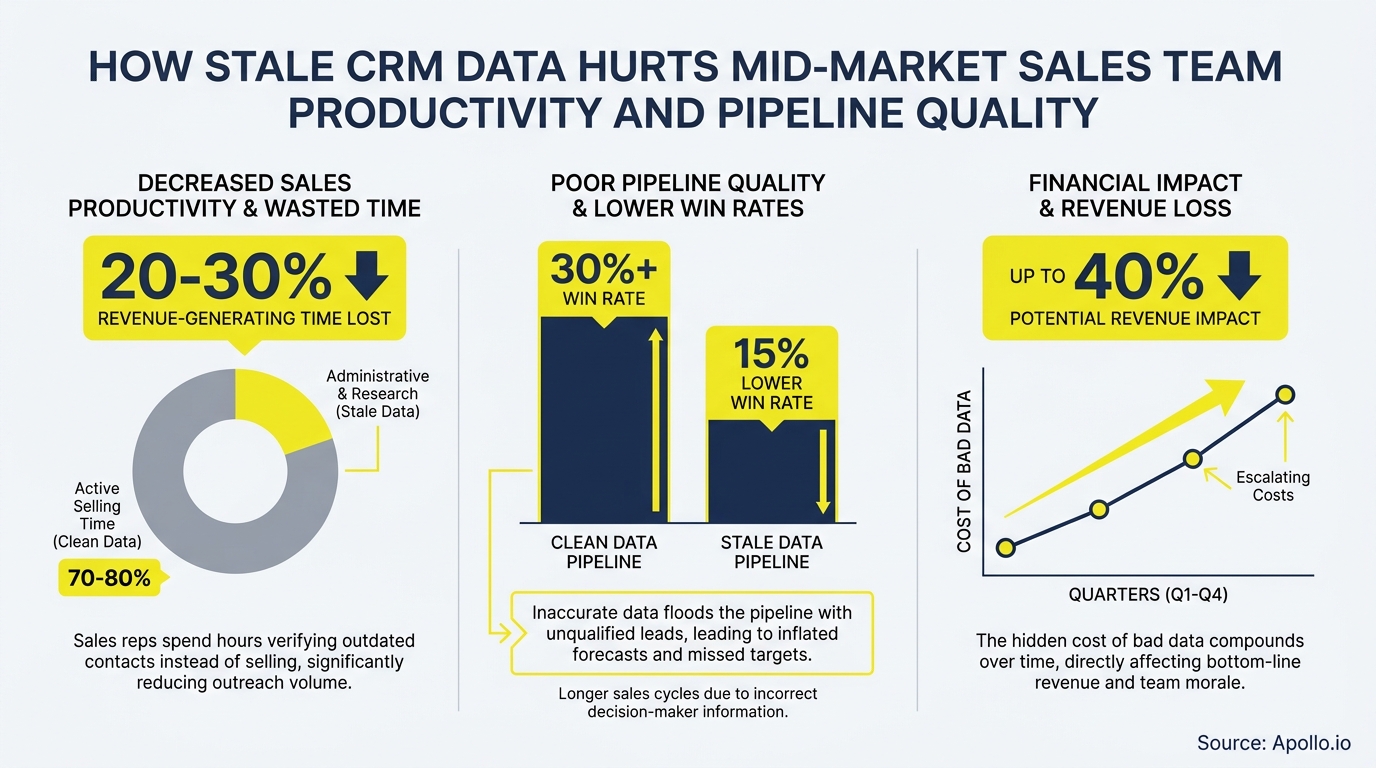
Stale CRM data is not a minor inconvenience. It is a measurable revenue leak that compounds every week reps spend working from outdated contacts, duplicate records, and incomplete account fields. For mid-market sales teams running lean coverage models, the cost shows up in missed forecasts, wasted rep cycles, and AI tools that produce unreliable recommendations. Understanding what drives sales productivity starts with confronting what destroys it: bad data at the foundation of your pipeline.

Research Less, Close More With Apollo
Tired of burning hours verifying contacts before a single email goes out? Apollo delivers 97% accurate business contact data so your reps spend time selling, not searching. Join 600K+ companies building pipeline faster.
Start Free with Apollo →Key Takeaways
- Stale CRM data forces reps to spend a substantial portion of their week on non-selling tasks like data verification and manual re-entry instead of closing deals.
- Five specific data quality issues (incomplete, missing, incorrect, duplicate, and expired records) each cause distinct pipeline distortions that inflate coverage numbers while hiding real risk.
- Poor data quality is a top barrier to sales analytics effectiveness, which means forecasts built on stale data carry compounding inaccuracy for revenue leaders.
- AI tools amplify the problem: stale CRM inputs produce wrong prioritization, low trust in recommendations, and slower adoption across GTM teams.
- RevOps teams that treat data hygiene as an ongoing operating system rather than a quarterly cleanup see measurable improvements in forecast reliability and rep efficiency.
What Are the Five Types of Stale CRM Data That Hurt Mid-Market Teams?
Stale CRM data breaks down into five categories, each producing a different failure mode in your pipeline. According to Forbes Business Council, annual decay rates for B2B contact data range from 30-40%, with some industries seeing decay as fast as 70.3% per year.
| Data Issue | What It Looks Like | Pipeline Impact |
|---|---|---|
| Incomplete data | Missing job title, company size, or industry fields | Misrouted leads, failed segmentation, wasted sequences |
| Missing data | No contact email, phone, or decision-maker name | Reps rebuild lists manually before outreach can start |
| Incorrect data | Wrong phone number, outdated title, merged company info | Bounced emails, dead dials, credibility loss with prospects |
| Duplicate records | Same contact or account entered multiple times | Inflated pipeline coverage, redundant outreach, forecast distortion |
| Expired data | Contacts who changed roles or left the company | Sequences sent to the wrong person, deals stalled at wrong stakeholder |
Gartner research, cited by The Data Business, suggests around 30% of CRM data becomes outdated within 12 months. For mid-market teams without dedicated data stewardship, that rate compounds silently across every account in the system.
How Does Stale Data Directly Kill Rep Productivity?
Stale CRM data kills rep productivity by forcing sellers to spend significant time on verification, re-entry, and list rebuilding instead of selling activities. According to Firmable, Salesforce reports that reps spend 28% of their week searching for information or manually entering data. Salesforce's own 2026 State of Sales report confirms salespeople spend more than half their time on non-selling work overall, and CRM staleness compounds that overhead at every stage.
For SDRs, the impact is immediate: a contact with an outdated title or missing direct line means a sequence that never lands. For AEs managing active deals, incorrect stakeholder records mean preparation based on the wrong person's role. As noted by PR Newswire citing Validity's research, workers spend an average of 13 hours per week hunting for basic information in the CRM. That is more than a quarter of a standard work week consumed by a solvable data problem.
Tired of your reps losing hours to bad data? Apollo's data enrichment keeps your CRM accurate and current automatically.
How Does Stale CRM Data Distort Pipeline Quality and Forecasts?
Stale CRM data distorts pipeline quality by inflating coverage with dead opportunities, misrouting live deals, and degrading the accuracy of every forecast built on top of it. A Gartner survey of 303 sales leaders found 44% cited poor data quality as a barrier to analytics success, and 84% agreed sales analytics had less influence on performance than leadership expected.
The specific distortions mid-market revenue leaders see most often:
- Phantom pipeline: Duplicate opportunities and inactive accounts inflate coverage ratios, making deals look healthier than they are.
- Stage mismatch: Deals sit in the wrong stage because activity data was never captured or synced correctly, skewing velocity metrics.
- Forecast drift: As SyncMatters notes, incomplete, outdated, or inaccurate CRM data directly degrades forecast accuracy. When the underlying records are wrong, every rollup report compounds the error.
- Misrouted leads: Incorrect firmographic fields send inbound leads to the wrong rep or territory, creating friction that delays follow-up and lowers conversion.
For RevOps leaders, this means pipeline reviews become debates about data validity rather than deal strategy. Connecting your CRM to verified, continuously refreshed data is the prerequisite for any meaningful sales analytics program.

How Does Stale Data Block AI Adoption for Mid-Market Sales Teams?
Stale CRM data blocks AI adoption because AI tools require clean, connected inputs to produce reliable outputs. When fields are missing, contacts are outdated, or accounts are duplicated, AI-powered routing, scoring, and forecasting tools surface wrong recommendations, which erodes rep trust and slows adoption.
Salesforce's 2026 State of Sales report found 94% of sales leaders with AI agents say they are critical for meeting business demands, yet 51% say tech silos delay or limit their AI initiatives. Mid-market teams running an average of eight tools per team face compounding field-mismatch problems that make CRM data stale faster than manual hygiene processes can fix.
The result: AI copilots that prioritize dead accounts, forecasting models that surface phantom deals, and routing automation that misassigns leads.
The fix is not just cleaning data once. It is connecting your CRM to a live enrichment layer so data stays current as contacts change roles, companies grow, and new stakeholders enter accounts. Learn more about building that foundation with a structured data enrichment strategy.
Turn Funnel Guesswork Into Pipeline Wins
Pipeline forecasting a guessing game because leads stall before they ever reach your AEs? Apollo surfaces high-intent prospects so your top-of-funnel actually converts. Join 600K+ companies building predictable pipeline.
Start Free with Apollo →How Should RevOps Teams Build a Data Hygiene Operating System?
RevOps teams should treat data hygiene as an ongoing operating system with defined ownership, SLAs, and KPIs, not a one-time cleanup project. The practical framework for mid-market teams:
- Ownership: Assign a named data quality owner (or RevOps function lead) with accountability for field completeness rates and duplicate thresholds.
- Audit cadence: Run weekly automated checks on required fields, monthly deduplication sweeps, and quarterly full-database reviews.
- Entry standards: Define required fields for every object (contact, account, opportunity) with validation rules that prevent incomplete records from being saved.
- Enrichment automation: Connect CRM to a live data layer that auto-fills and updates fields on a defined schedule, reducing manual re-entry burden.
- KPIs to track: Field completeness rate, duplicate record percentage, data freshness score (days since last verified), and bounce rate on outbound sequences.
Integrating enrichment directly into your CRM workflow removes the manual overhead. Connecting Apollo with Salesforce or HubSpot keeps contact and account data current without requiring reps to update records manually.

What Is the 90-Day Playbook for Fixing Stale CRM Data?
A 90-day remediation plan gives mid-market RevOps teams a structured path from reactive cleanup to proactive governance. The phased approach:
| Phase | Actions | Outcome |
|---|---|---|
| Days 1-30 | Audit current field completeness. Identify and merge top duplicate clusters. Set required-field validation rules. | Baseline data health score established. Highest-volume duplicates removed. |
| Days 31-60 | Deploy enrichment integration to auto-fill missing fields. Run enrichment pass on active pipeline accounts. Establish stage exit criteria tied to data requirements. | Active pipeline accuracy improves. Reps stop losing time to manual verification. |
| Days 61-90 | Launch weekly automated health reports. Train reps on data entry standards. Set KPI targets for next quarter review. | Data hygiene becomes a managed process, not a cleanup event. |
For teams using HubSpot or Salesforce, contact data enrichment integrated at the CRM level removes the manual overhead from this entire cycle. Apollo's enrichment layer continuously verifies and updates contact and account records, so your 90-day plan does not reset to zero after the first cleanup.
Struggling with pipeline distortion from bad data? Apollo gives your team a clean, verified pipeline foundation to build from.
How Can Mid-Market Teams Fix Stale CRM Data for Good in 2026?
Fixing stale CRM data permanently requires moving from manual cleanup to automated enrichment connected to a verified B2B data source. The mid-market teams seeing the most improvement are those that consolidate prospecting, enrichment, and engagement into a unified platform rather than managing separate tools that create field-mismatch and sync lag.
Apollo serves B2B GTM teams from startups through enterprise, giving SDRs, AEs, RevOps leaders, and sales managers a single workspace where contact and account data stays current, sequences run on verified contacts, and pipeline reflects real activity. As Cyera noted, "Having everything in one system was a game changer." That consolidation removes the data fragmentation that makes CRM staleness inevitable when teams run eight disconnected tools.
To get started, explore how data enrichment done right transforms CRM quality, and how revenue operations teams structure governance around it. Then put clean data to work across every stage of your pipeline.
Ready to stop losing revenue to stale data? Try Apollo Free and give your team a verified, continuously enriched foundation for every deal.
Prove Pipeline ROI With Apollo
Budget approval stuck on unclear metrics? Apollo gives revenue teams measurable pipeline impact from day one. Teams like Leadium 3x'd annual revenue — see results fast enough to justify every dollar.
Start Free with Apollo →Don't miss these
Sales
Inbound vs Outbound Marketing: Which Strategy Wins?
Sales
What Is a Sales Funnel? The Non-Linear Revenue Framework for 2026
Sales
What Is a Go-to-Market Strategy? The 2026 GTM Playbook
See Apollo in action
We'd love to show how Apollo can help you sell better.
By submitting this form, you will receive information, tips, and promotions from Apollo. To learn more, see our Privacy Statement.
4.7/5 based on 9,690 reviews
