
How Sales Automation Software Differs from a CRM
Your CRM stores everything. Your sales automation software does everything. That distinction sounds simple, but confusing the two costs B2B GTM teams real pipeline. SDRs end up doing manual follow-ups that should be automated. RevOps leaders pay for overlapping tools. AEs lose selling time to admin work that a workflow engine should handle.
Understanding how sales automation software drives revenue differently from a CRM is the first step toward building a leaner, faster-moving tech stack in 2026.

Build Pipeline, Not Spreadsheets
Tired of burning hours verifying contacts while your pipeline stalls? Apollo delivers 230M+ accurate business contacts so your team sells instead of researches. Start building predictable pipeline today.
Start Free with Apollo →Key Takeaways
- A CRM is your system of record: it stores contacts, accounts, deals, and interaction history.
- Sales automation software is your system of action: it executes sequences, triggers follow-ups, and moves deals forward automatically.
- In 2026, the line is blurring as CRM vendors embed AI agents directly into their platforms, but standalone automation still wins for complex outbound.
- RevOps teams that treat both tools as complementary (not competing) build faster pipelines with fewer manual handoffs.
- Consolidating CRM, automation, and prospecting into one platform cuts tool sprawl and speeds up rep ramp time.
What Is the Core Difference Between Sales Automation Software and a CRM?
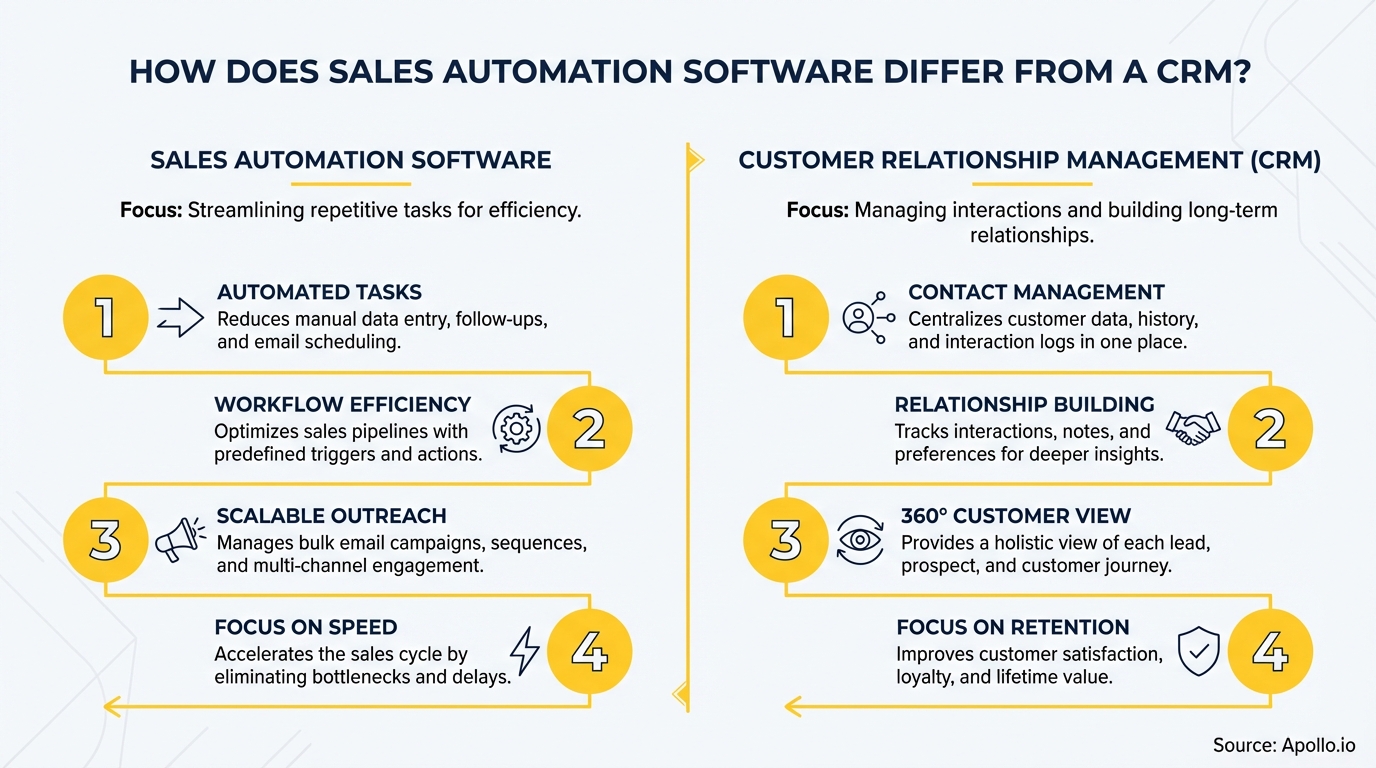
A CRM is a system of record that stores customer data, deal history, and contact information. Sales automation software is a system of action that executes tasks, triggers outreach sequences, and updates records automatically without rep intervention.
As Stob.ai describes it, sales automation acts as a "workflow engine" that automatically executes sales actions, such as responding to leads, triggering follow-up sequences, and updating the CRM system. The CRM provides the data context; the automation layer acts on it.
| Dimension | CRM | Sales Automation Software |
|---|---|---|
| Primary role | System of record | System of action |
| Core function | Store contacts, deals, history | Execute sequences, trigger follow-ups |
| Who uses it most | Sales managers, RevOps | SDRs, BDRs, AEs |
| ROI driver | Data quality and visibility | Time saved on repetitive tasks |
| Outputs | Reports, forecasts, pipeline views | Sent emails, booked meetings, updated records |
How Do CRM and Sales Automation Software Work Together?
CRM and sales automation work best as complementary layers: the CRM holds the data, and the automation tool acts on it. According to Breakcold, CRM is a comprehensive strategy for managing all customer interactions and data to build long-term relationships, whereas sales automation is a subset focused on streamlining and automating repetitive sales tasks to boost efficiency.
A practical example: when a prospect opens an email (automation trigger), the CRM logs the activity and the automation tool queues a follow-up call for the SDR. Neither tool alone closes that loop.
Spending hours on manual outreach? Automate your sequences with Apollo's multi-channel engagement platform and keep your CRM updated automatically.
Turn Funnel Guesswork Into Real Pipeline
Tired of watching marketing leads die before they ever become opportunities? Apollo surfaces high-intent prospects and puts your team in front of ready buyers first. Join 600K+ companies forecasting with confidence.
Start Free with Apollo →How Does AI Change the CRM vs. Sales Automation Equation in 2026?
In 2026, AI agents are collapsing the traditional boundary between CRM and sales automation. Salesforce's Agentforce and Microsoft Dynamics 365's Copilot now execute workflows directly inside the CRM, blurring the old model where automation lived in a separate layer on top.
This shift changes the buyer question. Teams no longer ask "CRM or automation tool?" They ask "how capable is our CRM's execution engine, and when do we still need a specialized automation platform?" Standalone automation still wins for complex outbound prospecting, deliverability controls, and high-volume sequence experimentation. Learn more about how to use sales automation the right way in a modern GTM stack.
The market reflects this momentum. According to Cirrus Insight, the global sales automation market was valued at $16 billion in 2025 and is projected to surpass $31 billion by 2035, driven largely by AI-powered execution capabilities.
How Do SDRs and RevOps Teams Decide Which Tool to Prioritize?
SDRs and RevOps leaders should choose based on the job to be done: CRM for data governance and pipeline visibility, automation for execution speed and rep productivity.
A practical decision framework:
- Use CRM-native automation when: your workflows are simple (stage-based triggers, task creation, basic email alerts) and you want fewer integrations to maintain.
- Use specialized automation when: you run high-volume outbound, need advanced deliverability controls, want multi-channel sequences across email, phone, and social, or require deep prospecting data built into the workflow.
- Use a unified platform when: you want to consolidate prospecting data, sequencing, and CRM sync into one workspace to eliminate tool sprawl entirely.
RevOps leaders find that clean data sync between automation and CRM is the single biggest lever for improving pipeline accuracy. When automation tools write back to the CRM in real time, forecasts become reliable and reps stop maintaining duplicate records.
For AEs managing active deals, the question is simpler: does your automation layer surface the right context at the right stage, or does it just send more emails? Modern workflow automation platforms handle both signal-triggered actions and deal-stage updates in one place.

What Does the CRM Market Size Tell Us About Tool Consolidation?
The CRM market's scale explains why vendors are racing to absorb automation capabilities. Data from Kixie shows the global CRM market is projected to reach approximately $112 billion in 2025 and is on a trajectory to reach $262.74 billion by 2032 at a CAGR of about 12.8%.
At that scale, CRM vendors have both the incentive and the resources to bundle automation, AI, and engagement tools into their platforms. For buyers, this means evaluating not just "what does this CRM store" but "what can it execute." Teams that consolidate see real results: "Having everything in one system was a game changer" (Cyera).
How Does Apollo Unify CRM Integration and Sales Automation?
Apollo unifies prospecting data, multi-channel sequences, AI-powered automation, and CRM sync into one platform, so SDRs, AEs, and RevOps teams stop switching between tools to execute a single workflow.
Apollo integrates directly with Salesforce and HubSpot, writing activity data back to CRM records automatically. Reps prospect, sequence, and log activity without leaving one workspace. As Predictable Revenue put it: "We reduced the complexity of three tools into one." See exactly how this works in the Apollo CRM integration guide for Salesforce and HubSpot.
Apollo's AI sales automation platform handles sequence enrollment, follow-up timing, contact enrichment, and CRM updates, so reps focus on conversations rather than admin. Trusted by nearly 100K paying customers including Anthropic, Smartling, and Redis.

What Is the Bottom Line for B2B GTM Teams in 2026?
CRM and sales automation are not competitors. One stores your revenue data; the other acts on it.
The smartest GTM teams in 2026 use both, but they minimize the friction between them by choosing platforms that sync seamlessly or unify the functions entirely.
The risk of keeping them siloed: reps spend time on manual data entry instead of selling, and RevOps loses visibility when automation tools don't write back to the CRM in real time. The opportunity: a unified system where prospecting, sequencing, and pipeline tracking live together.
Ready to stop managing disconnected tools? Start your free trial of Apollo and run prospecting, automation, and CRM sync from one platform.
Prove ROI Before the Next Budget Review
ROI pressure killing your tool adoption? Apollo delivers measurable pipeline impact from day one — no lengthy onboarding, no guesswork. Leadium 3x'd their annual revenue. Your CFO will thank you.
Start Free with Apollo →Don't miss these
Sales
Inbound vs Outbound Marketing: Which Strategy Wins?
Sales
What Is a Sales Funnel? The Non-Linear Revenue Framework for 2026
Sales
What Is a Go-to-Market Strategy? The 2026 GTM Playbook
See Apollo in action
We'd love to show how Apollo can help you sell better.
By submitting this form, you will receive information, tips, and promotions from Apollo. To learn more, see our Privacy Statement.
4.7/5 based on 9,690 reviews
