
How Does Intent Data Work and How Can It Improve Outbound Targeting?
Most outbound teams are reaching out to accounts that aren't ready to buy, while missing the ones that are actively researching right now. Intent data fixes that by surfacing behavioral signals that reveal when a prospect is in-market, before they ever fill out a form. For SDRs and AEs, this means fewer wasted touches and more conversations with accounts that are already moving toward a purchase decision. To understand the full landscape, start with how intent data is collected and which providers lead the market.

Research Less, Close More With Apollo
Tired of your reps burning hours hunting down contact info that bounces? Apollo delivers verified business emails and phone numbers so your team spends time selling, not searching. Join 600K+ companies building pipeline faster.
Start Free with Apollo →Key Takeaways
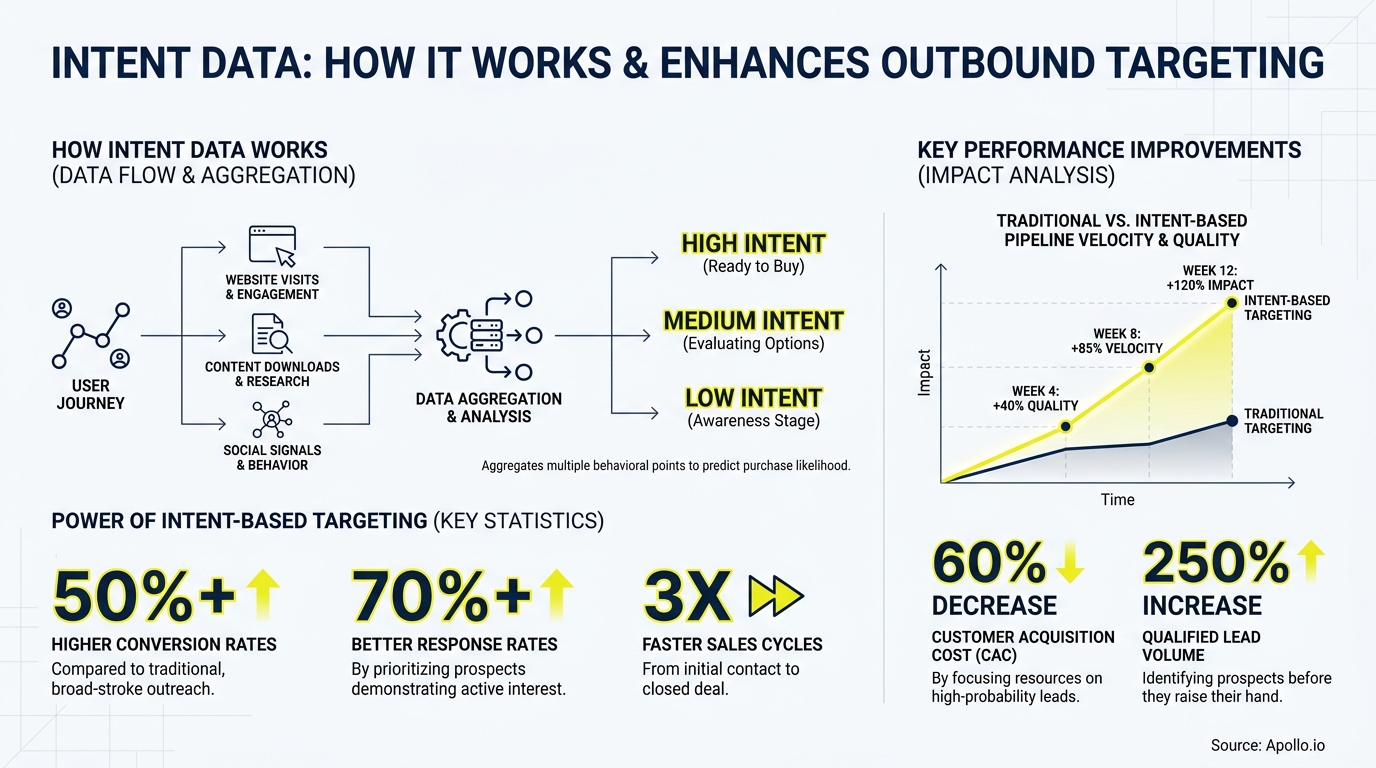
- Intent data captures behavioral signals (content consumption, search activity, review site visits) and aggregates them at the account level to reveal buying readiness.
- First-party signals (your own site, product, CRM) combined with third-party signals create a more precise picture than either source alone.
- Outbound teams can segment prospects by intent horizon (0–3, 3–6, 6–12 months) to match messaging and channel mix to where each account is in their buying journey.
- According to Landbase, 93% of B2B marketers observe increases in conversion rates across all funnel stages when using intent data.
- The biggest differentiator is not buying intent signals alone, but the execution layer: clear plays, recency weighting, and message alignment that converts signals into booked meetings.
What Is Intent Data and How Does It Work?
Intent data works by collecting and analyzing behavioral information that indicates a prospect's active research and potential buying interest. As described by MarketsandMarkets, these signals are aggregated across content networks, publisher sites, review platforms, and your own digital properties, then resolved to the account level.
Two core signal types feed intent systems:
- First-party signals: Website visits, product page views, pricing page hits, chat interactions, CRM activity, and email engagement from your own channels.
- Third-party signals: Content consumption patterns across external publisher networks, keyword research activity, review site visits (such as G2 or Capterra), and co-op data from B2B content platforms.
The leading approach in 2026 has shifted from single-source "intent scores" to multi-source signal stacks, combining third-party intent with first-party engagement, technographics, and CRM history to reduce false positives. As noted by TechInformed, effectiveness increases substantially when intent is layered with firmographic context such as company size, industry, and geography, allowing teams to prioritize with precision. Learn more about building that foundation with a data enrichment strategy that supports account-level activation.
Why Does Intent Data Matter for Outbound Teams in 2026?
Intent data matters because most of the B2B buying process happens before buyers speak to a seller. Research from 6sense's 2024 B2B Buyer Experience study (n=2,509) found that 69% of the purchase process is complete before buyers engage sales, and 85% of buyers establish purchase requirements before contacting a vendor.
Outbound teams that wait for inbound signals are arriving after decisions are already forming.
Budget waste compounds the urgency. The EMARKETER and Demandbase B2B Advertising Survey (January 2025, n=231) found that 58% of B2B marketers identify waste as a major concern, with over half estimating losses between 16% and 45% of their total ad budget.
Intent-driven prioritization and suppression rules directly address this problem by concentrating spend on accounts with active buying signals.
According to data from MyShortlister, 55% of businesses noted an increase in lead conversions when using intent data, reinforcing the direct pipeline impact. Explore how intent data powers smarter B2B sales across the full funnel.
Turn Funnel Guesswork Into Pipeline Clarity
Tired of watching marketing leads stall before they ever reach your pipeline? Apollo surfaces in-market buyers at the right moment so your team acts on real signals, not hunches. 600K+ companies forecast with confidence.
Start Free with Apollo →How Do SDRs and AEs Use Intent Data to Prioritize Outbound?
SDRs use intent data primarily for lead and account prioritization, replacing gut-feel sequencing with signal-ranked account lists. According to nrich.io, 69% of respondents cite lead and account prioritization as intent data's most common application. For AEs, intent signals inform pre-meeting research, competitive positioning, and timing for re-engagement on dormant opportunities.
A practical intent-based outbound workflow looks like this:
- Score and rank accounts by signal recency, frequency, and topic relevance against your ICP.
- Apply suppression rules to exclude accounts showing no signal or already in active pipeline.
- Trigger sequences automatically when an account crosses a signal threshold, routing to the right rep via RevOps workflows.
- Align messaging to the signal topic, not just the account name, so the first touch is contextually relevant.
Struggling to prioritize which accounts to contact first? Search Apollo's 230M+ contacts with 65+ filters, including buying intent signals, to build a precisely targeted outbound list in minutes.

What Is Intent Horizon Planning and Why Does It Change Your Outreach?
Intent horizon planning segments target accounts by their estimated time-to-purchase, then tailors channel mix, message angle, and content assets to each window. NetLine's 2025 State of B2B Content Consumption report (based on 2024 data) found that mid-term buying intent (3–6 months) increased by 15% year over year, while short-term intent (next 3 months) declined by 12%, signaling that nurture-first cadences are increasingly relevant.
| Intent Horizon | Signal Characteristics | Recommended Channel Mix | Messaging Angle |
|---|---|---|---|
| 0–3 months (Active) | High-frequency, recent, topic-specific signals; pricing or competitor research | Direct outbound (email + phone), paid retargeting | Solution-specific, ROI-focused, request meeting |
| 3–6 months (Building) | Mid-frequency signals; category-level research, use case content | Multi-channel sequences, educational content, webinar invites | Problem-awareness, peer benchmarks, thought leadership |
| 6–12 months (Early) | Low-frequency, broad topic signals; industry trend content | Paid social nurture, newsletter, light-touch email | Category education, future-state vision, relationship building |
This horizon framework prevents the common mistake of sending demo-request messaging to accounts that are still 6 months from budget approval, which drives unsubscribes and damages sender reputation. For RevOps leaders, this structure maps directly into sequence triggers and routing rules inside your GTM stack. See how revenue operations drives growth by connecting intent signals to pipeline workflows.
How Should RevOps Govern Intent Data for Accuracy?
RevOps teams govern intent data by establishing clear rules for signal ingestion, match rates, deduplication, and CRM integration before intent feeds any outbound workflow. Without governance, intent signals create noise rather than precision: reps receive contradictory or stale signals and lose trust in the system.
Core governance considerations:
- Match rate standards: Define minimum account-match confidence thresholds before a signal triggers a sequence.
- Recency weighting: Signals older than 30–45 days should decay in priority score; signals from the past 7 days should rank highest.
- First-party vs. third-party hierarchy: First-party signals (your own site, CRM) are higher-confidence and should override or amplify third-party signals, not compete with them.
- Suppression lists: Current customers, recently closed-lost accounts (within 90 days), and accounts in active deal stages should be excluded from intent-triggered outbound.
- Privacy alignment: As identifier volatility increases with evolving ad ecosystem policies, account-level aggregation (not individual tracking) is the sustainable approach.
Keeping CRM data clean and enriched is prerequisite to intent governance. Explore how contact data enrichment drives ROI by ensuring your account records are complete enough to match intent signals accurately.
How Can Apollo Help Teams Act on Intent Data Faster?
Apollo combines buying intent signals with a database of 230M+ contacts and 65+ search filters, so SDRs and AEs can move from signal to sequence inside one platform without stitching together separate tools. Apollo's buying intent data surfaces accounts actively researching solutions like yours, and Apollo's AI-powered workflows can trigger personalized outreach at the moment of highest signal strength.
As Cyera noted, "Having everything in one system was a game changer." Instead of exporting intent signals from one tool, cross-referencing a contact database in another, and building sequences in a third, Apollo consolidates the entire workflow. This directly addresses the operational maturity gap that separates teams who get results from intent data from those who find it generates noise.
Spending too much time manually building outreach sequences after identifying intent signals? Automate your multi-channel sequences with Apollo's sales engagement platform and trigger outreach the moment an account shows buying intent.

Conclusion: Turn Intent Signals Into Pipeline
Intent data works best when it is tied to clear execution: horizon-based segmentation, governed signal stacks, and contextually aligned messaging. Teams that treat intent as a prioritization layer, not just a list of "interested" companies, see measurable improvements in conversion rates, shorter sales cycles, and reduced budget waste. Data from Intentsify shows that 84% of marketers anticipate increasing their intent data budgets, with 33% expecting a significant boost, reflecting growing confidence in the approach.
The practical next step: connect verified contact data, buying intent signals, and automated sequences in one workspace so your outbound team can act on signals the moment they appear. Apollo brings all three together without the complexity of a fragmented tech stack.
Ready to activate intent data across your outbound motion? Schedule a Demo and see how Apollo surfaces in-market accounts and converts signals into booked meetings.
Prove Pipeline ROI With Apollo
Budget approval stuck on unclear metrics? Apollo surfaces measurable pipeline impact from day one, so you walk into every renewal conversation with hard numbers. Leadium 3x'd their annual revenue — your ROI story starts here.
Start Free with Apollo →Don't miss these
Sales
Inbound vs Outbound Marketing: Which Strategy Wins?
Sales
What Is a Sales Funnel? The Non-Linear Revenue Framework for 2026
Sales
What Is a Go-to-Market Strategy? The 2026 GTM Playbook
See Apollo in action
We'd love to show how Apollo can help you sell better.
By submitting this form, you will receive information, tips, and promotions from Apollo. To learn more, see our Privacy Statement.
4.7/5 based on 9,690 reviews
