
How Does an SDR Team Use Job Change Alerts to Trigger Timely Outbound Outreach?
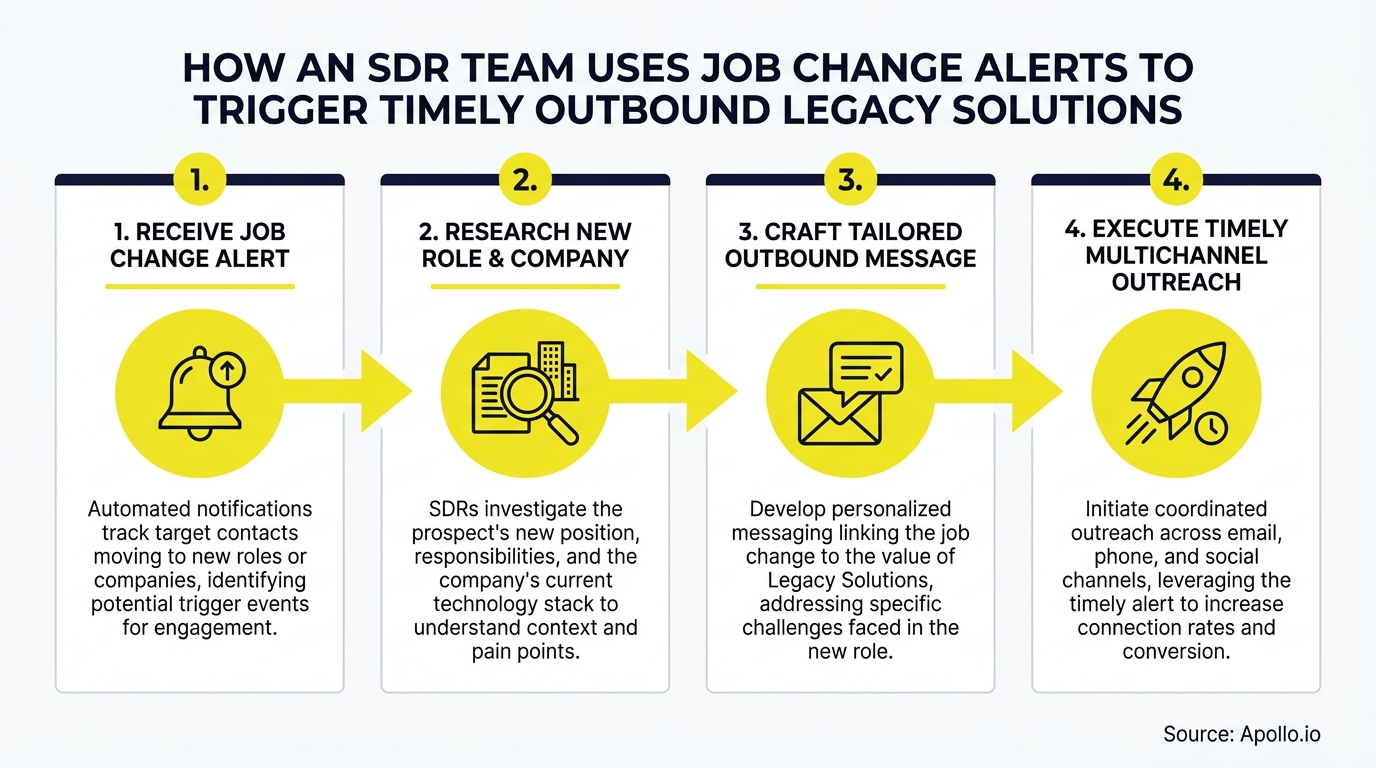
SDR teams use job change alerts to detect when a buyer, champion, or past contact moves to a new role, then trigger a structured outbound sequence within hours. The window is short. New executives are actively evaluating vendors, rebuilding their tech stack, and looking to make an early impact. Miss that window and you're back to cold outreach. According to Boomerang, job change tracking can lead to 2-4x higher response rates compared to cold outreach, with some sources indicating 15-25% response rates.
The best SDR teams treat job changes not as a nice-to-have signal, but as a high-priority trigger that feeds directly into automated sequences. Learn how to build that system below, starting with how job change alerts grow your pipeline.

Research Less, Close More With Apollo
Tired of your reps burning hours on manual lead research instead of selling? Apollo surfaces verified contacts instantly so your team spends time closing, not digging. Join 600K+ companies building pipeline faster.
Start Free with Apollo →Key Takeaways
- Job change alerts create a narrow, high-conversion outreach window that requires SLA-backed response times to capture.
- Previous champions who change companies convert significantly more often than cold prospects, making champion tracking a core RevOps motion.
- Outreach triggered by job changes works best when it addresses the buying group, not just the individual who moved.
- Omnichannel sequencing (email + phone + social) outperforms single-channel outreach for alert-triggered plays.
- Data quality and automated routing determine whether job change alerts reach the right SDR in time to matter.
Why Do Job Change Alerts Matter for SDR Outbound?
Job change alerts matter because they convert the chaos of personnel movement into a predictable, high-intent pipeline signal. A contact moving to a new company often means fresh budget authority, an open vendor evaluation, and a mandate to make changes fast. Research from UserGems found that previous champions who change jobs convert 114% more often than cold prospects. That is not a marginal lift. That is a fundamentally different category of lead.
Data from SalesMotionreinforces the urgency: selling to accounts with active buying triggers like job changes delivers a 37% win rate, compared to 19% for cold outreach. For SDR teams under quota pressure, that gap is the difference between hitting and missing the number.
How Do SDRs Build a Job-Change Alert Operating System?
An SDR job-change alert operating system converts a raw signal into a routed, enriched, sequenced outreach task, automatically. The core components are signal detection, enrichment, routing, and sequencing.
Without all four, alerts become noise rather than pipeline.
| Step | Action | SLA Target |
|---|---|---|
| 1. Signal Detection | Alert fires when a tracked contact updates their role | Real-time or daily batch |
| 2. Identity Resolution | Match contact to CRM record, deduplicate, update email/phone | Automated, within 1 hour |
| 3. Routing | Assign to correct SDR based on territory or account ownership | Within 2 hours of alert |
| 4. Sequence Enrollment | Auto-enroll in a job-change-specific multi-touch sequence | First touch within 24 hours |
Speed is non-negotiable. Martal reports that responding to new leads within 5 minutes makes them 9x more likely to convert, highlighting the need for timely SDR outreach powered by real-time alerts. Even if a 5-minute response is aspirational for outbound, the principle holds: every hour of delay reduces conversion probability.
Struggling to find qualified contacts after an alert fires? Enrich contact records automatically with Apollo to get verified emails and direct dials the moment a job change is detected.
What Is the Champion Left Playbook for SDR Teams?
The Champion Left playbook is a structured response for when a key contact, buyer, or deal champion departs an active account or open opportunity. It is one of the highest-leverage use cases for job change alerts because inaction directly risks deal loss or churn. RevOps teams that productize this motion protect both pipeline and renewal revenue.
Execute this playbook in three tracks simultaneously:
- Track the champion at their new company. Reach out with a warm, context-rich message. They already know your product and are likely evaluating vendors in their new role.
- Re-multithread the vacated account. Identify the next senior stakeholder, map the new buying group, and re-engage with a business-case-focused message rather than a pitch.
- Escalate to executive sponsor. If the deal is material, loop in an AE or sales leader for an executive-to-executive outreach to the account's leadership.
According to Jolly Marketer, outreach tied to leadership changes achieves a 14% response rate, significantly higher than the 1.2% for generic cold calls. The champion's departure is not just a risk, it is also an opening at both the old and new account.
Turn Funnel Gaps Into Pipeline Gold
Tired of watching MQLs die before they ever become opportunities? Apollo surfaces in-market buyers with verified contact data so your team reaches the right prospects at right moment. 600K+ companies trust Apollo to build predictable pipeline.
Start Free with Apollo →How Should SDRs Structure Omnichannel Sequences for Job Change Triggers?
Omnichannel sequencing for job change alerts combines email, phone, and social outreach in a defined cadence, paired with a self-serve resource that lets the prospect engage on their own timeline. Single-channel outreach underperforms because new executives use multiple channels to evaluate vendors simultaneously.
A proven 5-touch job-change sequence looks like this:
- Day 1 (Email): Personalized congratulations + one relevant insight tied to their new role and industry.
- Day 2 (Phone): Brief voicemail referencing the email. Keep it under 20 seconds.
- Day 4 (Social): Engage with their recent post or send a short, non-pitchy note on a professional network.
- Day 7 (Email): Share a consensus-building asset (ROI calculator, implementation checklist, or peer case study) designed for their buying group, not just them.
- Day 14 (Email + Phone): Final follow-up with a clear ask and a low-friction next step (a 15-minute call or a self-serve demo link).
The messaging shift matters as much as the channel mix. Research from Gartner (based on an Aug-Sep 2024 survey of 632 B2B buyers) found that tailoring content for buying-group relevance positively impacts consensus by 20%, while individual-level hyper-personalization has a negative impact on group consensus. Send assets that help the new hire's entire team align, not just messages that flatter the individual.
Spending hours building sequences manually? Automate multi-touch sequences with Apollo's sales engagement platform and trigger them the moment an alert fires.

How Do RevOps Teams Ensure Data Quality for Job Change Alerts?
RevOps teams ensure data quality by automating identity resolution, deduplication, and contact enrichment at the moment a job change alert fires. Without this, alerts route to the wrong SDR, sequences send to dead emails, and the high-intent window closes before a single touch lands.
The core data hygiene checklist for alert-driven outreach:
- Verify the contact's new email and direct dial before sequence enrollment.
- Deduplicate the CRM record to prevent double outreach from multiple reps.
- Suppress contacts who are currently in an active deal or customer account (to avoid cannibalizing AE relationships).
- Update account firmographics for the contact's new employer (company size, tech stack, revenue).
- Route based on territory rules, not just the alert source.
Apollo's job change alerts and data enrichment automates this entire layer, detecting role changes, refreshing contact data, and routing to the right owner without manual intervention. For sales operations teams, that automation eliminates a major source of dropped pipeline.
How Do SDRs Combine Job Change Alerts with Intent Signals?
SDRs combine job change alerts with intent signals by using the career move as the timing trigger and intent data as the prioritization filter. A job change alone tells you when to reach out.
Intent data tells you who to reach out to first.
This "compound signal" approach works as follows:
- High priority: Contact changed jobs AND their new company is researching your category. Reach out within 24 hours.
- Medium priority: Contact changed jobs, no current intent signal. Reach out within 48-72 hours with a general value message.
- Low priority / hold: Contact changed jobs but moved to a company outside your ICP. Tag for future monitoring, do not enroll immediately.
This tiering prevents SDRs from treating every alert as equal, which leads to wasted effort on low-fit targets. For more on how intent signals integrate with outbound prospecting, the combination of timing and intent is what separates signal-based selling from spray-and-pray outreach. Learn more about how intent data works and who provides it.

Start Turning Job Changes Into Pipeline Today
Job change alerts are one of the highest-ROI signals available to SDR teams, but only when they feed into a structured, automated system. The teams winning in 2026 are not just monitoring for career moves.
They are routing enriched, verified contacts into omnichannel sequences within hours, using buying-group-aware messaging, and measuring lift at every stage.
Apollo consolidates signal detection, contact enrichment, sequence automation, and CRM integration into one platform, replacing the fragmented stack of point solutions most teams are stitching together today. As Cyera put it, "Having everything in one system was a game changer."
Ready to build your job-change alert playbook? Try Apollo Free and start capturing high-intent pipeline from every career move in your market.
Prove Pipeline ROI Before Next QBR
ROI pressure killing your tool budget? Apollo delivers measurable pipeline impact from day one — faster meetings, cleaner data, and results leadership can see. Leadium 3x'd revenue. Your turn.
Start Free with Apollo →Don't miss these
Sales
Inbound vs Outbound Marketing: Which Strategy Wins?
Sales
What Is a Sales Funnel? The Non-Linear Revenue Framework for 2026
Sales
What Is a Go-to-Market Strategy? The 2026 GTM Playbook
See Apollo in action
We'd love to show how Apollo can help you sell better.
By submitting this form, you will receive information, tips, and promotions from Apollo. To learn more, see our Privacy Statement.
4.7/5 based on 9,690 reviews
