
How an Integrated Prospecting Platform Cuts SDR Ramp Time
SDR ramp time is getting longer, not shorter. According to SalesHive's SDR benchmark data, average ramp time for SaaS companies reached 5.7 months in 2025, up 32% from 4.3 months in 2020. Every extra week an SDR spends learning disconnected tools instead of booking meetings costs revenue directly. An integrated prospecting and engagement platform fixes this by collapsing the tool stack into one workflow, giving new reps a single place to find contacts, send sequences, and track results from day one. If you're comparing platform options, see how Apollo, Salesloft, and Outreach stack up before committing.

Apollo Turns Hours of Research Into Minutes
Tired of your reps burning half their day verifying contact info instead of selling? Apollo surfaces accurate, ready-to-contact leads instantly. Join 600K+ companies building pipeline faster.
Start Free with Apollo →Key Takeaways
- Fragmented tool stacks are a leading cause of slow SDR ramp — new reps lose productive time learning multiple systems before making their first call.
- Top-performing companies are cutting SDR ramp time by up to 40% using AI-driven platforms that unify prospecting and engagement.
- Consolidating your tech stack removes administrative drag, reduces training overhead, and frees budget to reinvest in enablement.
- Gartner research shows 70% of sellers feel overwhelmed by the number of technologies they must master — integrated platforms directly address this friction.
- Apollo's all-in-one GTM platform gives SDRs, RevOps teams, and sales leaders a unified workspace for prospecting, sequencing, and pipeline management.
Why Does SDR Ramp Time Keep Getting Longer?
SDR ramp time grows when new hires must master multiple disconnected tools before executing their first outbound sequence. A Gartner Seller Skills Survey (n=1,026 B2B sellers) found 70% of sellers feel overwhelmed by the number of technologies required and 72% by the number of skills required. That cognitive load hits new SDRs hardest.
The typical fragmented stack forces a new hire to navigate a separate data tool, a separate sequencer, a separate dialer, and a CRM — each with its own login, logic, and failure point. The result: weeks spent on tool onboarding instead of pipeline generation. According to Gradient Works, SDRs generate between 46% and 73% of total pipeline conversion depending on the organization. Slow ramp means that pipeline engine stalls during the most costly period: early tenure.
What Is an Integrated Prospecting and Engagement Platform?
An integrated prospecting and engagement platform unifies contact discovery, outreach sequencing, multi-channel execution, and CRM sync into a single workspace. It is not simply a data tool plus a bolt-on sequencer.
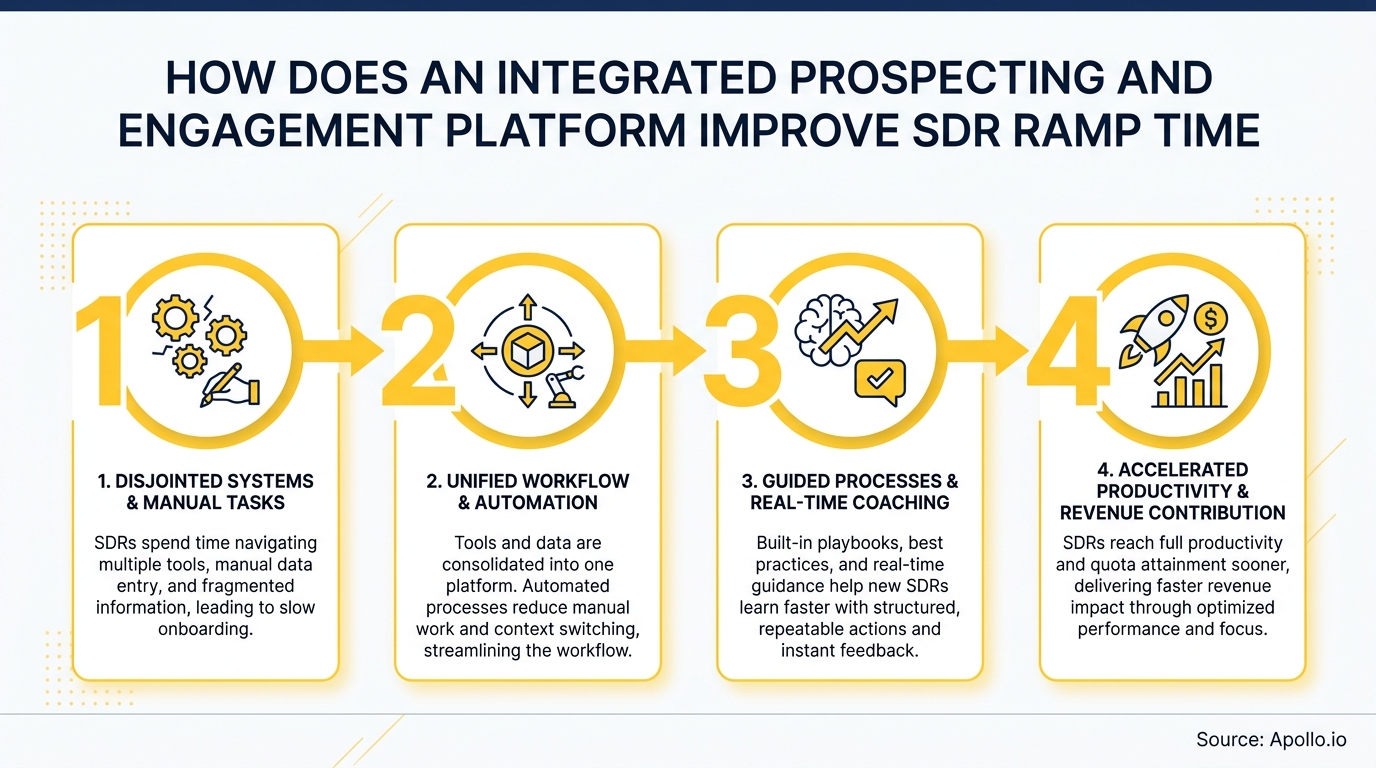
The distinction matters for ramp time: when SDRs find a contact, enrich it, add it to a sequence, and track replies without switching tabs, they execute the core job function from week one.
Three capability layers define this category:
- Integrated Prospecting: Verified contact database, ICP filters, and intent signals in one search interface.
- Engagement Execution: Email, phone, and social sequences launched from the same record — no export/import cycle.
- Revenue Orchestration: CRM sync, workflow automation, and coaching signals that surface in the flow of work, not a separate dashboard.
Platforms built on this model eliminate the handoffs that create ramp drag. New SDRs get a default playbook baked into the tool itself, not stored in a shared drive no one reads. Explore how sales automation done right accelerates this process.

How Does an Integrated Platform Cut SDR Ramp Time Specifically?
An integrated platform cuts SDR ramp time by reducing the number of systems a new rep must learn, providing pre-built sequence templates, and surfacing next-best-action guidance in a single workflow.
Research from Eubrics shows top-performing companies are cutting SDR ramp time by as much as 40% by combining innovative onboarding methods with technology-enabled training, particularly AI-driven platforms.
| Ramp Drag Source | Fragmented Stack Impact | Integrated Platform Fix |
|---|---|---|
| Tool training overhead | 2–4 systems to learn before first sequence | One workspace, one login, one workflow |
| Data quality issues | Bounced emails erode confidence and deliverability | Verified contacts reduce wasted outreach |
| Sequence setup friction | Manual export/import between data and engagement tools | One-click add to sequence from search results |
| Coaching visibility | Manager must pull data from multiple dashboards | Activity, reply rates, and meeting data in one view |
| Playbook access | Tribal knowledge in Slack threads and shared docs | Templates and proven sequences built into the platform |
Spending hours building prospect lists in one tool, pasting them into another, and then manually logging calls in a third? Automate your sequences with Apollo's multi-channel engagement platform and keep new SDRs in one workflow from day one.
Turn Funnel Guesswork Into Pipeline Clarity
Tired of marketing leads that never convert and forecasts built on stale data? Apollo surfaces high-intent prospects ready to buy — so your pipeline reflects reality, not hope. Join 600K+ companies forecasting with confidence.
Start Free with Apollo →How Do SDRs and RevOps Teams Benefit Differently?
SDRs benefit from reduced context-switching and pre-built outreach templates that let them execute quality sequences in their first weeks.
RevOps leaders benefit from a single source of truth for activity data, cleaner CRM records, and fewer integrations to maintain.
Both groups gain when the platform instructs behavior instead of just recording it.
For SDRs specifically, Apollo's multichannel sales engagement platform provides email, phone, and social touchpoints in one sequence editor — removing the need to coordinate across separate tools. For RevOps, unified data means data sync across the GTM stack becomes manageable rather than a full-time maintenance job. Companies like Cyera have noted that "having everything in one system was a game changer" precisely because it removed the RevOps burden of stitching systems together.
Sales leaders get coaching leverage too. When all activity signals live in one platform, managers can identify which sequence steps are converting and replicate that playbook for incoming SDRs — compressing the learning curve without adding headcount. Data from Persistence Market Research shows companies implementing sales engagement platforms report an average 25% increase in productivity.
What Is the ROI Case for Tech Stack Consolidation?
Consolidating prospecting and engagement tools into one platform funds faster ramp by reallocating the budget previously spent on redundant subscriptions into enablement, coaching, and headcount. When Census moved to Apollo, they reported cutting costs in half.
Predictable Revenue noted "we reduced the complexity of three tools into one" — a consolidation that directly reduced onboarding complexity for new SDRs.
The financial logic is straightforward for RevOps and finance leaders:
- Fewer contracts to renew, negotiate, and audit.
- Lower integration costs from eliminating middleware between point solutions.
- Reduced training overhead per new hire when one platform covers what three previously required.
- Faster time-to-first-meeting means each SDR seat pays back sooner.
The dominant GTM platform trend in 2026 is consolidating data, outreach, and signal-to-action workflows into fewer systems — specifically to reduce training overhead and eliminate failure points that slow new SDRs. Struggling to prospect at scale while managing too many tools? Search 230M+ verified contacts with 65+ filters in Apollo without leaving your engagement workflow.
How Does Buyer Behavior Make Integrated Platforms More Critical in 2026?
Buyers spend only 17% of their purchase journey time meeting with potential suppliers, according to Gartner's Future of Sales research — which means the window to make an impression is narrow and multi-touch coordination is essential. New SDRs on fragmented stacks frequently miss follow-up timing because signals live in different systems.
An integrated platform captures engagement signals and surfaces them in the sequence workflow automatically.
Gartner also projects 80% of B2B sales interactions will occur in digital channels. SDRs who can execute coordinated email, phone, and social sequences from a single workspace are better positioned to reach buyers across the channels they actually use. This precision-outbound model — targeted, multi-channel, signal-driven — is exactly what integrated platforms enable by design, and what new SDRs can execute from week two instead of month four. See how outbound prospecting works when prospecting and engagement live in the same system.
How Should Sales Leaders Implement an Integrated Platform for Faster SDR Ramp?
Sales leaders should implement an integrated platform by standardizing the SDR workflow inside the tool before the first hire logs in.
The platform should ship with approved sequences, ICP filter templates, and CRM field mappings already configured — so new reps execute on day one, not week three.
A practical 90-day framework:
- Days 1–30: Migrate prospecting and sequencing into one platform. Retire redundant tools. Set up pre-approved sequence templates aligned to ICP. See top-performing sequence examples to start.
- Days 31–60: Onboard new SDRs with live platform training using real ICP searches. Measure time-to-first-sequence and time-to-first-meeting as leading indicators.
- Days 61–90: Review sequence performance data to identify the highest-converting templates. Codify them as the default playbook for the next cohort.
Track customer engagement metrics from week one so managers have coaching data before the first 30-day review, not after. Use Apollo's sequence builder to create, test, and replicate winning outreach patterns across the entire SDR team.

How Does Apollo Help SDRs Ramp Faster in 2026?
Apollo gives SDRs a unified workspace for prospecting, sequencing, dialing, and CRM sync — eliminating the tool-switching that extends ramp time. With 230M+ verified business contacts, 65+ search filters, and multi-channel sequences built into the same platform, new SDRs can find their first ICP-fit prospect and launch their first sequence without leaving a single interface.
Trusted by nearly 100K paying customers including Anthropic, Smartling, Redis, and Cyera, Apollo consolidates what competing stacks split across multiple vendors. For RevOps, that means one integration to maintain and one data model to govern.
For SDR managers, it means every rep's activity, reply rate, and meeting data is visible in one dashboard from week one. For SDRs themselves, it means less time configuring tools and more time booking meetings — which is the only metric that actually accelerates ramp.
Ready to compress SDR ramp time with a unified GTM platform? Get Leads Now and see how Apollo's all-in-one platform helps your team hit quota faster.
Apollo Proves ROI Before Day 30
Budget approval stuck on unclear metrics? Apollo delivers measurable pipeline impact fast — so you walk into every renewal conversation with proof, not promises. Join 600K+ companies justifying every dollar.
Start Free with Apollo →Don't miss these
Sales
Inbound vs Outbound Marketing: Which Strategy Wins?
Sales
What Is a Sales Funnel? The Non-Linear Revenue Framework for 2026
Sales
What Is a Go-to-Market Strategy? The 2026 GTM Playbook
See Apollo in action
We'd love to show how Apollo can help you sell better.
By submitting this form, you will receive information, tips, and promotions from Apollo. To learn more, see our Privacy Statement.
4.7/5 based on 9,690 reviews
