
How AI-Powered Platforms Verify and Clean Contact Information
Your CRM is lying to you. According to industry studies, up to 30% of B2B contact data becomes outdated every year — and that decay silently kills pipeline, ruins sender reputation, and breaks AI-powered workflows before they even start. Understanding how an AI-powered platform verifies and cleans contact information is no longer optional for B2B GTM teams: it's the foundation of every meeting booked, deal closed, and dollar retained. Learn how contact data enrichment drives ROI and why the verification layer underneath it matters just as much.

Research Less. Pipeline More With Apollo.
Tired of burning hours verifying contacts that go nowhere? Apollo delivers 97% email accuracy so your team spends time selling, not searching. Nearly 100K paying customers scaled pipeline without scaling headcount.
Start Free with Apollo →Key Takeaways
- AI-powered verification significantly outperforms traditional methods in accuracy, catching errors that manual or rules-based systems miss entirely.
- Poor contact data quality carries a direct, measurable revenue cost — the risk is not hypothetical.
- Modern verification goes far beyond syntax checks: it layers syntax, domain, SMTP, engagement, and network signals into a multi-step waterfall.
- RevOps and SDR teams that treat verification as continuous (not a one-time cleanup) protect both deliverability and AI workflow integrity.
- Consolidating verification, enrichment, and outreach into a unified platform eliminates the gaps that dirty data exploits.
Why Does Contact Data Quality Degrade So Quickly?
B2B contact data decays because people change jobs, companies restructure, and domains expire — constantly. With up to 30% of records going stale annually, a list that was clean 12 months ago may now have nearly a third of its contacts compromised. The damage compounds: Brainforge reports poor data quality costs businesses an average of $12.9 million annually, with some organizations losing over $40 million per year.
The most common failure modes are not typos. They are missing and incomplete fields — the silent gaps that break routing logic, personalization engines, and AI scoring models before a single email is sent.
For SDRs and AEs, this means wasted outreach effort on contacts who no longer exist at their listed company.
How Does an AI-Powered Platform Verify Contact Information?
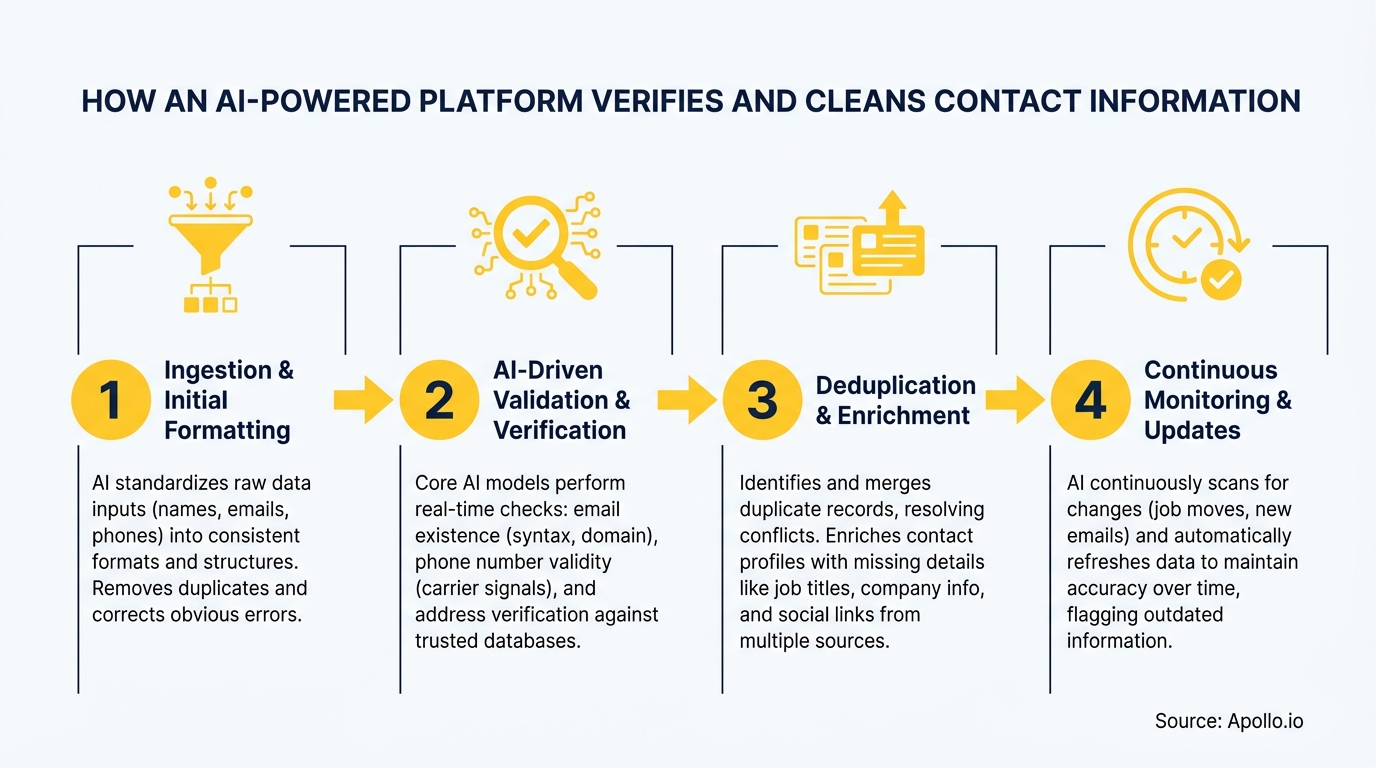
An AI-powered platform verifies contact information through a multi-layer waterfall: syntax validation, domain and MX record checks, SMTP handshake testing, engagement signal analysis, and network-contributed feedback loops — all applied in sequence to assign a confidence score to each record.
Here is how each layer works:
| Verification Layer | What It Checks | What It Catches |
|---|---|---|
| Syntax Validation | Email format, phone structure, field completeness | Typos, malformed addresses, blank required fields |
| Domain / MX Check | DNS records, mail server existence | Defunct domains, expired company email infrastructure |
| SMTP Handshake | Server response to delivery probe | Non-existent mailboxes, catch-all domains |
| Engagement Signals | Historical open/reply/bounce patterns | Dead addresses that technically "accept" mail |
| Network Verification | Contributor-sourced confirmation signals | Stale job titles, recent role changes, company moves |
According to StoreCensus, AI-powered verification achieves accuracy rates of 85–95%, a notable improvement over the 60–75% range of traditional methods. That gap translates directly into fewer bounces, better sender reputation, and more meetings reached.
Tired of bounced emails damaging your domain? Verify and enrich your contacts with Apollo's data platform — built on a 230M+ person database with 97% email accuracy.
Turn Funnel Guesswork Into Pipeline Clarity
Pipeline forecasting a guessing game because leads stall before they ever become opportunities? Apollo surfaces in-market buyers and moves them through your funnel with precision. Nearly 100K paying customers stopped guessing and started closing.
Start Free with Apollo →How Does AI Clean Contact Data Beyond Simple Verification?
AI cleaning goes beyond confirming an email is deliverable — it standardizes, deduplicates, enriches missing fields, and resolves identity across multiple data sources. Verification answers "does this contact exist?" Cleaning answers "is this contact record complete, accurate, and non-duplicate?"
The cleaning workflow follows a structured sequence:
- Ingest: Pull records from CRM, CSV uploads, form fills, and event data.
- Standardize: Normalize name casing, phone formats, job title variants, and company name spelling.
- Validate: Run the waterfall verification checks described above.
- Deduplicate / Entity-Resolve: Merge records representing the same person or company using fuzzy matching and identity resolution logic.
- Enrich: Fill missing fields (title, company size, industry, direct phone) from verified third-party sources.
- Monitor: Continuously re-check records on a defined cadence to catch decay before it reaches outreach queues.
This is why the industry is shifting from one-time list scrubs to always-on "agentic data hygiene" — platforms that detect decay, trigger re-verification, and write updates back to the CRM automatically. Explore the differences between data enrichment vs. data cleansing to understand where each step fits your workflow.
How Do RevOps and SDR Teams Use Verified Data to Protect Revenue?
RevOps leaders use verified contact data as the control layer for routing accuracy, lead scoring, and AI workflow integrity — because a single bad field can misroute a high-value lead, break a sequence, or corrupt a scoring model. For SDRs, verified data means every contact in their outreach queue is reachable, reducing wasted dials and protecting the sending domain.
Research from Sopro shows 56% of sales teams are already using AI specifically for data quality improvement — making it one of the highest-adoption AI use cases in the GTM stack. The revenue case is clear: as noted above, poor data carries a direct financial cost measured in millions annually.
For RevOps teams managing multiple tools, consolidation matters. "Having everything in one system was a game changer," noted Cyera, an Apollo customer. Platforms that unify prospecting, verification, enrichment, and engagement eliminate the data gaps that arise when these functions live in separate tools. See how revenue operations drives growth when built on clean, verified data.
Struggling with leads that go cold before your team can act? Search Apollo's 230M+ verified contacts with 65+ filters and reach the right buyer with confidence.

Why Does Verification Directly Impact Email Deliverability?
Verification impacts deliverability because mailbox providers use bounce rates, spam complaint rates, and sender reputation signals to decide whether your emails reach the inbox — and bad contacts trigger all three negative signals simultaneously. A contact that "accepts" mail but never engages still harms your sender score over time.
Modern AI platforms address this by incorporating engagement history into verification confidence scores — flagging addresses with low historical engagement even when SMTP checks pass. This is particularly important as mailbox providers have tightened bulk-sender requirements significantly, making inbox placement harder to achieve without clean lists. For a deeper look at this process, see how to verify email addresses for B2B sales.
The connection between verification and pipeline is direct: bounced emails damage domain reputation, which reduces inbox placement, which reduces reply rates, which reduces meetings booked. Treating deliverability as a downstream problem — rather than a verification problem — is the mistake most outbound teams make.
What Should GTM Teams Look for in an AI Verification Platform?
GTM teams should prioritize platforms that offer multi-layer verification, continuous re-enrichment, CRM write-back, and consolidated prospecting and engagement — not point solutions that only solve one part of the problem.
Key capabilities to evaluate:
- Waterfall verification: Multiple check types applied in sequence, not just SMTP or syntax alone.
- Enrichment breadth: Ability to fill missing fields across 65+ data attributes from verified sources.
- CRM sync: Automatic write-back of cleaned and enriched records. See how data sync improves B2B sales and marketing ROI.
- Continuous monitoring: Re-verification on a schedule, not just at import.
- Unified workflow: Verification, enrichment, and outreach in one platform to eliminate gaps.
Apollo consolidates all of these capabilities into a single GTM platform. "We reduced the complexity of three tools into one," noted Collin Stewart of Predictable Revenue — a direct result of moving prospecting, data verification, and engagement into one unified workspace. Explore how customer data enrichment fits into this unified approach.

Start Outreaching With Verified Contacts Today
AI-powered contact verification is the difference between outbound that burns domains and outbound that books meetings. The multi-layer waterfall, combined with continuous re-verification and enrichment, protects your pipeline, your sender reputation, and your AI workflow integrity simultaneously.
Apollo brings verification, enrichment, and engagement into one platform — so your team stops switching tools and starts closing deals on trusted data. Start Prospecting with Apollo for free and see what clean, verified contact data does for your pipeline.
Prove Pipeline ROI With Apollo
ROI pressure killing your tool budget? Apollo delivers measurable pipeline impact from day one — so you walk into every budget review with numbers that close the conversation. Nearly 100K paying customers already have.
Start Free with Apollo →Don't miss these
Sales
Inbound vs Outbound Marketing: Which Strategy Wins?
Sales
What Is a Sales Funnel? The Non-Linear Revenue Framework for 2026
Sales
What Is a Go-to-Market Strategy? The 2026 GTM Playbook
See Apollo in action
We'd love to show how Apollo can help you sell better.
By submitting this form, you will receive information, tips, and promotions from Apollo. To learn more, see our Privacy Statement.
4.7/5 based on 9,690 reviews
