
How Does a RevOps Leader Build a Business Case for Reducing Sales Tools from 5 to 2?
Your sales team is drowning in tabs. A RevOps leader builds a business case for reducing sales tools from 5 to 2 by quantifying four cost categories: license spend, labor friction, data fragmentation, and blocked AI initiatives.
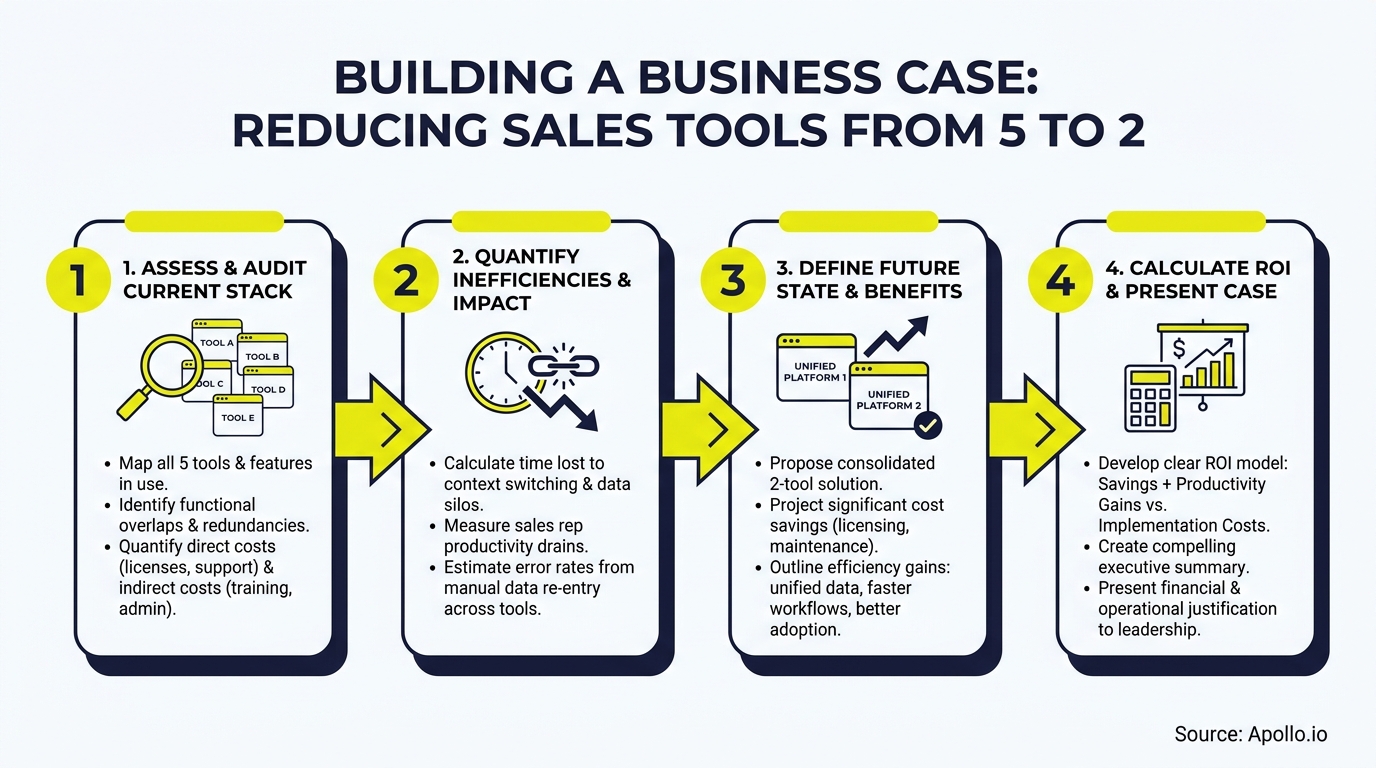
Then they present a CFO-ready ROI model that maps each retired tool to a measurable productivity or revenue outcome. This article gives you that exact blueprint, including a capability overlap matrix, migration checklist, and the external benchmarks your CFO will actually trust.
If you're also rethinking how your sales tech stack scales revenue, this consolidation framework applies directly to that conversation.

Let Apollo Find Your Next Deal
Tired of burning hours on manual research just to hit dead ends? Apollo surfaces verified contacts and qualified leads instantly — so your reps spend time selling, not searching. Join 600K+ companies building pipeline faster.
Start Free with Apollo →Key Takeaways
- Tool sprawl costs more than licenses: the hidden price is labor time, data silos, and stalled AI initiatives.
- A Gartner survey found 70% of sellers are overwhelmed by the technologies required to do their jobs, making consolidation a productivity intervention, not just a cost cut.
- Sellers overwhelmed by their tech stack are 43% less likely to hit quota, according to MarketBetter.ai, giving RevOps a direct quota-attainment argument.
- Consolidating to 2 core tools unifies your data into a single system of record, which is a prerequisite for AI forecasting and automated workflows.
- A phased migration plan with a defined exception process protects against change-management risk while keeping momentum.
Why Is Tool Sprawl a Bigger Problem Than Most RevOps Leaders Realize?
Tool sprawl silently destroys quota attainment. According to MarketBetter.ai, sellers who feel overwhelmed by their tech stack are 43% less likely to hit quota. Research from Zymplify shows employees switch between an average of 9.5 applications per day, spending up to 1.25 hours daily just navigating between tools.
A Gartner Seller Skills Survey (Jan–Mar 2024, n=1,026 B2B sellers) found 70% of sellers are overwhelmed by the number of technologies required to do their work. Salesforce's State of Sales, 7th Edition (April 2026) puts the average at 8 tools per team, with 42% of reps reporting overload. That's the problem statement your CFO needs to see on slide one.
For SDRs and BDRs, the impact is direct: every minute spent toggling between a prospecting tool, a sequencing platform, a dialer, a data enrichment vendor, and a CRM is a minute not spent booking meetings. Everstage reports sales reps spend only 28–34% of their time actively selling, with the rest consumed by administrative tasks and navigating between tools.
What Does a CFO-Ready ROI Model for Tool Consolidation Look Like?
A CFO-ready ROI model for tool consolidation includes four cost buckets: direct license costs, labor friction costs, data remediation costs, and AI opportunity costs. License savings are the easiest to calculate but often the smallest line item.
| Cost Category | How to Quantify It | Data Source |
|---|---|---|
| License Spend | Sum annual contracts for all 5 tools; subtract projected 2-tool cost | Vendor invoices |
| Labor Friction | Hours/week lost to switching x team size x avg. hourly cost ($44.40, BLS Sep 2024) | Time audit + BLS benchmark |
| Unused Licenses | Audit seat utilization; industry data shows 51% of SaaS licenses go unused | Ortto / vendor dashboards |
| AI Opportunity Cost | Salesforce reports 51% of sales leaders say tech silos delay AI initiatives | Salesforce State of Sales 2026 |
The U.S. Bureau of Labor Statistics reported total employer compensation averaged $44.40 per hour for private industry workers as of September 2024. Use that figure to convert time lost to tool friction into a conservative dollar impact. For a 20-person sales team losing 1.25 hours daily to context switching, that's a quantifiable labor drag your CFO can act on.
According to Ortto, the average enterprise wastes $18 million annually on unused or underutilized SaaS licenses, with 51% of SaaS licenses going unused. Even at a fraction of that scale, unused seats across 5 tools add up fast.
Overwhelmed by tracking all of this manually? See how Apollo's unified GTM platform consolidates your revenue operations into one workspace.
Turn Funnel Chaos Into Forecast Clarity
Pipeline forecasting a guessing game because leads stall before they ever become opportunities? Apollo surfaces verified, in-market contacts so your funnel fills with deals — not dead ends. Nearly 100K paying customers stopped guessing and started closing.
Schedule a Demo →How Does a RevOps Leader Build the Capability Overlap Matrix?
A capability overlap matrix maps every feature across your current 5 tools against a single capability taxonomy, revealing redundancy and consolidation opportunities. Build it in a spreadsheet with capabilities as rows and tools as columns, then mark which tools cover each capability.
Common capability categories for a GTM stack:
- Data: Contact discovery, enrichment, verification
- Prospecting: ICP filtering, list building, intent signals
- Engagement: Email sequences, phone dialing, social outreach
- Intelligence: Call recording, conversation analytics, coaching
- Operations: Pipeline tracking, forecasting, reporting
Any capability covered by 3 or more tools is immediate consolidation territory. Any capability covered by only one tool that isn't in your target 2 requires an exception process or migration plan. This matrix becomes exhibit A in your executive brief. For deeper context on what revenue operations covers and how it maps to tooling decisions, that framing helps you categorize capabilities correctly.

Why Does Tool Consolidation Unlock AI Readiness for RevOps Teams?
Tool consolidation unlocks AI readiness because AI models require clean, unified data — and fragmented stacks produce fragmented data. Salesforce's 2026 State of Sales report found 84% of data and analytics leaders say their data strategies need an overhaul to reach AI goals, with an estimated 19% of organizational data remaining inaccessible due to silos.
As Default notes, fragmented apps create data silos that make it harder to manage data, generate consistent reporting, and achieve a single source of truth. When your contact data lives in one tool, engagement history in another, and call recordings in a third, no AI system can produce reliable forecasts or automate outreach intelligently.
The minimum viable AI-ready revenue stack for most B2B GTM teams is two tools: a unified sales intelligence and engagement platform (covering prospecting, outreach, and enrichment) plus your CRM as the system of record. That's the target state your business case should defend. Learn more about which AI sales tools actually close more deals when data is unified.
What Is the Migration Playbook for Going from 5 Tools to 2?
The migration playbook for reducing from 5 to 2 tools runs in three phases: audit and map, pilot and validate, and sunset and govern. Each phase has a defined owner, timeline, and success metric.
- Phase 1 – Audit (Weeks 1–3): Complete capability overlap matrix. Identify contract renewal dates for all 5 tools. Define 2 core platforms and list any exceptions requiring approval.
- Phase 2 – Pilot (Weeks 4–10): Run a 10-rep pilot on the consolidated 2-tool stack. Measure adoption rate, time-to-first-activity, and pipeline generated vs. baseline.
- Phase 3 – Sunset (Weeks 11–16): Migrate data, deactivate licenses at renewal, document exception process for edge cases, and establish a quarterly tool review cadence.
The exception process is critical for change management: give teams a formal way to request a third tool with a documented capability justification and approval gate. This prevents shadow IT creep while respecting legitimate edge cases. For RevOps leaders managing broader sales transformation initiatives, this playbook integrates directly with change management frameworks.
How Do RevOps Leaders Frame the Executive Sponsorship Brief?
RevOps leaders secure executive sponsorship by framing the consolidation as a revenue initiative, not an IT project. The one-page executive brief should open with quota impact (sellers overwhelmed by tools are significantly less likely to hit quota), move to the ROI model, then close with the AI readiness argument.
Highspot's State of Sales Enablement Report 2025 gives you external validation: organizations reduced their GTM tool count by 2 on average year-over-year (from 10 in 2024 to 8 in 2025), signaling a mainstream shift away from best-of-breed sprawl. That benchmark answers the "why now" question your CRO or CFO will ask.
Real-world consolidation outcomes from Apollo customers reinforce the business case at the team level: "We cut our costs in half" (Census), and "Having everything in one system was a game changer" (Cyera). These quotes translate the ROI model into human terms that resonate in a board-level conversation. Explore how sales analytics drives revenue growth when all your data flows through a unified platform.
Spending too much time managing disconnected tools instead of building pipeline? See how Apollo's multi-channel sales engagement platform replaces your sequencing, dialing, and outreach tools in one workspace.

Start Your Tool Consolidation Case Today
The business case for reducing from 5 tools to 2 rests on four pillars: quota attainment risk from tool overload, quantifiable labor friction costs, wasted license spend, and blocked AI initiatives. Each pillar has external benchmarks, and together they build an argument that's hard for any CFO or CRO to dismiss.
Start with the capability overlap matrix, build the ROI model using the BLS labor cost benchmark, and frame the executive brief around quota impact and AI readiness. The migration playbook gives you a phased path that manages change-management risk without losing momentum.
For RevOps leaders ready to consolidate their stack, Apollo serves as the unified GTM platform that covers prospecting, enrichment, engagement, and pipeline in one workspace — trusted by nearly 100K paying customers including Anthropic, Cyera, and Census.
Schedule a Demo to see how Apollo consolidates your GTM stack and gives your team a single system of record for every revenue motion.
Prove Pipeline ROI Before Next QBR
ROI approval stuck because you can't quantify pipeline impact? Apollo gives revenue teams measurable wins fast — more meetings, higher conversion, clear attribution. Nearly 100K paying customers closed the ROI gap.
Schedule a Demo →Don't miss these
Sales
Inbound vs Outbound Marketing: Which Strategy Wins?
Sales
What Is a Sales Funnel? The Non-Linear Revenue Framework for 2026
Sales
What Is a Go-to-Market Strategy? The 2026 GTM Playbook
See Apollo in action
We'd love to show how Apollo can help you sell better.
By submitting this form, you will receive information, tips, and promotions from Apollo. To learn more, see our Privacy Statement.
4.7/5 based on 9,690 reviews
