
How Do SDR Managers Evaluate Sales Engagement Platforms Before Presenting to Leadership?
Getting leadership to approve a new sales engagement platform requires more than a vendor demo. SDR managers who win budget approval arrive with structured scorecards, pilot data, and a clear ROI narrative tied to metrics leadership already cares about. Before shortlisting any platform, smart managers run a rigorous pre-approval process that filters for team fit, integration depth, AI governance, and long-term stack consolidation. If you're comparing options, start with this breakdown of top sales engagement platforms to understand the landscape.

Research Less, Close More With Apollo
Tired of your reps burning hours on manual lead research instead of selling? Apollo surfaces verified contacts instantly so your team spends time closing, not digging. Join 600K+ companies building pipeline faster.
Start Free with Apollo →Key Takeaways
- SDR managers evaluate platforms across six dimensions before escalating to leadership: productivity recovery, AI governance, CRM integration, multichannel capability, pilot proof, and stack consolidation economics.
- Sales reps spend a significant portion of their week on non-selling tasks, making automation and workflow UX primary evaluation gates.
- AI capability is now a shortlist requirement, not a bonus, but only when paired with auditability and human-in-the-loop controls leadership can trust.
- A structured 2-4 week pilot with hard metrics (meetings booked, reply rates, ramp time) is the single strongest proof point for leadership approval.
- Consolidating multiple tools into one platform is a compelling financial argument that SDR managers use to frame the business case.
Why Do SDR Managers Lead the Platform Evaluation Process?
SDR managers lead platform evaluations because they sit closest to the daily workflow pain: they see where reps lose time, where pipeline stalls, and where tooling creates friction. According to Avoma, sales reps currently spend only 40% of their week selling, with the rest dedicated to manual tasks like CRM logging, creating follow-up tasks, and tracking outreach. That productivity gap is the core problem SDR managers are hired to solve.
Before escalating to a VP or CRO, SDR managers must translate that operational pain into a financial narrative. Leadership approves tools tied to pipeline, quota attainment, and cost efficiency, not feature lists. Data from SalesS0 shows SDRs are responsible for generating between 46% and 73% of total pipeline conversion, which makes the SDR team's tooling a direct revenue lever, not an overhead cost.
What Criteria Do SDR Managers Use to Score Platforms?
SDR managers use a structured scorecard that covers six evaluation dimensions, weighted by team size, current tech stack, and growth stage.
| Evaluation Dimension | What Managers Look For | Leadership Metric It Maps To |
|---|---|---|
| Productivity Recovery | Automated CRM logging, task creation, follow-up tracking | Selling time per rep, quota attainment rate |
| Multichannel Orchestration | Email, phone, and social outreach from one interface | Reply rate, meetings booked per rep |
| AI Capabilities | Personalization, sequence optimization, call summaries | Pipeline contribution, ramp time |
| CRM Integration Depth | Bi-directional sync, automatic activity logging | Data accuracy, forecasting reliability |
| AI Governance | Human-in-the-loop controls, audit trails, safe automation limits | Brand risk, compliance exposure |
| Stack Consolidation | Replaces or reduces need for separate tools | Total cost of ownership, vendor complexity |
Research from LaGrowthMachine confirms that seamless and reliable CRM integration is crucial for automatic activity logging, lead information capture, and updating deal stages. Platforms that require manual CRM reconciliation fail this gate immediately.

How Do SDR Managers Evaluate AI Capabilities Without Getting Burned?
AI evaluation requires separating genuine workflow impact from vendor marketing. SDR managers test AI on three practical outputs: message personalization quality, sequence optimization logic, and call summary accuracy.
As noted by Autobound, in an increasingly crowded outbound landscape, the ability to generate highly personalized messages that reference specific research findings, buying signals, and relevant value propositions is critical for higher response rates. Managers verify this by running blind tests: AI-generated drafts versus rep-written drafts, scored on open rates and reply rates during the pilot.
Equally important is governance. Leadership worries about autonomous outreach creating compliance or brand exposure.
Evaluation checklists now include: Who can approve AI-generated messages before send? Can you audit which sequences an AI modified?
Are there hard send limits to prevent deliverability damage? Platforms that lack these controls get removed before the leadership presentation, regardless of feature depth.
Spending hours on manual outreach with no AI assist? Automate your sequences with Apollo's AI-powered sales tools that include human-in-the-loop controls built for team accountability.
Turn Funnel Guesswork Into Pipeline Clarity
Pipeline forecasting a guessing game because your leads never convert? Apollo surfaces high-intent prospects who are actually ready to buy. Over 600K+ companies now forecast with confidence instead of crossed fingers.
Start Free with Apollo →What Does a Pre-Leadership Pilot Look Like for SDR Teams?
A pre-leadership pilot runs 2-4 weeks, involves 3-5 volunteer reps, and measures a narrow set of outcomes leadership will recognize: meetings booked, reply rate, CRM data completeness, and rep ramp time on the new platform.
SDR managers structure the pilot to answer three questions leadership will ask: Does this improve output? How fast will the team adopt it?
What does it cost relative to current tools? The pilot design should mirror real workflow conditions, not a curated demo environment.
Use actual ICP target lists, existing sequences, and production CRM data.
The pilot also validates multichannel execution. According to ZaphyrPro, AI capabilities for pre-call research, prospect intelligence, email personalization, and sequence optimization are becoming increasingly important, freeing SDRs to focus on meaningful engagement rather than admin. A platform that automates these steps during the pilot creates visible time savings managers can quantify before the leadership deck is built. For sequence design inspiration, explore these top sales sequence examples to benchmark pilot performance.
How Do SDR Managers Build the ROI Case for Leadership?
The ROI case connects pilot outcomes to three financial levers: increased revenue contribution per rep, reduced tooling cost through consolidation, and lower ramp time for new hires.
Stack consolidation is the fastest win to quantify. If a platform replaces separate tools for engagement, conversation intelligence, and data enrichment, the cost comparison is straightforward.
Predictable Revenue reported, "We reduced the complexity of three tools into one," and Census noted, "We cut our costs in half" after consolidating their sales tech stack onto Apollo. These outcomes directly address leadership's concern about total cost of ownership.
For sales analytics that leadership trusts, SDR managers should extract pilot data into a simple one-page summary: baseline metrics before the pilot, metrics during the pilot, and projected annual impact at full team scale. Avoid vendor-supplied ROI calculators. Build the model from your own pilot numbers.
How Should SDR Managers Present the Platform Decision to Leadership?
SDR managers present platform decisions most effectively when they frame the recommendation around leadership's language: pipeline risk, competitive position, and cost efficiency, not platform features.
Structure the executive presentation in this order:
- The Problem: Current selling time percentage, pipeline gap, and tooling cost baseline.
- The Pilot Evidence: 3-5 hard metrics from your internal test with real reps.
- The Consolidation Case: Tools replaced, estimated annual savings, reduced admin burden for RevOps.
- The Risk Mitigation Plan: AI governance controls, implementation timeline, and change management approach.
- The Ask: Specific budget, rollout scope, and 90-day success metrics.
RevOps leaders should be included in the presentation prep. Engagement platforms touch CRM data, email infrastructure, and reporting pipelines, so IT and Marketing Ops alignment before the leadership meeting prevents objections that derail approvals. Review how to build a sales tech stack that scales to anticipate the integration questions leadership will raise.
How Does Apollo Help SDR Managers Consolidate Their Sales Tech Stack?
Apollo gives SDR managers a unified platform covering prospecting, multichannel engagement, AI-assisted outreach, conversation intelligence, and CRM enrichment in one workspace, reducing the need to stitch together multiple point solutions.
For SDR managers building a leadership-ready business case, Apollo's transparent pricing and free tier make pilot setup fast. Teams can test Apollo's multichannel sales engagement platform with real sequences, real contacts, and real CRM sync before committing budget. Cyera summarized the consolidation value clearly: "Having everything in one system was a game changer."
Struggling to show leadership a complete picture of your outreach performance? See how Apollo's sales engagement platform tracks every touchpoint in one place so your pilot data tells a complete, credible story.

The Bottom Line: Build Your Evaluation Before You Build Your Deck
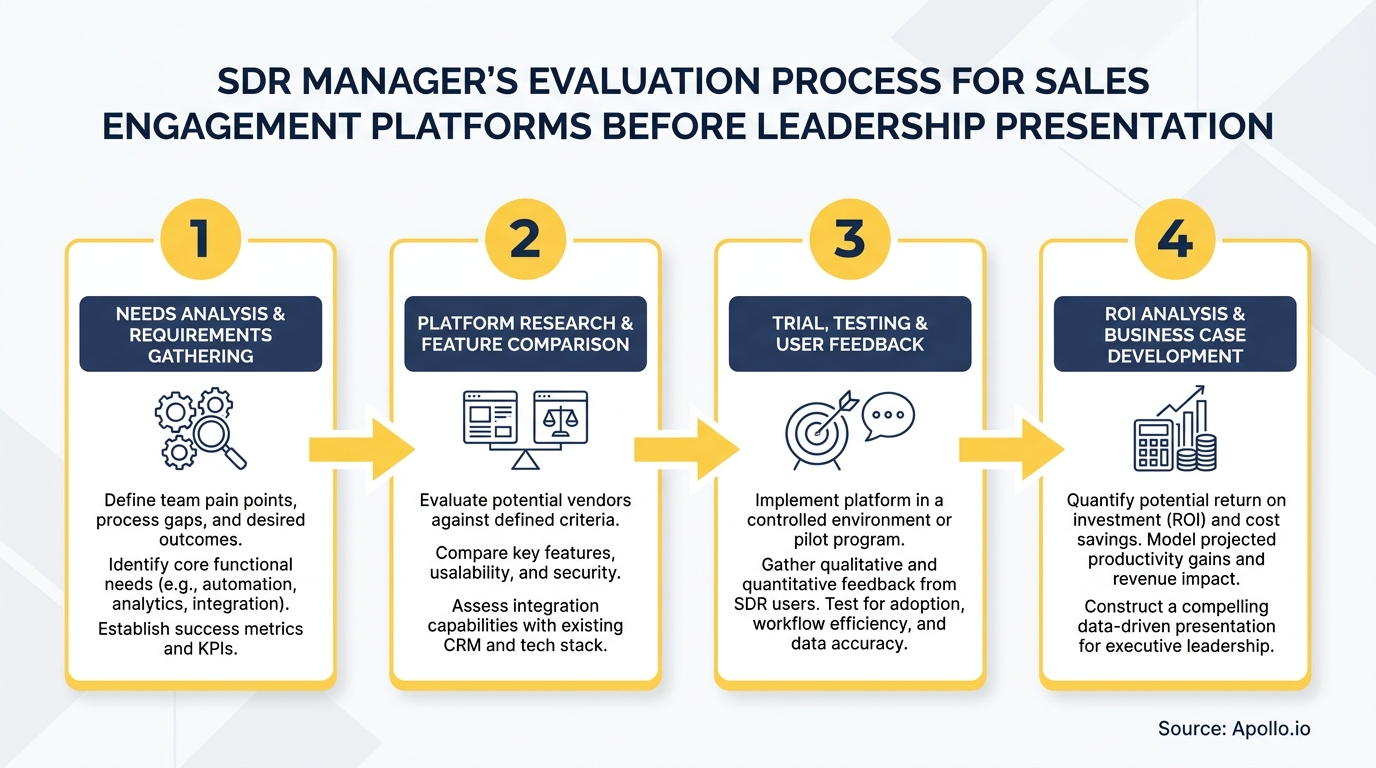
SDR managers who win leadership approval treat platform evaluation as a structured project, not a vendor selection exercise. The sequence matters: define criteria, run a controlled pilot, quantify consolidation savings, and only then build the executive presentation.
Platforms that survive this process earn budget because they have evidence behind them, not just demos.
Apollo is built for exactly this motion: a single platform that SDR managers can pilot quickly, measure precisely, and present to leadership with confidence. Start a free trial and run your evaluation today.
Prove Pipeline ROI With Apollo
ROI pressure killing your tool budget? Apollo delivers measurable pipeline impact your leadership can see — faster. Leadium 3x'd their annual revenue. Start yours today.
Start Free with Apollo →Don't miss these
Sales
Inbound vs Outbound Marketing: Which Strategy Wins?
Sales
What Is a Sales Funnel? The Non-Linear Revenue Framework for 2026
Sales
What Is a Go-to-Market Strategy? The 2026 GTM Playbook
See Apollo in action
We'd love to show how Apollo can help you sell better.
By submitting this form, you will receive information, tips, and promotions from Apollo. To learn more, see our Privacy Statement.
4.7/5 based on 9,690 reviews
