
How Mid-Market SDR Teams Should Structure Outbound Territory and Account Assignments
Most mid-market SDR teams assign accounts the wrong way: by geography alone, or worse, by gut feel. The result is uneven workloads, duplicate outreach, and reps burning time on research instead of conversations. Structured outbound prospectingstarts with a smarter foundation: capacity-first territory design that reflects how SDRs actually spend their time.
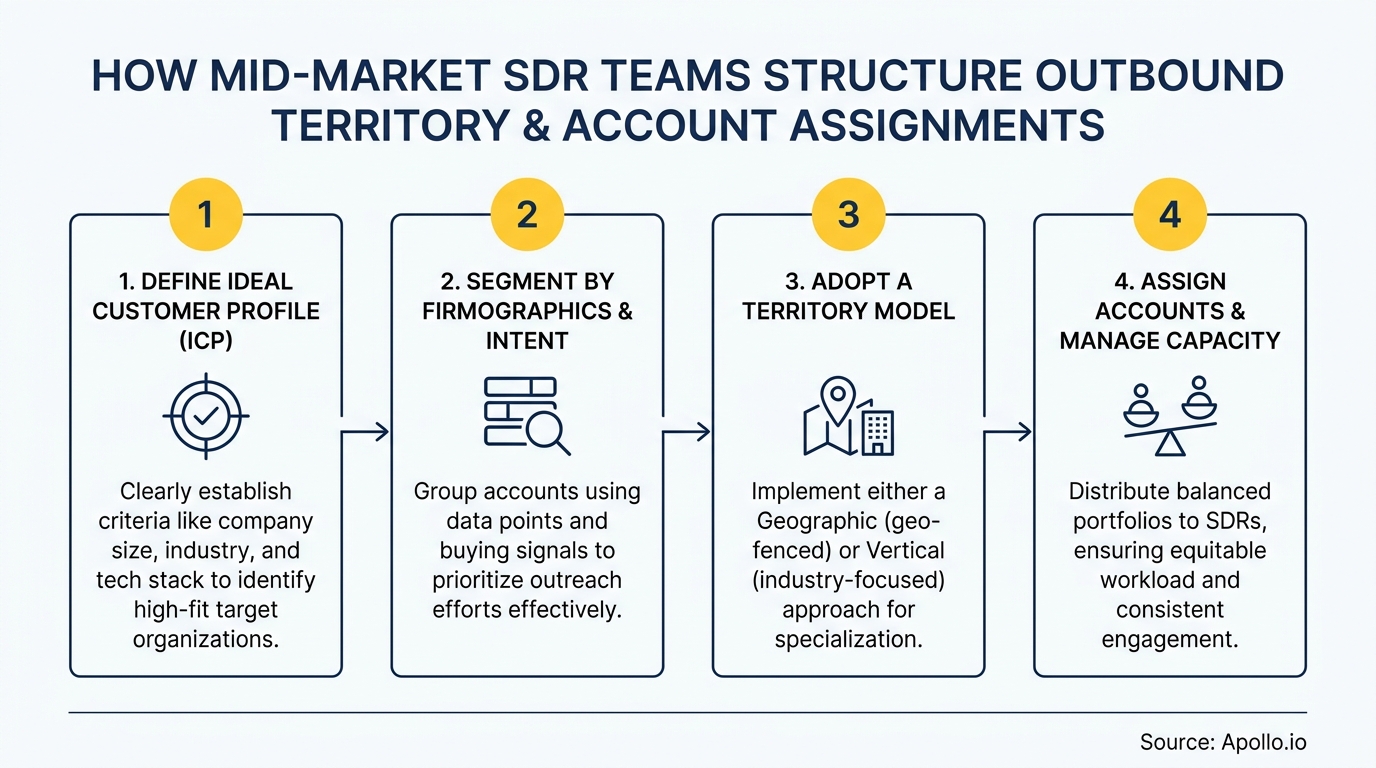

Research Less, Pipeline More With Apollo
Tired of your reps burning hours verifying contacts instead of selling? Apollo surfaces accurate, ready-to-dial leads instantly. Join 600K+ companies turning research time into revenue.
Start Free with Apollo →Key Takeaways
- Territory design should start with rep capacity math, not account counts or geography.
- ICP tier segmentation determines account load per SDR — Tier 1 accounts require more touches and fewer total accounts per rep.
- Data hygiene and clear ownership fields are prerequisites before any AI-driven prioritization can work reliably.
- Cross-functional engagement rules (SDR/AE/AM no-fly zones) prevent duplicate outreach and ownership disputes.
- Quarterly territory rebalancing beats annual planning cycles for mid-market teams facing fast TAM shifts and rep turnover.
How Do SDRs Structure Outbound Territory Assignments in Mid-Market?
Mid-market SDR teams structure outbound territory by combining ICP tier segmentation, capacity-based account loads, and clear ownership rules rather than relying on static geography alone. The shift is from "who covers which zip code" to "which accounts fit which rep's workable capacity and ICP profile." According to Gradient Works, outbound SDRs typically generate 46-73% of total pipeline, which makes territory precision a direct revenue lever, not just an ops exercise.
The most effective mid-market models combine three inputs:
- ICP tier classification (Tier 1 = highest fit, Tier 3 = lowest fit)
- Capacity-based account limits per rep per tier
- Engagement ownership rules that prevent SDR/AE/AM conflicts
How Do You Calculate the Right Account Load Per SDR?
The right account load per SDR is calculated by working backward from available selling time, not forward from total addressable accounts. Start with weekly selling hours, subtract research and follow-up overhead, then divide by the average touches required per account per week for each ICP tier.
Use this capacity formula as a starting point:
| ICP Tier | Avg. Touches/Account/Week | Research Time/Account | Max Accounts Per SDR |
|---|---|---|---|
| Tier 1 (High Fit) | 3-4 | 20-30 min | 50-80 |
| Tier 2 (Medium Fit) | 1-2 | 10-15 min | 150-250 |
| Tier 3 (Low Fit) | 1 | 5 min | 300-500 |
Most SDRs carry a blended portfolio: 60-70 Tier 1 accounts plus a larger Tier 2 pool for volume coverage. As noted by Highspot, territories should offer comparable earning opportunities by factoring in deal complexity, buying group size, and sales cycle length, not just equal account counts.
Struggling to build targeted account lists by ICP tier? Search Apollo's 230M+ contacts with 65+ filters to segment and assign accounts instantly.
Turn Funnel Guesswork Into Qualified Pipeline
Pipeline forecasting a guessing game because marketing leads never convert? Apollo surfaces high-intent prospects that actually move through the funnel. Nearly 100K paying customers stopped guessing and started closing.
Start Free with Apollo →What Data Governance Do SDR Teams Need Before Assigning Territories?
Clean data governance is the prerequisite for any territory or routing system to work. Without normalized firmographics, account hierarchy fields, and ownership logic in your CRM, routing rules break and capacity math becomes meaningless. As Xactly notes, internal CRM data, along with market demographic data, is crucial for effective territory planning.
Before assigning territories, confirm these fields exist and are populated in your CRM:
- Account owner (SDR, AE, AM — with start date)
- ICP tier score (rule-based or model-based)
- Parent/subsidiary hierarchy (prevents duplicate outreach to same org)
- Last contacted date and engagement status
- Segment/vertical tag for routing logic
- Intent signal field (if using intent data)
RevOps teams own this work. As outlined by Elefante RevOps, RevOps functions own territory design, capacity modeling, and quota setting. If data hygiene isn't in place first, AI-driven prioritization layers will amplify bad data at scale. Learn more about how revenue operations drives growth through clean data and structured processes.

How Do SDR, AE, and AM Teams Avoid Duplicate Outreach and Territory Conflicts?
Avoiding duplicate outreach requires explicit engagement rules that define which role owns which account at which stage, with no overlap periods. These are sometimes called "rules of engagement" or no-fly zones, and they need to live in the CRM, not in a shared doc.
A practical ownership model for mid-market outbound:
- SDR owns: Net-new Tier 1 and Tier 2 accounts with no prior AE contact in the last 90 days
- AE owns: Accounts in active pipeline (opportunity created) — SDR pauses outreach
- AM owns: Current customers and expansion accounts — SDR has a hard no-fly rule
- Whitespace accounts: Unassigned accounts in ICP that neither AE nor AM is actively working — SDR can claim via request process
For mid-market teams building or refining their target account lists, these rules should be encoded as CRM filters or routing logic, not enforced manually. Manual enforcement fails at scale.
How Should SDR Teams Design a Phone-First Territory Cadence?
A phone-first territory cadence means allocating call blocks as the primary time-bound activity in a rep's week, then building email and social touches around those blocks. The phone is a primary pipeline driver, which means territory account loads must be sized to support consistent call volume, not just email sequences. A strong outbound sales cadence accounts for channel mix from the start.
A practical phone-first weekly structure for an SDR covering 60 Tier 1 accounts:
- Monday/Wednesday/Friday: 2-hour call blocks (primary prospecting time on Tier 1)
- Tuesday/Thursday: Follow-up email and research sessions for Tier 2
- Daily: 15-minute CRM update window to keep ownership fields current
Spending too much time on manual outreach prep? Automate multi-channel sequences with Apollo so SDRs spend more time on conversations, not admin.
How Often Should Mid-Market SDR Teams Rebalance Territories?
Mid-market SDR teams should rebalance territories quarterly rather than annually. Annual planning cycles can't keep pace with rep turnover, ICP shifts, or segment changes that alter coverage capacity mid-year.
The practice of quarterly rebalancing is becoming standard as teams recognize that waiting until "everything breaks" costs pipeline.
A quarterly rebalancing checklist:
- Audit account load per rep: flag anyone more than 20% above or below target capacity
- Review Tier 1 account coverage: reassign any accounts with zero activity in 60+ days
- Check parent/subsidiary hygiene: catch new acquisitions or org changes
- Validate ownership fields: confirm SDR/AE/AM assignments match current pipeline status
- Refresh ICP tier scores: re-score accounts using updated firmographic or intent signals
RevOps should own this process with a documented rebalancing template.
Connecting territory rebalancing to your broader sales tech stack ensures routing rules stay synchronized with CRM data in real time.
How Do SDR Teams Move from Static Territories to Signal-Based Assignment?
Moving from static geo territories to signal-based assignment means layering intent signals, engagement history, and propensity scores on top of firmographic segmentation to dynamically prioritize which accounts SDRs work each week. This is the direction mid-market outbound is moving: territory as a starting boundary, signals as the daily prioritization engine.
The implementation path:
- Fix the data foundation first (governance checklist above)
- Define ICP tiers by firmographic rules (industry, headcount, revenue, tech stack)
- Add intent signals as a priority layer — accounts showing buying signals surface to the top of the weekly work queue
- Automate account surfacing via workflow triggers in your CRM or engagement platform
- Review signal performance quarterly and adjust scoring weights based on conversion data
This approach is described in Apollo's guide on sales automation — using automated workflows to surface the right accounts at the right time rather than leaving prioritization to rep intuition.

Build Smarter Territories and Book More Meetings in 2026
Mid-market SDR territory design is a capacity problem before it's an account problem. When you size territories by selling time, tier accounts by ICP fit, enforce clean ownership rules, and rebalance quarterly, SDRs spend more time on conversations that convert.
The teams seeing consistent outbound results are those treating territory structure as an operational system, not a spreadsheet exercise.
Apollo brings prospecting data, engagement sequences, AI-powered account prioritization, and CRM integration into one unified platform, so your SDR team can execute territory assignments without stitching together five separate tools. Trusted by nearly 100K paying customers including Anthropic, Smartling, and Redis, Apollo consolidates your outbound stack from search to booked meeting.
Start Your Free Trial and give your SDR team the tools to prospect smarter, assign accounts with precision, and book more meetings in 2026.
Prove Pipeline ROI Before Next QBR
Budget approval stuck on unclear metrics? Apollo delivers measurable pipeline impact your leadership can see — fast. Teams like Leadium 3x'd annual revenue. Start your free trial and show ROI before the next budget review.
Start Your Free Trial →Don't miss these
Sales
Inbound vs Outbound Marketing: Which Strategy Wins?
Sales
What Is a Sales Funnel? The Non-Linear Revenue Framework for 2026
Sales
What Is a Go-to-Market Strategy? The 2026 GTM Playbook
See Apollo in action
We'd love to show how Apollo can help you sell better.
By submitting this form, you will receive information, tips, and promotions from Apollo. To learn more, see our Privacy Statement.
4.7/5 based on 9,690 reviews
