
How Do Insurance and Fintech Companies Find New Leads in Their Sector in 2026?
Insurance and fintech lead generation has fundamentally changed. Cheap traffic is gone, cold outreach conversion is declining, and buyers are doing most of their research before ever talking to a rep. According to Cirrus Insight, lead generation is a top priority for 91% of B2B marketers, yet 80% of generated leads never convert — a direct signal that volume alone is a broken strategy. The winning approach in 2026 combines buyer-journey content, trust-first capture, and quality-focused measurement. Whether you're an SDR at an insurtech or a revenue leader at a payments fintech, this playbook maps exactly how sector-specific lead gen works today. Start with understanding what buyer leads are and how to find better ones.

Get Verified Leads, Skip the Research
Tired of burning hours tracking down accurate emails and phone numbers? Apollo surfaces verified business contacts instantly, so your team sells instead of searches. Nearly 100K paying customers trust Apollo to keep their pipeline full.
Start Free with Apollo →Key Takeaways
- Buyers in insurance and fintech complete most of their research before engaging sales, making content and self-serve assets the primary lead capture mechanism.
- Lead quality beats lead volume: most generated leads never convert, so SDRs and marketers should optimize for fit signals, not just form fills.
- Trust and compliance messaging must appear before the form, not after — especially in regulated financial sectors.
- ABM and intent data dramatically improve conversion rates for B2B insurance and fintech outbound teams.
- CAC, lead-to-close rate, and customer acquisition rate are the KPIs that connect lead gen to revenue impact.
Why Is Lead Generation Harder for Insurance and Fintech in 2026?
Insurance and fintech lead gen faces compounding pressure from rising digital acquisition costs, AI-disrupted search, and stricter buyer expectations. A February 2026 report on BFSI marketing found that Google AI Overviews are reducing click-throughs to educational and comparison content, with industry estimates citing 25–40% increases in digital customer acquisition costs as brands compensate with paid media. Meanwhile, Reach Marketing found that generating high-quality leads is the biggest challenge for 58% of B2B marketers — a number that skews even higher in regulated sectors.
The core problem: most teams measure lead volume, not lead quality. Shifting that measurement framework is the first unlock.
How Does the Buyer Journey Shape Lead Capture for Financial Services?
Insurance and fintech buyers move through three distinct stages before engaging sales, and the right content at each stage determines whether they convert or disappear.
| Buyer Stage | What Buyers Are Doing | What to Publish |
|---|---|---|
| Anonymous Research | Searching for category education, comparisons, risk framing | Ungated explainers, glossaries, compliance FAQs, AI Overview-optimized content |
| Vendor Evaluation | Comparing providers, checking ROI, assessing trust signals | Calculators, comparison pages, case studies, security and data-use disclosures |
| Sales Engagement | Ready to talk, seeking confirmation and next steps | Demo booking pages, personalized outreach, intent-triggered sequences |
The critical insight: most buyers in financial services reach the vendor evaluation stage before willingly submitting contact information. SDRs who reach out before a prospect has self-qualified typically generate low-intent leads. Publishing content that matches each stage keeps prospects in your orbit until they raise their hand. Learn more about how intent data powers smarter B2B sales at the moment buyers signal readiness.
What Are the Most Effective Lead Generation Channels for Insurance and Fintech?
The highest-performing channels in 2026 combine owned content, targeted outbound, and ecosystem partnerships — not paid media alone.
- SEO and answer-engine content: Structured educational content, comparison pages, and calculators capture buyers at the anonymous research stage. As AI search absorbs top-of-funnel traffic, answer-engine visibility (AEO) is now a pipeline asset.
- Account-Based Marketing (ABM): Research from The Insight Collective shows 87% of marketers report higher returns from ABM compared to other strategies. For B2B insurance and fintech, ABM targets named accounts in specific verticals with personalized messaging.
- Intent data-triggered outbound: Prospects researching competitors, compliance topics, or product categories signal buying intent. Outbound prospecting tied to intent signals converts at significantly higher rates than cold lists.
- Embedded finance and partner channels: Fintechs increasingly capture leads inside platforms where SMBs already operate — payroll tools, expense management, vertical SaaS — rather than through static forms.
- Webinars and virtual events: Compliance, risk, and regulatory education content attracts high-fit audiences in both insurance and fintech.
Struggling to identify which accounts are in-market right now? Search Apollo's 230M+ contacts with 65+ filters to find and prioritize your best-fit prospects.
Turn Funnel Gaps Into Pipeline Gold
Pipeline forecasting a guessing game? Apollo surfaces in-market buyers the moment they're ready, turning weak lead flow into a predictable revenue engine. Over 600K companies trust Apollo to close the gap between marketing leads and sales opportunities.
Schedule a Demo →How Do SDRs and Sales Teams Build Pipeline in Regulated Financial Sectors?
SDRs and BDRs in insurance and fintech face a unique challenge: outreach must be timely, relevant, and compliance-aware before prospects will engage. Generic cold sequences fail because financial buyers are trained to ignore irrelevant outreach — and trust signals matter from the first touchpoint.
High-performing SDR motions in this sector include:
- Intent-first sequencing: Trigger outreach when a target account visits pricing pages, reads compliance content, or researches specific product categories. This replaces cold volume with warm relevance. Explore how to build this with intent data collection and top providers.
- Personalization by vertical: Insurance SDRs should reference the prospect's specific coverage type, revenue tier, or regulatory environment. Fintech SDRs should frame outreach around the prospect's payment stack, compliance challenges, or growth stage.
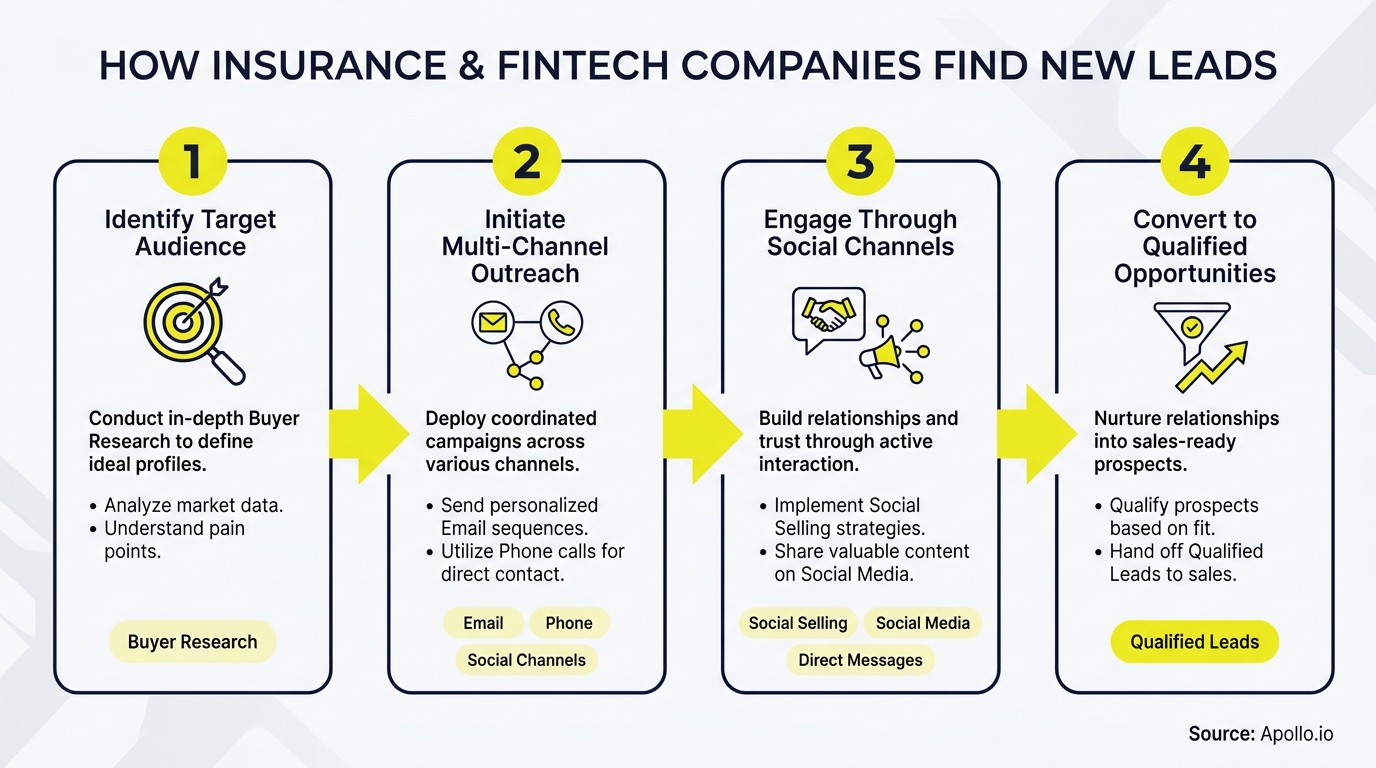
- Multi-channel sequencing: Combine email, phone, and social outreach across 7–10 touchpoints. Single-channel approaches miss buyers who prefer different communication modes.
- Consent-aware messaging: With ongoing TCPA scrutiny and data privacy expectations, SDRs must ensure outreach methods align with their organization's consent and compliance standards.
Research by Martal found that AI tools can automate up to 80% of prospecting tasks, giving fintech SDR teams the capacity to personalize at scale without adding headcount. Tools that consolidate prospecting, sequencing, and enrichment into one workspace are replacing multi-vendor stacks. As Cyera put it, "Having everything in one system was a game changer."
Spending hours manually building prospect lists? Automate your multi-channel sequences with Apollo and reach more qualified prospects faster.

How Should Insurance and Fintech Teams Build Trust-Led Lead Capture Assets?
Trust-led capture means placing security, compliance, and personalization signals before the form — not buried in a privacy policy. Financial buyers are acutely sensitive to how their data will be used, and unaddressed concerns kill conversions before they happen.
High-converting trust assets for this sector include:
- Premium calculators: Insurance premium estimators, fintech ROI calculators, and payment savings tools capture self-qualifying intent while delivering immediate value.
- Comparison pages: Side-by-side product comparisons help buyers at the vendor evaluation stage and drive high-intent organic traffic.
- Compliance and security explainers: Clearly stating data handling practices, encryption standards, and regulatory alignment reduces friction on lead capture forms.
- Personalized content by company type: Insurance buyers want coverage relevance; fintech buyers want risk-benefit framing specific to their business model. Generic nurture sequences erode trust.
This connects directly to building a B2B marketing funnel that converts — the asset mix at each funnel stage determines whether trust compounds or collapses.
How Do RevOps Leaders Measure Lead Generation Quality in Financial Services?
RevOps teams in insurance and fintech need metrics that connect lead generation activity to revenue outcomes, not just volume. According to Abacum, the median company now spends $2.00 in sales and marketing to acquire $1.00 of new customer ARR, a 14% increase in 2024 — making CAC efficiency a board-level concern.
| KPI | What It Measures | Why It Matters |
|---|---|---|
| Lead-to-Customer Rate | % of leads that close as customers | Reveals lead quality, not just volume |
| Customer Acquisition Cost (CAC) | Total sales + marketing spend / new customers | Benchmarks efficiency of each channel |
| CAC Payback Period | Months to recover acquisition cost | Critical in capital-constrained fintech environments |
| MQL-to-SQL Conversion Rate | % of marketing leads accepted by sales | Aligns marketing and sales on lead quality standards |
| Pipeline Coverage Ratio | Total pipeline value / revenue target | Ensures enough qualified opportunity exists to hit quota |
RevOps leaders who instrument these metrics at the channel level can cut spend on high-volume, low-conversion sources and double down on channels producing qualified pipeline. Explore how to calculate return on sales with industry benchmarks to set the right targets for your team.

How Can Apollo Help Insurance and Fintech Teams Find and Convert More Leads?
Apollo consolidates the tools that insurance and fintech GTM teams typically run as separate subscriptions: contact database, prospecting filters, multi-channel sequencing, intent signals, and enrichment — all in one platform. This directly addresses the cost and complexity pressure facing sales and marketing teams in 2026.
Key capabilities for financial services teams:
- 230M+ verified contacts with 65+ filters including industry, job title, company size, and technology stack — enabling precise targeting of CFOs at regional banks, compliance officers at insurtechs, or CTOs at B2B payments companies.
- Intent data integration that surfaces accounts actively researching relevant topics, so SDRs reach out when buyers are already in-market.
- AI-powered sequencing that personalizes outreach at scale — teams using Apollo's AI-powered messaging report a 35% increase in bookings.
- Enrichment and data hygiene to keep CRM records accurate, reducing the data quality barriers that LexisNexis identified as a top acquisition obstacle for financial institutions.
Trusted by nearly 100K paying customers including Anthropic, Smartling, and DocuSign, Apollo replaces the fragmented stack that slows financial services GTM teams down. As Census summarized: "We cut our costs in half."
Ready to build a cleaner, faster lead generation engine for your insurance or fintech team? Start Free with Apollo and access 230M+ verified contacts, intent data, and AI-powered sequencing in one unified platform.
Prove Pipeline ROI Before Q4 Ends
Budget approval stuck on unclear metrics? Apollo delivers measurable pipeline impact from day one — so you walk into every budget review with hard numbers. Leadium 3x'd annual revenue after making the switch.
Schedule a Demo →Don't miss these
Sales
Inbound vs Outbound Marketing: Which Strategy Wins?
Sales
What Is a Sales Funnel? The Non-Linear Revenue Framework for 2026
Sales
What Is a Go-to-Market Strategy? The 2026 GTM Playbook
See Apollo in action
We'd love to show how Apollo can help you sell better.
By submitting this form, you will receive information, tips, and promotions from Apollo. To learn more, see our Privacy Statement.
4.7/5 based on 9,690 reviews
