
How to Track Engagement Metrics Across All Outreach Channels in One Place
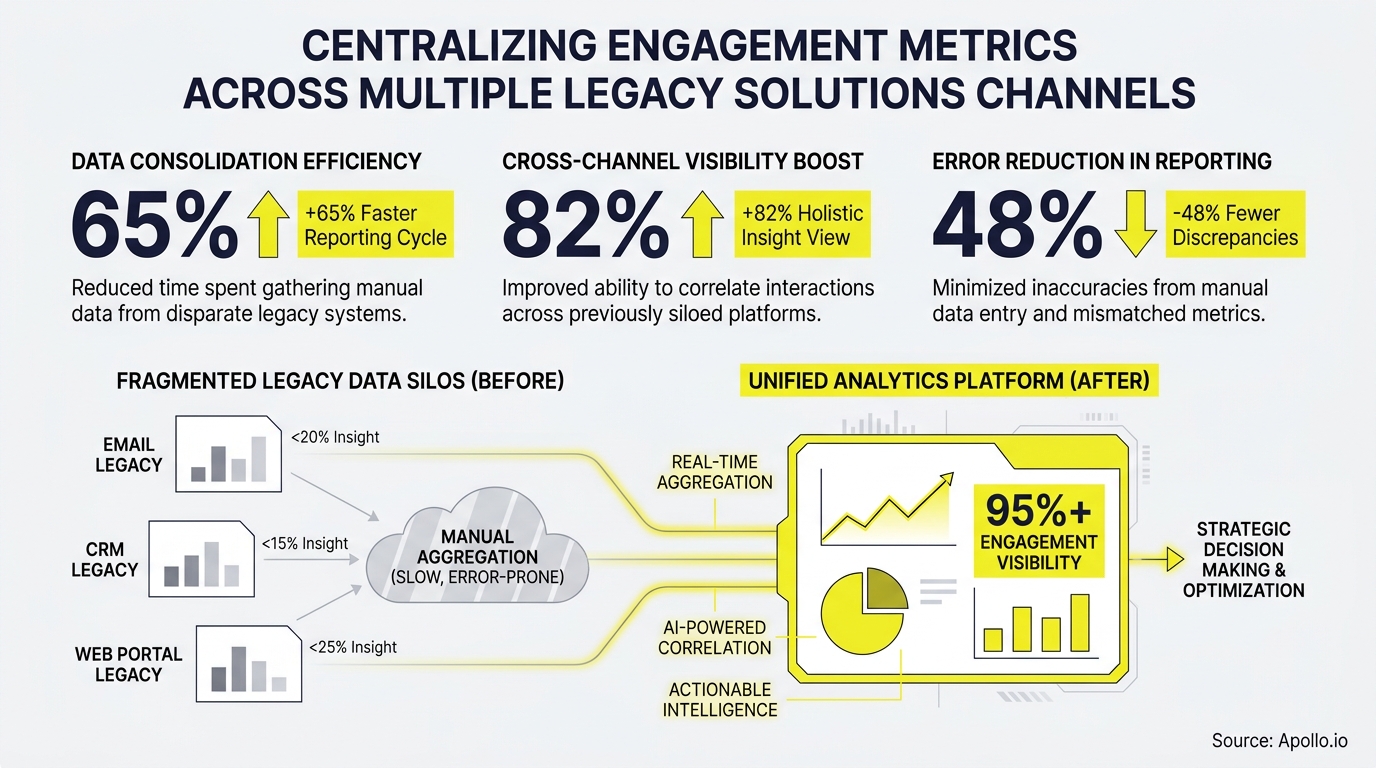
Your email tool shows one open rate. Your dialer shows a different connect rate. Your CRM shows something else entirely. If you're stitching together engagement data from three or four platforms every week, you're not measuring outreach — you're managing spreadsheets. According to Spotlight.ai, B2B buyers engage with 10 or more channels throughout their purchase journey, which means fragmented tracking isn't just inconvenient — it's a competitive disadvantage. The fix starts with understanding what unified engagement measurement actually requires.
Before jumping to tools, check out what engagement metrics actually work — because tracking the wrong signals across channels just amplifies noise.

Research Less. Pipeline More With Apollo.
Tired of your reps burning hours verifying contacts instead of closing deals? Apollo surfaces accurate, ready-to-engage prospects so your team sells from minute one. Join 600K+ companies building pipeline faster.
Start Free with Apollo →Key Takeaways
- Unified engagement tracking requires a shared identity layer and consistent event taxonomy before any dashboard will give you trustworthy data.
- B2B deals involve dozens of touchpoints across many channels — siloed tools mean you're only seeing a fraction of the picture.
- RevOps and SDR teams get the most immediate ROI from consolidating outreach and reporting into a single platform.
- Companies with strong omnichannel engagement retain customers at a significantly higher rate than those with fragmented channel strategies.
- The most effective 2026 approach combines a unified outreach platform with a consistent UTM and event-naming governance framework.
Why Is Tracking Engagement Across Channels So Hard?
Tracking engagement across channels is difficult because each tool uses its own identity model, event definitions, and reporting schema — making cross-channel aggregation unreliable without a unifying data layer.
A sales rep might send an email in one tool, make a call from another, and log a meeting in the CRM manually. Each of those systems stores the contact with a slightly different identifier (email address vs. phone number vs. CRM ID), and none of them talk to each other natively. A Reddit user shared a firsthand perspective that even building native integrations required significant engineering resources, and third-party connectors introduced their own reliability issues and ongoing costs.
The result: your engagement dashboard shows activity, but not truth. Deduplication failures, missing events, and mismatched contact IDs silently corrupt your reporting long before you notice.
What Engagement Metrics Should You Track Across Channels?
The core cross-channel engagement metrics to track are: email opens and replies, call connect and conversation rates, meeting set and held rates, social touches and responses, and downstream pipeline signals like opportunity created and stage progression.
Channel-level vanity metrics (opens, clicks) are table stakes. The metrics that actually move decisions are stage-based engagement signals: how many stakeholders at a target account have been contacted, how many have responded, and whether engagement is progressing toward a meeting or stalling. For a deeper look at which B2B marketing metrics drive revenue growth, the framework applies equally to outbound engagement tracking.
| Channel | Key Engagement Metrics | Pipeline Signal |
|---|---|---|
| Open rate, reply rate, bounce rate | Reply leading to meeting | |
| Phone | Connect rate, conversation rate, callback rate | Conversation leading to discovery |
| Social | Connection acceptance, message reply rate | Engagement leading to call booked |
| Meetings | Meetings held rate, no-show rate | Meeting advancing to opportunity |
| Multi-touch sequences | Sequence completion rate, step-level drop-off | Sequence reply or meeting booked |
How Do RevOps Teams Build a Single Source of Truth for Engagement?
RevOps teams build a single source of truth by establishing three things before selecting any dashboard tool: a shared contact identity key, a consistent event taxonomy, and a designated system of record for each engagement type.
Without these, even the best reporting layer will return contradictory numbers. Here's a practical framework:
- Identity resolution: Standardize on one primary contact identifier (CRM contact ID) across every tool. Map all secondary IDs (email, phone) back to it.
- Event taxonomy: Define what "engaged" means for each channel. An email open is not the same as a reply. A call logged is not the same as a conversation held. Document these definitions and enforce them in your CRM activity schema.
- UTM governance: Every outbound link — in emails, social messages, and sequences — should carry consistent UTM parameters so web-based engagement ties back to the originating outreach touch.
- System of record assignment: Decide which platform is the authoritative source for each engagement type. Avoid letting two tools each claim ownership of the same event category.
For RevOps leaders managing attribution across the funnel, pairing this with a clear view of KPIs, CAC, and marketing ROI creates a complete measurement model from first touch to closed revenue.
Spending hours reconciling engagement data across disconnected tools? Run all your multi-channel outreach and reporting from one place with Apollo.
Turn Funnel Gaps Into Pipeline Wins
Pipeline forecasting a guessing game? Apollo surfaces in-market buyers the moment they're ready, turning weak lead flow into a predictable revenue engine. Join 600K+ companies that stopped guessing and started closing.
Schedule a Demo →How Do SDRs and AEs Track Engagement Without Context-Switching?
SDRs and AEs eliminate context-switching by running email, phone, and social outreach from a single platform that logs every activity automatically to the CRM — no manual entry, no tab-juggling, no data gaps.
The practical problem for reps isn't analytical — it's operational. When a rep sends email from one tool, calls from another, and books meetings through a third, engagement data never consolidates automatically. A sales professional wrote on Redditthat trying to be active everywhere simultaneously is exhausting and ineffective, recommending instead a disciplined approach: categorize interactions into clear buckets (sales opportunity vs. relationship building vs. not relevant) to prioritize where time and tracking attention actually go.
For SDRs running high-volume outbound, the answer is a multi-channel sales engagement platform that sequences email, calls, and social touches in one workflow — so every rep touch is captured in one place without any manual logging.
Account Executives benefit from the same consolidation at the deal level: seeing all stakeholder engagement history in one view before a call, rather than piecing together activity from three different inboxes and dialers.

Why Does Omnichannel Engagement Tracking Drive Better Revenue Outcomes?
Unified omnichannel engagement tracking drives better revenue because it closes the feedback loop between outreach activity and pipeline movement — enabling faster course corrections and better rep coaching.
The business case is clear: according to Martal, companies with strong omnichannel engagement strategies retain 89% of their customers, compared to just 33% for those with weak channel integration. Research from Firework shows B2B businesses employing omnichannel approaches report an 11% year-over-year revenue growth. These aren't just marketing metrics — they reflect the compounding advantage of knowing which touches are working across every channel and doubling down on them.
For demand generation leaders, understanding which demand gen metrics actually drive revenue helps connect engagement signals upstream to pipeline outcomes downstream.
What Does a Unified Engagement Tracking Setup Actually Look Like in 2026?
A unified engagement tracking setup in 2026 combines a multi-channel outreach platform (which executes and auto-logs all activity), a CRM as the system of record, and consistent UTM and event naming that ties every touch to a contact, account, and opportunity.
The architecture is simpler than most teams expect:
- Outreach platform: Executes sequences across email, phone, and social. Automatically logs all activity to CRM with consistent event types. No manual entry.
- CRM: Single source of truth for contact-level engagement history and opportunity attribution. Receives activity sync from the outreach platform.
- Reporting layer: Pulls from CRM (not from individual channel tools) to produce cross-channel engagement dashboards. Segment by rep, account, channel, and sequence.
- UTM governance doc: A shared naming convention for all outbound links — campaign, medium, source, term — so web engagement attribution is consistent across every sequence and rep.
Teams that previously ran separate tools for prospecting, sequencing, dialing, and reporting consistently find that consolidating into one platform eliminates the identity-matching and deduplication problems entirely. As Cyera put it: "Having everything in one system was a game changer." See how top-performing sales sequences are built inside a unified platform to understand what this looks like in practice.
Tired of logging calls, emails, and meetings in separate tools? Apollo's AI sales automation captures every touch automatically across channels.
How Do You Start Tracking All Outreach Engagement in One Place?
Start by auditing your current tool stack, picking one system of record, and migrating all active sequences into a single outreach platform that auto-logs to your CRM.
Follow this sequence:
- Audit: List every tool currently generating outreach activity. Identify which ones sync to CRM and which don't.
- Define your event taxonomy: Document what each engagement event means (email sent, email opened, email replied, call connected, meeting held) and standardize those labels in your CRM.
- Choose your platform: Select one multi-channel outreach platform as the execution layer. Evaluate whether it auto-logs all activity types to your CRM natively.
- Migrate sequences: Move active email and call sequences into the unified platform. Retire redundant single-channel tools.
- Implement UTM governance: Create a shared UTM naming doc and enforce it for all outbound links going forward.
- Build your dashboard: Report from CRM data, not from individual channel tools. Segment by channel, rep, and sequence to identify what's driving pipeline.
If you're evaluating which platform to centralize on, a direct comparison of top sales engagement platforms is a useful starting point for understanding how auto-logging, CRM sync depth, and cross-channel coverage differ between options.

Conclusion: One Platform, Complete Visibility
Tracking engagement metrics across all outreach channels in one place is achievable — but only if you solve the data architecture problem before the dashboard problem. Shared identity keys, consistent event taxonomy, and a single outreach platform that auto-logs to your CRM are the three non-negotiables.
Apollo brings prospecting, multi-channel sequencing, dialing, and engagement reporting into one unified workspace — so SDRs, AEs, and RevOps teams stop reconciling spreadsheets and start making decisions from clean, consolidated data. Predictable Revenue described it directly: "We reduced the complexity of three tools into one."
Ready to see all your outreach engagement in one place? Get Leads Now and start your free Apollo account today.
Prove Pipeline ROI Before Next QBR
ROI pressure killing your tool approval? Apollo delivers measurable pipeline impact from day one — no guesswork, no waiting quarters to see results. Leadium 3x'd annual revenue. Start yours free.
Start Free with Apollo →Don't miss these
Sales
Inbound vs Outbound Marketing: Which Strategy Wins?
Sales
What Is a Sales Funnel? The Non-Linear Revenue Framework for 2026
Sales
What Is a Go-to-Market Strategy? The 2026 GTM Playbook
See Apollo in action
We'd love to show how Apollo can help you sell better.
By submitting this form, you will receive information, tips, and promotions from Apollo. To learn more, see our Privacy Statement.
4.7/5 based on 9,690 reviews
