
How to Roll Out an AI Sales Assistant Without Disrupting Your SDR Team
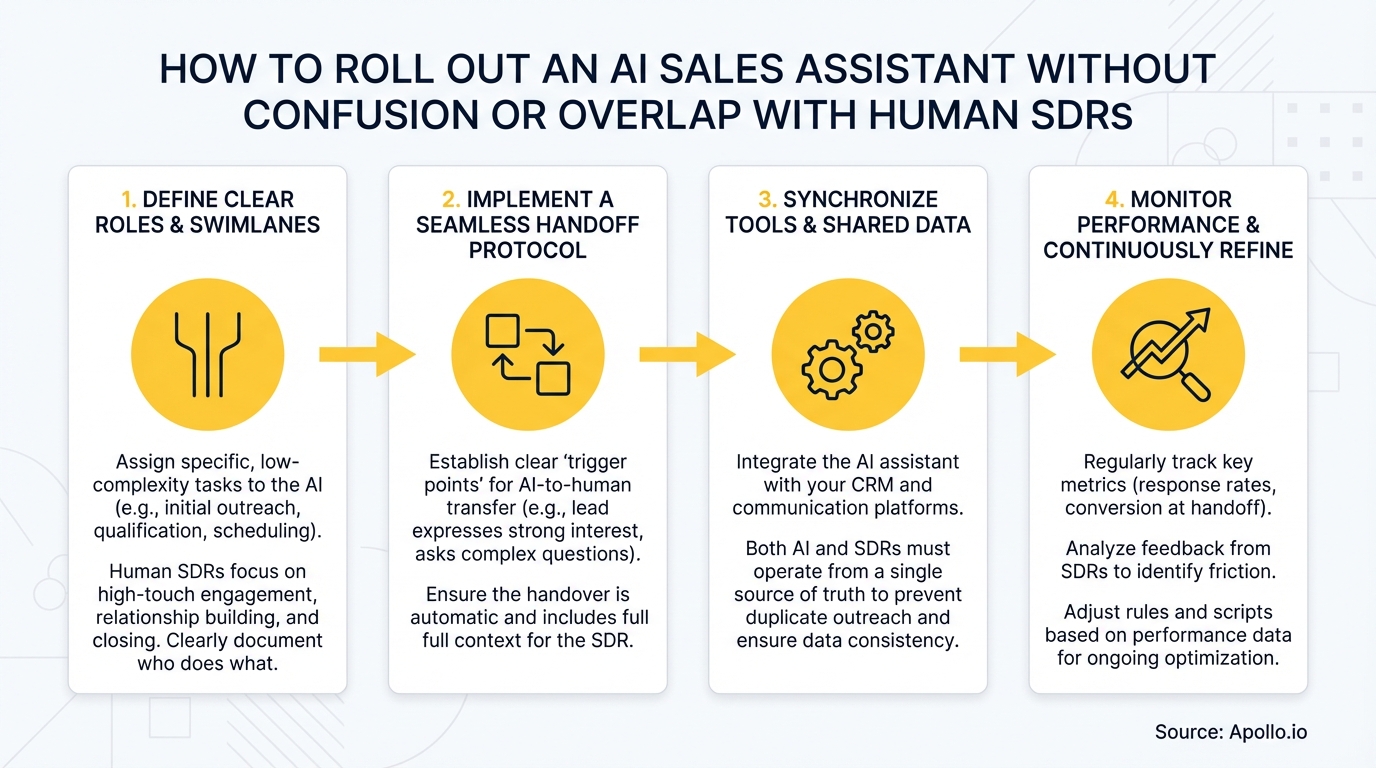
Rolling out an AI sales assistant without creating confusion or overlap with human SDRs requires a governance-first approach: define what the AI owns, what humans own, and how handoffs work before you flip the switch. Skip this step and you risk duplicate outreach, SDR frustration, and an abandoned pilot. Tools like Apollo's AI Sales Assistant are designed to slot into existing GTM workflows, handling research, list building, and sequence creation so SDRs focus on conversations that close.
According to TryKondo, 83% of sales teams are actively investing in AI technologies. The opportunity is real, but so is the execution risk. This blueprint shows you exactly how to roll out an AI sales assistant cleanly, without stepping on your SDRs.

Apollo Turns Hours of Research Into Minutes
Tired of your reps burning half their day verifying contact info instead of selling? Apollo delivers 230M+ accurate contacts so your team spends time closing, not researching. Start building real pipeline today.
Start Free with Apollo →Key Takeaways
- Define the AI's scope before launch: which segments, channels, and tasks it owns versus what SDRs handle.
- Use a RACI framework to assign ownership across RevOps, SDR management, and AEs to prevent overlap at every stage.
- A stage-gated rollout (Pilot → Assist → Copilot → Autopilot) reduces abandonment risk and builds SDR trust over time.
- CRM suppression windows and a single source of truth for contact status are the most practical tools for preventing duplicate outreach.
- Frame the AI as a capacity multiplier for SDRs, not a replacement, and tie incentives to incremental pipeline contribution.
Why Do AI Sales Assistant Rollouts Create SDR Overlap?
Overlap happens when both the AI assistant and human SDRs are allowed to contact the same prospect simultaneously without a shared routing rule. This is not a technology problem — it is an ownership problem. Research from Optif.ai shows that 89% of revenue organizations now use AI-powered tools, yet most lack formal governance for who acts on which contact at what time.
Common failure modes include:
- AI sends a cold email sequence while an SDR simultaneously makes a call to the same prospect
- No suppression window after AI first-touch, so SDRs re-engage the same lead within 48 hours
- AI and SDR sequences both writing to CRM with conflicting activity logs, breaking pipeline visibility
- No escalation rule, so Tier-1 accounts get AI-only treatment when they need human attention
Spending hours untangling duplicate outreach? Centralize your multi-channel sequences in Apollo to enforce routing rules automatically.
How Do You Build a Governance Framework (RACI) for AI and SDR Workflows?
A RACI matrix is the fastest way to prevent AI-SDR overlap by assigning clear Responsible, Accountable, Consulted, and Informed roles before launch. Build it across four functions: RevOps, SDR Management, AEs, and Marketing Ops.
| Task | AI Assistant | SDR | RevOps | AE |
|---|---|---|---|---|
| ICP list building | Responsible | Consulted | Accountable | Informed |
| First-touch outreach (Tier-2/3) | Responsible | Informed | Accountable | — |
| First-touch outreach (Tier-1) | Draft only | Responsible | Accountable | Consulted |
| Qualification + discovery call | — | Responsible | Informed | Accountable |
| Handoff to AE | Informed | Responsible | Consulted | Accountable |
| Suppression window management | — | Informed | Responsible | — |
Non-negotiables to define upfront: the AI cannot make pricing commitments, reference contract terms, or send messages to contacts already in an active SDR sequence. These guardrails protect both brand and legal exposure.

What Is a Stage-Gated AI Sales Rollout Model?
A stage-gated model moves your AI assistant through four maturity phases, each requiring explicit criteria before advancing. This prevents premature automation and gives SDRs time to adapt.
| Stage | AI Role | SDR Role | Gate Criteria to Advance |
|---|---|---|---|
| Pilot | Drafts only, SDR approves all sends | Reviews and edits AI outputs | 90%+ SDR approval rate; zero duplicate touches |
| Assist | Sends Tier-2/3 first-touch; SDR monitors | Handles replies and Tier-1 accounts | Reply rate on par with SDR benchmark; CRM data clean |
| Copilot | Runs full sequences for defined segments | Takes qualified hand-offs, handles objections | Meetings booked attributed; no unsubscribe spike |
| Autopilot | Autonomous on approved segments | Focus on mid-funnel and strategic accounts | Incremental pipeline contribution confirmed in attribution model |
Most teams spend 4-8 weeks in the Pilot stage. Rushing past it is the primary cause of SDR trust breakdown and pipeline contamination. Learn how to layer automation progressively with Apollo's sales automation tools to match your team's readiness at each stage.
Turn Funnel Guesswork Into Real Pipeline
Tired of watching marketing leads stall before they ever reach your pipeline? Apollo surfaces high-intent prospects so your team works deals that convert. Join 600K+ companies building predictable revenue.
Start Free with Apollo →How Do SDRs and AEs Handle Handoffs Without Losing Context?
Clean handoffs require a single source of truth in CRM: every AI-initiated touch, reply, and disqualification signal must write back to the contact record before an SDR or AE takes over. Without this, reps walk into calls without context and prospects feel the friction.
Practical handoff rules to implement:
- Suppression window: Once AI contacts a prospect, lock the record for a defined period (typically 5-10 business days) before any SDR outreach is permitted.
- Escalation triggers: AI hands off to SDR when a prospect replies, books a meeting, or hits a defined intent score threshold.
- AE notification: When an SDR qualifies a lead and books a meeting, an automated alert fires to the assigned AE with full conversation history attached.
- CRM field standards: Standardize fields for "Contact Owner," "Last AI Touch Date," and "Sequence Status" so routing is unambiguous.
For RevOps leaders, solving data synchronization across your GTM systems is the foundation that makes suppression windows and routing rules actually work. Without clean sync, the RACI framework above becomes theoretical.
Apollo's Outbound Copilot supports manual or automatic approval gates before adding new prospects to sequences, giving RevOps the control layer needed during the Pilot and Assist stages.
How Do SDRs Stay Motivated During an AI Sales Assistant Rollout?
SDR morale drops when the AI rollout narrative is "automation replaces prospecting." Flip the message: the AI handles volume so SDRs focus on the high-value conversations that actually require human judgment. Data from SuperAGI shows companies using AI for sales have a 52% higher likelihood of exceeding quota, which is the SDR incentive to lean in, not resist.
Change management actions that work:
- Involve top SDRs in the Pilot stage as co-designers, not just users
- Share AI-generated meeting attribution in team standups to show lift, not threat
- Adjust quota credit so SDRs get attribution for AI-booked meetings in their territory
- Create a feedback loop: SDRs flag AI messaging that misses the mark, which improves outputs and builds ownership
"Apollo's AI Assistant makes building targeted prospecting lists effortless. I can give it very specific prompts, and it stays within those parameters to deliver accurate, high-quality results." — Matt Tumbiolo, Enterprise BDR, Smartling
For SDRs looking to sharpen their own outreach alongside AI-assisted sequences, building a strong sales cadence strategy ensures human and AI touchpoints are complementary, not duplicative.
What KPIs Should You Track for an AI Sales Assistant Rollout?
Measure both positive and negative signals. AI can inflate activity metrics easily; the metrics that matter are incremental outcomes and quality signals.
| Metric Category | KPI | Why It Matters |
|---|---|---|
| Coverage | % of ICP accounts contacted per week | Measures capacity expansion beyond SDR bandwidth |
| Quality | Reply rate (AI vs. SDR baseline) | Signals if AI messaging is on-brand and relevant |
| Pipeline | Meetings booked attributed to AI sequences | Proves incremental revenue contribution |
| Negative signals | Unsubscribe rate, spam complaints, duplicate touches | Catches AI cannibalizing SDR performance |
| Handoff quality | % of AI-sourced meetings that advance to Stage 2 | Validates qualification accuracy before SDR handoff |
Struggling to see what's actually driving pipeline? Track AI-sourced and SDR-sourced pipeline in one place with Apollo's pipeline builder.
Use sales analytics to build a weekly dashboard that shows AI activity, SDR activity, and overlap incidents side by side. If the overlap count is above zero in weeks three or four, the suppression rules need tightening before advancing to the next stage.
How Do You Keep AI Outreach Compliant and On-Brand?
AI-generated outreach must operate within defined legal and brand guardrails, especially when sending at scale. Establish these rules in writing before the Pilot stage launches.
- Non-negotiable content rules: No pricing commitments, no contract language, no claims the legal team has not approved
- Unsubscribe compliance: Every AI-sent email must include a compliant opt-out mechanism; suppression lists must sync to CRM in real time
- Brand voice grounding: Use Apollo's AI Content Center to configure your value proposition, pain points, and tone so every AI-generated message reflects your actual positioning, not a generic template
- Approval gates for Tier-1: Any outreach to named strategic accounts requires human review before send, regardless of rollout stage
As "agent sprawl" grows across GTM stacks, leading revenue teams are adopting a governance layer approach: defining what each AI agent is permitted to do, where it can write data, and how it is monitored. Building these guardrails at launch is far less costly than retrofitting them after a brand or compliance incident.

Start Your AI Sales Assistant Rollout the Right Way in 2026
A clean AI sales assistant rollout comes down to three decisions made before go-live: who owns what, how the CRM enforces routing, and how you will measure incremental pipeline rather than just activity volume. SDRs who see the AI as a capacity multiplier, not a threat, become its strongest advocates.
Apollo's end-to-end GTM platform gives RevOps and SDR leaders the unified workspace to run AI-assisted prospecting, enforce suppression rules, and track attribution without stitching together separate tools. As Ian Kistner, Head of Sales Development at Crusoe, put it: "We're using Apollo's AI Assistant to score and tier accounts, which makes it much easier to prioritize outbound in a quickly expanding market."
Ready to build a rollout your SDRs will actually embrace? Start a free trial of Apollo and see how the AI Sales Assistant, Outbound Copilot, and pipeline analytics work together in one platform.
Prove Pipeline ROI With Apollo
ROI pressure killing your tool budget? Apollo delivers measurable pipeline impact your leadership can see — fast. Leadium 3x'd their annual revenue. Get results you can actually defend in your next budget review.
Start Free with Apollo →Don't miss these
Sales
Inbound vs Outbound Marketing: Which Strategy Wins?
Sales
What Is a Sales Funnel? The Non-Linear Revenue Framework for 2026
Sales
What Is a Go-to-Market Strategy? The 2026 GTM Playbook
See Apollo in action
We'd love to show how Apollo can help you sell better.
By submitting this form, you will receive information, tips, and promotions from Apollo. To learn more, see our Privacy Statement.
4.7/5 based on 9,690 reviews
