
How to Roll Out a New Sales Engagement Platform for a Team of 20+ Reps in 2026
Rolling out a sales engagement platform (SEP) for 20 or more reps is a change management project as much as a technical one. Get the phasing, governance, and adoption plan wrong, and you'll have an expensive tool that reps ignore. Get it right, and you consolidate your tech stack, automate admin work, and give reps back time to actually sell. According to Persistence Market Research, approximately 75% of sales teams are already using sales engagement technology, meaning your competitors are likely already running structured sequences and automating follow-ups. Before comparing platforms, review how Apollo stacks up against other top sales engagement platforms to understand what a consolidated solution looks like.

Research Less, Pipeline More With Apollo
Tired of burning hours verifying emails and chasing down contact info? Apollo delivers 230M+ accurate business contacts so your team sells instead of searches. Start building pipeline today.
Start Free with Apollo →Key Takeaways
- Treat adoption as your primary success metric. A platform reps don't use generates zero ROI, regardless of features.
- Consolidation must come before launch. Adding a SEP on top of an already bloated stack accelerates failure.
- Buyer-stage orchestration matters more than raw volume. Automate early-stage education; deploy reps at the decision stage.
- A phased 90-day rollout with clear owners and deliverables is the difference between a successful deployment and shelfware.
- Governance standards (MQL/SQL definitions, routing rules, SLAs) need to be set before go-live, not after problems emerge.
Why Do Most SEP Rollouts Fail for 20+ Rep Teams?
Most SEP rollouts fail because they add complexity instead of removing it. Tool overload is the primary culprit: when reps juggle separate tools for prospecting, sequencing, dialing, and logging, adoption collapses under the friction.
The fix is a consolidation-first mandate before any go-live date is set.
Before choosing a platform, audit your current stack. List every tool touching outbound workflows and flag duplicates. A unified platform that combines prospecting data, multi-channel sequences, a dialer, conversation intelligence, and CRM sync eliminates the switching costs that kill rep productivity. As the team at Predictable Revenue put it: "We reduced the complexity of three tools into one" after consolidating onto Apollo. See the full story in the Predictable Revenue case study.
Spending hours on manual outreach tasks your platform should handle? Automate your sequences with Apollo's multi-channel engagement platform.
What Should the 90-Day Rollout Plan Look Like?
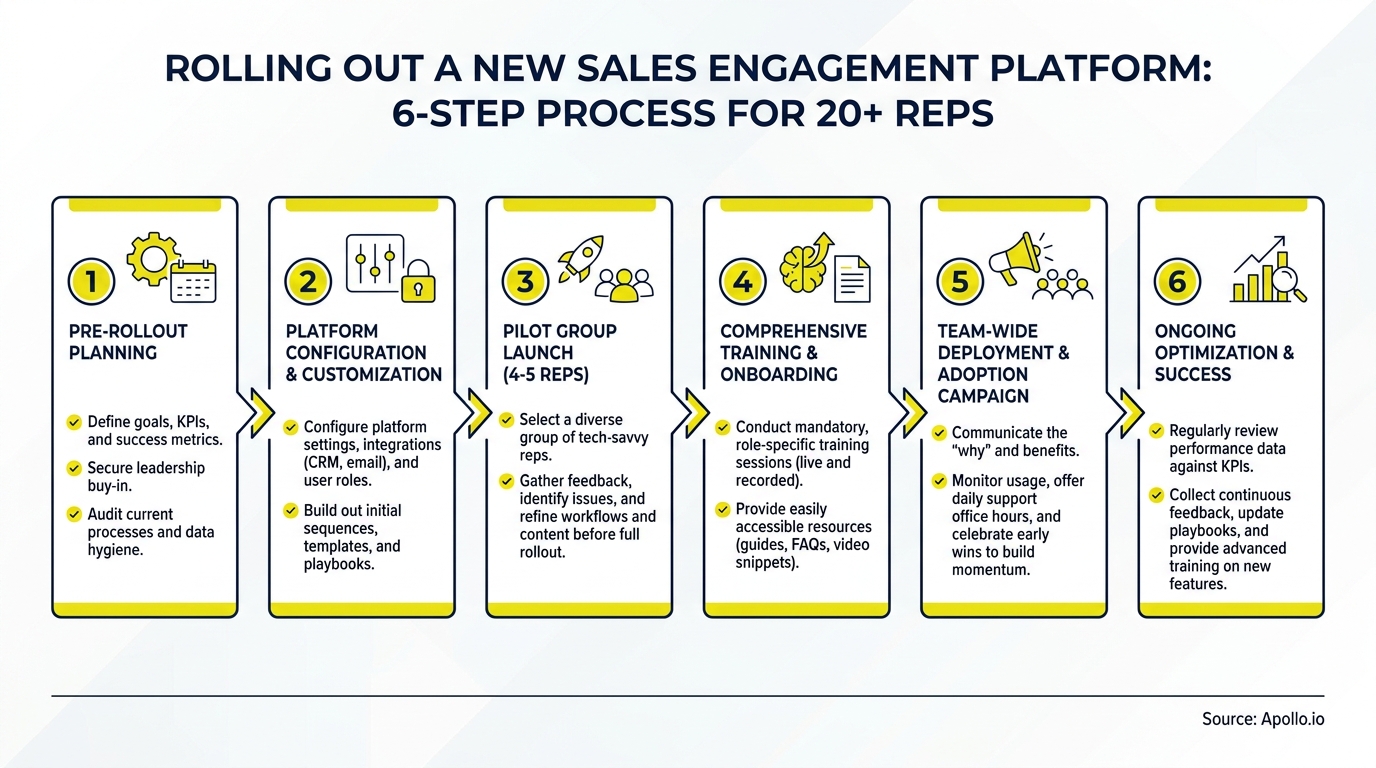
A structured 90-day rollout is the most reliable framework for deploying a SEP across a 20+ rep team. Each phase has distinct owners, deliverables, and success gates.
| Phase | Timeframe | Owner | Key Deliverables |
|---|---|---|---|
| Foundation | Days 0–30 | RevOps + Sales Leader | Tool audit, CRM integration, data standards, routing rules, pilot cohort (3–5 reps) |
| Enablement | Days 30–60 | Sales Enablement + RevOps | Sequence library, training certification, buyer-stage playbooks, call recording policy |
| Full Deployment | Days 60–90 | Sales Leader + Managers | Full team rollout, coaching cadences, weekly inspection metrics, sunset legacy tools |
Days 0–30 (Foundation): Run a pilot with a small cohort before full deployment. This surfaces integration issues, data gaps, and workflow friction at a manageable scale. Set MQL/SQL definitions, lead routing rules, and SLA standards now, not after launch. Also establish your OAuth and integration security checklist: with connected-app vulnerabilities becoming a frontline risk in 2026, integration approval and token governance belong in your implementation checklist from day one.
Days 30–60 (Enablement): Build the sequence library before reps touch the platform independently. Standardize 3–5 core plays (cold outbound, inbound follow-up, re-engagement). Train reps with role-specific paths and certify completion before granting full access. Include call recording consent policies as part of onboarding, especially if you're deploying conversation intelligence alongside sequences.
Days 60–90 (Full Deployment): Roll out to the full team with manager inspection cadences already scheduled. Week-over-week coaching reviews should focus on sequence adherence, reply rates, and meetings booked, not just activity volume. Sunset legacy tools on a hard date to prevent reps from reverting to old habits. For a deeper look at building a sales tech stack that scales, this playbook covers the full consolidation picture.
Turn Funnel Guesswork Into Pipeline Clarity
Pipeline forecasting a guessing game because leads stall before they ever become opportunities? Apollo surfaces high-intent prospects so your funnel fills with buyers, not dead weight. Join 600K+ companies forecasting with confidence.
Start Free with Apollo →How Should RevOps Leaders Set Governance Before Go-Live?
RevOps leaders should define four governance standards before any rep logs into the new platform: MQL/SQL criteria, lead routing rules, data field standards, and sequence ownership rules.
- MQL/SQL definitions: Align marketing and sales on what triggers a handoff. Document the criteria in the CRM and the SEP simultaneously.
- Lead routing rules: Configure territory, segment, and round-robin rules inside the platform before go-live. Routing gaps cause duplicate outreach and rep conflict.
- Data field standards: Standardize required fields for contact records. Dirty data in the CRM becomes dirty sequences in the SEP.
- Sequence ownership: Assign ownership of each sequence template. Unowned sequences become outdated and inconsistent within weeks.
RevOps leaders also find that agentic AI features in modern platforms, where the system recommends and takes actions proactively, require clear human-in-the-loop policies. Define what the platform can do automatically versus what requires rep review before deployment. For analytics setup, review how sales analytics drives revenue growth to align your SEP reporting to pipeline metrics from day one.

How Do SDRs and AEs Use Buyer-Stage Orchestration Effectively?
SDRs and AEs should use the SEP differently based on where the buyer is in their journey. Early-stage education runs largely through automated sequences; rep involvement should increase significantly at the decision stage.
Research from Kixie found that automation tools save sales professionals around 5 hours per week. For a 20-rep team, that reclaimed time should be redirected toward decision-stage conversations, not more early-stage prospecting volume.
Structure your buyer-stage playbooks as follows:
- Early stage (awareness/education): Automated email and social sequences with relevant content. Reps review replies; the platform handles the cadence.
- Mid-stage (consideration): Rep-triggered touchpoints. SDRs personalize follow-up based on engagement signals (opens, clicks, intent data).
- Decision stage: Account Executives take the lead with multi-threaded outreach, mutual action plans, and stakeholder-specific messaging. This is where human involvement drives the highest return.
For AEs managing active opportunities, pair your SEP with Apollo's deal management tools to track pipeline health and ensure no deal goes dark between touchpoints.
For sequence structure best practices, see proven outbound sequence length and cadence guidance to calibrate step counts by stage.
What Adoption Metrics Should Sales Leaders Track?
Sales leaders should track adoption metrics, not just activity metrics, in the first 90 days. High email send volume with low sequence adherence signals reps are bypassing the platform, not using it.
| Metric | What It Signals | Target (Days 0–90) |
|---|---|---|
| % of reps using platform daily | Core adoption rate | 80%+ by Day 60 |
| Sequences created via platform (vs. manual email) | Workflow compliance | 90%+ of outreach through platform |
| CRM sync rate | Data hygiene | 100% (non-negotiable) |
| Reply rate by sequence | Sequence quality | Baseline in Week 1; improve 10%+ by Day 90 |
| Meetings booked per rep per week | Pipeline impact | Track vs. pre-rollout baseline |
Data from Everstage shows that among teams using AI, 83% saw revenue growth in the past year, compared with 66% of teams without AI. The differentiator is consistent platform usage tied to AI-assisted workflows, not just having access to the tool.
Manager inspection cadences should run weekly in the first 60 days. Review sequence performance in the platform, not in a spreadsheet.
Coaching in the flow of work, using the platform's own analytics, drives faster behavior change than post-hoc reporting reviews.
How Do You Choose the Right Platform to Consolidate Your Stack?
Choose a platform that replaces the most tools in your current stack without requiring new integrations to cover gaps. For most B2B GTM teams, the core consolidation target is: prospecting data + multi-channel sequences + dialer + conversation intelligence + CRM sync, all in one workspace.
Apollo consolidates all of these into a single platform, which is why teams like Cyera found that "having everything in one system was a game changer." For SDRs, that means one place to find contacts, build sequences, dial, and log activity. For RevOps, it means one data source for pipeline reporting. For sales leaders, it means one system to inspect rep activity and coach from.
Compare the total cost of your current stack against a unified platform. As Census noted after consolidating: "We cut our costs in half." Explore Apollo's use cases across sales and marketing teams to map which tools it replaces in your specific workflow. For enterprise GTM teams requiring advanced routing, governance, and admin controls, Apollo's Organization tier covers those requirements without adding separate vendors.

Ready to Launch Your SEP Rollout?
A successful sales engagement platform rollout for a 20+ rep team comes down to three things: consolidate before you launch, govern before reps go live, and measure adoption before measuring activity. The phased 90-day framework, buyer-stage playbooks, and governance standards above give you a repeatable blueprint regardless of which platform you choose.
If you want a platform that consolidates prospecting, sequencing, dialing, and deal management into one workspace, Apollo is built for exactly that. Explore Apollo's multichannel sales engagement platform or see how top platforms compare in the Apollo vs. Salesloft vs. Outreach breakdown. When you're ready to see it in action, request a demo and see how Apollo fits your team's rollout plan.
Prove Pipeline ROI With Apollo
ROI pressure killing your tool budget? Apollo delivers measurable pipeline impact from day one — teams like Leadium 3x'd annual revenue. Start your free trial and show leadership real numbers fast.
Start Free with Apollo →Don't miss these
Data
How to Structure a Marketing Team That Actually Drives Revenue in 2026
Data
Solving Data Synchronization Headaches Across Multiple Business Systems
Data
What Marketing Metrics Should B2B Teams Track in 2026?
See Apollo in action
We'd love to show how Apollo can help you sell better.
By submitting this form, you will receive information, tips, and promotions from Apollo. To learn more, see our Privacy Statement.
4.7/5 based on 9,690 reviews
