
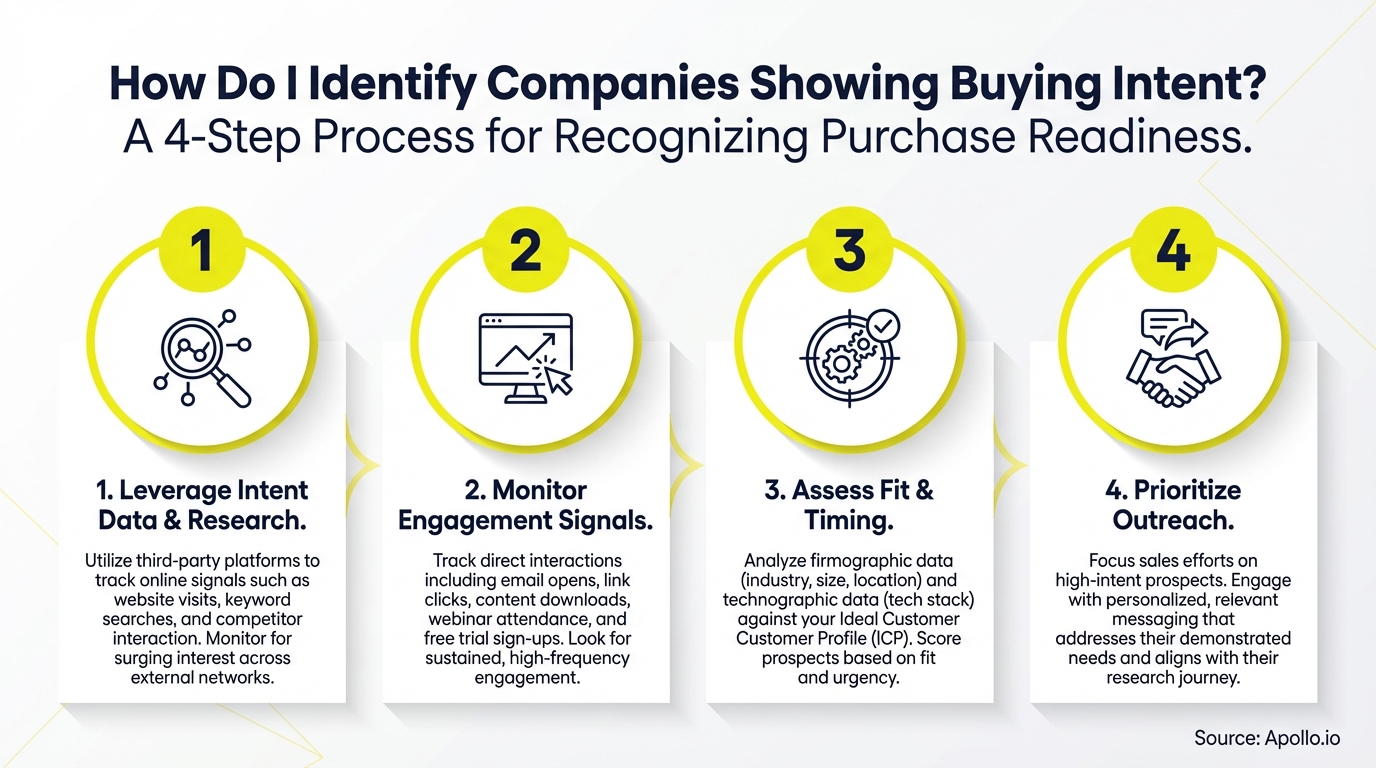
How Do I Identify Companies Showing Buying Intent? A 2026 Framework for SDRs and GTM Teams
Most B2B teams wait for a form fill before acting on buyer interest. That strategy leaves most of the market untouched. According to Landbase, buyers are often 60-90% through their decision-making process by the time they contact a vendor. By then, the preferred vendor is usually already chosen. If you want to reach in-market companies before your competitors do, you need to read signals that happen long before any hand-raise.
This framework shows you exactly how to identify companies showing buying intent using first-party signals, third-party data, and stage-based triggers — without relying on form fills. For a deeper primer on the underlying data, see What Is Intent Data? How It Powers Smarter B2B Sales.

Research Less, Close More With Apollo
Tired of your reps burning hours on manual lead research instead of selling? Apollo surfaces verified contacts instantly so your team spends time closing, not digging. Join 600K+ companies building pipeline faster.
Start Free with Apollo →Key Takeaways
- Most buyer research happens invisibly — form fills capture only a fraction of real intent activity.
- Effective intent identification layers first-party signals (site behavior, product usage) with third-party research data and firmographic filters.
- Stage-based signal maps let SDRs and RevOps teams trigger the right outreach at the right moment, reducing irrelevant touches.
- In 2026, intent programs must be AI-ready: structured pages, pricing transparency, and comparison content that AI engines can surface.
- Apollo consolidates intent data, prospecting, and outreach in one platform — replacing the need for multiple disconnected tools.
Why Are Form Fills a Poor Proxy for Buying Intent?
Form fills represent a tiny slice of buyer activity. Research from MarketBetter shows that up to 70% of the buyer journey unfolds in the "dark funnel" — an invisible research phase where evaluation occurs without direct vendor interaction. Meanwhile, The Insight Collective reports that B2B buyers perform an average of 12 online searches before visiting a specific brand's website.
Waiting for a demo request means you are engaging a buyer who has already shortlisted vendors. The intent signals you need to act on happen much earlier: content consumption, pricing page visits, review site activity, and third-party topic surges. Teams that target prospects showing buying intent earlier consistently reach buyers before the competitive window closes.
What Are the Main Types of Buying Intent Signals?
Buying intent signals fall into two categories: first-party (signals from your own properties) and third-party (signals from external sources). Effective intent programs layer both.
| Signal Type | Examples | Strength |
|---|---|---|
| First-Party Behavioral | Pricing page visits, return visits, product trial activity, high-intent content downloads | High — directly observed |
| Third-Party Research Intent | Topic surges on industry sites, review platform activity, category research spikes | Medium-High — validated by coverage |
| Firmographic Triggers | New funding, leadership hires, headcount growth, tech stack changes | Medium — contextual fit signal |
| Engagement Velocity | Multiple contacts from one account visiting in a short window, email open clusters | High — buying committee signal |
For a detailed breakdown of how these signals are collected and scored, see What Is Intent Data? How It Works, Uses, and Top Providers.
How Do SDRs and AEs Use a Stage-Based Intent Signal Map?
A stage-based signal map connects specific signals to specific actions. Instead of treating all intent the same, this approach lets SDRs prioritize hot accounts and lets AEs prepare context-rich outreach before a meeting is even scheduled.
- Awareness stage: Third-party topic surge on relevant category keywords. Action: add to nurture sequence, serve educational content.
- Consideration stage: Multiple visits to solution pages + review site activity from the same company. Action: SDR outreach with relevant case study or comparison asset.
- Evaluation stage: Pricing page visits, return visits within 7 days, or multiple stakeholders from one account engaging. Action: AE-led outreach with proof assets (ROI calculators, customer stories, implementation guides).
- Decision stage: Demo page visits, contract-related content, or direct trial activity. Action: immediate personalized outreach, fast-track to meeting.
Struggling to prioritize which accounts to call first? Apollo's buying intent data surfaces in-market companies automatically so SDRs can focus on the highest-signal accounts without manual research.
How Do RevOps Teams Operationalize Intent Data Without Creating Noise?
RevOps leaders face a consistent challenge: intent data generates noise if there are no thresholds or suppression rules. Gartner's 2025 survey found 73% of B2B buyers actively avoid suppliers who send irrelevant outreach.
Poor intent activation erodes trust faster than no outreach at all.
Key governance rules for clean intent activation:
- Recency thresholds: Only act on signals from the past 7-14 days. Stale intent signals produce wasted cycles.
- Multi-signal confirmation: Require at least two independent signals before triggering a sales play (e.g., pricing page visit + third-party topic surge).
- Suppression lists: Exclude current customers, recent closed-lost accounts within 90 days, and accounts already in active sequence.
- Firmographic overlay: As noted by Vereigen Media, intent data effectiveness is significantly enhanced when combined with firmographic data such as company size, industry, and revenue — ensuring signals come from accounts that actually fit your ICP.
RevOps teams building this infrastructure should also review What Is Revenue Operations and How Does It Drive Growth? for the broader operational context.

What Content Assets Help Capture Intent Before a Sales Touch?
In 2026, buyers prefer to self-serve. This means your content needs to answer the four questions buyers ask before speaking to sales: Does this fit my situation?
What does it cost? How hard is it to implement?
Does it actually work?
Build these assets to capture and accelerate intent:
- Fit pages: Industry-specific use case pages that match your ICP's language and pain points.
- Pricing transparency: Even ranges or "starting at" figures reduce friction and signal credibility to AI-assisted buyers.
- Implementation content: Onboarding timelines, integration guides, and technical specs answer evaluation-stage questions without a call.
- Proof content: Customer stories with specific outcomes, peer review links, and comparison matrices.
These assets also serve AI search engines. Forrester's 2025 Buyers' Journey Survey found 94% of business buyers use AI in their buying process, with generative AI and conversational search cited as a primary information source.
Structured, citation-friendly pages get surfaced to buyers before they ever visit your site directly.
Turn Funnel Chaos Into Pipeline Clarity
Tired of watching marketing leads stall before they ever reach your pipeline? Apollo surfaces in-market buyers with real buying signals so your team works deals worth closing. Join 600K+ companies turning lead gaps into predictable revenue.
Start Free with Apollo →How Does Apollo Help Identify and Act on Buying Intent in One Platform?
Most teams cobble together intent data, a contact database, and an engagement platform from separate vendors. That fragmentation slows down activation and creates the data inconsistencies that erode buyer trust.
Apollo consolidates all of this into a single GTM platform.

With Apollo, SDRs and GTM teams can:
- Filter the 230M+ contact database by intent signals, firmographics, and 65+ other attributes to build precise in-market lists.
- Use Apollo's buying intent data to surface companies actively researching relevant topics.
- Launch multi-channel sequences via email, phone, and social directly from the same workspace — no tool-switching required.
- Track engagement signals and route hot accounts to AEs automatically using the workflow engine.
"Having everything in one system was a game changer" — Cyera. "We cut our costs in half" — Census. Teams that consolidate intent, data, and outreach in one platform move from signal to outreach faster with less ops overhead. Explore how to build the right foundation in How to Build a Sales Tech Stack That Scales Revenue.
Spending too much time researching accounts before reaching out? Search Apollo's 230M+ contacts filtered by buying intent signals and go straight to outreach.
How Do You Start Identifying Buying Intent Today?
Identifying companies showing buying intent does not require a complex six-month implementation. Start with what you can observe directly, then layer in third-party signals as your program matures.
Week 1-2: First-party baseline
- Tag high-intent pages (pricing, demo, comparison) in your analytics platform.
- Set up account-level tracking so you can see company-level visit patterns, not just individual visitors.
- Build a suppression list of current customers and active pipeline accounts.
Week 3-4: Add third-party intent and firmographic filters
- Connect a third-party intent data source and select 20-50 topics directly relevant to your solution category.
- Overlay ICP firmographic filters: target company size, industry, and revenue range.
- Build your first stage-based signal map with clear triggers for SDR outreach vs. AE routing.
Month 2+: Measure and tighten
- Track pipeline influence: do intent-triggered accounts convert at a higher rate?
- Audit signal recency and adjust thresholds based on what actually predicts meetings booked.
- Expand to additional channels using Apollo's multi-channel sales engagement platform to reach intent-flagged accounts across email, phone, and social.
Start Reaching In-Market Companies Before Your Competitors Do
Identifying companies showing buying intent is now a core GTM competency, not a nice-to-have. Buyers complete most of their journey before contacting vendors, prefer self-serve research, and tune out irrelevant outreach.
Teams that act on early signals with relevant, well-timed outreach win more deals at a lower cost per opportunity.
Apollo gives SDRs, AEs, RevOps, and marketing leaders a single platform to find intent-flagged accounts, enrich them with verified contact data, and execute outreach — all without switching tools. See how it works at Apollo Buying Intent: Target Prospects Ready to Purchase, or get started now.
Start Free with Apollo and surface your next in-market accounts today.
Prove Pipeline ROI With Apollo
Budget approval stuck on unclear pipeline metrics? Apollo delivers measurable results fast — teams like Leadium 3x'd annual revenue after switching. Start your free trial and show ROI before your next review.
Start Free with Apollo →Don't miss these
Sales
Inbound vs Outbound Marketing: Which Strategy Wins?
Sales
What Is a Sales Funnel? The Non-Linear Revenue Framework for 2026
Sales
What Is a Go-to-Market Strategy? The 2026 GTM Playbook
See Apollo in action
We'd love to show how Apollo can help you sell better.
By submitting this form, you will receive information, tips, and promotions from Apollo. To learn more, see our Privacy Statement.
4.7/5 based on 9,690 reviews
