
How to Evaluate Which Sales Engagement Platform Is the Best Fit for a High-Volume Outbound Team
Choosing the wrong sales engagement platform for a high-volume outbound team is an expensive mistake. With vendors racing to rebrand as "AI agents" and "revenue orchestration platforms," the feature checklist approach no longer works. You need a structured evaluation framework anchored to benchmarks, compliance risk, and actual workflow fit. This guide gives you exactly that, so you can build a sales tech stack that drives real outcomes rather than vanity activity metrics.

Scale Your Team Without the Chaos
Tired of inconsistent processes slowing your team down? Apollo gives every rep a repeatable playbook — verified contacts, automated outreach, and 97% email accuracy built in. Start building pipeline that actually scales.
Start Free with Apollo →Key Takeaways
- High-volume outbound teams should evaluate platforms on workflow orchestration and admin time reduction, not just sequence volume.
- Deliverability authentication (SPF/DKIM/DMARC) and DNC suppression are now first-tier selection criteria, not afterthoughts.
- Revenue Orchestration Platforms (ROPs) have replaced standalone sequencing tools as the benchmark for modern outbound evaluation.
- SDRs and BDRs gain the most from platforms that unify prospecting, sequencing, and conversation intelligence in a single workspace.
- The strongest ROI case comes from consolidating your tech stack, not adding another point tool.
What Has Changed About Evaluating Sales Engagement Platforms in 2026?
Sales engagement platform evaluation has fundamentally shifted from feature comparison to ecosystem and orchestration fit. Forrester formalized this in its Q3 2024 Wave, recognizing a new category called Revenue Orchestration Platforms (ROPs) that converge engagement, conversation intelligence, and revenue operations into unified systems.
Meanwhile, vendors like Outreach relaunched as an "AI Revenue Workflow Platform" and added an MCP Server (February 2026) to connect external AI agents directly to workflows. Salesloft launched its agentic AI "Closing Power" suite in Fall 2025.
The market is moving fast, and buyers who evaluate on sequencing features alone will be left behind.
According to SuperAGI, the global sales engagement platform market was valued at $7.87 billion in 2023 and is projected to reach $29.62 billion by 2033. That growth signals intense vendor competition and makes disciplined evaluation more critical than ever. For a detailed comparison of leading platforms, see Apollo vs. Outreach vs. Salesloft.
What Are the Core Evaluation Criteria for a High-Volume Outbound Team?
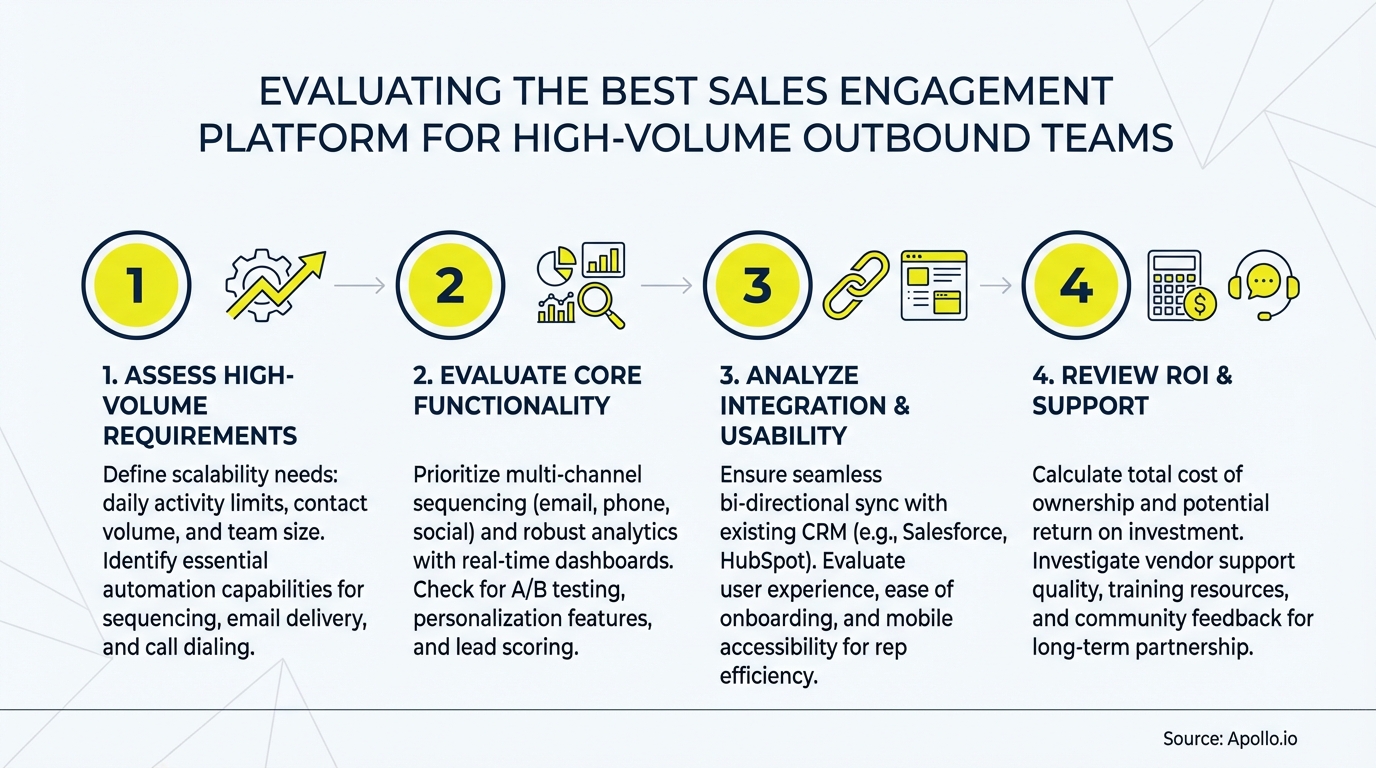
The right evaluation framework scores platforms across five dimensions, each weighted by your team's motion and scale.
| Evaluation Dimension | What to Score | Why It Matters at Scale |
|---|---|---|
| Workflow Orchestration | Auto-logging, routing rules, AI prioritization | Reps spend only ~30% of time selling; automation reclaims the rest |
| Multi-Channel Execution | Email, phone, social steps in a single sequence | Multi-channel outreach drives significantly higher engagement than single-channel |
| Deliverability & Compliance | SPF/DKIM/DMARC enforcement, DNC suppression, audit logs | Microsoft enforced bulk-sender authentication in May 2025; non-compliance kills deliverability |
| Data Unification | Unified contact/account timeline, CRM sync depth | Fragmented interaction data is a leading cause of B2B customer churn |
| AI Governance & ROI Measurement | Measurable time savings, outcome-based reporting | AI adoption is now competitive necessity, not experimentation |
Research from Forecastio shows sales engagement platforms can free up to 25% of time spent on administrative tasks for sales reps. Use that as your baseline ROI target when scoring automation depth.
How Should SDRs and BDRs Score a Platform Before Buying?
SDRs and BDRs are the highest-frequency users of any sales engagement platform, so their workflow requirements should carry the most weight in your evaluation. The key question for this persona is: does the platform let me prospect, sequence, dial, and log in one workspace, or am I context-switching across four tools?
Spending hours on manual outreach? Automate your sequences with Apollo's multi-channel platform and reclaim time for actual selling.
When evaluating for SDR/BDR teams, score each platform on:
- Sequence builder flexibility: Can reps build and A/B test cadences without RevOps involvement? Review proven outbound sequence structures to benchmark against.
- Integrated dialer: Power dial, call recording, and AI call summaries in the same platform (not a separate subscription).
- Prospecting and contact data: Does the platform include a verified B2B contact database, or does it require a separate data provider?
- Auto-logging: Activities should sync to CRM automatically. Manual logging is dead time at volume.
- AI personalization: Signal-based messaging suggestions, not just merge-field templates.
For AEs and Account Executives, add deal-stage routing, mutual action plan support, and conversation intelligence as scoring criteria. RevOps leaders should prioritize CRM integration depth, governance controls, and unified reporting.

Why Is Deliverability and Compliance Now a First-Tier Criterion?
Deliverability and compliance must be evaluated as core platform capabilities, not post-purchase configuration tasks. Microsoft began enforcing SPF/DKIM/DMARC requirements for Outlook, Hotmail, and Live senders in May 2025.
Platforms that do not enforce these standards by default will erode your sender reputation at scale.
On the phone side, the FTC reported approximately 258.5 million active Do Not Call registrations as of September 30, 2025. Any platform used for high-volume dialing must include built-in DNC suppression, audit logs, and policy controls.
Evaluate this as a hard requirement, not a nice-to-have.
Your compliance checklist for platform evaluation:
- Automated SPF/DKIM/DMARC enforcement and domain warm-up tools
- DNC registry integration with real-time suppression
- Opt-out and unsubscribe handling across all channels
- Audit logs for sequences, calls, and contact interactions
- Role-based access controls for sequence approval workflows
Turn Funnel Gaps Into Pipeline Wins
Tired of watching leads stall before they ever reach your pipeline? Apollo surfaces high-intent prospects and puts verified contacts in front of your reps instantly. Nearly 100K paying customers stopped guessing and started closing.
Start Free with Apollo →What Is a Revenue Orchestration Platform and Do You Need One?
A Revenue Orchestration Platform (ROP) is a unified system that combines sales engagement, conversation intelligence, pipeline management, and revenue operations into a single workflow engine, replacing the need for separate sequencing, dialing, and analytics tools. Forrester recognized this as a distinct category in 2024, and it represents the evolution beyond traditional sales engagement platforms (SEPs).
You need ROP-level capabilities if your team runs:
- Multi-touch sequences across email, phone, and social channels simultaneously
- Signal-based outreach triggered by intent data, job changes, or product usage
- Inbound routing and rep assignment at volume
- Cross-functional handoffs between SDRs, AEs, and Customer Success
If you are still running a standalone sequencing tool layered on a separate data provider and a separate dialer, you are carrying compounding integration debt. As Predictable Revenue noted, "We reduced the complexity of three tools into one." That consolidation outcome is what ROP evaluation should target. See how Apollo unifies the full GTM workflow for teams at every stage.
Struggling to find qualified leads across your existing stack? Search Apollo's 230M+ verified contacts with 65+ filters and eliminate the separate data provider cost entirely.
How Do You Build a Fit Scorecard for Platform Selection?
A fit scorecard standardizes evaluation across vendors and prevents the loudest demo from winning. Score each platform from 1 to 5 on each criterion, then weight by team priority.
| Criterion | Weight (High-Volume Outbound) | Score (1-5) |
|---|---|---|
| Workflow automation and auto-logging | High | |
| Multi-channel sequence execution | High | |
| Deliverability controls and DNC suppression | Critical | |
| Built-in contact database or enrichment | High | |
| CRM integration depth (bidirectional sync) | High | |
| AI personalization and prioritization | Medium-High | |
| Reporting tied to outcomes (not just activity) | High | |
| Total cost of ownership (platform + integrations) | High | |
| Ecosystem fit (AI stack, CRM, MAP compatibility) | Medium |
Run every shortlisted vendor through this scorecard using a live pilot, not just a demo. Require vendors to demonstrate DNC suppression workflows, show their deliverability dashboard, and walk through how AI suggestions are generated. Understanding how sales automation works in practice will sharpen your evaluation questions significantly.
How Should RevOps Leaders Calculate TCO and ROI?
RevOps leaders should calculate total cost of ownership (TCO) by including not just license fees but integration maintenance, data provider costs, and internal admin time. The strongest ROI case in 2026 is consolidation: replacing a sequencing tool, a separate data provider, and a standalone dialer with a single platform eliminates both per-tool costs and the engineering overhead of keeping three systems in sync.
Use these benchmark targets when building your ROI model:
- Admin time reduction: Score platforms on how much auto-logging, routing, and AI research reduces per-rep daily admin
- Time-to-first-touch: Measure how quickly a new lead enters a sequence after entering your CRM or triggering a signal
- Meeting-to-sequence ratio: Track booked meetings per sequence sent as your primary outcome KPI (not open rates)
- Data decay cost: Factor in the cost of maintaining a separate enrichment provider vs. a platform with built-in verified data
According to Market Growth Reports, approximately 48% of global B2B sales teams in 2024 prioritized adopting sales engagement platforms to improve outreach efficiency and lead conversion workflows. The teams seeing the best ROI are those treating platform selection as a consolidation decision, not a feature upgrade. For a deeper look at how sales analytics drives revenue growth, benchmark your current metrics before signing any contract.

Which Platform Is the Best Fit for a High-Volume Outbound Team in 2026?
The best-fit platform for a high-volume outbound team is one that unifies prospecting data, multi-channel sequencing, dialing, and pipeline reporting in a single workspace, while meeting all deliverability and compliance requirements. Apollo is purpose-built for this use case, serving nearly 100K paying customers across B2B GTM teams from startups through enterprise. "Having everything in one system was a game changer," noted Cyera, reflecting the consolidation outcome that high-volume teams consistently report.
Apollo's platform combines a 230M+ person contact database with 97% email accuracy, multi-channel sales engagement sequences, AI-powered workflow automation, and built-in conversation intelligence. That means SDRs, AEs, and RevOps leaders work from one unified system instead of stitching together three or four tools. For enterprise teams, Apollo adds advanced routing, governance controls, and admin oversight to support larger GTM operations. Explore how enterprise sales solutions in 2026 stack up before finalizing your shortlist.
Ready to evaluate Apollo against your current stack? Schedule a Demo and see how consolidating your outbound workflow into one platform changes your team's output.
Prove Pipeline ROI From Day One
ROI pressure killing your tool adoption? Apollo delivers measurable pipeline impact fast — 46% more meetings with AI, real results your leadership can see. Start free and show the numbers that matter.
Start Free with Apollo →Don't miss these
Sales
Inbound vs Outbound Marketing: Which Strategy Wins?
Sales
What Is a Sales Funnel? The Non-Linear Revenue Framework for 2026
Sales
What Is a Go-to-Market Strategy? The 2026 GTM Playbook
See Apollo in action
We'd love to show how Apollo can help you sell better.
By submitting this form, you will receive information, tips, and promotions from Apollo. To learn more, see our Privacy Statement.
4.7/5 based on 9,690 reviews
