
How to Drive Real SDR Team Adoption of Your New Sales Platform
You bought the platform. You ran the demo.
You got buy-in from leadership. Then week two arrives and half your SDR team is still working from spreadsheets.
Sound familiar? SDR platform adoption fails more often than it succeeds—not because reps resist change, but because rollouts add work instead of removing it.
This playbook fixes that.
Before diving in, check out How to Build a Sales Tech Stack That Scales Revenue for the foundational framework that makes everything below work.

Research Less, Close More With Apollo
Tired of burning hours verifying contact info instead of selling? Apollo delivers accurate business contacts instantly, so your team spends time closing — not chasing. Join 600K+ companies building pipeline faster.
Start Free with Apollo →Key Takeaways
- SDR adoption fails when the new platform adds to the existing tool pile instead of replacing tools reps already resent.
- CRM integration is non-negotiable: a platform that doesn't embed into existing workflows becomes an ignored extra tab.
- Reps adopt tools that visibly help them hit quota—frame every rollout decision around that outcome.
- Measure adoption through outcome-linked KPIs (meetings booked, speed-to-lead), not just login counts.
- Data hygiene is an adoption prerequisite, especially when AI-assisted workflows are involved.
Why Do SDR Platform Rollouts Fail in the First Place?
SDR platform rollouts fail because they add friction instead of eliminating it. According to a State of Sales report, 48% of sales professionals cite tool overload and integration complexity as primary concerns. When a new platform lands on top of an already crowded stack, reps default to the path of least resistance: the tools they already know.
Three root causes drive most failed rollouts:
- Tool sprawl: The platform becomes tool number nine in a stack where reps are already overwhelmed.
- Workflow mismatch: The platform lives outside the CRM, so reps have to context-switch to use it.
- Missing quota connection: Reps can't see how the platform helps them book more meetings or hit their number.
According to WaveCnct, the average CRM user adoption rate among sales professionals is 72%—meaning 28% of reps with full access still don't use the tool consistently. A new platform layered on top of a fragmented stack faces even steeper odds.
What Should You Retire Before Rolling Out the New Platform?
Before launch day, publish a retirement list alongside the new platform announcement. Every tool the new platform replaces should be scheduled for deactivation within 30 to 60 days of go-live.
This signals to SDRs that the new platform is the system, not an addition.
Use this decision framework for each existing tool:
| Tool Category | Keep If | Retire If |
|---|---|---|
| Prospecting / data | Covers a unique data source | New platform covers same contacts |
| Sequencing / cadence | Unique channel not supported | New platform runs email, phone, social |
| Dialer | Compliance requirement differs | New platform has native dialer |
| Meeting scheduler | Complex routing logic needed | New platform books meetings natively |
As Predictable Revenue found after consolidating their stack: "We reduced the complexity of three tools into one." See their full story at Predictable Revenue: How to Reduce Tech Stack Costs by 50%.
Spending too much on a fragmented SDR stack? See how Apollo consolidates prospecting, sequencing, and dialing into one workspace.
How Do You Embed the Platform Into CRM-Native Workflows?
Embed the new platform directly into your CRM so reps never need to leave their existing workflow to use it. According to Kondo's B2B Sales Report, while CRM systems have an 87% penetration rate, the primary challenge has shifted from initial adoption to effective utilization and data quality. A platform that sits outside the CRM compounds both problems.
Practical CRM-native embedding steps:
- Map the new platform's sequences to CRM deal stages so sequences trigger automatically on stage change.
- Push all call logs, email opens, and replies back to the CRM contact record in real time.
- Surface next-best-action prompts inside CRM views, not as a separate tab or login.
- Use the platform's CRM integration to sync contacts bidirectionally so reps always work from clean, current data.
The 2026 shift in sales enablement is clear: "agents in the flow of work" replaces "new tabs and tools." Adoption rises when the platform pushes next-best actions where reps already work, rather than requiring a separate login.
Turn Funnel Gaps Into Pipeline With Apollo
Pipeline forecasting a guessing game because quality leads never make it past stage one? Apollo surfaces in-market buyers before they stall, turning weak top-of-funnel into real opportunities. Nearly 100K paying customers stopped guessing and started closing.
Start Free with Apollo →How Should SDRs and RevOps Leaders Measure Platform Adoption?
SDRs and RevOps leaders should measure adoption through outcome-linked KPIs, not just activity counts. Login frequency tells you nothing about whether the platform is generating pipeline.
The metrics that matter connect usage to quota progress.
| KPI | What It Measures | Target Signal |
|---|---|---|
| Speed-to-lead | Time from new lead to first touch | Decreasing week-over-week |
| Meetings booked per rep | Quota-relevant output | Trending up vs. pre-launch baseline |
| Sequence enrollment rate | Platform engagement depth | Above 80% of weekly new leads |
| CRM sync rate | Data hygiene compliance | Near 100% auto-log vs. manual entry |
| Opp-conversion rate | Pipeline quality from platform | Equal or better vs. pre-launch |
For RevOps leaders, sales analytics dashboards that surface these KPIs weekly close the leadership-frontline perception gap. Review them in team meetings so reps see the connection between platform usage and their own quota attainment.

Why Is Data Hygiene an Adoption Prerequisite for AI-Enabled Platforms?
Data hygiene is a prerequisite because AI-powered features break down on dirty data, and reps stop trusting a platform that surfaces stale or inaccurate contacts. According to Kondo's B2B data insights, poor CRM hygiene directly contributes to low confidence in forecasting accuracy among sales leaders. That same distrust bleeds into rep behavior: if the data looks wrong, reps revert to their own lists.
Pre-launch data readiness checklist:
- Deduplicate contact and account records before migration.
- Validate email addresses and direct dials against a verified source.
- Define field ownership: which fields the platform owns vs. which the CRM owns.
- Set automated enrichment rules so new records populate on creation.
- Establish a monthly hygiene review owned by RevOps, not individual reps.
Struggling with contact data quality before your rollout? Apollo's data enrichment keeps your CRM records accurate and AI-ready.
How Do You Build an Enablement Plan That Actually Drives SDR Adoption?
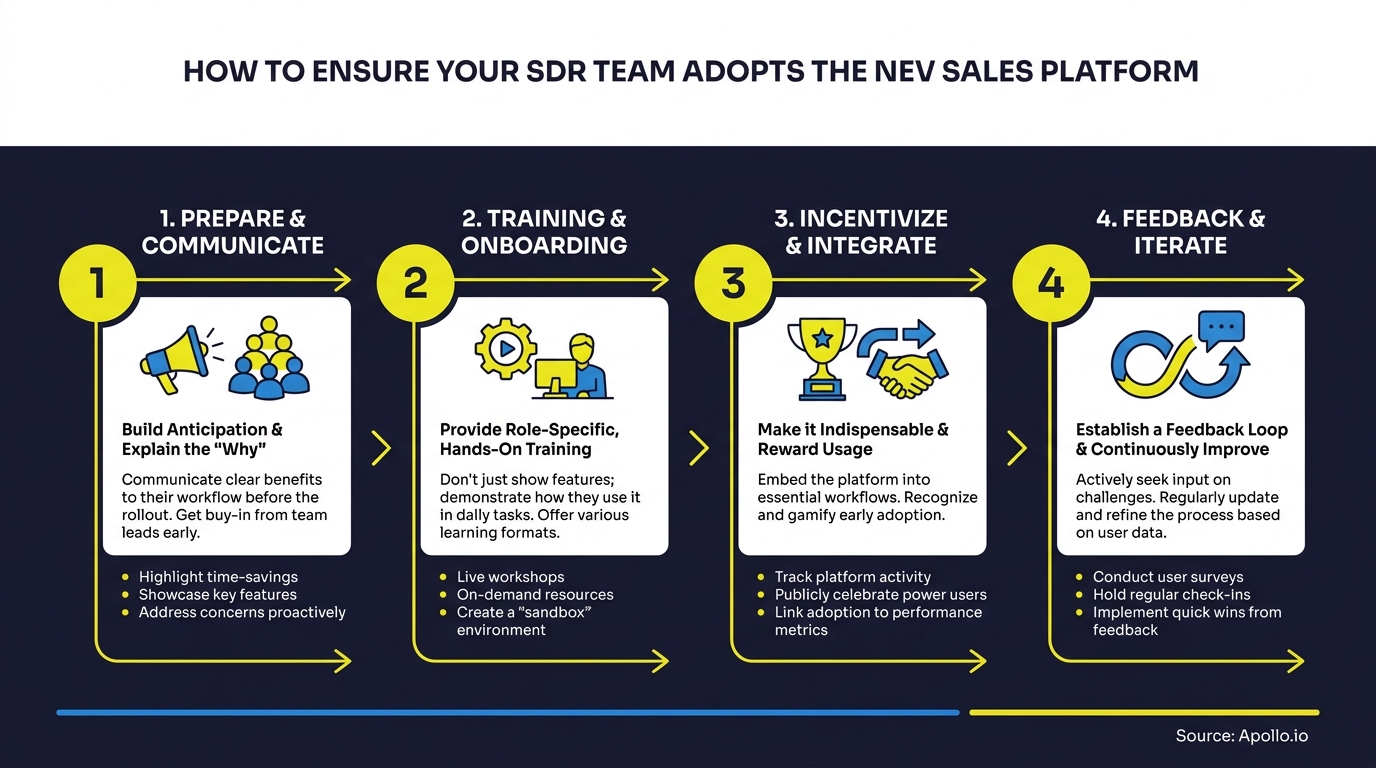
An effective SDR enablement plan focuses on removing admin work in the first two weeks, not feature training. Reps decide whether to adopt a platform based on whether it makes their day easier immediately.
Feature-depth training can come later.
Week-by-week pilot structure:
- Week 1: Enroll a pilot cohort of 3-5 top-performing SDRs. Focus only on the highest-value workflow: prospecting and first-touch sequence enrollment. Have a dedicated sales trainer or enablement lead available for live questions.
- Week 2: Review pilot KPIs in a public team forum. Let pilot SDRs share what changed in their day. Peer proof outperforms manager mandates.
- Week 3: Expand to full team. Retire the first tool from the consolidation list. Make the new platform the only path to complete the workflow.
- Week 4+: Introduce advanced features (AI research assist, intent signals, call intelligence) only after core workflows are habitual.
For SDRs, the key question is always: "Does this help me book more meetings this week?" Connect every training touchpoint to that outcome. See how leading teams structure outbound sequences that actually convert to give reps a concrete win from day one.
How Do You Sustain Long-Term SDR Platform Adoption?
Long-term adoption is sustained by making the platform the path of least resistance for every quota-relevant action. Governance should live in workflow design, not policy documents.
When the platform auto-logs calls, auto-enrolls new leads, and surfaces next steps inside the CRM, reps have no reason to go around it.
Governance mechanisms that work:
- Make platform enrollment a required step before a lead can progress in the CRM pipeline.
- Run a weekly 15-minute adoption review in team standup using the KPI dashboard from the measurement section above.
- Tie platform usage metrics to coaching conversations, not performance reviews. The goal is improvement, not punishment.
- Review the tool retirement list quarterly. Every redundant tool that stays active competes with adoption.
Teams that consolidate their stack see the strongest long-term adoption. As Cyera's team put it: "Having everything in one system was a game changer." Explore how Apollo's unified GTM platform handles prospecting, engagement, and pipeline management in one workspace, so reps have one place to work and one set of data to trust.

Start Rolling Out With Confidence
SDR platform adoption is an engineering problem, not a change management problem. Remove the competing tools, embed the platform into CRM workflows, connect usage to quota outcomes, and clean the data before AI features go live.
Reps adopt tools that make hitting their number easier. Build the rollout around that truth and adoption follows.
Want a platform your SDR team will actually use? Apollo consolidates prospecting, sequencing, dialing, and pipeline tracking into one workspace. Trusted by nearly 100K paying customers including Anthropic, Smartling, and Redis. Start Your Free Trial and give your SDRs a platform they'll open every morning.
Prove Pipeline ROI From Day One
ROI pressure killing your next budget approval? Apollo delivers measurable pipeline impact fast — with AI-powered outreach that books 46% more meetings. Nearly 100K paying customers proved the return. Yours is next.
Start Free with Apollo →Don't miss these
Sales
Inbound vs Outbound Marketing: Which Strategy Wins?
Sales
What Is a Sales Funnel? The Non-Linear Revenue Framework for 2026
Sales
What Is a Go-to-Market Strategy? The 2026 GTM Playbook
See Apollo in action
We'd love to show how Apollo can help you sell better.
By submitting this form, you will receive information, tips, and promotions from Apollo. To learn more, see our Privacy Statement.
4.7/5 based on 9,690 reviews
