
How to Audit Your Outbound Process Before Investing in New Tooling
Buying new outbound tooling before auditing your current process is one of the most expensive mistakes a GTM team can make. According to the State of RevOps 2025 report, 99% of RevOps professionals agree that revenue is lost due to process issues, with nearly three-quarters missing more than 10% of revenue from process gaps alone. New tools layered on broken processes don't fix the process. They amplify the dysfunction.
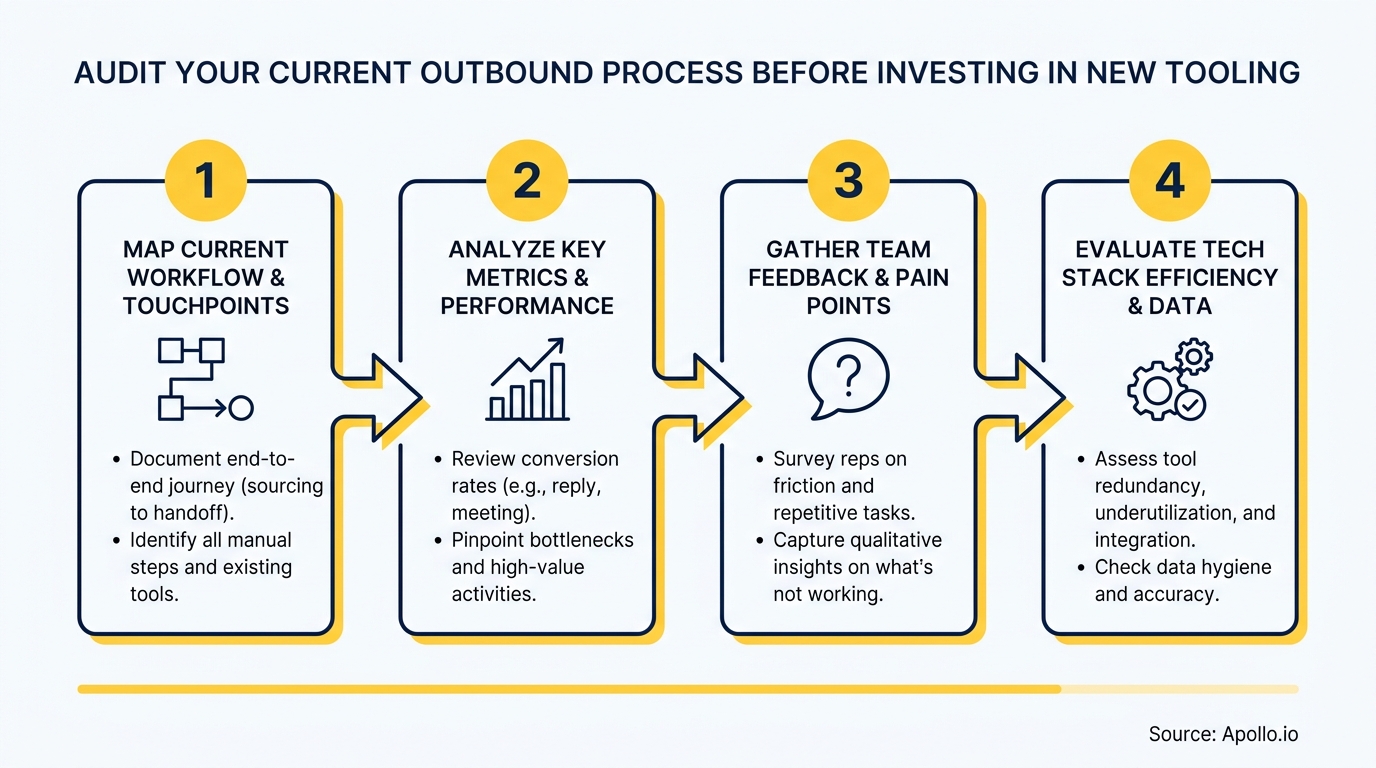
Before you sign another contract, here is a practical framework for auditing your outbound prospecting process so you invest in solutions that actually solve your real problems.

Research Less, Pipeline More With Apollo
Tired of your reps burning hours verifying contact info instead of selling? Apollo delivers 230M+ accurate business contacts so your team hits the phones faster. Start building pipeline today.
Start Free with Apollo →Key Takeaways
- Most revenue loss comes from process gaps, not missing tools. Audit first, buy second.
- Poor data quality is the top barrier to AI adoption, so clean your foundation before adding AI tooling.
- Deliverability compliance (SPF/DKIM/DMARC) is a gating requirement, not an afterthought.
- Tool consolidation often delivers better ROI than adding new point solutions to a fragmented stack.
- SDRs and RevOps leaders who map time sinks before buying new tools reclaim significant selling capacity.
Why Should You Audit Before Buying New Outbound Tools?
Auditing your outbound process before buying new tooling protects your budget and surfaces the real root cause of pipeline underperformance. Research from Martal Group shows that 68% of salespeople do not follow any structured process at all. Adding a new sequencer or dialer to an unstructured process produces inconsistent results at higher cost.
The audit answers three questions that a vendor demo cannot:
- Where exactly is pipeline breaking down?
- Which current tools are underutilized or redundant?
- What process changes would deliver ROI without any new spend?
For RevOps leaders, this is also a consolidation opportunity. Mapping your current stack often reveals overlapping capabilities you are already paying for across separate licenses.
What Does a Practical Outbound Audit Scorecard Look Like?
An outbound audit scorecard captures three baseline numbers that benchmark your current process performance before any tooling decision.
| Audit Dimension | What to Measure | Warning Signal |
|---|---|---|
| Process Adherence | % of reps following the defined outbound sequence | Below 70% adherence |
| Tool Utilization | % of licensed features actively used in past 30 days | Below 60% utilization |
| Selling Time Ratio | % of rep time spent on actual prospect outreach vs. admin | Below 35% selling time |
| Pipeline Attribution | % of meetings traceable to a specific sequence or channel | Below 50% attribution |
| Quota Attainment | % of reps hitting quota in the last two quarters | Below 50% attainment |
Data from CloudApps State of Sales 2025 shows 65% of sales reps do not fully adhere to their organization's defined sales process. If your adherence score is below that threshold, a new tool will not solve it. A coaching and enablement intervention will.
Struggling to understand where your pipeline is stalling? Get full pipeline visibility with Apollo's deal management and pipeline tracking.

How Do SDRs and RevOps Teams Map Time Sinks During an Audit?
SDRs and RevOps leaders should map every step in the outbound workflow and tag each step as selling time or non-selling time. Common non-selling time sinks include manual list building, CRM data entry, routing approvals, bounce management, and reporting exports.
Run this exercise with your SDR team over one week:
- List every task performed before sending the first touch in a sequence.
- Record the average time per task per rep per day.
- Classify each task: prospect-facing, admin, or compliance.
- Identify which tasks a tool already purchased could automate but currently does not.
The output is a time-sink map. This map tells you whether your ROI gap is a tooling gap or an adoption gap. For most teams, it is the latter. Review your outbound sequence design as part of this step to confirm your cadence structure is not creating unnecessary manual work between touches.
Turn Funnel Guesswork Into Real Pipeline
Tired of watching marketing leads stall before they ever reach your pipeline? Apollo surfaces in-market buyers the moment they're ready, so your team stops chasing cold leads and starts closing. Trusted by 600K+ companies building predictable revenue.
Start Free with Apollo →What Is the Deliverability Gate, and Why Does It Block New Tooling ROI?
The deliverability gate is a non-negotiable checklist that must pass before evaluating or deploying any new outbound email tooling. Without proper email authentication, new sequencers and AI personalization tools will fail at the inbox level regardless of message quality.
Audit these deliverability prerequisites before buying anything:
- SPF record: Verified and aligned to your sending domain
- DKIM signature: Configured for all sending domains and subdomains
- DMARC policy: Set to at least
p=quarantinewith reporting enabled - Spam complaint rate: Monitored and kept below 0.1% per Google Postmaster Tools
- One-click unsubscribe: Implemented on all bulk outbound sequences
- Bounce rate: Hard bounces below 2% before scaling send volume
Gmail and Yahoo bulk-sender requirements effective February 2024 made authentication mandatory for high-volume senders. If your domain authentication is misconfigured, no sequencer upgrade will fix your inbox placement.
Fix the foundation first.
Poor data quality compounds deliverability risk. As noted by Eubrics, 60% of sales leaders cite poor data quality as their top barrier to AI adoption. Stale contact lists drive bounces. Clean your contact data before scaling outreach volume or layering AI onto your sequences. Enrich and verify your contact list with Apollo's 230M+ person database before your next campaign launch.
How Does a Stack Consolidation Audit Unlock Outbound ROI?
A stack consolidation audit identifies overlapping tools, unused licenses, and integration friction that together create the illusion that you need more tooling when you actually need fewer, better-integrated tools. Build a simple stack map listing every tool in your outbound workflow, its monthly cost, its primary use case, and its actual weekly active users.
Look for these consolidation signals:
- Two tools performing the same function (e.g., two data providers, two dialers)
- Tools with less than 40% of licensed seats actively used
- Integrations that require manual data export between platforms
- Tools that require dedicated admin time to maintain
Teams that consolidate their outbound stack onto a unified platform consistently report cost and complexity reductions. "We reduced the complexity of three tools into one," noted Collin Stewart of Predictable Revenue. "We cut our costs in half," reported Census. "Having everything in one system was a game changer," said Cyera. Review the sales tech stack playbook to evaluate which tools in your current stack are candidates for replacement by a unified platform.
Consolidation also unblocks AI initiatives. When data lives in silos across five tools, AI features cannot access the context they need to personalize or prioritize effectively.
A leaner, integrated stack is the prerequisite for AI-enabled outbound, not an optional upgrade.
What Is the Outbound Audit Checklist for 2026?
Use this checklist to structure your audit across four dimensions before making any tooling decision.
| Audit Area | Checklist Items |
|---|---|
| Process | Documented ICP definition; defined sequence stages; rep adherence rate measured; handoff criteria from SDR to AE documented |
| Data | Contact list freshness verified; bounce rate below 2%; CRM fields standardized; lead source attribution active |
| Deliverability | SPF/DKIM/DMARC configured; complaint rate monitored; unsubscribe mechanism tested; sending domain warmed |
| Stack | All tools inventoried with cost and use case; seat utilization measured; integration map drawn; redundant tools flagged |
For sales automation to work at scale, all four audit areas must pass. Missing any one of them creates a leak that new tooling cannot seal. Document your findings for each area with a pass, partial, or fail rating. Prioritize remediation in the order listed above: process before data, data before deliverability, deliverability before stack decisions.
How Do You Turn Audit Findings Into a Tooling Decision?
Your audit findings map directly to one of three decision outcomes: fix internally, consolidate existing tools, or buy new tooling. Use this decision tree to route each finding correctly.
- Process adherence below 70%: Fix internally with coaching and documented playbooks before any tooling change.
- Tool utilization below 60%: Run enablement on existing tools before buying new ones. Low utilization means training debt, not a feature gap.
- Deliverability failing: Fix authentication and data quality before deploying any new sequencing or AI tool.
- Stack overlap identified: Consolidate onto a unified platform. Evaluate whether one platform covers multiple current tool use cases.
- Genuine capability gap confirmed: Only now evaluate new tooling, with a defined use case, success metric, and rollback plan.
Linking audit findings to the return on sales calculation helps revenue leaders quantify the expected lift from each decision. This is how you build a business case for consolidation or new investment that finance will approve.

Start Auditing, Then Start Winning
An outbound audit is not a delay. It is the fastest path to outbound that actually works.
Teams that audit first buy fewer tools, use what they buy, and see measurable pipeline improvement faster than teams that buy first and troubleshoot later.
Once your audit is complete and your process is clean, you need a platform that consolidates prospecting, sequencing, data enrichment, and pipeline management into one workspace. Apollo brings all of that together for SDRs, AEs, RevOps, and revenue leaders without the fragmentation of a five-tool stack.
Start Prospecting with Apollo for free and see how a unified GTM platform replaces the complexity your audit just uncovered.
Prove Pipeline ROI With Apollo
ROI pressure killing your next tool renewal? Apollo delivers measurable pipeline impact from day one — 46% more meetings with AI, real results leadership can't argue with. Start free today.
Start Free with Apollo →Don't miss these
Sales
Inbound vs Outbound Marketing: Which Strategy Wins?
Sales
What Is a Sales Funnel? The Non-Linear Revenue Framework for 2026
Sales
What Is a Go-to-Market Strategy? The 2026 GTM Playbook
See Apollo in action
We'd love to show how Apollo can help you sell better.
By submitting this form, you will receive information, tips, and promotions from Apollo. To learn more, see our Privacy Statement.
4.7/5 based on 9,690 reviews
