
How High-Performing Outbound Sales Teams Structure Their Daily Workflow
Most outbound sales teams run on gut feel and habit. The best ones run on a repeatable daily system. The difference shows up in quota attainment: according to BookYourData, 69% of sales reps are still falling short on quota. The teams that consistently beat it protect buyer-facing time, build AI into every block of their day, and treat their workflow as a precision instrument — not a to-do list. This article gives you the exact blueprint, anchored to real benchmarks, so your team can replicate it starting tomorrow. Pair it with the right outbound sales software and the system compounds fast.

Research Less, Close More With Apollo
Tired of burning hours verifying contact info instead of selling? Apollo delivers accurate business contacts instantly, so your team spends time closing — not chasing. Join 600K+ companies building pipeline faster.
Start Free with Apollo →Key Takeaways
- Top quota attainers spend roughly 60% of their day on buyer-facing activities — significantly more than average performers.
- Administrative work silently kills outbound productivity; automation is the only structural fix.
- AI is no longer optional — sellers who operationalize it daily are structurally more likely to meet quota.
- High-performing workflows follow a 5-block Daily Operating System: signal scan, prospecting, outreach execution, conversations, and CRM hygiene.
- Omnichannel sequencing across email, phone, and social is now a baseline expectation, not a differentiator.
Why Do Most Outbound Workflows Fail?
Most outbound workflows fail because reps spend more time on administration than on selling. Research from Everstage shows sales reps spend only 28–39% of their time on revenue-generating activities, with administrative tasks consuming as much as 41% of a rep's day. That structural imbalance is the root cause of missed quota — not lack of effort.
The fix is not working longer hours. It is redesigning the day so that buyer-facing time is protected by default, and everything else is automated, batched, or eliminated.
That is exactly what a Daily Operating System (DOS) achieves.
What Is the 60% Benchmark and Why Does It Matter?
The 60% benchmark is the share of the workday that top-performing sellers (those exceeding 130% of quota) spend on customer-facing activities, compared to roughly 44% for average performers, according to Gong's 2024 State of Sales Productivity report. That 16-percentage-point gap is not accidental — it is the direct result of how elite teams structure their days.
Closing that gap requires two things: automating non-selling tasks and building a daily schedule that defaults to outreach, calls, and conversations. Use sales productivity frameworks to audit where your team's time actually goes before redesigning the workflow.
What Does a High-Performing Outbound Daily Operating System Look Like?
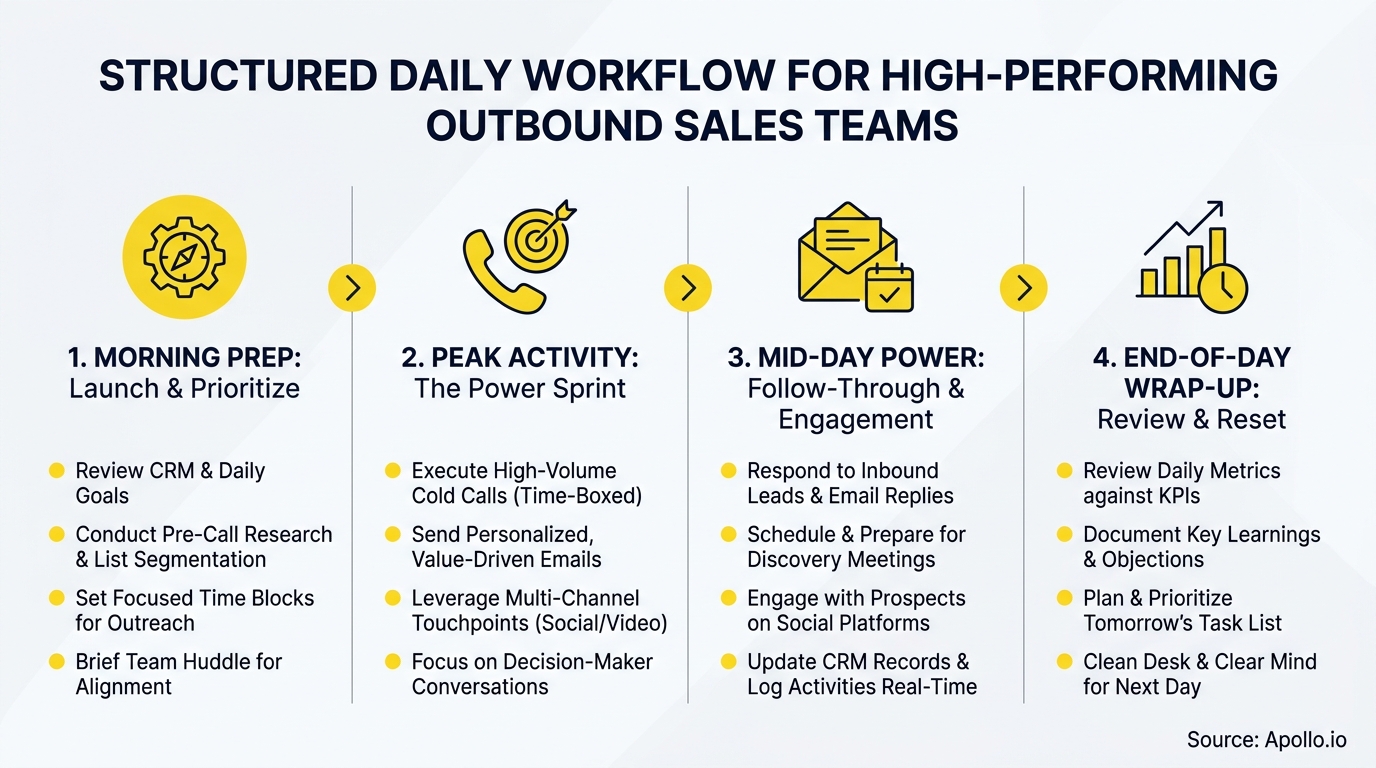
A high-performing outbound Daily Operating System divides the workday into five focused time blocks, each with a clear purpose, AI touchpoint, and channel assignment.
| Block | Time Budget | Activity | AI Touchpoint |
|---|---|---|---|
| 1. Signal Scan | 20–30 min | Review intent signals, job changes, CRM alerts, reply queue | AI prioritization queue surfaces hottest accounts |
| 2. Prospecting | 45–60 min | ICP list building, account research, contact enrichment | AI research agent generates account briefs |
| 3. Outreach Execution | 60–90 min | Send personalized emails, launch sequences, social touches | AI-powered messaging for first drafts and subject lines |
| 4. Conversations | 90–120 min | Cold calls, discovery calls, follow-up calls | AI call assistant captures notes and next steps |
| 5. CRM Hygiene + Review | 20–30 min | Log activities, update pipeline, prep tomorrow's queue | Automated sync reduces manual entry |
Block 4 is the most protected. Calls and live conversations are where deals move — no automation replaces them. SDRs and BDRs should treat the conversations block as non-negotiable. Everything else in the day exists to make those conversations better and more frequent. Struggling to find qualified contacts to fill your prospecting block? Search Apollo's 230M+ contacts with 65+ filters and build your list in minutes.

How Do SDRs and BDRs Integrate AI Into Their Daily Routine?
SDRs and BDRs integrate AI into their daily routine by embedding it into specific workflow blocks rather than using it ad hoc. Research from Gartner found that sellers who effectively partner with AI are 3.7 times more likely to meet quota — but only when AI use is systematic, not occasional.
Practical AI touchpoints for SDRs and BDRs:
- Signal Scan (Block 1): AI surfaces the top 10–15 accounts to contact today based on engagement, intent, and timing signals.
- Prospecting (Block 2): AI research agents generate one-paragraph account briefs so reps walk into calls prepared without spending 20 minutes on manual research.
- Outreach (Block 3): AI drafts personalized email openers and subject lines based on account context. Reps edit and approve — they do not start from blank.
- Follow-up (Post-call): AI call assistants auto-generate call summaries, next steps, and CRM updates immediately after every conversation.
This is the shift from task-list days to queue-based days: reps open their workflow tool and the AI tells them exactly what to do next. Explore which AI sales tools actually close more deals to find the right stack for your team.
Turn Funnel Guesswork Into Closed Deals
Quota stress mounting while marketing leads stall before they ever reach your pipeline? Apollo surfaces high-intent buyers and moves them forward — fast. Join 600K+ companies forecasting with confidence.
Start Free with Apollo →How Does Omnichannel Sequencing Fit Into a Daily Outbound Workflow?
Omnichannel sequencing fits into the daily workflow by mapping specific channel touches to specific days in a sequence, so reps rotate across email, phone, and social without improvising. McKinsey's 2024 B2B Pulse survey found B2B buyers use an average of 10 interaction channels in their buying journey — up from 5 in 2016 — making single-channel outreach structurally insufficient.
A practical 10-day sequence structure for outbound teams:
- Day 1: Personalized email (AI-drafted opener)
- Day 2: Cold call attempt + voicemail
- Day 3: Social touch (professional network connection or comment)
- Day 5: Follow-up email referencing voicemail
- Day 7: Call attempt #2
- Day 9: Final email with clear CTA or break-up
The goal is not volume — it is relevant, coordinated contact across channels. Gartner reports 73% of B2B buyers actively avoid suppliers that send irrelevant outreach. Every touch in the sequence must earn its place with personalization and timing precision. See how to build winning outbound sequences for cadence length and timing benchmarks.
What Role Does Data Hygiene Play in a High-Performing Outbound Workflow?
Data hygiene is a prerequisite for workflow performance, not an afterthought. Automation, AI prioritization, and omnichannel sequencing all break down when the underlying contact data is stale or inaccurate.
The Salesforce State of Sales report found 51% of sales leaders say tech silos delay or limit their AI initiatives — and dirty data is the most common silo.
RevOps leaders should build a weekly data hygiene checklist into the team's workflow:
- Verify bounce rates from last week's sequences and flag bad domains
- Enrich new contacts before they enter any sequence
- Review CRM duplicate and missing-field reports
- Check email authentication (SPF, DKIM, DMARC) and sending reputation
- Audit sequence enrollment counts vs. active contacts
According to Salesgenie, automation has helped top-performing B2B sales organizations free up about 20% of sellers' capacity and improve productivity by up to 30%. That only holds when the data feeding those automations is clean. Pair clean data with a strong sales tech stack to make every workflow block more efficient.
How Do You Measure Whether Your Outbound Daily Workflow Is Working?
You measure outbound workflow performance with five core KPIs that map directly to each block of the Daily Operating System.
| KPI | What It Measures | Target Benchmark |
|---|---|---|
| Buyer-facing time % | Share of day in conversations and outreach | 50–60% of working hours |
| Contact rate | Live connects per dials attempted | Varies by industry; track week-over-week trend |
| Meeting booked rate | Meetings set per sequence enrolled | Track against team baseline; improve monthly |
| Pipeline velocity | Speed deals move from first touch to qualified | Reduce days in each stage quarter-over-quarter |
| Data hygiene score | % of contacts with complete, verified fields | 90%+ completeness before sequence enrollment |
Review these KPIs weekly in a 15-minute team standup. Flag any block where time allocation is drifting — especially if administrative work is creeping back above 20% of the day. Use sales analytics to make these reviews data-driven rather than anecdotal. Spending too much time managing sequences manually? Automate your multi-channel outreach with Apollo's sales engagement platform and reclaim hours for actual selling.

How Do You Start Building This Workflow for Your Team?
Building a high-performing outbound daily workflow starts with an honest time audit, then a structured rollout of the five-block DOS over 30–60 days.
Week 1–2: Audit current time allocation. Track how each rep spends their day across five categories: research, outreach, conversations, admin, and other. Most teams are surprised by how little time lands in the conversations bucket.
Week 3–4: Implement the DOS. Set calendar blocks for each of the five segments. Start with conservative time budgets and adjust based on what each rep's pipeline actually requires.
Week 5–8: Layer in AI and automation. Introduce AI research briefs for Block 2, AI-assisted messaging for Block 3, and automated CRM logging for Block 5. Sales automation works best when it is introduced after the workflow structure is already established — not before.
Teams that follow this ramp typically see buyer-facing time increase meaningfully within 60 days, with measurable improvements in meeting rates and pipeline velocity following shortly after. As Cyera's team put it: "Having everything in one system was a game changer." That consolidation effect is what makes the DOS sustainable — not just a two-week experiment.
Ready to build your outbound engine on a unified platform? Get Leads Now and see why nearly 100K paying customers trust Apollo to run their daily outbound workflow from one workspace.
Prove Pipeline ROI With Apollo
ROI pressure killing your next tool renewal? Apollo delivers measurable pipeline impact from day one — so budget conversations become easy. Join 600K+ companies with results leadership actually approves.
Start Free with Apollo →Don't miss these
Sales
Inbound vs Outbound Marketing: Which Strategy Wins?
Sales
What Is a Sales Funnel? The Non-Linear Revenue Framework for 2026
Sales
What Is a Go-to-Market Strategy? The 2026 GTM Playbook
See Apollo in action
We'd love to show how Apollo can help you sell better.
By submitting this form, you will receive information, tips, and promotions from Apollo. To learn more, see our Privacy Statement.
4.7/5 based on 9,690 reviews
