
How Enterprise Revenue Teams Select and Standardize on a Sales Engagement Platform
Enterprise revenue teams in 2026 face a clear mandate: consolidate fragmented sales tools into a single, governed engagement platform or risk falling behind. According to Trykondo, 66% of sales representatives feel overwhelmed by the number of tools they use. Meanwhile, Global Growth Insights reports the sales engagement platform market is projected to reach USD 9.98 billion in 2026, reflecting how urgently teams are investing in standardization.
The selection process is no longer just a RevOps exercise. After a 2025 OAuth supply-chain incident reshaped enterprise security requirements for sales engagement vendors, procurement now includes Security, IT, and Data Governance alongside revenue leadership. For enterprise sales solutions, the buying committee has expanded and the stakes are higher.

Apollo Turns Research Hours Into Revenue
Tired of your reps burning hours verifying contacts instead of closing deals? Apollo delivers 230M+ accurate business contacts so your team sells from minute one. Join 600K+ companies building pipeline faster.
Start Free with Apollo →Key Takeaways
- Enterprise SEP selection is now driven by cost, integration depth, security posture, and AI-workflow outcomes, not feature counts alone.
- RevOps leaders who standardize on a single platform eliminate definitional mismatches between sales and marketing, reducing pipeline leakage.
- A scored evaluation rubric with weighted criteria prevents subjective vendor decisions and creates an auditable procurement record.
- Governance-first rollout, including standardized lifecycle definitions and disposition codes, is the difference between adoption and shelfware.
- Tool consolidation delivers measurable ROI: teams that unify prospecting, engagement, and analytics in one platform reduce tech stack complexity and speed up sales cycles.
Why Do Enterprise Revenue Teams Standardize on a Single Sales Engagement Platform?
Enterprise revenue teams standardize on a single sales engagement platform to eliminate data silos, enforce consistent messaging governance, and reduce vendor risk. As noted by Sera Leads, disconnected systems across marketing, sales, and CRM platforms create a fragmented view of potential customers. That fragmentation directly undermines pipeline quality.
Three macro forces are accelerating standardization in 2026:
- Security mandates: Following the 2025 Salesloft/Drift OAuth supply-chain incident, enterprises now require OAuth governance, vendor security reviews, and audit trails as hard procurement criteria.
- Buyer behavior: A 2024 Gartner survey found 73% of B2B buyers actively avoid suppliers who send irrelevant outreach, pushing enterprises to enforce messaging rules across every rep inside one system.
- Vendor consolidation targets: Capgemini research found 75% of organizations pursued vendor consolidation in 2022, up from 29% in 2020. Revenue leaders now apply this mandate directly to their GTM stack.
For Revenue Operations teams, a single platform means one data model, one set of routing rules, and one source of performance truth, all of which reduce the cross-functional friction that erodes pipeline velocity.
What Is the Enterprise SEP Evaluation Rubric?
The enterprise SEP evaluation rubric is a scored framework that assigns weighted criteria to vendor capabilities, enabling objective platform comparison across stakeholder groups. Without a rubric, selection defaults to stakeholder preference rather than business-fit evidence.
Use this scoring table as a starting framework. Weight each criterion based on your organization's priorities:
| Criterion | Suggested Weight | What to Evaluate |
|---|---|---|
| CRM Integration Depth | 20% | Bidirectional sync, field mapping, object support |
| Security and Compliance Controls | 20% | OAuth governance, SSO, data residency, audit logs |
| AI Workflow Outcomes | 15% | Measurable meeting and booking lift, not feature counts |
| Data Enrichment and Accuracy | 15% | Contact coverage, email accuracy, enrichment freshness |
| Total Cost of Ownership | 15% | Seat cost, add-on fees, integration overhead |
| Multi-Channel Execution | 10% | Email, phone, social, and task coverage in one workflow |
| Adoption and UX | 5% | Rep onboarding time, daily workflow fit |
Compare finalists side-by-side using this rubric in your RFP. See how top platforms stack up in our Apollo vs. Outreach vs. Salesloft comparison.
Struggling to manage outreach consistency across a fragmented stack? Explore Apollo's multi-channel sales engagement platform and run sequences from a single governed workspace.

How Do RevOps Leaders Build a Governance Playbook for SEP Standardization?
RevOps leaders build a SEP governance playbook by standardizing lifecycle definitions, disposition codes, and stage-exit criteria inside the chosen platform before rollout begins. A 2024 Gartner survey found 49% of CSOs say sales' definition of a qualified lead differs greatly from marketing's definition.
Without governed definitions enforced inside the platform, that mismatch persists regardless of which tool you choose.
A practical governance playbook covers four layers:
- Lifecycle definitions: MQL, SAL, SQL, and opportunity thresholds documented and mapped to CRM stage fields inside the SEP.
- Disposition codes: Standardized outcome labels (e.g., "Connected - Not Interested," "No Answer - Attempt 2") required for every call and email task.
- Routing rules: Territory, account tier, and inbound intent logic enforced via workflow automation, not manual rep judgment.
- RACI ownership: RevOps owns sequence templates and field governance; Sales Managers own rep-level coaching; IT owns OAuth and integration security.
For SDRs and BDRs, standardized disposition codes mean every touch is logged consistently, enabling managers to coach from clean data rather than guessing at rep behavior. Learn how to build a sales tech stack that scales with governance built in from day one.
Turn Funnel Chaos Into Forecast Confidence
Pipeline forecasting a guessing game because leads stall before they ever reach your AEs? Apollo surfaces high-intent prospects so your pipeline reflects reality, not wishful thinking. Nearly 100K paying customers trust it to keep revenue on track.
Schedule a Demo →How Do Enterprise Teams Govern Outreach Relevance at Scale?
Enterprise teams govern outreach relevance by centralizing messaging templates, data enrichment standards, and channel rules inside the SEP, making compliant outreach the default rather than the exception.
This matters because fragmented stacks let individual reps override messaging standards, exposing the brand to buyer backlash.
Key relevance governance controls include:
- Approved sequence libraries: Centrally managed templates with required personalization tokens; reps choose from approved sequences rather than creating ad hoc emails.
- Enrichment quality gates: Contacts below a defined data completeness threshold are excluded from active sequences automatically.
- Channel frequency caps: Maximum touches per contact per week enforced at the platform level across email, phone, and social channels.
- AI message review: AI-generated drafts reviewed against approved messaging guidelines before send.
For Account Executives managing named accounts, relevance governance also protects relationship capital. One off-brand email to a strategic account can stall a deal.
Platform-enforced rules remove that risk.
What Is the Enterprise SEP Migration Blueprint?
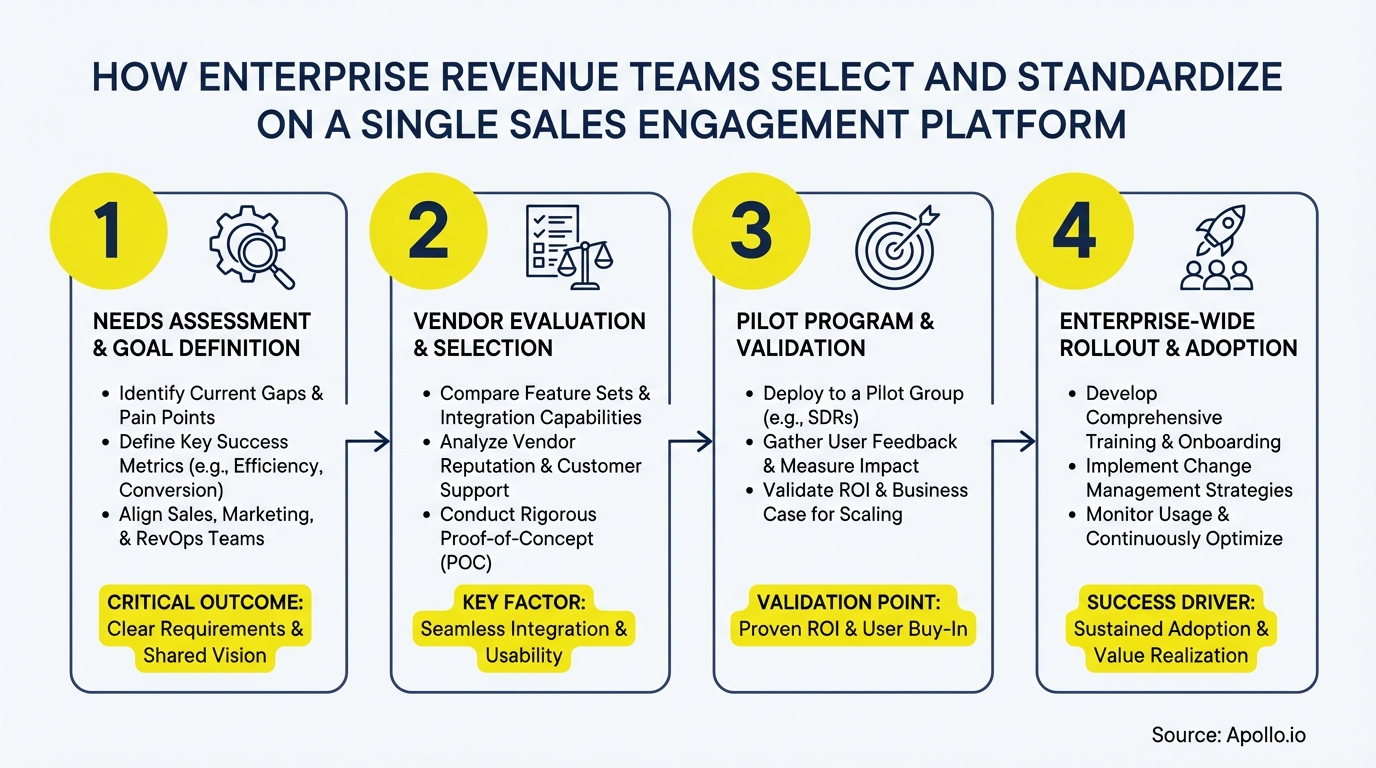
The enterprise SEP migration blueprint is a phased rollout plan that sequences data migration, governance setup, pilot testing, and full deployment to minimize disruption and accelerate adoption. MarketsandMarkets notes that many organizations fail to achieve adoption of sophisticated intelligence platforms because insights are not integrated into daily workflows. Phased rollout directly addresses this failure mode.
A four-phase blueprint:
- Phase 1 (Weeks 1-4): Foundation. CRM field mapping, SSO and OAuth setup, governance document finalized, RACI signed off.
- Phase 2 (Weeks 5-8): Pilot. One SDR/BDR pod runs live sequences. Collect disposition data, sequence performance, and rep NPS. Identify friction points.
- Phase 3 (Weeks 9-14): Controlled rollout. Expand to all SDRs and AEs by region or segment. Decommission legacy point tools on a documented schedule.
- Phase 4 (Weeks 15+): Optimize. RevOps reviews sequence performance monthly. AI insights surfaced to managers in weekly pipeline reviews.
Adoption metrics to track: daily active users, sequence launch rate, disposition code compliance, and CRM sync error rate. If compliance drops below a threshold in Phase 2, pause Phase 3 and resolve root causes before expanding.
For teams building multi-touch sequences, see top sales sequence examples to accelerate your pilot library.
How Do RevOps Leaders Build the ROI Case for SEP Consolidation?
RevOps leaders build the ROI case for SEP consolidation by quantifying three categories of value: direct cost reduction from vendor elimination, productivity gains from unified workflows, and pipeline quality improvement from clean, governed data. Research from MarketingOps found that nearly half (47%) of RevOps professionals rated their stack's ROI as average or worse in 2025, making the consolidation case straightforward to frame.
A practical TCO comparison structure:
| Cost Category | Fragmented Stack (4 tools) | Unified Platform |
|---|---|---|
| Annual licensing | 4 separate contracts | 1 contract |
| Integration maintenance | High (custom connectors) | Low (native CRM sync) |
| Admin overhead | 4 admin seats across tools | 1 admin function |
| Onboarding time per rep | Multiple tool certifications | Single platform ramp |
Teams that consolidate also capture a governance dividend: cleaner data reduces bad-fit outreach, improving reply rates and protecting sender reputation. "We cut our costs in half," reported Census after consolidating onto Apollo. "Having everything in one system was a game changer," noted Cyera.
Managing too many tools across your revenue team? See how Apollo's unified GTM platform consolidates your stack and builds the pipeline visibility your revenue leaders need.
How Does Apollo Help Enterprise Revenue Teams Standardize?
Apollo serves as a unified GTM platform that combines sales intelligence, multi-channel engagement, AI automation, and deal management in one workspace, eliminating the need to stitch together separate tools for prospecting, sequencing, dialing, and analytics. Trusted by nearly 100K paying customers including Anthropic, Cyera, and Autodesk, Apollo gives enterprise teams a single platform to govern outreach from first touch to closed deal.
Key capabilities for enterprise standardization:
- 230M+ verified contacts with 97% email accuracy, reducing enrichment tool sprawl.
- Multi-channel sequences across email, phone, and social, governed by centrally managed templates.
- AI Research Agent that delivers 46% more meetings by surfacing account context directly in rep workflows.
- Native CRM integrations with bidirectional sync, keeping RevOps data models intact without custom connectors.
- Workflow automation engine that enforces routing rules, enrichment thresholds, and sequence triggers without manual intervention.
"We reduced the complexity of three tools into one," said Collin Stewart of Predictable Revenue. For enterprise teams evaluating platform options, see the full Apollo vs. Outreach vs. Salesloft breakdown for a side-by-side capability and pricing comparison.

How Do Enterprise Revenue Teams Get Started with SEP Standardization?
Enterprise revenue teams get started by completing the scored evaluation rubric, aligning the buying committee (RevOps, Sales, Security, Procurement), and piloting with one team before full rollout. The governance playbook and migration blueprint should be drafted in parallel with vendor evaluation, not after selection.
Three actions to take this week:
- Run the weighted rubric in this article against your current shortlist and identify your top two finalists.
- Map your current lifecycle definitions and disposition codes. Identify which are missing or inconsistent across systems.
- Start a pilot with Apollo's multichannel sales engagement platform to test sequence governance, CRM sync fidelity, and rep adoption before committing to full deployment.
Platform standardization is an operating model decision as much as a tooling choice. Teams that treat it as such, with governance baked in from day one, are the ones that close the gap between pipeline generation and revenue realization. Try Apollo Free and see how a unified GTM platform accelerates the path from evaluation to standardized, scalable revenue execution.
Prove Pipeline ROI From Day One
ROI pressure killing your tool budget before it even starts? Apollo delivers measurable pipeline impact fast — 600K+ companies trust it to show results leadership actually approves. Start free today.
Start Free with Apollo →Don't miss these
Sales
Inbound vs Outbound Marketing: Which Strategy Wins?
Sales
What Is a Sales Funnel? The Non-Linear Revenue Framework for 2026
Sales
What Is a Go-to-Market Strategy? The 2026 GTM Playbook
See Apollo in action
We'd love to show how Apollo can help you sell better.
By submitting this form, you will receive information, tips, and promotions from Apollo. To learn more, see our Privacy Statement.
4.7/5 based on 9,690 reviews
