
How Do CRM Workflows Respond to Actions Taken in the Sales Platform? (2026)
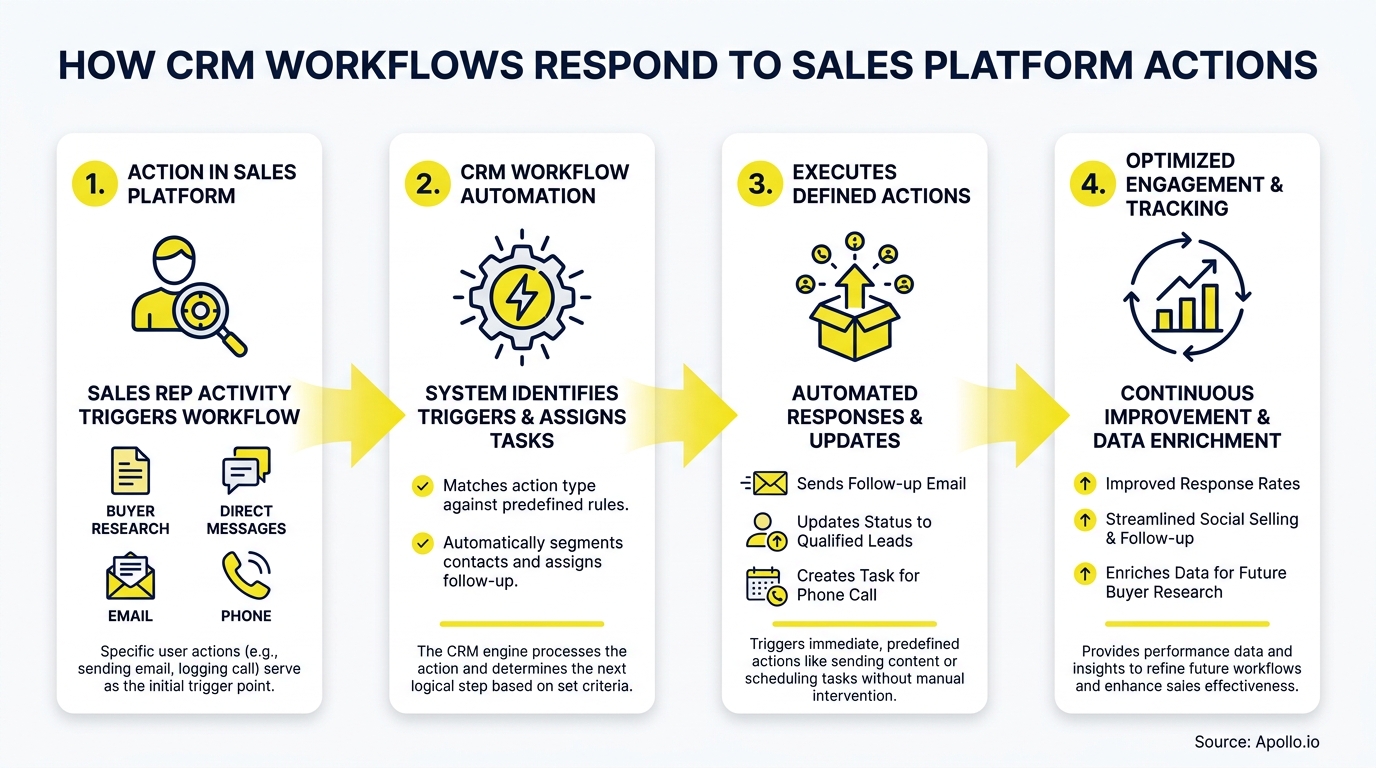
Your CRM should respond before your rep remembers to. Every time a rep logs a call, changes a deal stage, books a meeting, or sends a quote, the sales platform generates a signal. Well-designed CRM workflow triggerscatch those signals and fire the right response automatically: routing the lead, updating fields, creating tasks, notifying stakeholders, and surfacing next-best actions.
In 2026, that process is accelerating. ServiceNow's Autonomous CRM launch in May 2026 and Salesforce's Agentforce updates both frame CRM as a system of action, not just a system of record. The question for RevOps and sales leaders is no longer whether to automate, but which actions trigger which responses and how much AI should handle autonomously.

Scale Smarter With Apollo's AI Engine
Tired of your reps burning hours on manual research instead of closing deals? Apollo surfaces verified contacts and automates outreach so your team scales without the chaos. Join 600K+ companies building predictable pipeline.
Start Free with Apollo →Key Takeaways
- Every rep action in the sales platform (call logged, stage changed, quote sent, meeting booked) should map to a specific, automatic CRM response.
- Modern workflows combine deterministic rules with AI-assisted recommendations and, increasingly, agentic execution with human-in-the-loop approval gates.
- Data quality is the limiting factor: AI-triggered workflows amplify whatever data they receive, making enrichment and governance prerequisites, not afterthoughts.
- RevOps teams that unify prospecting, engagement, and CRM in one platform eliminate the integration gaps where workflow triggers most often fail.
- Measuring workflow health requires tracking trigger coverage, failure rate, field-fill accuracy, and downstream conversion, not just automation volume.
What Are CRM Workflow Triggers and Where Do They Come From?
CRM workflow triggers are events in the sales platform that automatically initiate one or more downstream actions in the CRM. They originate from two source categories: rep-generated actions and buyer-generated signals.
| Trigger Type | Example Event | Where It Originates |
|---|---|---|
| Deal stage change | Opportunity moved to "Proposal Sent" | Sales platform / CRM pipeline |
| Call disposition | Rep logs "Connected – Interested" | Dialer / call assistant |
| Meeting booked | Demo scheduled via calendar link | Meeting scheduler |
| Email reply received | Prospect responds to sequence step 2 | Sales engagement platform |
| Quote created or viewed | Buyer opens pricing proposal | CPQ / document tracking |
| No-response timeout | No activity for 7 days on open deal | CRM rule / time-based trigger |
| Buyer intent signal | Target account visits pricing page | Intent data / web analytics |
| Product usage event | Trial user hits feature limit | Product analytics integration |
According to SalesHive, 70-75% of organizations use a CRM, yet most still rely on manual data entry for many of these events. That gap is exactly where workflow automation creates the most immediate value. For deeper context on how sales automation reduces manual work, the principles apply directly to trigger design.
What Is the CRM Response Matrix for Sales Platform Actions?
Each trigger should map to a defined set of CRM responses covering field updates, task creation, notifications, routing, and next-best-action recommendations. The table below shows the core response matrix.
| Sales Action | CRM Field Updates | Tasks Created | Notifications Sent | Next-Best Action |
|---|---|---|---|---|
| Deal stage: Proposal Sent | Stage, close date, next step | Follow-up in 48 hrs | AE + manager | Send case study sequence |
| Call disposition: Connected | Last contacted, lead status | Log outcome, schedule next call | SDR manager if no-show | Enroll in nurture sequence |
| Meeting booked | Meeting date, stage update | Pre-meeting research task | AE, SE, CSM as needed | Trigger pre-meeting brief |
| Quote viewed by buyer | Quote engagement timestamp | Immediate follow-up task | AE real-time alert | Draft personalized follow-up |
| No response (7 days) | Risk flag, next step cleared | Re-engagement task | Manager deal-risk alert | Switch sequence or reassign |
| Intent signal: pricing page | Intent score, account activity | Outreach task for assigned rep | AE or SDR owning account | Prioritize in prospecting queue |
For RevOps leaders, keeping this matrix consistent requires clean data sync between your sales platform and CRM. Without reliable two-way sync, field updates fail silently and workflows route on stale data.
Struggling to keep your pipeline moving automatically? Get complete pipeline visibility with Apollo's deal management, where deal stage changes trigger the right next steps without manual intervention.
How Do AI Agents Change CRM Workflow Responses in 2026?
AI agents change CRM workflow responses by moving from static if/then rules to contextual reasoning: detecting a sales action, pulling CRM history, conversation data, and account context, then recommending or executing the next step. The practical design question is which tier of automation each action warrants.
| Automation Tier | How It Works | Best For | Human Required? |
|---|---|---|---|
| Deterministic rule | If X then Y, no reasoning | Field updates, task creation, routing | No |
| AI recommendation | Agent drafts or suggests, rep approves | Follow-up messages, next-step coaching | Yes (review) |
| AI agent (agentic) | Agent reasons and executes end-to-end | Prospecting, enrichment, scheduling | Optional (approval gate) |
Salesforce's Agentforce introduced "Review Before Send" workflows so sellers can approve AI-drafted engagement before it reaches the buyer. This human-in-the-loop pattern is now a design standard, especially for outbound messaging, pricing approvals, and deal-risk actions.
For SDRs and AEs, the practical benefit is speed without loss of control. An AI agent can enrich a new inbound lead, score it, draft an initial outreach message, and create a follow-up task, all from a single form-fill trigger, while the rep reviews before sending. Apollo's AI-native sales platform applies this same pattern across prospecting, engagement, and pipeline management in one workspace.

How Do RevOps Teams Keep CRM Workflow Data Reliable?
RevOps teams keep CRM workflow data reliable by treating data quality as a prerequisite for automation, not an afterthought. AI-triggered workflows amplify whatever data they receive: bad inputs produce bad routing, bad scoring, and bad outreach at scale.
Research from Overton Collective found automated CRM enrichment can reduce data decay by up to 65% and save an average of 8 hours per representative per week. That makes continuous enrichment one of the highest-ROI investments in workflow reliability.
CRM workflow data quality checklist:
- Contact completeness: Name, title, email, phone, and company filled for every active record
- Duplicate suppression: Merge rules running before any workflow fires
- Stage definitions: Entry/exit criteria documented and enforced at the field level
- Activity logging: Calls, emails, and meetings auto-logged from engagement tools
- Enrichment cadence: Automated re-enrichment triggered on record age or field gap
- Ownership assignment: Every record has a clear owner before routing workflows run
Tired of stale contact data breaking your automations? Apollo's automated data enrichment keeps your CRM records accurate and workflow-ready across 230M+ verified business contacts.
For teams using HubSpot or Salesforce, connecting Apollo to your CRM adds continuous enrichment and intent signals directly into the records your workflows depend on.
Turn Funnel Guesswork Into Pipeline Wins
Pipeline forecasting a guessing game because leads stall before they ever become opportunities? Apollo surfaces verified contacts and buyer signals so your team hits the right prospects at right moment. Join 600K+ companies building predictable pipeline.
Start Free with Apollo →How Do SDRs and AEs Benefit From Automated CRM Workflow Responses?
SDRs benefit most from trigger-based routing and enrichment workflows, while AEs gain the most from deal-stage triggers that surface next-best actions and flag at-risk opportunities. Both roles recover selling time that would otherwise go to manual CRM updates.
Data from Cirrus Insight shows the global sales automation market more than doubled from $7.8 billion in 2019 to $16 billion in 2025, reflecting how broadly teams have moved to automate rep workflows. The payoff is measurable: DemandLocal reports 94% of businesses observed improved sales productivity after implementing a CRM.
SDR workflow wins:
- New inbound lead triggers automatic enrichment, ICP scoring, and sequence enrollment
- Call disposition logs a specific outcome and creates the correct follow-up task type
- Intent signal on a target account creates a prioritized outreach task for the assigned SDR
- Job change alerts trigger re-engagement workflows when a champion moves to a new company
AE workflow wins:
- Quote viewed triggers an immediate real-time notification and a drafted follow-up for review
- Meeting booked fires a pre-meeting research brief and stakeholder notification
- No activity for a defined period raises a deal-risk flag visible to the AE and manager
- Stage change to Closed Won triggers onboarding handoff and CSM assignment automatically
For sales leaders wanting to see how this consolidation plays out in practice, the Predictable Revenue case studyshows how unifying tools reduces workflow complexity: "We reduced the complexity of three tools into one."
How Do You Measure CRM Workflow Performance?
CRM workflow performance is measured by tracking trigger coverage, failure rates, field-fill accuracy, and downstream conversion outcomes, not just the number of automations running.
| KPI | What It Measures | Target Benchmark |
|---|---|---|
| Trigger coverage rate | % of qualifying events that fire a workflow | >90% |
| Workflow failure rate | % of triggers that error or skip | <5% |
| Field-fill accuracy | % of required fields populated post-trigger | >95% |
| Task completion rate | % of auto-created tasks completed on time | >80% |
| Response-to-meeting rate | Trigger-to-meeting conversion by workflow type | Benchmark by segment |
| Data decay rate | % of enriched fields that go stale monthly | <10% monthly |
Teams building toward AI-aware workflows should also track AI draft acceptance rate (how often reps send AI-recommended messages without major edits) and approval gate latency (time between AI draft and rep send). These two metrics reveal whether your AI recommendations are useful or creating friction. For broader context on turning data into revenue decisions, see how sales analytics drives revenue growth.

How Does Apollo Unify CRM Workflow Triggers in One Platform?
Apollo unifies CRM workflow triggers by combining prospecting, sales engagement, AI automation, and CRM integration in a single workspace, eliminating the integration gaps where triggers most often fail. When every action from first contact to closed deal happens in one system, the workflow logic is simpler, the data is cleaner, and the responses are faster.
Trusted by nearly 100K paying customers including Anthropic, Smartling, and Redis, Apollo's native CRM integrations with Salesforce and HubSpot ensure that every sequence step, call, meeting, and enrichment event syncs back to the CRM record that drives your workflows. RevOps teams get a single source of truth. SDRs and AEs get automatic next steps without manual logging. Sales leaders get pipeline visibility without chasing reps for updates.
As one customer put it: "Having everything in one system was a game changer" (Cyera). For teams currently running separate tools for prospecting, engagement, and CRM updates, consolidating your sales tech stack is the fastest path to reliable workflow automation.
Start Prospecting free with Apollo and see how unified trigger-action workflows move deals forward without manual intervention.
Prove Pipeline ROI With Apollo
ROI pressure killing your tool budget approvals? Apollo delivers measurable pipeline impact your leadership can actually see. Leadium 3x'd annual revenue — get results that justify every dollar.
Start Free with Apollo →Don't miss these
Sales
Inbound vs Outbound Marketing: Which Strategy Wins?
Sales
What Is a Sales Funnel? The Non-Linear Revenue Framework for 2026
Sales
What Is a Go-to-Market Strategy? The 2026 GTM Playbook
See Apollo in action
We'd love to show how Apollo can help you sell better.
By submitting this form, you will receive information, tips, and promotions from Apollo. To learn more, see our Privacy Statement.
4.7/5 based on 9,690 reviews
