
How Can I Find Prospects Who Use My Competitors' Products or Services in 2026?
Competitor-user prospecting is one of the highest-ROI activities in B2B sales. These buyers already understand the problem, have budget allocated, and are often quietly evaluating alternatives. The challenge is identifying them before they raise their hand. According to Avista PR, on average 65% of sales opportunities for B2B software companies are competitive, which means most of your pipeline already involves someone using a rival product.
The good news: competitor-user signals are everywhere. Tech stack data, review sites, job postings, social activity, and intent data all reveal who is currently locked into a competing solution and who may be ready to switch. This guide gives you a practical framework to find them, prioritize them, and reach them the right way.

Your Reps Research. Rivals Close.
Tired of watching hours vanish on manual lead research instead of actual selling? Apollo surfaces verified contacts instantly so your team spends time closing, not digging. Join 600K+ companies turning research time into revenue.
Start Free with Apollo →Key Takeaways
- 65% of B2B software sales opportunities are competitive, making competitor-user prospecting central to pipeline growth.
- Tech stack intelligence tools, review sites, and intent signals are the most reliable ways to identify which companies use a competitor.
- Personalized outreach anchored in competitor context dramatically outperforms generic messaging.
- SDRs and AEs who combine third-party data with first-party signals build higher-quality prospect lists faster.
- Winning competitor-user deals requires positioning around switching ease and clear ROI, not just feature comparison.
What Are the Best Sources for Finding Competitor Users?
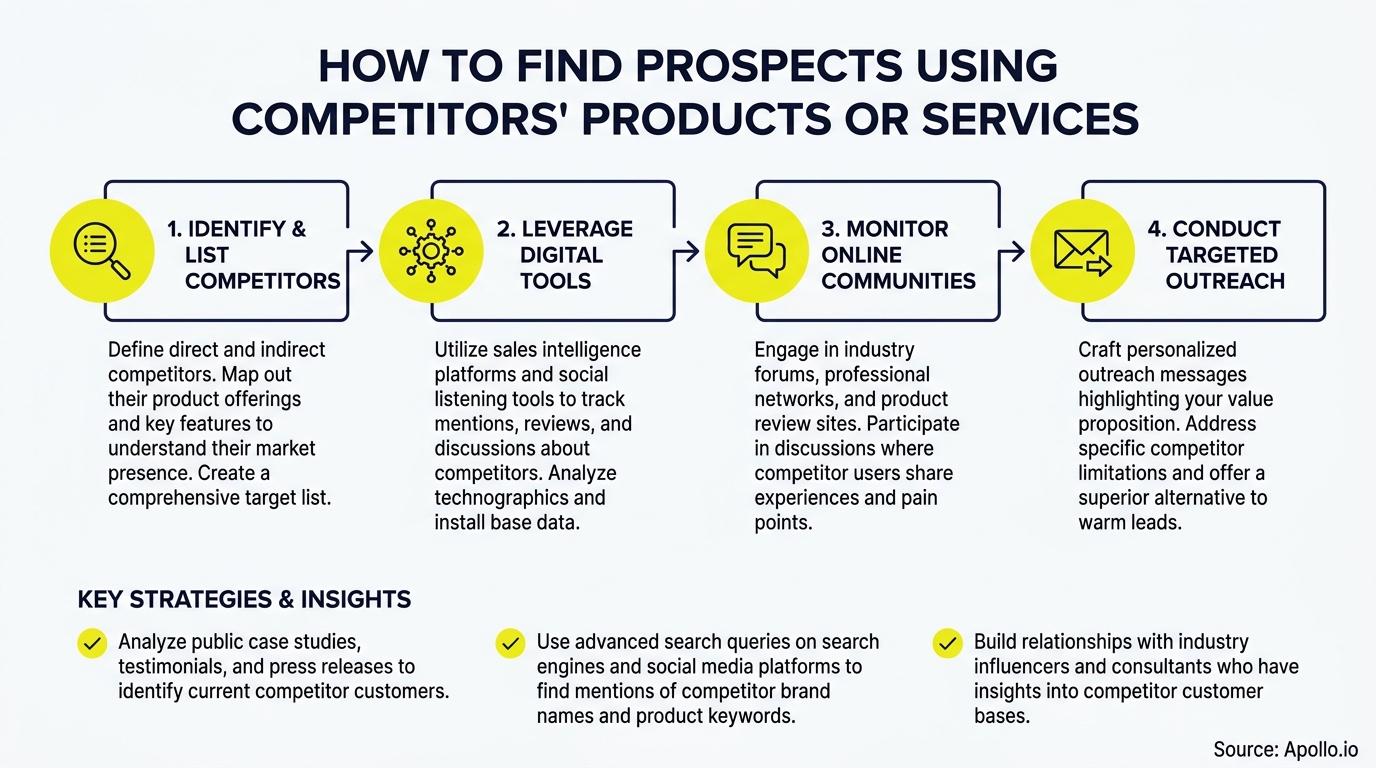
The most reliable sources for identifying competitor users are tech stack databases, review platforms, and intent signals. Each reveals a different layer of the prospect's buying context.
- Tech stack intelligence: Tools like BuiltWith identify which software a business currently runs. A sales professional shared on Redditthat BuiltWith lets you build lists based on competitor usage, though they noted an honest caveat: the data can sometimes reflect tools a company no longer actively uses.
- Review platforms: G2, Capterra, and TrustRadius show which companies have reviewed your competitors. Reviewers are active users and often vocal about pain points.
- Competitor website: Customer logos, testimonials, and case studies on a competitor's site are publicly visible. As Aqute notes, examining competitor customer logos and testimonials can directly reveal key clients worth targeting.
- Job postings: A company hiring for a role that requires experience with a specific tool signals active usage. Search job boards for your competitor's product name in the requirements field.
- Intent data: Third-party intent providers surface companies researching competitor alternatives. Learn more about how intent data is collected and used to prioritize these accounts.
Struggling to turn that list into verified contacts? Search Apollo's 230M+ contacts with 65+ filters to build precise competitor-user lists instantly.
How Do SDRs Build a Competitor-User Prospecting List?
SDRs build the sharpest competitor-user lists by layering multiple signals rather than relying on a single data source. A one-signal approach produces false positives; a layered approach builds conviction.
| Signal Type | Where to Find It | Confidence Level |
|---|---|---|
| Tech stack data | BuiltWith, similar tools | Medium (may be outdated) |
| Review activity | G2, Capterra | High (active users) |
| Job postings | Job boards | High (current usage) |
| Intent data | Third-party intent providers | High (active evaluation) |
| Social mentions | Professional networks, communities | Medium (self-reported) |
For RevOps leaders, the goal is operationalizing this scoring. Build a simple weighted model: accounts matching three or more signals get prioritized for outreach.
Accounts with only one signal go into a nurture sequence. This prevents wasted outreach capacity and keeps SDRs focused on the warmest opportunities.
Turn Funnel Gaps Into Pipeline Gold
Tired of watching marketing leads die before they reach your pipeline? Apollo surfaces in-market buyers the moment they're ready, so your team stops guessing and starts closing. Join 600K+ companies building predictable revenue.
Start Free with Apollo →How Does Social Selling Help Identify Competitor Users?
Social selling surfaces competitor users through professional network activity, job change signals, and community discussions. Research by Trinity42 shows that 78% of salespeople who use social media outsell their peers who don't.
Practical social tactics for competitor-user discovery include:
- Search professional networks for job titles at companies where employees list a competitor product in their profile or recent posts.
- Monitor community forums (Reddit, Slack groups, industry forums) for complaints or questions about competitor tools. These are warm signals.
- Track follower and engagement activity on your competitor's company page. Engaged followers are often current customers.
- Use verified email finder tools to convert social profile data into actionable contact information.
For email personalization to land, the social context you gather needs to show up in your first line. Generic outreach to competitor users fails fast.

How Should You Approach Outreach to Competitor Users?
Outreach to competitor users works best when it acknowledges their current vendor and opens a curiosity gap rather than attacking the competitor. A sales professional described a field-tested approach on Reddit: ask prospects to rate their current vendor on a scale of 1 to 10. A 9 or 10 means you focus on learning what they value. A 5 to 8 means you probe for what could be better.
This approach works because it removes defensiveness. The prospect isn't being sold to; they're being asked for an opinion. Key outreach principles for competitor-user prospects:
- Lead with context: Reference the competitor tool by name to show you've done your research.
- Focus on outcomes, not features: Ask about results they're getting, not whether they use feature X.
- Offer a comparison asset: A migration checklist or ROI comparison makes the self-serve buyer feel in control.
- Time your follow-up: Review best time to contact prospects data to maximize reply rates on competitive sequences.
Spending hours building and sequencing these lists manually? Automate your competitor-user sequences with Apollo's multi-channel sales engagement platform.
Why Does Win-Loss Analysis Sharpen Competitor-User Targeting?
Win-loss analysis reveals exactly which competitor-user segments you win most often, so you can build lookalike lists and sharpen your ICP. As Klue's Win-Loss Trends Report explains, win-loss analysis is a crucial method for understanding why deals are won or lost, providing direct insight into competitor strengths and weaknesses.
For Account Executives managing competitive deals, win-loss data answers three critical questions:
- Which competitor-user segments convert at the highest rate?
- What objections come up repeatedly in competitive deals?
- Which use cases does your product win against a specific competitor?
Feed those answers back into your prospecting filters. If you consistently win deals against Competitor X in the 50-200 employee range in a specific industry, build that exact segment as your next outbound list. This closes the loop between intelligence and execution. See how identifying better buyer leads connects to this kind of targeted segmentation.
How Can You Build SEO and Content Assets to Attract Competitor Users?
Content assets designed around competitor comparison keywords pull in buyers who are actively evaluating alternatives. These buyers are often further along in their decision than a cold outbound prospect.
High-value content formats for capturing competitor-user search traffic include:
- "Alternative to [Competitor]" pages: Target buyers searching for options beyond their current vendor.
- "[Your Product] vs. [Competitor]" comparison pages: Meet buyers mid-evaluation with a clear, honest comparison.
- Migration checklists: Practical switching guides reduce the perceived friction of changing vendors.
- ROI calculators: Self-serve tools let buyers quantify the business case without needing a sales conversation first.
This matters because most competitor-user evaluation happens before any sales interaction. Buyers who find your comparison content are already in motion. Pair these assets with proven lead generation practices to convert that traffic into pipeline. Data from Evalueserve confirms that 90% of Fortune 500 companies already use competitive intelligence systematically, meaning your competitors are investing here too.

Start Finding Competitor Users at Scale
Finding prospects who use your competitors' products requires layering signal sources, scoring accounts by confidence, and reaching out with context-aware messaging. The teams that do this well combine tech stack data, review activity, intent signals, and win-loss insights into a repeatable system rather than a one-off search.
Apollo consolidates prospecting, data enrichment, and sales engagement in one platform, eliminating the need to stitch together multiple tools for competitor-user targeting. As Cyera put it: "Having everything in one system was a game changer." Whether you're an SDR building lists or a RevOps leader systematizing the process, one unified workspace removes the friction.
Start Free with Apollo and build your first competitor-user prospect list today.
Prove Pipeline ROI With Apollo
Budget approval stuck on unclear metrics? Apollo delivers measurable pipeline impact from day one — so you walk into every review with numbers that justify the spend. Join 600K+ companies closing the ROI gap fast.
Start Free with Apollo →Don't miss these
Sales
Inbound vs Outbound Marketing: Which Strategy Wins?
Sales
What Is a Sales Funnel? The Non-Linear Revenue Framework for 2026
Sales
What Is a Go-to-Market Strategy? The 2026 GTM Playbook
See Apollo in action
We'd love to show how Apollo can help you sell better.
By submitting this form, you will receive information, tips, and promotions from Apollo. To learn more, see our Privacy Statement.
4.7/5 based on 9,690 reviews
