
How Can Event Organizers Use a Sales Database to Find Sponsors or Partners in 2026
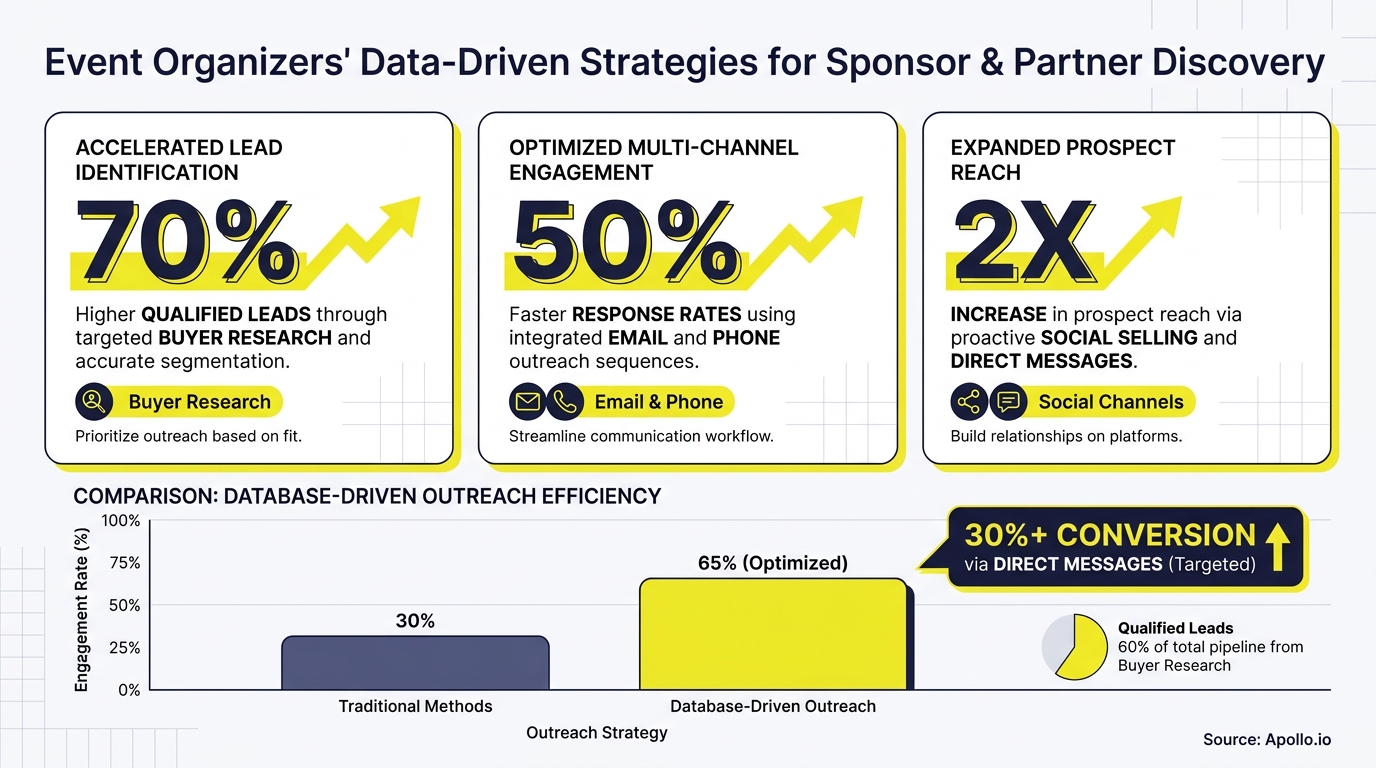
The sponsor list you need already exists — it's inside your sales database. Most event organizers still rely on generic prospect lists and cold outreach, but the teams closing the most sponsorship deals treat sponsor acquisition as a revenue operations problem: clean data, scored accounts, personalized outreach, and renewal-ready reporting. According to Event Academy, 88.4% of event marketers identify sponsorships and partnerships as the most effective drivers of event revenue. The market opportunity is real — yet Eventeny found that 24.6% of organizers cited securing sponsorship as their single biggest event marketing challenge in 2024.
This playbook shows how to convert your sales database into a CRM-driven sponsor prospecting engine — from data prep through fit scoring, outreach, and post-event ROI reporting. For a broader look at how sales analytics drives revenue growth, the same data-first principles apply here.

Scale Smarter With Apollo's Living Data
Tired of your team burning hours verifying contacts instead of closing deals? Apollo surfaces accurate, ready-to-act leads so your reps spend time selling. Join 600K+ companies building predictable pipeline from day one.
Start Free with Apollo →Key Takeaways
- Sponsor prospecting works best as a revenue operations workflow — not a one-off outreach blast.
- A Sponsor Fit Score built from firmographic, technographic, and engagement data replaces guesswork with ranked targets.
- Data quality is non-negotiable: inaccurate records disrupt outreach, and CAN-SPAM violations carry per-email penalties.
- Sponsors in 2026 buy pipeline access and qualified meetings — not logo placements. Your pitch must reflect that.
- Post-event ROI reporting is the renewal lever most organizers leave unused — connecting meetings, leads, and outcomes closes that gap.
How Do You Prepare a Sales Database for Sponsor Prospecting?
Sponsor prospecting starts with clean, enriched data — not a raw export. Before building any scoring model, your records need four foundational fields: company name, industry vertical, headcount, and a verified decision-maker contact (VP Marketing, CMO, or Partnerships lead).
Run three data hygiene steps first:
- Deduplicate: Merge duplicate company records caused by inconsistent naming (e.g., "Acme Corp" vs. "Acme Corporation").
- Enrich: Append missing firmographic fields — revenue range, tech stack, hiring signals, and intent topics — using a B2B enrichment tool.
- Validate contacts: Confirm email deliverability before any outreach sequence launches. Stale contacts inflate bounce rates and damage sender reputation.
Struggling to enrich sponsor prospect records at scale? Start free with Apollo's 230M+ verified business contacts and 65+ data attributes to fill gaps fast.
What Is a Sponsor Fit Score and How Do You Build One?
A Sponsor Fit Score is a weighted numeric ranking that tells you which accounts in your database are most likely to sponsor your event, so your team prioritizes outreach on the highest-probability targets first.
Use this rubric to score each account on a 0–100 scale:
| Signal | Weight | How to Source It |
|---|---|---|
| Industry alignment with event audience | 25 pts | CRM industry field / enrichment |
| Prior sponsorship or booth history | 20 pts | Past event CRM records |
| Audience account overlap (attendees from this company) | 20 pts | Registration data cross-match |
| Buyer intent signals matching event topics | 15 pts | Intent data layer (e.g., ABM, AI, cybersecurity) |
| Company growth signals (hiring, funding) | 10 pts | Enrichment / news triggers |
| CRM engagement (opens, replies, meetings) | 10 pts | CRM activity log |
Accounts scoring 70+ are Tier 1 targets. Scores between 40–69 are Tier 2. Below 40, deprioritize unless a specific strategic reason exists. Pairing intent signals with firmographic fit is where this model outperforms generic sponsor lists — for a deeper dive, see how intent data powers smarter B2B sales.
Turn Funnel Guesswork Into Real Pipeline
Tired of watching marketing leads die before they ever reach your pipeline? Apollo surfaces high-fit prospects and buying signals so your team acts first. Nearly 100K paying customers stopped guessing and started closing.
Start Free with Apollo →How Do SDRs and Sponsorship Teams Turn Segments into Outreach?
Once accounts are scored and segmented, SDRs and sponsorship managers should run tiered, personalized outreach sequences — not a single blast email. For small hosted events (50–200 attendees), even a 15-account Tier 1 list can generate meaningful revenue if outreach is precise.
Worked example (small B2B summit, 120 attendees):
- Database filtered by: SaaS companies, 50–500 employees, marketing tech stack, intent topic "demand generation"
- Fit Score applied: 8 Tier 1 accounts, 14 Tier 2 accounts identified
- Outreach sequence: personalized email (Day 1) → follow-up with audience overlap data (Day 4) → phone or social touchpoint (Day 7)
- Pitch lead: "Your ICP attends this event — here are 12 matching companies in the registration list."
CAN-SPAM compliance is not optional. Each violating commercial email can carry penalties up to $53,088 per the FTC, and CAN-SPAM has no B2B exception. Every sequence must include a physical mailing address, a clear unsubscribe mechanism, and honest subject lines. For broader outreach strategy, these proven sales pitch techniques apply directly to sponsor conversations.
Spending hours building manual sequences? Automate multi-channel sponsor outreach with Apollo's sales engagement platform and keep every touchpoint tracked in one place.

What Should a Sponsor ROI Dashboard Include?
A sponsor ROI dashboard connects pre-event targets to post-event outcomes, giving sponsors measurable proof of value — and giving you the data to secure renewals. According to Splash's 2025 Events Outlook, 57% of companies plan more partner events, and 51% plan more sponsored events. Sponsors funding that growth expect results, not impressions.
Include these metrics in every post-event sponsor report:
| Metric | Data Source | Why Sponsors Care |
|---|---|---|
| Meetings booked with target accounts | Meeting scheduler / lead retrieval | Pipeline impact proof |
| Attendee-to-ICP match rate | Registration data vs. sponsor ICP | Audience quality validation |
| Leads generated by tier (MQL/SQL) | Lead capture + CRM enrichment | Funnel contribution clarity |
| Session/booth engagement | Event platform analytics | Brand reach evidence |
| Post-event follow-up conversion | CRM sequence tracking | Revenue attribution |
RevOps leaders building sponsor pipelines should treat this dashboard the same way they treat sales pipeline reporting: with consistent fields, clean data, and attribution tied to revenue outcomes. See how revenue operations drives this kind of growth across GTM teams.
How Do You Use Database Data to Improve Sponsor Renewal Rates?
Sponsor renewal is a data problem disguised as a relationship problem. Organizers who track tenure, category exclusivity, and prior-year outcomes in their CRM can identify at-risk sponsors before renewal conversations and arm themselves with evidence of impact.
Key renewal triggers to track in your database:
- Sponsor tenure: Flag accounts in their first year — first-year sponsors need more proactive ROI communication.
- Category exclusivity: Note which categories are exclusive — this signals higher commitment and renewal probability.
- Year-over-year lead quality delta: Did they get more or fewer qualified meetings than the prior event? Show the trend.
- Post-event CRM activity: Did their sales team follow up on leads? Low follow-up signals disengagement — address it early.
Connecting sponsor acquisition to renewal probability is the same GTM motion as account expansion in B2B sales. The principles behind sales transformation led by RevOps map directly to how sponsorship teams should think about their accounts.
How Can Small Sponsorship Teams Prospect Like Enterprise Sales Teams?
Small sponsorship teams can run enterprise-grade prospecting by consolidating their workflow into a single platform rather than juggling spreadsheets, email tools, and separate enrichment services. Research from Salmon Labs shows B2B event budgets grew 3.9% in Q3 2025, with projected growth of 10.9% for 2025/2026 — meaning more sponsor budget is available, but competition for it is rising.
The consolidation advantage is real. Apollo users describe the shift: "Having everything in one system was a game changer" (Cyera), and "We reduced the complexity of three tools into one" (Predictable Revenue). For sponsorship teams, that means data enrichment, fit scoring, outreach sequencing, and deal tracking in one workspace instead of four. Learn how to build a sales tech stack that scales revenue without adding complexity.

Start Building Your Sponsor Pipeline Today
Event organizers who treat sponsor acquisition as a data-driven revenue operation — with clean records, scored accounts, compliant outreach, and renewal-ready reporting — consistently outperform teams relying on generic prospect lists and one-off pitches. The global sponsorship market is growing, sponsor budgets are under pressure to show ROI, and the organizers who provide measurable proof will win the renewals and referrals that compound over time.
Apollo gives event sales teams and RevOps leaders one unified platform: 230M+ verified business contacts, 65+ search filters for sponsor prospecting, multi-channel engagement sequences, and deal tracking — all in one workspace. Trusted by nearly 100K paying customers including Anthropic, Smartling, and Autodesk.
Start Your Free Trial and turn your sales database into a sponsor acquisition engine today.
Prove Pipeline ROI From Day One
ROI pressure killing your tool budget before it even starts? Apollo delivers measurable pipeline impact fast — so you walk into every budget review with numbers, not excuses. Nearly 100K paying customers already closed the case.
Start Free with Apollo →Don't miss these
Sales
Inbound vs Outbound Marketing: Which Strategy Wins?
Sales
What Is a Sales Funnel? The Non-Linear Revenue Framework for 2026
Sales
What Is a Go-to-Market Strategy? The 2026 GTM Playbook
See Apollo in action
We'd love to show how Apollo can help you sell better.
By submitting this form, you will receive information, tips, and promotions from Apollo. To learn more, see our Privacy Statement.
4.7/5 based on 9,690 reviews
