
CRM Sales Software: How to Choose the Right Platform for Your Team
CRM sales software centralizes customer data, automates workflows, and tracks deals from first contact to close. In 2026, sales teams using modern CRM platforms report 35% shorter sales cycles and 46% more meetings booked through AI-powered automation. The right system transforms scattered spreadsheets into a unified revenue engine that integrates seamlessly with your existing tools.

Apollo Eliminates 4+ Hours Of Daily Research
Tired of spending 4+ hours daily hunting for contact info? Apollo delivers 224M verified contacts with 96% email accuracy instantly. Join 550K+ companies who replaced manual research with predictable pipeline.
Start Free with Apollo →Key Takeaways
- CRM sales software consolidates contact data, engagement tracking, and deal management into one platform, eliminating 3-5 separate tools
- AI-powered CRMs deliver 83% higher goal attainment and generate $3.7 billion in 2026 revenue through automated research and messaging
- Sales teams save 8-12 hours weekly by automating manual tasks like data entry, lead scoring, and follow-up sequencing
- Modern CRM platforms integrate natively with email, calendar, and communication tools to capture every customer interaction automatically
- ROI appears within 3-6 months through increased pipeline velocity, higher win rates, and reduced tech stack costs
What Is CRM Sales Software?
CRM sales software is a platform that manages customer relationships and sales processes in one centralized system. It stores contact information, tracks interactions, automates outreach, and provides visibility into your entire pipeline.
Unlike basic contact databases, modern CRM systems connect prospecting, engagement, and deal management workflows.
According to Gartner, the CRM sales software market grew 12.2% to $25.7 billion in 2024, with AI capabilities driving adoption. Sales teams use CRM software to eliminate manual data entry, coordinate multi-channel outreach, and forecast revenue with real-time pipeline data.
The best CRM platforms integrate with your existing tech stack. Connecting HubSpot, Salesforce, and Apollo creates a unified workspace where SDRs prospect, AEs manage deals, and RevOps leaders analyze performance without switching tools.
How Does CRM Sales Software Work?
CRM sales software captures customer data from multiple sources and organizes it into searchable contact records. The system automatically logs emails, calls, meetings, and website visits to build a complete interaction history.
Sales reps access this data to personalize outreach and prioritize high-value opportunities.

Modern CRM platforms use AI to enrich contact records with job titles, company information, and intent signals. They score leads based on engagement patterns and trigger automated workflows when prospects take specific actions. Sales automation features handle repetitive tasks like follow-up emails, meeting reminders, and data updates.
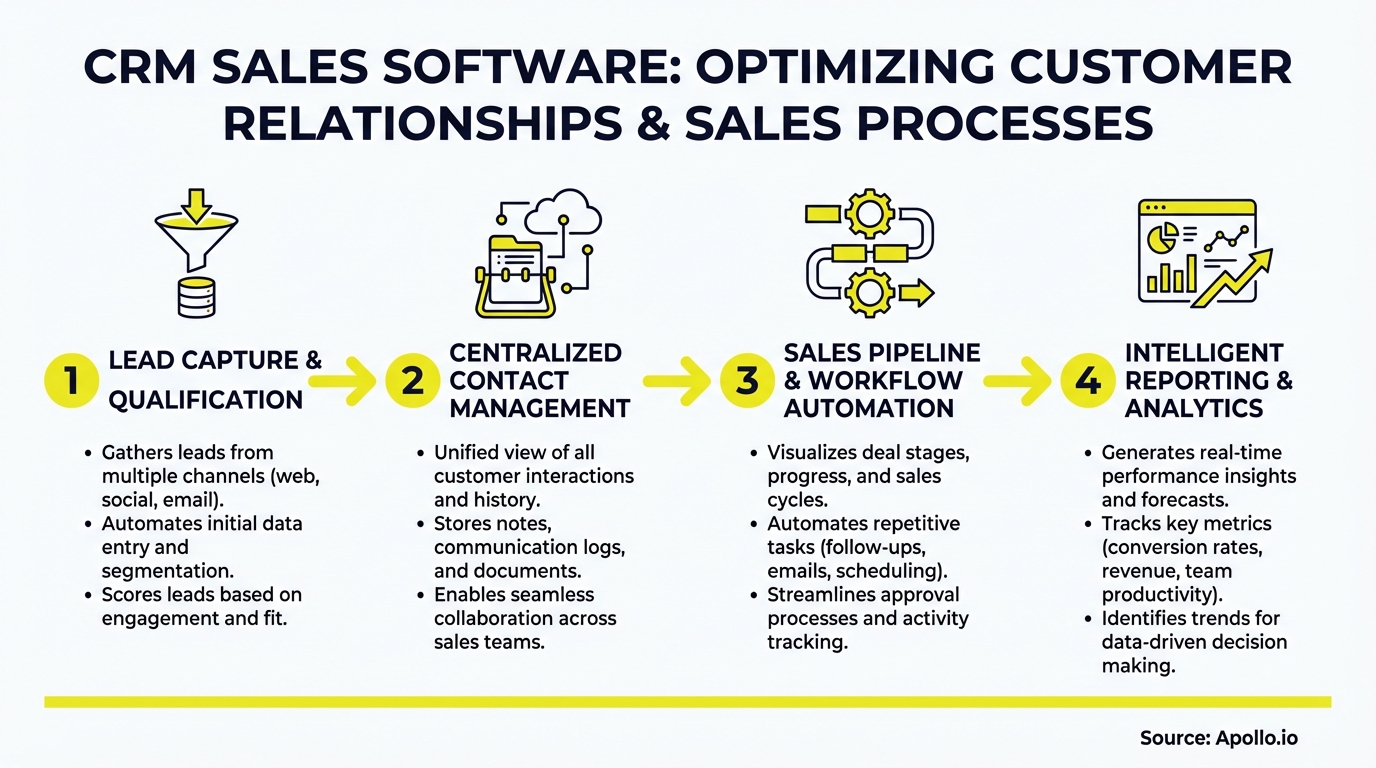
The workflow operates in four stages:
- Data Collection: Import contacts from LinkedIn, web forms, email signatures, and third-party databases
- Engagement Tracking: Monitor opens, clicks, replies, and website behavior across channels
- Pipeline Management: Move deals through stages, assign tasks, and forecast revenue
- Reporting: Analyze conversion rates, activity metrics, and team performance
Tired of juggling multiple sales tools? Apollo consolidates prospecting, engagement, and CRM into one platform with 224M+ verified contacts.
Why Do Sales Teams Need CRM Software in 2026?
Sales teams need CRM software to compete in a market where buyers expect personalized, timely outreach backed by research. Manual prospecting and spreadsheet tracking cannot scale beyond 10-15 accounts per rep.
CRM platforms automate research, coordinate team handoffs, and surface buying signals that indicate deal readiness.
Research by CRM.org shows businesses using generative AI in their CRM are 83% more likely to exceed sales goals. AI-powered systems analyze call transcripts, suggest messaging improvements, and identify cross-sell opportunities that reps miss manually.
The tech stack consolidation benefit matters most for growing teams. Instead of paying for separate tools for prospecting, outreach, dialing, and pipeline management, modern CRM platforms handle everything in one workspace.
Census reported: "We cut our costs in half" by consolidating tools. Cyera added: "Having everything in one system was a game changer."
What Problems Does CRM Software Solve for SDRs?
SDRs struggle with manual research, scattered contact data, and inconsistent follow-up. CRM software solves these problems by automating prospect discovery, enriching contact records, and triggering sequences based on engagement.
SDRs using AI-powered CRMs book 46% more meetings by focusing on conversations instead of administrative tasks.
The platform eliminates hours spent copying LinkedIn profiles into spreadsheets. Sales software built for efficiency pulls company data, job titles, and verified email addresses automatically. SDRs filter by 65+ criteria to build targeted lists in minutes instead of days.
What Are the Essential CRM Sales Software Features?
Essential CRM sales software features include contact management, pipeline tracking, email automation, and native integrations. Sales teams need accurate data, workflow automation, and reporting dashboards to hit quota consistently.
The platform must sync with email, calendar, and communication tools to capture interactions without manual logging.
| Feature Category | Key Capabilities | Impact on Sales Team |
|---|---|---|
| Contact Database | 224M+ verified contacts, 65+ search filters, data enrichment | Reduce research time by 8-10 hours weekly |
| Engagement Tools | Email sequences, dialer, meeting scheduler, multi-channel outreach | Increase touchpoints by 3-5x without adding headcount |
| Pipeline Management | Deal stages, forecasting, task automation, team visibility | Shorten sales cycles by 25-35% |
| AI Automation | Research agents, message generation, call summaries, lead scoring | Book 46% more meetings with AI-powered assistance |
| Integrations | Native CRM sync, Chrome extension, API access, webhook triggers | Eliminate duplicate data entry across tools |
Struggling with disconnected sales tools? Apollo's unified platform manages deals, contacts, and outreach in one workspace.
Turn Forecast Guesswork Into Revenue Certainty
Marketing leads stalling before they become opportunities. Apollo scores and tracks every prospect in real-time so you know exactly which deals will close. Built-In increased win rates 10% with Apollo's intelligence.
Start Free with Apollo →How Do Account Executives Use CRM Software to Close Deals Faster?
Account Executives use CRM software to prioritize high-intent accounts, coordinate with SDRs, and track deal progress across multiple stakeholders. The platform surfaces engagement data that reveals which contacts are active, what content resonates, and when to push for close.
AEs shorten sales cycles by 25-35% through better preparation and timely follow-up.
Pre-meeting intelligence makes the difference. AEs review conversation history, recent interactions, and company news before calls. CRM integration strategy ensures data flows automatically from prospecting through close, eliminating gaps where deals stall.
Deal management features help AEs juggle 15-30 active opportunities simultaneously. The system sends reminders for follow-ups, flags at-risk deals based on engagement drops, and suggests next steps based on similar closed-won patterns.
Predictable Revenue noted: "We reduced the complexity of three tools into one," allowing AEs to focus on selling instead of tool management.
What Role Does AI Play in Modern CRM Platforms?
AI in modern CRM platforms automates research, personalizes messaging, and analyzes conversations to surface insights. The technology generates account summaries, drafts contextual emails, and scores leads based on fit and intent.
Sales teams using AI-powered CRMs report 35% increases in bookings and 500% year-over-year platform growth.
AI call assistants handle note-taking during customer conversations. They transcribe calls, identify action items, and update CRM records automatically. AI sales tools also analyze win-loss patterns to recommend which deals deserve more attention and which should be deprioritized.
How Should RevOps Leaders Choose CRM Sales Software?
RevOps leaders should choose CRM sales software based on data quality, integration architecture, and automation capabilities. The platform must provide a single source of truth for customer data while connecting seamlessly to existing tools like Salesforce, HubSpot, and communication platforms.
Evaluate vendors on accuracy rates, API flexibility, and governance features.
Key selection criteria include:
- Data Accuracy: Verify email deliverability rates exceed 95% and contact information updates regularly
- Native Integrations: Confirm bi-directional sync with your CRM and ability to trigger workflows across tools
- Team Scalability: Ensure the platform supports role-based permissions and territory management
- Reporting Depth: Check for customizable dashboards that track metrics from prospecting through close
- Support Quality: Review response times, onboarding resources, and implementation assistance
RevOps teams managing complex tech stacks benefit from platforms that eliminate tool sprawl. B2B software integration becomes simpler when prospecting, engagement, and pipeline management operate within one system instead of three separate vendors.

What Does CRM Implementation Look Like for Growing Teams?
CRM implementation for growing teams takes 2-6 weeks depending on data migration complexity and integration requirements. The process involves importing existing contact data, mapping custom fields, connecting communication tools, and training reps on workflows.
Successful rollouts prioritize quick wins like automated data entry before tackling advanced features.
Implementation follows this timeline:
- Week 1: Import contacts, set up user accounts, configure basic workflows
- Week 2-3: Connect integrations, customize deal stages, build reporting dashboards
- Week 4-6: Train team on features, refine sequences, optimize automations based on usage
The fastest-growing teams start with AI-powered platforms that require minimal configuration. They focus on adoption metrics like daily active users, sequence engagement rates, and pipeline coverage to measure success. Sales leaders report ROI within 3-6 months through increased activity, better data quality, and higher win rates.
Start Building Your Sales Pipeline with Apollo
CRM sales software transforms disconnected sales activities into a unified revenue engine. The right platform eliminates tool sprawl, automates repetitive tasks, and provides the intelligence teams need to close deals faster.
In 2026, AI-powered CRM systems deliver measurable ROI through increased meeting bookings, shorter sales cycles, and consolidated tech stacks.
Apollo combines 224M+ verified business contacts, multi-channel engagement tools, and AI automation in one platform. SDRs prospect faster, AEs close more deals, and RevOps leaders gain complete pipeline visibility without managing multiple tools.
Over 550,000 companies use Apollo to cut costs, increase efficiency, and compete with better-funded competitors.
Ready to consolidate your tech stack? Start prospecting with Apollo's free plan and experience how an all-in-one platform accelerates revenue growth.
Prove Apollo's ROI In Your First 30 Days
Budget approval stuck on unclear metrics? Apollo tracks every dollar's impact—time saved, pipeline generated, deals closed. Built-In increased win rates 10% and ACV 10% with measurable intelligence.
Start Free with Apollo →Don't miss these
Sales
Inbound vs Outbound Marketing: Which Strategy Wins?
Sales
What Is a Sales Funnel? The Non-Linear Revenue Framework for 2026
Sales
What Is a Go-to-Market Strategy? The 2026 GTM Playbook
See Apollo in action
We'd love to show how Apollo can help you sell better.
By submitting this form, you will receive information, tips, and promotions from Apollo. To learn more, see our Privacy Statement.
4.7/5 based on 9,690 reviews
