
What Is CRM Sales Meaning in 2026? The Buyer-Enabled Revenue Operating System
CRM in sales used to mean one thing: log your calls, update your pipeline, close your deals. In 2026, that definition is obsolete. Modern CRM sales meaning has expanded into a full revenue operating system that orchestrates buyers across 10+ channels, coordinates human and AI agents, and governs the data quality that makes every interaction relevant. If your CRM is still just a contact database, you're leaving significant pipeline on the table. Understanding the true CRM sales meaning today starts with recognizing how dramatically buyer behavior has shifted and what your tech stack must do to keep up. For teams already using Apollo's CRM integration with Salesforce and HubSpot, this evolution is already underway.

Verified Data That Actually Connects
Tired of burning hours verifying contact info that still bounces? Apollo delivers 97% email accuracy so your team spends time selling, not searching. Nearly 100K paying customers stopped guessing and started closing.
Start Free with Apollo →Key Takeaways
- CRM sales meaning in 2026 is the omnichannel revenue operating system that connects buyer data, seller actions, and AI agents into one governed workflow.
- B2B buyers now interact across an average of 10 channels, making unified CRM data the foundation of every relevant outreach and deal.
- Poor data quality is the top barrier preventing CRM analytics from delivering on leadership expectations.
- CRM adoption correlates with a 29% increase in sales, and teams using CRM-based forecasting achieve 42% better accuracy than spreadsheet-reliant teams.
- The shift to agentic CRM means reps spend less time inside the CRM UI and more time acting on CRM intelligence in their flow of work.
What Is CRM Sales Meaning in 2026?
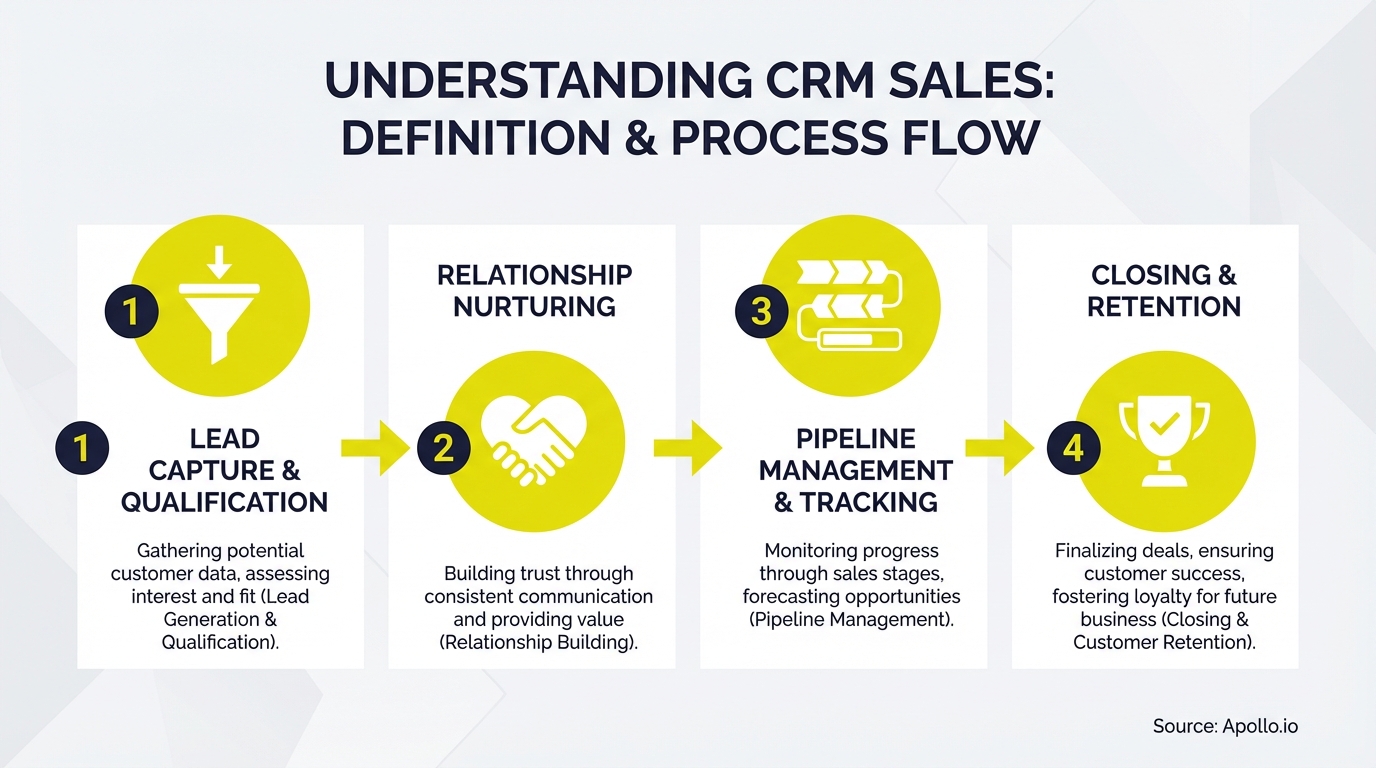
CRM sales meaning refers to how Customer Relationship Management software directly enables revenue generation: capturing buyer intent, coordinating outreach, tracking pipeline stages, and surfacing analytics that drive decisions. Historically, CRM was a system of record.
Today, it is a system of action.
The shift is driven by buyer behavior. According to Freshworks, 73% of businesses use CRM software, making it the default infrastructure for B2B revenue teams. But adoption alone does not equal results. The teams extracting real value treat their CRM as the connective tissue between prospecting, engagement, pipeline management, and forecasting, not just a place to store contacts.
For a broader view of how this fits into B2B sales meaning overall, the CRM is the operational backbone that makes every other sales motion scalable and measurable.
How Does Modern CRM Sales Work Across Omnichannel Buyer Journeys?
The operational definition of CRM sales in 2026 is omnichannel orchestration. McKinsey's 2024 B2B Pulse Survey of nearly 4,000 decision makers found that buyers now use an average of 10 interaction channels, up from 5 in 2016.
Your CRM must capture and attribute every one of those touchpoints to build a complete picture of buyer intent.
This has direct implications for how RevOps leaders configure their CRM architecture:
- Channel attribution: Map each touchpoint (email, phone, social, web, events, chat) to lifecycle stages in the CRM.
- Handoff automation: Trigger stage transitions based on buyer behavior signals, not manual rep updates.
- Unified contact records: Merge all channel interactions into a single timeline per account and contact.
- Self-serve intelligence: Track content consumption, pricing page visits, and comparison activity as CRM signals.
Struggling to keep pipeline data clean across every channel? Apollo's deal management tools give RevOps complete pipeline visibility in one workspace, reducing the need for manual updates across disconnected systems.
Understanding what actually works in CRM integration strategy is essential before layering additional tools on top of this omnichannel foundation.
Why Does CRM Data Quality Determine Sales Performance?
CRM analytics consistently underdeliver for one reason: dirty data. A Gartner survey of 303 sales leaders found that 84% agreed sales analytics has had less influence on performance than leadership expected, with poor data quality cited as a top barrier by 44% of respondents.
For SDRs and AEs, bad CRM data means wasted outreach, missed follow-ups, and inaccurate forecasts. For RevOps leaders, it means dashboards that no one trusts.
Addressing data quality requires both process discipline and tooling:
| Data Quality Issue | CRM Impact | Fix |
|---|---|---|
| Stale contact records | Bounced emails, missed buyers | Automated enrichment on job change signals |
| Duplicate accounts | Broken attribution, double outreach | Deduplication rules + merge workflows |
| Missing fields | Incomplete segmentation, poor ICP scoring | Required fields + waterfall enrichment |
| Manual stage updates | Inaccurate pipeline forecasts | Behavior-triggered stage automation |
Leveraging job change alerts to keep CRM records current is one of the highest-ROI data hygiene tactics available to modern sales teams. Pair this with data sync best practices to maintain accuracy across your full revenue stack.
Turn Funnel Chaos Into Closed Revenue
Pipeline forecasting a guessing game? Apollo surfaces high-quality leads and tracks deal momentum so your team acts on real signals, not gut feel. Nearly 100K paying customers stopped flying blind and started closing.
Schedule a Demo →How Do RevOps Leaders Use CRM Analytics to Drive Forecast Accuracy?
CRM analytics governance is the difference between dashboards that sit unused and insights that change pipeline decisions. Research from Gain.io shows teams using CRM-based forecasting achieve 42% better accuracy than those relying on spreadsheets. That gap is directly tied to how well the underlying data is governed.
For sales leaders and RevOps teams, the priority is moving from descriptive reporting to decision-driven analytics:
- Define one source of truth: All pipeline data lives in the CRM, not in personal spreadsheets or slides.
- Establish weekly review cadence: Gartner found CSO-led analytics programs are 2.3x more likely to achieve higher forecast accuracy.
- Tie metrics to decisions: Each report should answer a specific question (e.g., "Which deals need acceleration this week?").
- Automate data entry: Reduce manual logging so reps stay compliant without extra effort.
Explore how sales analytics drives revenue growth when paired with clean, enriched CRM data from the start of the funnel.

What Does Agentic CRM Mean for SDRs and Account Executives in 2026?
The most significant shift in CRM sales meaning right now is the move from passive record-keeping to active AI-assisted execution. In March 2026, Salesforce launched Agentforce Contact Center, blending CRM with AI agents and telephony into a single workflow.
This signals a fundamental redefinition: CRM is no longer where reps log work after it happens. It is where AI and human agents coordinate to execute work in real time.
For SDRs, this means research, personalization, and sequence enrollment happen faster with AI assistance embedded directly in the CRM workflow. For Account Executives, pre-meeting intelligence, deal risk signals, and next-best-action recommendations surface automatically. The result is that sales automation no longer competes with CRM use, it amplifies it.
Spending too much time on manual CRM updates and outreach prep? Apollo's multi-channel sales engagement platform automates sequences while keeping your CRM in sync, so reps focus on conversations, not data entry.
What ROI Should You Expect from CRM in Sales?
The business case for CRM investment is well-established. According to Research Nester, the average ROI of CRM is $8.71 for every dollar spent, with some projections suggesting up to $30.48 per dollar. Meanwhile, Kixie reports that CRM adoption leads to a 29% increase in sales.
To build a credible internal ROI case, frame the investment around three measurable outcomes:
- Pipeline efficiency: Fewer deals lost to poor follow-up or stale data.
- Forecast accuracy: More reliable revenue projections for finance and leadership.
- Rep productivity: Less time on admin, more time on revenue-generating activity.
The teams with the strongest CRM ROI treat it as the center of their sales tech stack, not one tool among many. As Predictable Revenue put it: "We reduced the complexity of three tools into one." Consolidation amplifies ROI by reducing integration friction and improving data consistency across the entire revenue workflow.

How Do You Get Started with a Modern CRM Sales Setup?
Getting CRM sales right in 2026 starts with connecting your prospecting data, engagement workflows, and pipeline management into a unified system. Apollo serves as the all-in-one GTM platform that consolidates your sales tech stack: 230M+ verified contacts, multi-channel sequencing, deal management, and CRM sync in one workspace. "Having everything in one system was a game changer," said the team at Cyera.
The global CRM market reflects this momentum. According to SLT Creative, the global CRM software market was valued at approximately $101.4 billion in 2024 and is projected to reach $262.74 billion by 2032. The teams winning right now are the ones who treat CRM not as a reporting tool, but as the operating system for their entire revenue motion.
Ready to see what modern CRM-connected selling looks like? Request a Demo and see how Apollo connects prospecting, engagement, and pipeline management in one platform built for B2B GTM teams.
Prove Pipeline ROI With Apollo
ROI pressure killing your tool budget? Apollo delivers measurable pipeline impact from day one — no lengthy pilots, no guesswork. Leadium 3x'd their annual revenue. Start your free trial and show leadership real numbers fast.
Start Your Free Trial →Don't miss these
Sales
Inbound vs Outbound Marketing: Which Strategy Wins?
Sales
What Is a Sales Funnel? The Non-Linear Revenue Framework for 2026
Sales
What Is a Go-to-Market Strategy? The 2026 GTM Playbook
See Apollo in action
We'd love to show how Apollo can help you sell better.
By submitting this form, you will receive information, tips, and promotions from Apollo. To learn more, see our Privacy Statement.
4.7/5 based on 9,690 reviews
