
Best Sales Intelligence Platform for RevOps Enrichment and Routing
RevOps leaders in 2026 face a deceptively simple problem: routing logic fails when enrichment data fails. Mis-scored leads, blank fields, and duplicate records create a cascade of assignment errors that cost pipeline before a single rep makes contact. Selecting the best sales intelligence platform for RevOps teams managing enrichment and routing is not a feature-checklist decision. It is a data governance and revenue reliability decision. See how Apollo's unified GTM platform addresses this end-to-end.
According to Grand View Research, the global RevOps market was estimated at USD 4.39 billion in 2024 and is projected to reach USD 16.98 billion by 2033, growing at a CAGR of 16.6%. That growth is driven by teams demanding platforms that unify enrichment, scoring, and routing, not point tools that create silos.

Rich Data That Makes Every Outreach Land
Tired of sending generic outreach because your contact data has zero context? Apollo arms you with firmographic, technographic, and verified data so every message hits. Join 600K+ companies turning cold lists into warm conversations.
Start Free with Apollo →Key Takeaways
- CRM data incompleteness is the root cause of most routing failures, not routing logic itself.
- RevOps teams without dedicated data-quality staff get the strongest ROI from platforms that automate enrichment and governance together.
- Routing reliability should be measured as a revenue metric with explicit SLAs, not treated as an admin task.
- Platform convergence in 2026 favors all-in-one solutions that reduce integration debt and consolidate the tech stack.
- Apollo unifies prospecting, enrichment, engagement, and workflow automation in one workspace, replacing multiple separate tools.
Why Is CRM Data Quality the Real Routing Problem?
Routing fails because the data feeding the routing logic is incomplete, not because the routing rules are wrong. A 2024 Validity survey of 631 CRM admins found that 68% reported incomplete data and 65% reported missing data in their CRM.
Both are direct drivers of mis-scoring and misrouting. You cannot assign a lead to the right territory or segment if the firmographic fields are blank.
The same study found that 55% of organizations have no full-time employee dedicated to CRM data quality. This is the business case for a sales intelligence platform that automates enrichment: it replaces a headcount problem with a platform capability. For RevOps leaders driving sales transformation, this shift from manual stewardship to automated governance is foundational.
What Should RevOps Teams Look for in an Enrichment and Routing Platform?
The best sales intelligence platform for RevOps teams managing enrichment and routing must satisfy four criteria simultaneously: coverage, completeness, integration depth, and workflow automation.
| Criteria | What to Evaluate | Why It Matters for Routing |
|---|---|---|
| Coverage | Database size, firmographic depth, contact-level fields | Blank fields trigger routing exceptions or fallback queues |
| Completeness | Match rate on inbound form submissions, email accuracy | Low match rates leave leads unscored and unrouted |
| Integration depth | Native CRM sync, MAP connectors, webhook support | Enrichment latency between form capture and CRM write delays assignment |
| Workflow automation | Trigger-based routing rules, SLA timers, fallback logic | Deterministic fallbacks prevent lead leakage when primary rules fail |
Tired of enrichment gaps breaking your routing logic? Fill CRM blanks automatically with Apollo's 230M+ verified business contacts.
Turn Funnel Guesswork Into Pipeline Wins
Tired of marketing leads that never convert and forecasts built on wishful thinking? Apollo surfaces high-intent prospects and fills your funnel with buyers who are actually ready. Join 600K+ companies building pipeline they can count on.
Start Free with Apollo →How Do RevOps Leaders Treat Routing as a Revenue Metric?
Routing is a revenue-leakage control system, not a Salesforce admin task. The key operational shift is defining routing SLAs with measurable KPIs and monitoring them as pipeline metrics.
RevOps teams leading in 2026 track the following:
- Time-to-first-touch: How quickly a routed lead receives rep contact after assignment.
- Exception rate: Percentage of leads that fall through routing rules and enter a manual queue.
- Reassignment rate: How often leads are re-routed after initial assignment, indicating upstream data quality failure.
- Enrichment-to-routing latency: The elapsed time between form submission, enrichment completion, and CRM assignment write.
Platforms that surface these metrics natively, rather than requiring custom BI builds, give RevOps teams the observability needed to close pipeline leaks quickly. Research from QuotaPath cites Gartner's prediction that 75% of the highest-growth companies will adopt a RevOps model, which reinforces why routing observability is now a baseline expectation, not a premium capability.
How Can RevOps Teams Build a Unified Enrichment and Routing Architecture?
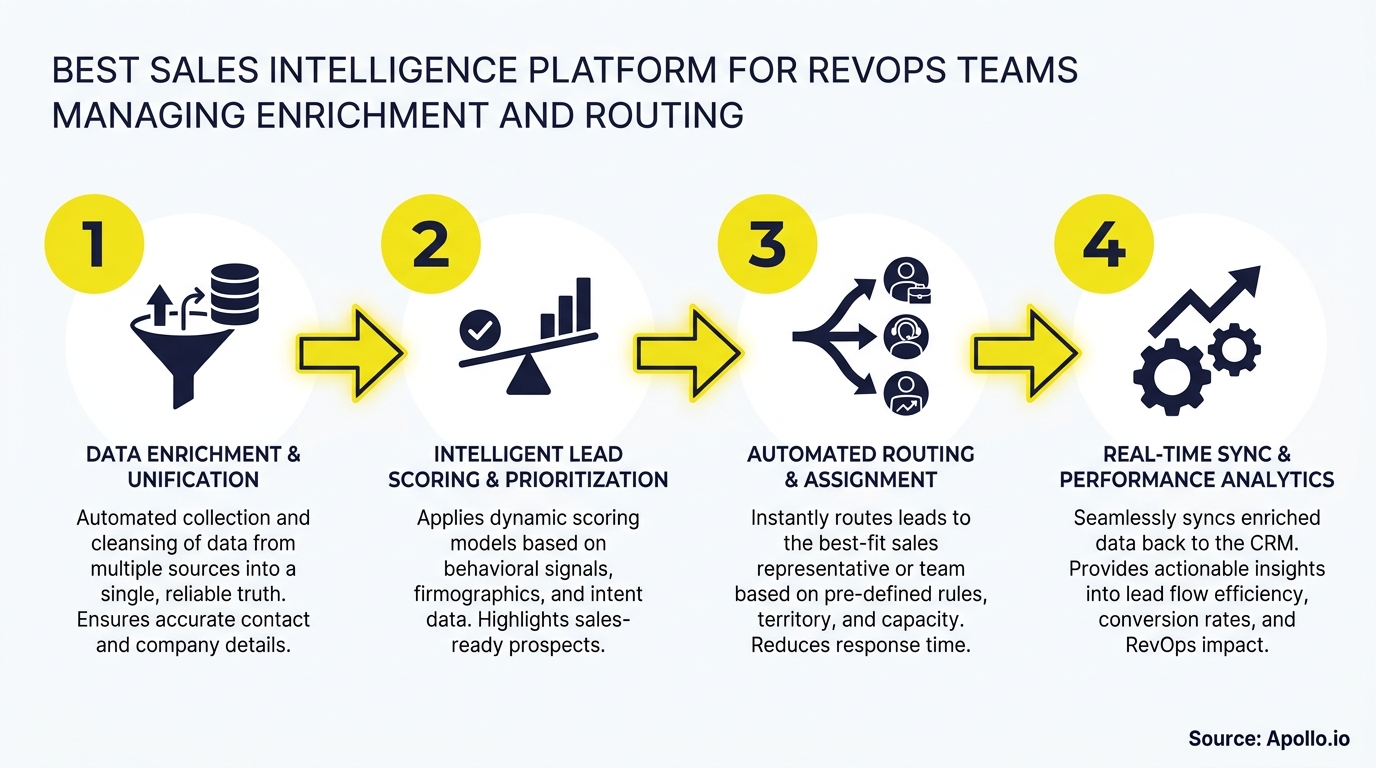
A unified architecture connects the enrichment layer directly to routing triggers, eliminating the latency gap between data arrival and lead assignment. The recommended integration pattern follows three stages.
- Inbound capture: Form submission writes a raw record to CRM with minimal fields.
- Enrichment trigger: Platform API fires immediately on record creation, appending firmographic, technographic, and contact-level fields within seconds.
- Routing execution: Enriched fields drive scoring, segmentation, and assignment rules with deterministic fallbacks for any unmatched records.
Identity resolution and deduplication must happen at stage two, before routing executes. Duplicate records are one of the most common causes of split routing outcomes, where the same lead reaches two reps simultaneously or neither. Platforms with built-in deduplication logic reduce this failure mode without requiring a dedicated admin. This architecture also supports a scalable sales tech stack that does not accumulate integration debt as the team grows.

What Makes Apollo the Best Sales Intelligence Platform for RevOps Managing Enrichment and Routing?
Apollo is the all-in-one GTM platform that consolidates prospecting, enrichment, engagement, and workflow automation in a single workspace, eliminating the point-tool sprawl that creates data silos and routing gaps. With 230M+ business contacts, 97% email accuracy, and 65+ enrichment data attributes, Apollo provides the coverage and completeness RevOps teams need to keep routing logic clean.
Apollo's data enrichment and CRM sync capabilities write verified firmographic and contact fields back to records automatically, reducing the manual stewardship burden that 55% of teams currently carry without dedicated staff. The workflow engine supports trigger-based automation so enriched records move through scoring and routing without manual handoffs. Customers describe the impact directly: "Having everything in one system was a game changer" (Cyera) and "We cut our costs in half" (Census).
For RevOps leaders evaluating sales intelligence tools against an enterprise-grade standard, Apollo also provides advanced routing controls, admin governance, and integrations with leading CRMs, making it a fit across startup, mid-market, and enterprise GTM teams. Sales performance management at scale requires a single source of truth, and Apollo's unified data layer delivers that.
How Should RevOps Leaders Evaluate the Business Case for Platform Consolidation?
The business case for consolidating enrichment and routing into a single platform rests on three cost drivers: headcount, tooling spend, and pipeline leakage from data quality failures. A practical evaluation framework compares cost-to-serve per routed lead across two scenarios: a fragmented stack of separate enrichment, routing, and engagement tools versus a unified platform.
- Headcount cost: Platforms with automated enrichment and deduplication reduce the need for manual data stewardship FTEs.
- Tooling spend: Replacing three to five separate tools with one platform reduces subscription overhead and integration maintenance costs.
- Pipeline leakage reduction: Faster enrichment-to-routing latency and lower exception rates convert more inbound leads before response window closes.
Research from Fortune Business Insights valued the global sales intelligence market at USD 4.85 billion in 2025, projecting growth to USD 12.45 billion by 2034 at an 11.10% CAGR. That investment trajectory reflects how seriously B2B organizations are treating enrichment governance as a revenue-critical function. "We reduced the complexity of three tools into one," noted Collin Stewart of Predictable Revenue, capturing the consolidation ROI that RevOps leaders are now demanding from platform decisions.

What Is the Right Next Step for RevOps Teams Ready to Improve Enrichment and Routing?
The right next step is to audit your current routing exception rate and trace exceptions back to their enrichment failure points. Most teams discover that a small number of missing fields, industry, employee count, or company domain, account for the majority of routing errors.
A unified sales intelligence platform closes those gaps at the source.
Apollo gives RevOps teams the enrichment coverage, workflow automation, and CRM integration depth to run routing as a governed, observable revenue system rather than a fragile admin configuration. Trusted by nearly 100K paying customers including Anthropic, Cyera, and Smartling, Apollo is built for GTM teams that need pipeline reliability without bloated tech stacks.
Request a Demo and see how Apollo unifies enrichment and routing in one platform built for RevOps.
Prove Pipeline ROI Before Next QBR
Budget approval stuck on unclear metrics? Apollo surfaces measurable pipeline impact so your team justifies every dollar spent. Leadium 3x'd annual revenue — your next QBR deserves numbers like that.
Schedule a Demo →Don't miss these
Sales
Inbound vs Outbound Marketing: Which Strategy Wins?
Sales
What Is a Sales Funnel? The Non-Linear Revenue Framework for 2026
Sales
What Is a Go-to-Market Strategy? The 2026 GTM Playbook
See Apollo in action
We'd love to show how Apollo can help you sell better.
By submitting this form, you will receive information, tips, and promotions from Apollo. To learn more, see our Privacy Statement.
4.7/5 based on 9,690 reviews
