
What Is the Best CRM for Sales Teams in 2026? ROI, Integration, AI
Sales teams waste 70% of their time on non-selling work. The best CRM for sales teams in 2026 isn't the one with the most features or the biggest brand name. It's the platform that integrates seamlessly with your revenue tech stack, delivers measurable ROI, and actually gets adopted by your reps. According to Freshworks, 73% of businesses reported using CRM software in 2024, with tech companies leading at 94% adoption. But adoption without outcomes is just expensive shelfware.
This guide cuts through the noise with integration-first selection criteria, ROI benchmarks, and practical frameworks. Whether you're an SDR looking to book more meetings or a RevOps leader consolidating your tech stack, you'll find actionable checklists and governance playbooks to ensure measurable results. We'll cover how CRM integration strategy impacts adoption, why AI readiness now matters more than dashboards, and how to evaluate platforms that deliver time savings instead of feature bloat.

Get Verified Contacts Instantly With Apollo
Tired of spending 4+ hours daily hunting for contact info? Apollo delivers 224M verified contacts with 96% email accuracy. Join 550K+ companies who eliminated manual research.
Start Free with Apollo →Key Takeaways
- The best CRM for sales teams in 2026 prioritizes integration architecture and data governance over feature count, with 70% of companies struggling to integrate sales plays into CRM systems
- AI-enabled CRMs show a 17-point revenue growth advantage, but only when paired with adoption frameworks and workflow design that reduce non-selling work
- CRM ROI has declined to $3.10 per dollar spent, making tool consolidation and measurable productivity outcomes critical evaluation criteria
- Agentic AI and flow-of-work CRM capabilities are reshaping selection criteria, turning platforms from databases into autonomous work systems
What Makes a CRM Best for Sales Teams in 2026?
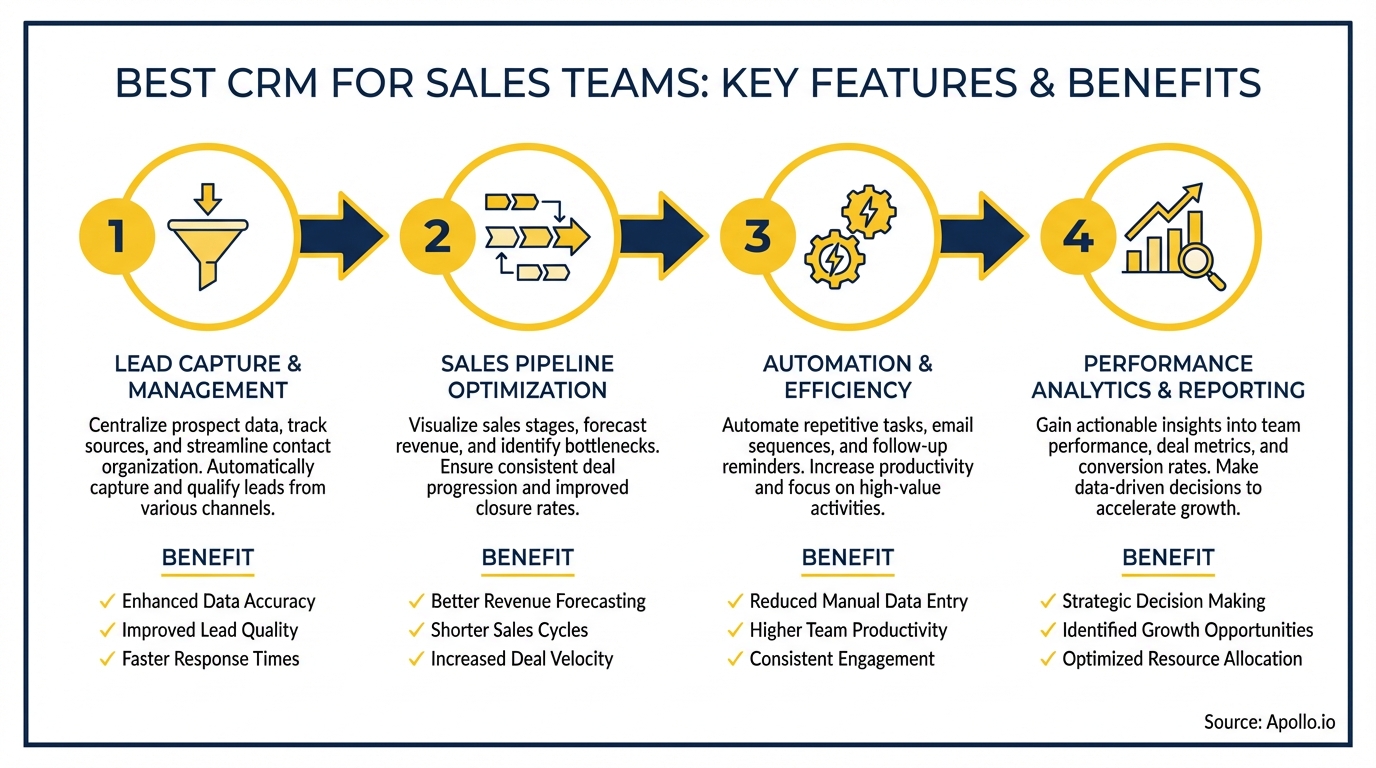
The best CRM for sales teams is a platform that integrates with your existing revenue tech stack, automates non-selling work, and provides data governance for AI-assisted workflows. In 2026, CRM selection has shifted from feature comparison to integration architecture.
Bain & Company research found 70% of companies struggle to integrate their sales plays into CRM and revenue technologies, with only 20% realizing full value.
Sales teams spend 70% of their time on administrative tasks rather than selling. The winning CRM reduces this tax through native integrations, automated data capture, and workflow design.
It must support agentic AI capabilities while maintaining data quality and governance. For SDRs and AEs, this means less manual logging and more time on prospecting and deal advancement.
Key evaluation criteria include:
- Integration depth: Native connectors to sales engagement, conversation intelligence, and enrichment tools
- Data quality: Automated enrichment, deduplication, and validation workflows
- AI readiness: Unified customer data model, semantic layers, and governed agent permissions
- Adoption velocity: Intuitive UX, mobile-first design, and flow-of-work data capture
- Measurable ROI: Time saved, pipeline acceleration, and cost consolidation metrics
Why Does CRM Integration Matter More Than Features?
CRM integration determines whether your sales team uses the platform or works around it. The 2026 revenue tech stack typically includes 8-12 tools spanning prospecting, engagement, enrichment, conversation intelligence, and analytics.
When these systems don't share data bidirectionally, reps manually copy-paste between platforms or abandon CRM logging entirely.
Research from Cirrus Insight shows the U.S. CRM market was estimated at $40.6 billion in 2023 and is expected to reach $51.53 billion by 2030, growing at a CAGR of 12.5% from 2023 to 2030. Despite this investment, integration failures remain the primary reason CRMs fail to deliver ROI. When sales plays, sequences, and playbooks live outside the CRM, teams lose visibility into what's actually driving pipeline.
For RevOps teams managing sales tech stacks that scale revenue, the best CRM acts as a central nervous system. It should automatically enrich contacts from your data provider, sync engagement activity from your sequencing platform, capture conversation insights from your call recording tool, and surface next-best actions to reps. Struggling to unify data across multiple platforms? Start free with Apollo's 224M+ verified contacts and native CRM integrations.
Turn Low-Quality Leads Into Pipeline With Apollo
Marketing leads falling flat at handoff. Apollo scores and enriches every prospect with real-time signals so your team pursues only sales-ready opportunities. Built-In boosted win rates 10% with Apollo's buyer intelligence.
Start Free with Apollo →How Do SDRs and AEs Evaluate CRM Platforms Differently?
SDRs prioritize speed, volume, and prospecting efficiency when evaluating CRM platforms. They need instant access to contact data, one-click sequence enrollment, and automated task creation.
The best CRM for SDRs surfaces net-new accounts, provides enrichment without leaving the interface, and syncs activity to their manager's pipeline reports. SDRs using modern platforms report significant time savings on research and data entry.
Account Executives focus on deal intelligence, relationship mapping, and forecast accuracy. AEs need complete account histories, stakeholder org charts, and buying signal alerts.
They evaluate CRMs based on mobile accessibility, opportunity management workflows, and integration with contract/CPQ systems. For AEs managing complex deals, the CRM must provide pre-meeting intelligence and post-call action items without manual logging.
| Role | Top CRM Priorities | Key Workflows |
|---|---|---|
| SDRs/BDRs | Contact data access, sequence automation, activity logging | Prospecting, outbound sequences, meeting booking |
| Account Executives | Deal intelligence, relationship mapping, mobile access | Opportunity management, stakeholder tracking, forecasting |
| Sales Leaders | Pipeline visibility, coaching insights, performance analytics | Forecast reviews, rep coaching, quota attainment tracking |
| RevOps Teams | Data governance, integration health, adoption metrics | Tech stack management, workflow automation, reporting |
Sales Leaders need visibility into team performance, coaching moments, and forecast accuracy. They evaluate CRMs based on pipeline inspection tools, conversation intelligence integration, and sales analytics that drive revenue growth. The platform must surface which reps need coaching and which deals need attention.

What Role Does AI Play in Modern CRM Selection?
AI has moved from nice-to-have feature to core operating model in 2026 CRM evaluation. Salesforce's State of Sales research shows 87% of sales orgs currently use some form of AI, with 54% of sellers having used AI agents.
Teams with AI capabilities saw a 17-point revenue growth advantage compared to those without. The shift is from AI that generates text to agentic AI that takes actions autonomously.
Modern CRM AI capabilities include autonomous prospecting, qualification scoring, next-best action recommendations, and automated meeting summaries. The best platforms provide governed agent permissions, audit trails for AI actions, and data grounding that ensures AI recommendations are based on trustworthy context.
For sales teams, this means AI that drafts personalized outreach, prioritizes accounts based on buying signals, and suggests optimal follow-up timing.
Key AI evaluation criteria:
- Agentic capabilities: Can AI take actions (enroll in sequences, update records, create tasks) or just suggest them?
- Data governance: How does the platform ensure AI acts on clean, unified customer data?
- Audit trails: Can you track what AI decided and why?
- Customization: Can you train AI on your sales plays and messaging?
- Cost model: Is AI bundled, metered, or a separate add-on?
The 2026 shift toward agentic CRM means platforms compete on autonomous workflows rather than dashboard design. HubSpot's Breeze Agents and Salesforce's Agentforce represent this evolution, positioning AI as the layer that executes sales plays rather than just providing insights. Spending too much time on prospect research? Automate prospecting and outreach with Apollo's AI-powered sequences.
How Should RevOps Leaders Calculate CRM ROI?
CRM ROI calculation in 2026 must account for total cost of ownership, not just seat price. Nucleus Research found CRM returns $3.10 for every dollar spent, down from $4.90 a decade ago.
This decline reflects the complexity of modern revenue tech stacks and the hidden costs of poor integration. RevOps leaders must evaluate CRM costs holistically, including implementation, training, ongoing administration, and integration maintenance.
The formula for CRM ROI includes measurable productivity gains, pipeline acceleration, and tech stack consolidation savings. Calculate time saved through automation (hours per rep per week), multiply by fully-loaded rep cost, and compare against total CRM spend.
Factor in opportunity cost: when reps spend less time on admin work, they can work more deals. Include cost savings from retiring redundant tools through consolidation.
ROI calculation framework:
- Hard costs: Seat licenses, implementation fees, admin/ops headcount, integration costs
- Productivity gains: Hours saved per rep weekly × fully-loaded cost × team size
- Pipeline impact: Cycle time reduction, conversion rate improvement, deal size increase
- Consolidation savings: Retired tool costs + reduced integration complexity
- Opportunity cost: Additional deals worked due to time savings
For Founders and CEOs evaluating CRM platforms, focus on payback period and breakeven timeline. The best CRM delivers measurable outcomes within 90 days: improved data quality, increased activity volume, faster deal velocity. According to Salesso, 91% of companies with more than 10 employees currently use a CRM system. The question isn't whether to use CRM, but which platform delivers the fastest time-to-value.
What Integration Architecture Should You Require?
The best CRM for sales teams provides native integrations to your core revenue stack: sales engagement platforms, conversation intelligence tools, data enrichment services, and marketing automation. Native integrations ensure bidirectional data sync, real-time updates, and field mapping that doesn't break with product updates.
API-based custom integrations require ongoing maintenance and often lag in data freshness.
Evaluate integration depth, not just integration count. A native CRM integration that connects Salesforce and HubSpot fast should sync activities, enrich contacts automatically, and update deal stages without manual intervention. Flow-of-work integration captures data from email, calendar, and chat tools where reps actually work, reducing the tax of logging into separate CRM tabs.
Required integration capabilities:
- Sales engagement sync: Sequences, activities, and replies flow to CRM in real-time
- Enrichment automation: New contacts and accounts auto-populate with firmographic and contact data
- Conversation intelligence: Call recordings, transcripts, and AI insights attach to opportunities
- Calendar integration: Meeting attendance and outcomes update CRM without manual logging
- Marketing automation: Lead scoring, campaign attribution, and form fills sync bidirectionally
Microsoft's Copilot for Sales demonstrates the flow-of-work integration model: AI meeting summaries from Teams automatically write back to CRM records. This reduces context switching and improves data freshness. For RevOps teams managing sales performance and forecasting accuracy, integration architecture determines whether your CRM becomes a source of truth or just another data silo.

How Does Tool Consolidation Impact CRM Selection?
Tool consolidation is a primary CRM selection driver in 2026 as companies reduce costs and complexity. Sales teams using 8-12 separate tools face integration debt, data inconsistency, and vendor fatigue. The best CRM for sales teams consolidates multiple capabilities into a unified platform: contact database, engagement sequences, conversation intelligence, and deal management that streamlines your pipeline.
Apollo customers report significant consolidation benefits. "We reduced the complexity of three tools into one," says Collin Stewart of Predictable Revenue. "We cut our costs in half," reports Census. "Having everything in one system was a game changer," notes Cyera. These outcomes reflect the 2026 shift from best-of-breed to integrated platforms that reduce vendor sprawl.
Consolidation evaluation checklist:
- Capabilities covered: Which tools can you retire? (prospecting, enrichment, sequences, dialer, analytics)
- Feature parity: Does the consolidated platform match or exceed current tool capabilities?
- Cost comparison: Total spend on current stack vs. consolidated platform all-in pricing
- Integration reduction: How many fewer integrations will RevOps maintain?
- Training simplification: Single platform training vs. onboarding reps to multiple tools
For growing teams and startups, consolidation accelerates time-to-productivity. New SDRs learn one platform instead of four.
RevOps teams maintain one integration instead of a dozen. Sales Leaders get unified reporting without stitching together data from multiple sources.
The best CRM consolidates your tech stack while improving outcomes, not just reducing costs.
Start Free with Apollo: The All-in-One GTM Platform
The best CRM for sales teams in 2026 delivers integration-first architecture, measurable ROI, and AI-powered automation that reduces non-selling work. Apollo provides 2M+ users with a unified platform that consolidates prospecting, engagement, enrichment, and deal management into one workspace.
With 224M verified business contacts, 96% email accuracy, and native integrations to leading CRM systems, Apollo helps SDRs book more meetings, AEs close deals faster, and RevOps teams reduce tech stack complexity.
Apollo customers at Predictable Revenue, Census, and Cyera report significant time savings and cost reductions through tool consolidation. Whether you're evaluating CRM integration with HubSpot and Salesforce or building a scalable revenue tech stack, Apollo delivers the integration depth, data quality, and AI capabilities that drive measurable outcomes.
Start Free with Apollo and experience the all-in-one platform that sales teams at 550K+ companies trust to grow revenue.
Prove Apollo's ROI In Your First 30 Days
Budget approval stuck on unclear metrics? Apollo delivers measurable pipeline impact from day one—track time saved, meetings booked, and revenue generated. Built-In increased win rates 10% and ACV 10% with Apollo's buyer intelligence.
Start Free with Apollo →Don't miss these
Sales
Inbound vs Outbound Marketing: Which Strategy Wins?
Sales
What Is a Sales Funnel? The Non-Linear Revenue Framework for 2026
Sales
What Is a Go-to-Market Strategy? The 2026 GTM Playbook
See Apollo in action
We'd love to show how Apollo can help you sell better.
By submitting this form, you will receive information, tips, and promotions from Apollo. To learn more, see our Privacy Statement.
4.7/5 based on 9,690 reviews
