
Best AI Prospecting Tool for Revenue Leaders Trying to Reduce Manual SDR Work in 2026
Manual SDR work is one of the biggest capacity drains in modern B2B sales. List building, account research, and email drafting consume hours that should go toward conversations and closing. Tools that automate the full prospecting workflow, not just one step, are now the differentiator between teams that scale and teams that stall. Apollo's AI Sales Assistant is built for exactly this problem: an end-to-end GTM assistant that handles research, list building, messaging, and sequence execution from a single natural-language interface.
According to Autobound, AI adoption among sales representatives nearly doubled, rising from 24% in 2023 to 43% in 2024. The teams pulling ahead aren't just experimenting with AI — they're running it as their default prospecting operating system. This article gives revenue leaders a practical framework for evaluating, selecting, and scaling an AI prospecting tool that actually reduces manual SDR work.

Get Rich Context on Every Prospect
Tired of sending generic outreach because your data is spotty? Apollo delivers enriched firmographic and technographic intel so every message lands with precision. Start building pipeline that actually converts.
Start Free with Apollo →Key Takeaways
- The best AI prospecting tools cover the full workflow: ICP targeting, enrichment, intent signals, sequencing, and QA — not just email generation.
- SDRs and BDRs who adopt AI daily are significantly more likely to exceed quota than non-users, making enablement a revenue-critical priority.
- Workflow-native tools that embed AI inside existing prospecting and engagement surfaces drive faster adoption than standalone chatbot-style add-ons.
- Data quality and governance are now the primary failure points as teams move from pilots to enterprise-wide deployment.
- Tool consolidation — replacing multiple point solutions with one unified platform — delivers compounding ROI beyond the cost of any single subscription.
Why Do Revenue Leaders Need an AI Prospecting Tool in 2026?
Revenue leaders need AI prospecting tools in 2026 because manual SDR workflows are no longer competitively viable at scale. Research from Cirrus Insight shows that 56% of sales professionals are using AI daily, and those users are twice as likely to exceed their sales targets compared to non-users. That gap in quota attainment is a direct consequence of time allocation: AI users spend more time in conversations and less time on list building, research, and copy.
The revenue operations framework has shifted to demand measurable lift from every tool in the stack. Revenue leaders are now asking: does this tool reduce research time, improve pipeline quality, and free reps for higher-value work? If the answer isn't yes across all three, it's a point tool masquerading as a solution.
What Does an End-to-End AI Prospecting Workflow Look Like?
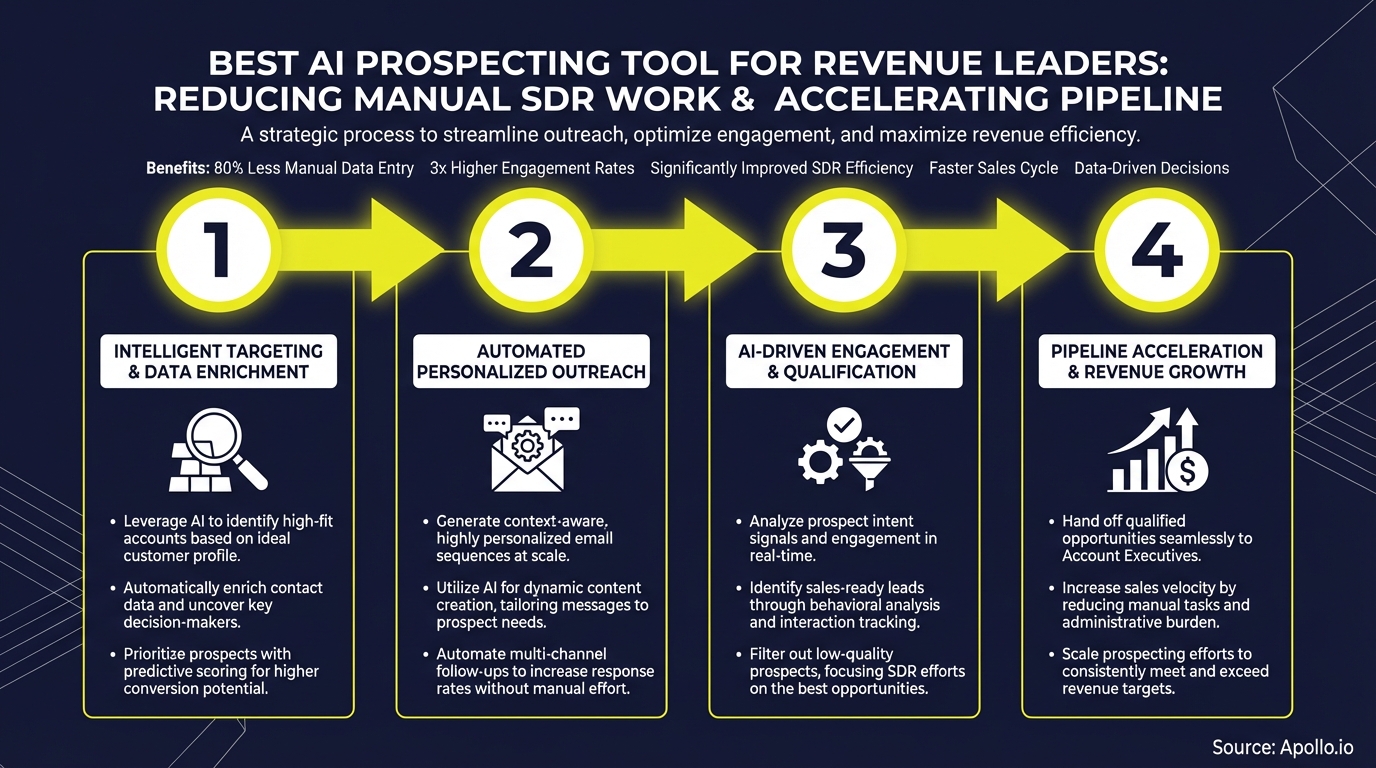
An end-to-end AI prospecting workflow moves from ICP definition to booked meeting without requiring reps to manually switch between tools at each step. The full chain looks like this:
| Stage | Manual SDR Task | AI-Automated Replacement |
|---|---|---|
| ICP Targeting | Manual filter search, spreadsheet export | Natural-language list building with 65+ filters |
| Enrichment | Cross-referencing multiple data sources | Waterfall enrichment from verified contact database |
| Prioritization | Gut-feel scoring, manual CRM tagging | AI lead scores based on ICP match and activity signals |
| Sequencing | Copy-paste templates, manual step setup | AI-generated multi-channel sequences from one prompt |
| Personalization | Manual research per prospect | Signal-based messaging grounded in real account context |
| Follow-up | Post-meeting manual drafting | AI-drafted follow-ups using conversation summaries |
Tools that only solve one stage create new handoff problems. The value compounds when AI carries work across the entire chain inside one platform. Explore automated prospecting tools that cover multiple stages to see where your current stack has gaps.

How Do SDRs and BDRs Benefit Most from AI Prospecting Tools?
SDRs and BDRs benefit most from AI prospecting tools by reclaiming research and admin time and redirecting it toward outbound conversations. A report from Sales Hiker found that sales teams have reported a 42% reduction in research time per lead by using AI tools. For an SDR running 50+ prospects per week, that's a material shift in daily capacity.
The shift is augmentation, not replacement. SDRs move from list-builder to agent operator: setting targeting rules, reviewing AI outputs, and focusing on the judgment-heavy conversations that convert. As Apollo's AI writing experiments with SDRs have shown, the reps who adopt AI as a workflow layer outperform those who treat it as a one-off writing aid.
Apollo BDR Erik Fernando Nieto at JumpCloud describes the day-to-day impact directly: "Apollo's AI Assistant filters and cleans prospect data for me, so I can find the right people faster and run better searches. It saves me about an hour per prospecting session."
Struggling to find qualified leads fast enough? Search Apollo's 230M+ contacts with 65+ filters and let AI do the targeting work.
What Should Revenue Leaders Look for in an AI Prospecting Tool?
Revenue leaders should evaluate AI prospecting tools on five criteria: workflow coverage, data quality, governance controls, CRM integration depth, and total cost of ownership. Feature checklists matter less than whether the tool actually reduces manual steps across the full prospecting motion.
- Workflow coverage: Does it handle targeting, enrichment, scoring, sequencing, and follow-up in one place — or only one piece?
- Data quality: What is the verified email accuracy rate? Is enrichment sourced from a maintained, regularly updated database?
- Governance controls: Can RevOps set approval gates, credit limits, and output review workflows before AI actions execute?
- CRM integration: Does it sync bidirectionally with your CRM, or does it create a parallel data silo?
- Total cost: Does it consolidate tools you're already paying for, or add to a fragmented stack?
Platform consolidation is increasingly the ROI story. As Collin Stewart at Predictable Revenue noted, "We reduced the complexity of three tools into one." Tool sprawl doesn't just cost money — it creates data inconsistency and slows rep adoption.
Turn Funnel Guesswork Into Pipeline Clarity
Tired of watching marketing leads stall before they ever reach your pipeline? Apollo surfaces high-intent prospects and accelerates lead-to-opportunity conversion. Nearly 100K paying customers have replaced forecast anxiety with predictable revenue.
Start Free with Apollo →How Does Apollo Handle the Full AI Prospecting Workflow?
Apollo handles the full AI prospecting workflow through a unified platform where AI is embedded at every stage, not bolted on as a separate module. The Apollo AI layer includes AI Research, Outbound Copilot, AI Sequence Builder, Scoring, Content Center, and Conversation Intelligence — all working from the same data and ICP context.
Key capabilities by workflow stage:
- List building: Web-powered list building lets reps ask for targeted prospect sets in plain English. The AI builds the list from Apollo's 230M+ contact database combined with live web search.
- Scoring and prioritization:Apollo Scores automatically rate prospects as Excellent, Good, Fair, or Not a Fit based on ICP match criteria and activity signals.
- Sequencing: The Outbound Copilot generates complete multi-channel sequences, adds matched prospects automatically, and supports A/B testing — all from a single prompt.
- Personalization: The AI Content Center grounds every message in your value proposition, ICP pain points, and real account signals. The Perplexity integration lifted successful content generation to 84%.
- Meeting prep and follow-up: Pre-meeting AI summaries surface company priorities and past objections. Post-meeting, AI drafts follow-up emails using conversation context.
For RevOps leaders managing governance, Apollo includes credit transparency before each AI run, manual approval gates, and configurable automation cadences. Customer data is protected under SOC2 and ISO 27001 standards and is not used to train external models.
Tory Kindlick, Head of Revenue Ops at RapidSOS, captures the end-to-end value: "On a short Sunday train ride, I used the AI Assistant to find lookalike accounts, research them, and prep my team for outreach. Work that would've taken me hours was done before I even got off the train."
Spending too much time on manual outreach sequences? Automate your multi-channel sequences with Apollo and let AI handle the build.
How Do You Scale AI Prospecting from Pilot to Full Team Deployment?
Scaling AI prospecting from pilot to full deployment requires a phased approach that prioritizes data readiness, workflow integration, and rep enablement before expanding usage. Most teams that stall after a pilot do so because they skipped one of these three foundations.
- Phase 1 — Data readiness: Audit CRM data quality, confirm ICP criteria are documented, and set up the AI Content Center with your value proposition and pain points before running any outbound.
- Phase 2 — Pilot with one workflow: Start with AI-assisted list building and scoring for a single SDR segment. Measure meeting rate and time-to-sequence-launch against your baseline.
- Phase 3 — Expand with governance: Add Outbound Copilot automation with manual approval gates. Set credit limits per rep. Review AI output quality weekly in team coaching sessions.
- Phase 4 — Full enablement: Roll out AI Research, personalized sequencing, and conversation intelligence across the team. Integrate with CRM for bidirectional data sync.
The sales performance management layer matters here: leaders need to track not just pipeline outcomes but AI usage rates, approval rates, and sequence quality scores to coach effectively during rollout. For a broader look at how to build your stack for this kind of scale, see how to build a sales tech stack that scales revenue.
What Is the ROI Framework for Evaluating AI Prospecting Tools?
The ROI framework for AI prospecting tools should measure time recovered, pipeline quality improvement, and tool consolidation savings — not just license cost. Revenue leaders who frame the evaluation as a cost center miss the compounding value of rep capacity freed for selling.
| Metric | What to Measure | Benchmark Signal |
|---|---|---|
| Research time per lead | Minutes from ICP filter to enriched contact | Meaningful reduction vs. manual baseline |
| Sequence launch time | Time from prospect identified to first touch sent | Hours reduced to minutes with AI sequencing |
| Meeting booking rate | Meetings booked per 100 prospects contacted | Apollo AI-powered messaging drove a 35% increase in bookings in Anthropic case study |
| Tool consolidation savings | Subscriptions replaced by unified platform | Stack simplification with quantifiable cost reduction |
| Rep quota attainment | % of reps hitting quota before and after AI rollout | AI daily users 2x more likely to exceed targets (Cirrus Insight) |
For a deeper look at revenue generation strategy frameworks that incorporate AI tooling, the key insight is that pipeline velocity and rep productivity move together when the full workflow is automated, not just one stage.

Conclusion: Which AI Prospecting Tool Should Revenue Leaders Choose in 2026?
The best AI prospecting tool for revenue leaders trying to reduce manual SDR work is one that covers the full workflow natively, from ICP targeting through enrichment, scoring, sequencing, and follow-up, without requiring reps to stitch together multiple tools at each handoff. Fragmented stacks create adoption barriers, data inconsistency, and governance gaps that undermine the ROI case entirely.
Apollo delivers this as a unified platform: AI Research, Outbound Copilot, AI Scoring, Messaging 4.0, and Conversation Intelligence all running from the same database and ICP context. Teams like Predictable Revenue, Census, and Cyera have used Apollo to consolidate their stacks and redirect budget and rep time toward revenue-generating work.
The window to move from pilot to full enablement is narrowing. According to Salesroads, Gartner predicts 75% of sales organizations will rely on AI-powered tools to streamline their processes by 2025 — and the teams already operating at full AI enablement will be significantly harder to catch. The time to build your AI prospecting operating system is now.
Prove Pipeline ROI From Day One
ROI pressure killing your tool budget approval? Apollo delivers measurable pipeline impact fast — 46% more meetings with AI Research Agent. Stop waiting quarters to justify the investment.
Start Free with Apollo →Don't miss these
Sales
Inbound vs Outbound Marketing: Which Strategy Wins?
Sales
What Is a Sales Funnel? The Non-Linear Revenue Framework for 2026
Sales
What Is a Go-to-Market Strategy? The 2026 GTM Playbook
See Apollo in action
We'd love to show how Apollo can help you sell better.
By submitting this form, you will receive information, tips, and promotions from Apollo. To learn more, see our Privacy Statement.
4.7/5 based on 9,690 reviews
