
Why Is My Lead Generation Taking So Much Time? The 2026 Bottleneck Breakdown
If your lead generation feels like it's moving in slow motion, you're not imagining it. B2B lead generation has genuinely gotten harder: longer buying cycles, more stakeholders, and buyers who do most of their research before ever raising their hand. The problem usually isn't effort. It's that your process has invisible bottlenecks draining time at every stage.
According to Directive Consulting, the average B2B buying cycle is now 10.1 months, based on a 2025 report. That's not a pipeline problem. That's a structural reality you need to engineer around.

Apollo Turns Hours of Research Into Seconds
Tired of your reps burning the day on manual research instead of selling? Apollo delivers verified contacts instantly, so your team scales pipeline without scaling headcount. Nearly 100K paying customers already made the switch.
Start Free with Apollo →Key Takeaways
- The average B2B buying cycle now exceeds 10 months, meaning slow lead gen is often a buyer behavior issue, not just a process failure.
- Generic outreach actively suppresses lead flow. Buyers avoid irrelevant messaging, extending time-to-first-meeting.
- Multi-stakeholder deals and misaligned sales and marketing teams are two of the biggest hidden time drains.
- SDRs and BDRs lose the most time to manual prospecting and poor data quality, both of which are fixable with the right tools.
- Consolidating your tech stack into one GTM platform cuts handoff delays and accelerates pipeline creation.
Why Is B2B Lead Generation Getting Slower in 2026?
Lead generation is slow for two compounding reasons: buyers have changed their behavior, and most GTM teams haven't caught up operationally.
Research from Sopro found that in 2024, 45% of B2B companies reported that generating enough leads was their biggest challenge, and 42% cited low-quality leads as a significant issue. Volume and quality are both suffering, which stretches time-to-pipeline further.
Buyer behavior is also a major factor. B2B buyers now complete a large portion of their research independently before engaging a vendor.
When your outreach doesn't match where buyers are in their journey, responses slow to a crawl.
What Are the Biggest Lead Generation Bottlenecks?
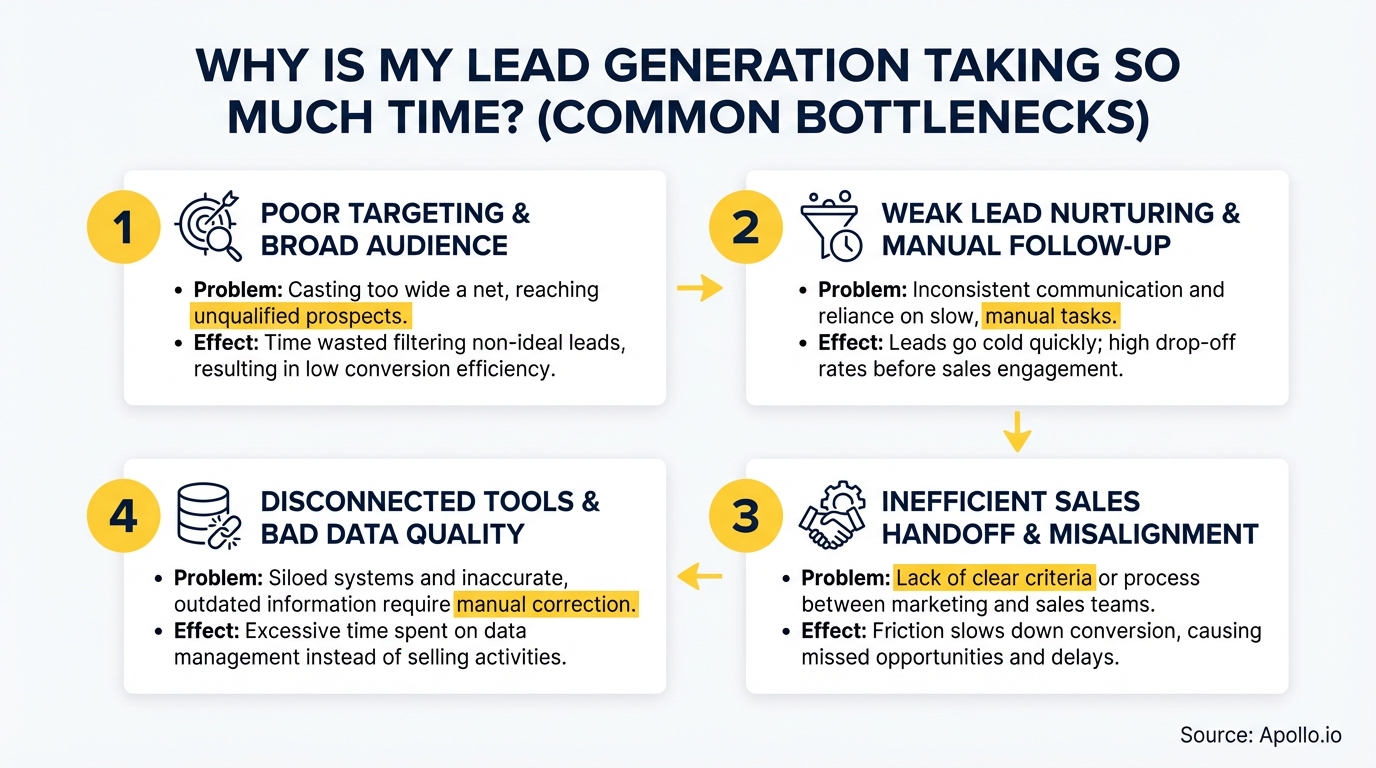
Most lead gen delays cluster around five root causes. Identifying yours is the fastest way to fix it.
| Bottleneck | What It Looks Like | Impact |
|---|---|---|
| Poor targeting | Reaching contacts outside your ICP | Low reply rates, wasted sequences |
| Bad data quality | Bounced emails, wrong numbers | Time lost on dead-end outreach |
| Manual workflows | Reps researching one contact at a time | Prospecting capacity severely limited |
| Sales-marketing misalignment | MQLs that sales ignores | Qualified leads stall and go cold |
| Multi-stakeholder complexity | Deals waiting on committee approval | Longer time-to-SQL and close |
Data from Foleon shows that in 2024, 65% of sales and marketing professionals reported a lack of alignment between their leaders. That disconnect is one of the most fixable, yet most overlooked, reasons lead gen feels slow.
Struggling to find qualified leads fast enough? Search Apollo's 230M+ contacts with 65+ filters to surface the right prospects in seconds.
How Do SDRs and BDRs Lose the Most Time in Lead Gen?
For SDRs and BDRs, lead generation slowdowns are almost always operational. The top time drains are manual research, switching between tools, and chasing unverified contact data.
- Manual research: Reps spend significant time finding contact info across disconnected sources before writing a single message.
- Tool fragmentation: Jumping between a data tool, a sequencer, a dialer, and a CRM creates constant context-switching that kills throughput.
- Low-quality data: Bounced emails and wrong numbers mean reps burn sequences on contacts they can never actually reach.
- Generic messaging: Blasting untailored outreach generates fewer replies, forcing more follow-up touches per meeting booked.
According to Sales Genie, 73% of B2B leads are not ready to make a purchase upon their first interaction with a brand. SDRs who understand this build multi-touch sequences instead of expecting immediate responses, which fundamentally changes how they structure their time.
As Collin Stewart at Predictable Revenue put it: "We reduced the complexity of three tools into one." That kind of consolidation is what gives SDRs more selling time per day.
Turn Weak Leads Into Pipeline With Apollo
Tired of marketing leads that never become real opportunities? Apollo surfaces verified, in-market prospects so your team stops guessing and starts closing. Nearly 100K paying customers already run on it.
Start Free with Apollo →Why Does Poor Data Quality Slow Down Lead Generation?
Bad data is a silent tax on your entire lead gen operation. Every bounced email, disconnected number, or outdated job title means a rep wasted time building a sequence that could never convert.
The downstream effect compounds: low deliverability hurts sender reputation, which reduces reply rates on future campaigns. Teams that don't invest in verified, up-to-date contact data end up running harder just to stay in place.
This is especially painful for data-driven prospecting teams trying to scale outbound. The answer isn't more volume. It's better data at the source.
Spending hours chasing bad contact data? Enrich your records with Apollo's verified business contacts and stop wasting sequences on leads you can't reach.

How Does Multi-Stakeholder Buying Slow Down Your Pipeline?
Modern B2B deals involve multiple decision-makers across multiple departments. When your outreach only reaches one contact, the deal stalls internally while that contact tries to build internal consensus without your help.
The fix is multi-threaded outreach: identifying and engaging the full buying committee early, not just the champion. This means your outbound prospecting needs to map to multiple stakeholder personas at the same account, with messaging tailored to each role's specific concerns.
- Economic buyers (CFOs, VPs): Lead with ROI and cost justification.
- Technical buyers (IT, Security): Address risk, compliance, and integration.
- End users: Focus on workflow improvement and ease of adoption.
Targeting the full committee from the start reduces back-and-forth delays and shortens the time from first touch to qualified opportunity.
How Can RevOps Leaders Fix Lead Gen Velocity?
RevOps leaders have the most leverage to fix systemic lead gen slowdowns because they own the infrastructure. The highest-impact levers are routing speed, data quality governance, and tech stack consolidation.
- Lead routing: Slow or manual routing lets hot leads go cold. Automate assignment rules based on territory, segment, or intent signals.
- Attribution modeling: Single-touch attribution misrepresents what's actually driving pipeline. Move to multi-touch models to fund the right channels.
- Stack consolidation: Fragmented tools create data silos and handoff friction. Teams that unify prospecting, engagement, and CRM in one platform close the gap between activity and pipeline.
As the team at Cyera noted: "Having everything in one system was a game changer." For RevOps, a unified platform means fewer integrations to maintain, cleaner data, and faster handoffs between marketing and sales. Explore Apollo's automated lead generation capabilities to see what a consolidated workflow looks like in practice.

How Do You Speed Up Lead Generation in 2026?
Fixing slow lead generation requires addressing both process and tooling. Here's a prioritized action plan:
- Sharpen your ICP: Narrow targeting reduces wasted outreach and increases reply rates. Use firmographic and intent filters to focus on accounts most likely to convert.
- Automate sequences: Replace manual one-off outreach with multi-channel sequences that run across email, phone, and social without requiring rep intervention at every step.
- Invest in verified data: Use a B2B lead generation tool with high email accuracy to reduce bounce rates and protect sender reputation.
- Enable the full buying committee: Build stakeholder-specific content and outreach paths so no deal stalls waiting for internal alignment.
- Fix attribution: Multi-touch attribution tells you which channels actually produce pipeline, so you stop funding what doesn't work.
- Align sales and marketing on lead definitions: Agree on what qualifies as an SQL before leads enter the handoff process, not after.
For more proven approaches, see lead generation strategies that work and prospect nurturing tactics to keep leads moving through the funnel.
Stop Letting Slow Lead Gen Cost You Pipeline
Lead generation takes too long when buyers move independently, data is dirty, teams are misaligned, and tools are fragmented. Each bottleneck is solvable, and fixing even two or three of them produces a measurable difference in time-to-pipeline.
Apollo consolidates prospecting, outreach automation, data enrichment, and pipeline management into one unified GTM platform. Over 600K companies use Apollo to find the right contacts, run multi-channel sequences, and build pipeline faster without stitching together multiple tools. As the Census team summarized: "We cut our costs in half."
Ready to remove the bottlenecks slowing your lead generation? Try Apollo free and start building pipeline from a single workspace.
Prove Pipeline ROI With Apollo
ROI pressure killing your next budget approval? Apollo delivers measurable pipeline impact your leadership can't ignore. Leadium 3x'd annual revenue — see what Apollo can justify for your team.
Start Free with Apollo →Don't miss these
Sales
Inbound vs Outbound Marketing: Which Strategy Wins?
Sales
What Is a Sales Funnel? The Non-Linear Revenue Framework for 2026
Sales
What Is a Go-to-Market Strategy? The 2026 GTM Playbook
See Apollo in action
We'd love to show how Apollo can help you sell better.
By submitting this form, you will receive information, tips, and promotions from Apollo. To learn more, see our Privacy Statement.
4.7/5 based on 9,690 reviews
