
Who Signs Off on AI SDR Tool Purchases at a Mid-Market B2B Company?
In 2026, buying an AI SDR tool at a mid-market B2B company is no longer a single conversation with the VP of Sales. Security, finance, RevOps, and legal all have a seat at the table, and understanding the full approval chain is what separates deals that close from pilots that stall. If you're evaluating B2B marketing and sales tools or trying to build internal consensus for AI outbound tooling, this playbook maps every stakeholder, what they require, and how to move them to yes. Tools like Apollo's AI Sales Assistant are increasingly part of these conversations, helping GTM teams demonstrate productivity gains and consolidation value that make the business case easier to build.

Verify Leads Fast, Sell More With Apollo
Tired of hours lost to manual research and bounced contact info? Apollo delivers verified emails and business numbers so your team spends time selling, not searching. Nearly 100K paying customers trust Apollo to keep pipeline moving.
Start Free with Apollo →Key Takeaways
- AI SDR tool approvals at mid-market B2B companies typically require sign-off from 4-6 stakeholders across Sales, RevOps, Finance, IT/Security, and sometimes Legal.
- Security and data governance reviews have become a default step, not an afterthought, in the AI tool procurement process.
- CFOs are increasingly involved when AI SDR tools are framed as headcount alternatives, raising the ROI proof bar significantly.
- RevOps leaders now co-own the decision alongside Sales leadership, especially when the tool touches CRM data or email infrastructure.
- Platform tools embedded in existing GTM stacks face fewer approval barriers than standalone point solutions.
Who Are the Core Approvers for AI SDR Tools?
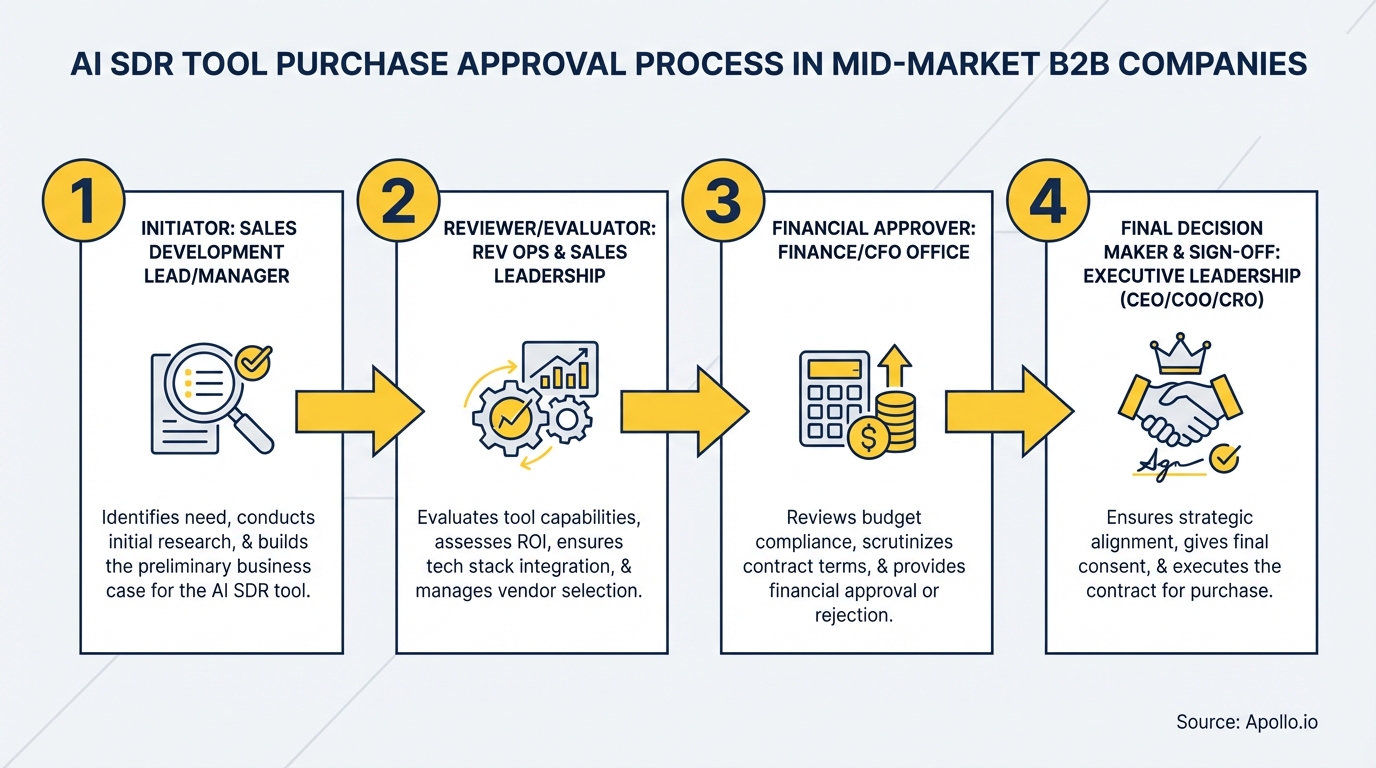
The primary sign-off for AI SDR tools at a mid-market B2B company typically involves four to six stakeholders, each owning a different piece of the approval puzzle. No single person controls the decision outright.
| Stakeholder | Primary Concern | What They Need to Approve |
|---|---|---|
| VP/CRO of Sales | Pipeline impact, rep adoption | Proof of meeting volume increase, workflow fit |
| RevOps Leader | CRM integration, data quality, deliverability | Technical fit, stack consolidation, admin controls |
| CFO / Finance | ROI, budget authority, payback period | Business case with measurable outcomes |
| IT / InfoSec | Data security, vendor risk, access controls | Vendor risk questionnaire, SOC2/ISO compliance docs |
| Legal / Compliance | Data processing, contact sourcing, brand risk | DPA review, data retention policies, autonomy limits |
| Marketing / CMO | Brand voice, email deliverability, sender reputation | Domain authentication governance, message review |
According to Cirrus Insight, budget controllers and organizational influencers demonstrate strong strategic commitment to AI adoption decisions. That commitment, however, comes with scrutiny — meaning champions need to prep each stakeholder with the right artifacts before the formal review.
Why Has the AI SDR Buying Committee Expanded in 2026?
The buying committee for AI SDR tools has grown because the risk profile of these tools has grown alongside their capability. Autonomous outreach that touches prospect data, email infrastructure, and CRM records pulls in stakeholders who previously had no role in sales tool decisions.
Three forces are driving this expansion:
- Security incidents: GenAI-related data loss prevention incidents now account for a meaningful share of SaaS security events, pushing IT and InfoSec into the approval chain as a default step.
- Deliverability governance: Email authentication requirements have hardened through 2025 and into 2026, making domain reputation a shared asset that RevOps and IT co-manage.
- CFO scrutiny on AI spend: When AI tools are positioned as replacements for SDR headcount, finance leadership requires a clear payback model before signing off.
Research from MarketsandMarkets shows the AI SDR market is expected to grow from approximately $4.12 billion in 2025 to $15.01 billion by 2030. That growth is accelerating procurement scrutiny, not reducing it — more vendors means more evaluation work for buying committees.
Struggling to build the pipeline proof your CRO needs? See how Apollo helps GTM teams build predictable pipeline with AI.
Turn Funnel Gaps Into Forecast Wins
Pipeline forecasting a guessing game? Apollo surfaces in-market buyers before they go cold, so your funnel fills with leads that actually convert. 600K+ companies have replaced pipeline anxiety with predictable revenue.
Schedule a Demo →What Do RevOps Leaders Need Before They Sign Off?
RevOps leaders are now co-decision-makers on AI SDR tools, not just implementers. Their approval hinges on technical fit and stack consolidation, not just feature lists.
According to Nektar.ai, RevOps tools are designed to streamline processes, provide data-driven insights, and improve collaboration between sales, marketing, and finance. An AI SDR tool that fragments these functions rather than unifying them will face resistance.
RevOps sign-off checklist:
- Native CRM integration (no manual sync required)
- Domain authentication and sender reputation controls
- Admin visibility into sequences, contact enrollment, and email volume
- Consolidation value: does this replace existing tools or add to the stack?
- Credit transparency and usage reporting
For RevOps leaders evaluating Apollo, the platform's Apollo AI Overview demonstrates how AI capabilities are embedded natively across prospecting, sequencing, and analytics, rather than bolted on as a separate module. Teams like Cyera have noted that "having everything in one system was a game changer" for RevOps efficiency.

How Do CFOs Evaluate AI SDR Tool ROI?
CFOs sign off on AI SDR tools when the business case includes a clear payback model tied to pipeline outcomes, not just productivity claims. Positioning a tool as a headcount replacement raises the proof bar substantially.
Data from Market.us indicates that sales teams using AI are 1.3 times more likely to report revenue growth. That directional finding helps, but CFOs want company-specific metrics: meetings booked per dollar spent, pipeline influenced, and time-to-payback.
A CFO-ready business case for an AI SDR tool should include:
- Baseline metrics: Current meetings booked per rep per month, cost per meeting, SDR fully-loaded cost
- Projected uplift: Use pilot data or vendor case studies with attributed outcomes
- Tool consolidation savings: If the platform replaces existing tools, quantify the reduction in vendor spend
- Payback period: Target 6-12 months for mid-market budgets
Apollo's AI Assistant helps internal champions build this narrative faster by generating account research, prospect lists, and outreach sequences that can demonstrate pilot ROI before the formal budget ask.
What Does IT and Security Need to Approve GenAI Outbound Tools?
IT and InfoSec require a formal vendor risk review before approving any AI SDR tool that processes business contact data or connects to email and CRM systems. This step is now standard, not optional.
Key artifacts IT and Security will request:
- SOC2 Type II and/or ISO 27001 certification
- Data processing agreement (DPA) and data retention policy
- Confirmation that customer data is not used to train external AI models
- Access control documentation (SSO, role-based permissions)
- Incident response and breach notification procedures
- Subprocessor list (which AI models does the tool use?)
Apollo is SOC2 and ISO 27001 certified and explicitly does not allow customer data to be used to train external AI models. For InfoSec teams reviewing the vendor, the AI Research Overview documents which underlying AI models are used and for what purposes, providing the transparency security teams require.
Need to show your IT team that AI outreach can be governed properly? See how Apollo's sales engagement platform gives admins full visibility and control.
How Can the Internal Champion Accelerate Sign-Off?
The internal champion, typically an SDR manager, Sales leader, or RevOps leader, determines whether the approval process takes weeks or months. Accelerating sign-off requires sequencing stakeholder conversations correctly and preparing stakeholder-specific materials in advance.
Proven sequencing approach:
- Start with RevOps: Validate technical fit and stack consolidation before going to Sales leadership. RevOps objections surfaced early save time later.
- Build the pilot first: A 30-day pilot with measurable output (meetings booked, sequences sent, reply rates) gives the CFO real data rather than projections.
- Prepare IT artifacts before the security review: Request vendor compliance docs proactively. Don't wait for IT to ask.
- Present to the CRO with pilot data: Frame the ask around pipeline impact, not features.
- Route legal review in parallel: DPA and data use reviews can run concurrently with the pilot, not after it.
SDR managers and RevOps leaders who have run this process with Apollo report that the platform's consolidated workflow reduces the number of vendors IT needs to review, which shortens the security approval cycle. As Tory Kindlick, Head of Revenue Ops at RapidSOS, noted: "Work that would've taken me hours was done before I even got off the train." That kind of tangible efficiency story is exactly what internal champions need to build their case.
For champions building their pitch, reviewing proven B2B sales techniques and enterprise sales solutions can help frame the ROI narrative for executive audiences. Understanding how the B2B buyer journey has shifted in 2026 also helps champions anticipate executive objections before they arise.
How Do You Move from Pilot to Approved Production Spend?
Moving from pilot to approved production spend requires translating pilot activity into business outcomes, then connecting those outcomes to the metrics each approver cares about.
Pilot-to-production checklist:
- Document meetings booked, reply rates, and sequences sent during the pilot period
- Calculate cost-per-meeting against your baseline
- Identify which existing tools the platform replaces and quantify vendor consolidation savings
- Get written sign-off from IT and Legal during the pilot, not after
- Present a 12-month projection to the CFO using pilot-validated assumptions
Apollo's Outbound Copilot is particularly useful during the pilot phase because it provides credit cost transparency before each run, giving champions precise data on activity and spend that directly feeds the CFO business case. The platform's AI-powered approach has driven a 35% increase in bookings with AI-powered messaging for teams like Anthropic, providing the kind of documented outcome data that moves budget approvals forward.

Start Your AI SDR Evaluation with Apollo
The sign-off process for AI SDR tools at mid-market B2B companies now spans Sales, RevOps, Finance, IT/Security, and Legal. Champions who sequence stakeholder conversations correctly, run a structured pilot, and prepare stakeholder-specific artifacts move fastest through the approval gate.
Apollo consolidates prospecting, outreach, data enrichment, and AI workflows into a single platform, reducing the vendor surface area that IT needs to review and giving RevOps the unified visibility they require. Teams at Predictable Revenue describe it as reducing "the complexity of three tools into one," while Census noted they "cut costs in half" by consolidating their stack.
Ready to build your business case? Start your free trial of Apollo and generate the pilot data your buying committee needs to say yes.
Prove Pipeline ROI Before Next QBR
Budget approval stuck on unclear metrics? Apollo surfaces measurable pipeline impact fast — so you walk into every review with hard numbers, not guesses. Leadium 3x'd annual revenue. You're next.
Start Free with Apollo →Don't miss these
Sales
Inbound vs Outbound Marketing: Which Strategy Wins?
Sales
What Is a Sales Funnel? The Non-Linear Revenue Framework for 2026
Sales
What Is a Go-to-Market Strategy? The 2026 GTM Playbook
See Apollo in action
We'd love to show how Apollo can help you sell better.
By submitting this form, you will receive information, tips, and promotions from Apollo. To learn more, see our Privacy Statement.
4.7/5 based on 9,690 reviews
