
Who Should You Involve Before Selecting and Rolling Out Sales Automation Software?
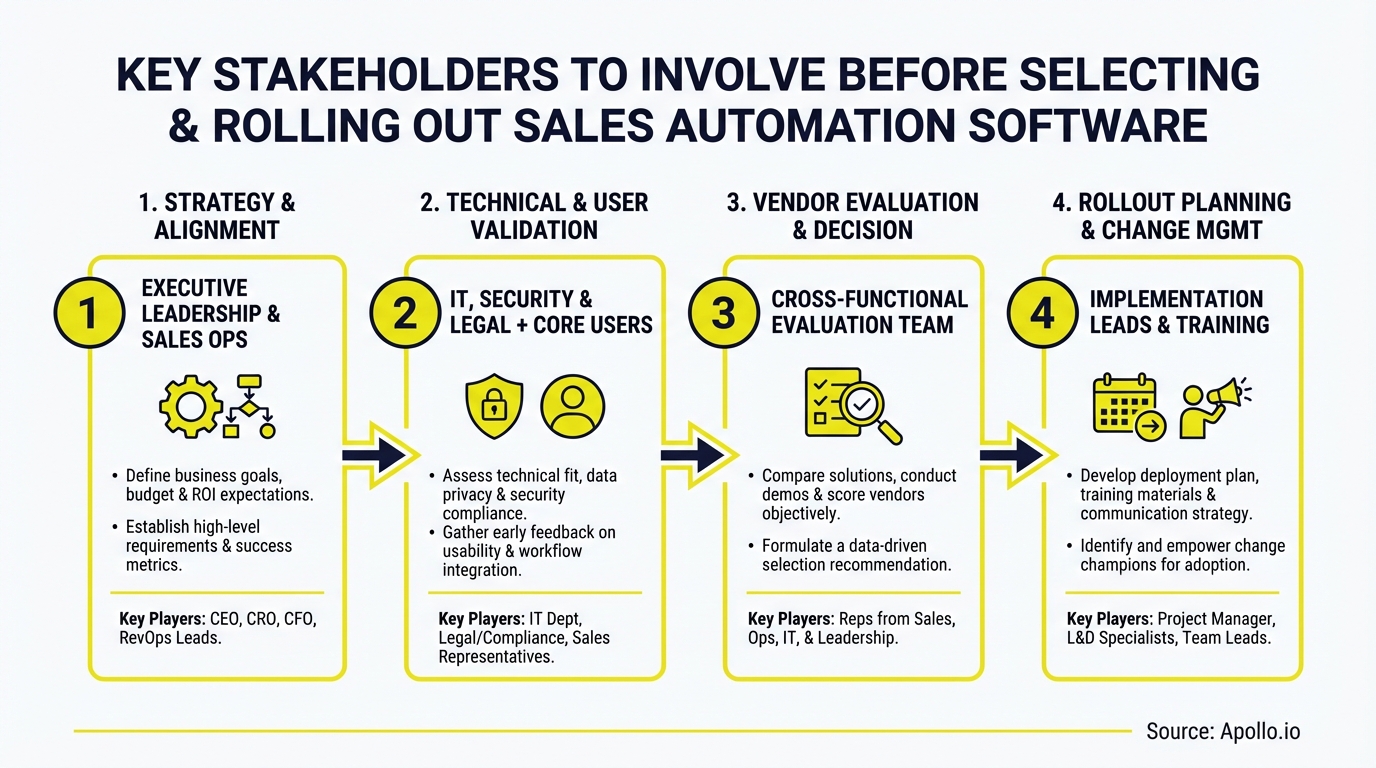
Picking the wrong stakeholders for your sales automation decision is one of the fastest ways to kill adoption before the first sequence fires. The right people in the room early mean smoother rollouts, cleaner data, and tools that actually get used. Before you evaluate a single vendor, you need a cross-functional buying committee, not just a sales leader with a credit card. Learn more about how sales automation software drives revenue before building your stakeholder list.
According to a Deloitte study cited by Unboxed Technology, 75% of successful projects report high levels of stakeholder involvement and buy-in from the start. That number alone justifies the investment in getting the right people aligned before you ever open a demo call.

Research Less, Close More With Apollo
Tired of your reps burning hours on manual lead research instead of selling? Apollo surfaces verified contacts instantly, so your team spends time closing — not digging. Join 600K+ companies building pipeline faster.
Start Free with Apollo →Key Takeaways
- Sales automation buying decisions require a cross-functional committee spanning Sales, RevOps, IT, Security, Finance, and Marketing.
- CRM admins and data owners are gating stakeholders, not afterthoughts — poor data quality directly undermines automation ROI.
- Security and Legal must be involved early when AI or agentic features are part of the platform.
- RevOps should own the process design and adoption instrumentation, not just the software configuration.
- Frontline reps and SDRs need a seat at the table to prevent low adoption after launch.
Who Are the Core Stakeholders for Sales Automation Selection?
The core stakeholders for sales automation selection are Sales leadership, RevOps, IT, CRM admins, Security/Legal, Finance, Marketing, and frontline reps. Each group controls a different gate in the selection and rollout process.
Missing any one of them creates a predictable failure point.
| Stakeholder | Role in Selection | Gate They Control |
|---|---|---|
| Sales Leadership (VP/CRO) | Define use cases, quota pressure, pipeline goals | Business justification and budget sponsorship |
| RevOps / Sales Ops | Workflow design, process requirements, integration specs | Technical fit and process operationalization |
| CRM Admin / Data Owner | Data quality audit, field mapping, governance rules | Data readiness and CRM compatibility |
| IT / Enterprise Architecture | Integration review, security posture, tool consolidation | Infrastructure approval and tech stack fit |
| Security / Legal / Privacy | Vendor risk review, AI governance, data retention policies | Compliance sign-off before go-live |
| Finance | ROI model, baseline metrics, contract review | Budget approval and value measurement |
| Marketing Ops | Lead handoff workflows, attribution, CRM field alignment | Marketing-to-sales process continuity |
| Frontline Reps / SDRs | Usability feedback, workflow validation, adoption input | Day-one adoption and long-term usage |
Why Do RevOps and CRM Admins Need to Be Involved First?
RevOps and CRM admins must be involved first because they own the data foundation that automation runs on. Revenue.io notes that Sales Operations professionals are increasingly leading initiatives in automation, data strategy, and revenue intelligence — making them the logical owners of pre-selection workflow design.
Data quality is a gating issue, not a configuration detail. Without clean CRM data, automation amplifies errors at scale rather than productivity. CRM admins need to audit field completeness, deduplication rules, and ownership before any vendor is selected. Spending hours cleaning data after go-live costs far more than doing it before. Struggling to keep your contact data clean? Apollo's data enrichment keeps your CRM accurate with 230M+ verified contacts.
Why Must Security and Legal Be Gating Stakeholders?
Security and Legal must be gating stakeholders because AI-enabled sales automation introduces vendor risk, data retention obligations, and model governance questions that require formal sign-off before rollout. As buying committees expand in 2026, Security and Privacy are no longer late-stage checkboxes — they are pre-selection participants.
The practical implication: run your vendor security review in parallel with your functional evaluation, not after you've already chosen a tool. Key review areas include:
- Data retention and deletion policies
- AI model governance and audit trail documentation
- Role-based access controls and admin policy management
- Subprocessor lists and data residency requirements
- SOC 2 Type II certification and penetration test recency
Turn Blind Forecasts Into Pipeline Clarity
Pipeline forecasting a guessing game because your deal stages are stale and inconsistent? Apollo's real-time signals show exactly where buyers stand — so your team acts first, not after. Join 600K+ companies forecasting with confidence.
Schedule a Demo →How Do SDRs and Frontline Reps Influence the Selection Decision?
SDRs and frontline reps influence selection by surfacing usability gaps and workflow mismatches that no stakeholder above them can identify. SuperAGI reports that 74% of sales professionals anticipate AI will redefine their roles, highlighting the need for their early involvement in automation discussions.
SDRs are the heaviest daily users of sales automation. If the tool doesn't fit their prospecting and sequencing workflow, adoption will collapse within weeks of launch.
Include 2-3 SDR or BDR representatives in the pilot evaluation group. Their feedback on sequence builder UX, contact data quality, and task management directly predicts post-launch adoption rates.
For Account Executives, the key evaluation questions center on deal visibility, call intelligence, and CRM sync reliability.
Spending hours on manual outreach while evaluating tools? See how Apollo's multi-channel sales engagement platform works for SDRs and AEs.

What Pre-Rollout Checklist Should Your Committee Work Through?
Your committee should work through a structured pre-rollout checklist covering data readiness, process design, security sign-off, and adoption planning before any go-live date is set. Treating rollout as a training event alone is the most common failure mode — operationalization requires configuration governance and instrumented adoption metrics from day one.
Pre-Selection Gates:
- CRM data audit complete (field mapping, deduplication, ownership rules)
- Current tool inventory reviewed for consolidation opportunities
- Security/Legal vendor review initiated in parallel with demos
- Finance baseline metrics documented (current cost per meeting, outreach volume, rep utilization)
- RevOps workflow requirements documented and signed off
- SDR/AE pilot group identified
Pre-Rollout Gates:
- Integration testing complete (CRM, calendar, dialers)
- Admin policy and role-based access configured
- Sequence templates and workflow configurations reviewed by Sales Ops
- Adoption metrics and success KPIs defined (sequence open rates, meetings booked, CRM update rates)
- Enablement content and training sessions scheduled
- Security sign-off documented
Explore Apollo's workflow automation engine to see how pre-built templates reduce configuration time during rollout.
How Should Finance and RevOps Build the ROI Model?
Finance and RevOps should build the ROI model by first documenting current-state baselines, then projecting productivity gains against those baselines using a pilot-to-scale approach. Without a baseline, you cannot measure value — and without RevOps owning the model, Finance will default to cost-only analysis that misses productivity upside.
Key baseline metrics to capture before selection:
- Average hours per rep spent on non-selling tasks per week
- Current cost per qualified meeting booked
- Average sequence build time and outreach volume per SDR
- CRM data accuracy rate (target: above 90% before automation scales)
- Number of tools currently in the sales tech stack and their combined cost
Tool consolidation is a significant ROI lever that Finance teams often undervalue. Teams that consolidate from multiple point solutions to a unified platform report material reductions in both licensing cost and integration maintenance. As Census put it: "We cut our costs in half." Cyera found that "having everything in one system was a game changer." These outcomes start with the right stakeholders asking the right consolidation questions before vendor selection.
What Does a Successful Rollout Look Like for Growing B2B Teams?
A successful rollout for growing B2B GTM teams is one where adoption is instrumented, process design is complete before go-live, and the tool consolidates rather than adds to the existing stack. Cirrus Insight reports that 75% of organizations globally use sales automation in some form — meaning the competitive baseline already assumes automation is in place.
The teams that extract the most value from sales automation done right are those where RevOps owns process design, SDRs own daily execution, and Sales leadership owns the adoption accountability loop. A phased rollout — starting with a 5-10 rep pilot, measuring results over 30-45 days, then scaling — consistently outperforms full-team launches with no baseline measurement.
For enterprise GTM teams, the rollout plan must also include advanced routing rules, admin governance controls, and security policy documentation as first-class deliverables alongside the standard enablement content.

Ready to Roll Out Sales Automation the Right Way?
Getting the right stakeholders involved before selection is the difference between a tool that transforms your pipeline and one that collects dust after 90 days. RevOps, CRM admins, Security, Finance, and your frontline reps all need a seat at the table — and they all need clear ownership of their gate before you sign a contract.
Apollo is the all-in-one GTM platform trusted by nearly 100K paying companies to consolidate prospecting, engagement, data enrichment, and workflow automation into a single workspace. Teams like Predictable Revenue found that Apollo let them reduce the complexity of three tools into one. Try Apollo free and see how your team's buying committee evaluates it against your current stack.
Prove Pipeline ROI From Day One
ROI pressure killing your tool budget before it even launches? Apollo delivers measurable pipeline impact fast — so justifying the investment is easy. Join 600K+ companies turning GTM spend into revenue.
Start Free with Apollo →Don't miss these
Sales
Inbound vs Outbound Marketing: Which Strategy Wins?
Sales
What Is a Sales Funnel? The Non-Linear Revenue Framework for 2026
Sales
What Is a Go-to-Market Strategy? The 2026 GTM Playbook
See Apollo in action
We'd love to show how Apollo can help you sell better.
By submitting this form, you will receive information, tips, and promotions from Apollo. To learn more, see our Privacy Statement.
4.7/5 based on 9,690 reviews
