
Who Is a GTM Engineer and What Skills Do They Need in 2026?
The GTM Engineer role is one of the fastest-growing functions in B2B sales — and one of the most misunderstood. Many organizations frame it as a systems architect job: someone whose primary value is stitching 14 tools together into a so-called "seamless" workflow. That framing misses the point entirely. The best GTM Engineer is a revenue strategist — someone who builds elegant, scalable systems that convert strategy into pipeline without the integration overhead. If you're exploring GTM strategy or building a revenue function, understanding this role is now table stakes.

Let Apollo Find Contacts While You Close
Tired of your reps burning hours on manual research instead of selling? Apollo surfaces verified contacts instantly, so your team spends time closing—not hunting. Join 600K+ companies building pipeline on autopilot.
Start Free with Apollo →Key Takeaways
- A GTM Engineer is a technical specialist who ensures go-to-market systems operate seamlessly, reliably, and efficiently — not just a tool administrator.
- The role sits at the intersection of revenue strategy, automation, data orchestration, and AI operations.
- Core skills span API/SQL fluency, scoring model design, messaging architecture, and multi-stakeholder journey instrumentation.
- GTM Engineers differ from RevOps: they build the system; RevOps maintains and governs it.
- The trajectory of the role is toward agentic GTM — where research, scoring, personalization, and routing run autonomously at scale.
What Is a GTM Engineer?
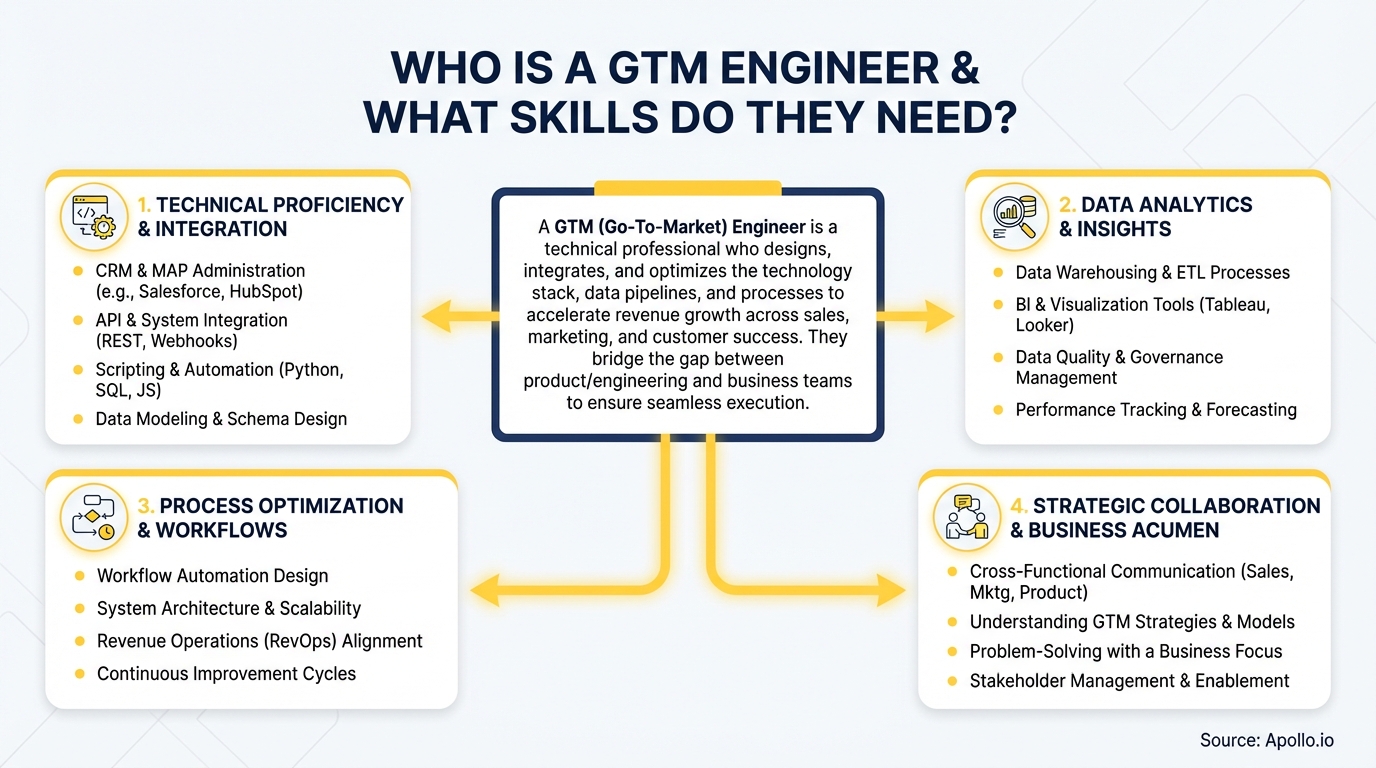
According to GoFractional, a Go-to-Market Engineer is "a technical specialist dedicated to ensuring that go-to-market systems operate seamlessly, reliably, and efficiently." In practice, that means designing and operating the full revenue infrastructure: TAM lists, scoring models, data pipelines, outbound sequences, and performance reporting — all connected into one coherent system.
As noted by Saleshandy, GTM Engineers concentrate specifically on integrating and automating GTM tech stacks for revenue teams, unlike traditional product developers or general IT engineers. The distinction matters: this is a revenue-first role, not an IT role wearing a sales hat.
Spending hours building prospect lists manually? Search Apollo's 230M+ contacts with 65+ filters and let your GTM system do the heavy lifting.
How Does a GTM Engineer Differ from RevOps?
A GTM Engineer builds the system; RevOps maintains and governs it. These are complementary functions, not competing ones. The clearest way to see the distinction is by output:
| Function | Primary Output | Time Horizon | Owns |
|---|---|---|---|
| GTM Engineer | System design + build | Project-based (weeks) | TAM, scoring, data pipelines, messaging architecture |
| RevOps | System maintenance + governance | Ongoing (monthly/quarterly) | CRM hygiene, reporting, process enforcement, deliverability |
| Sales Engineer | Technical pre-sales support | Deal-based | Product demos, solution design, POC execution |
For more context on how sales and marketing functions divide responsibilities, the boundaries are similarly fluid — and GTM Engineering lives at the intersection of both.

What Skills Does a GTM Engineer Need?
GTM Engineers need a blend of technical depth and revenue strategy fluency. The skill set has two layers: foundational technical capabilities and strategic systems thinking.
What Are the Core Technical Skills?
According to GTM Engineer Club, proficiency in APIs, SQL, Python, or JavaScript is essential for automating processes, manipulating data, and building light applications. These aren't optional extras — they're the foundation for everything a GTM Engineer builds.
- API and webhook literacy: Connect data sources, trigger automations, and build enrichment pipelines without relying on engineering teams.
- SQL and data querying: Pull and transform CRM and pipeline data for scoring, segmentation, and reporting.
- Workflow automation: Design and operate orchestration workflows that run enrichment, scoring, and sequencing automatically.
- Prompt engineering: Build AI prompt architectures that generate persona-specific, research-based messaging at scale.
- Deliverability management: Size domain and mailbox infrastructure mathematically against TAM and burn rate targets.
What Are the Strategic Skills GTM Engineers Need?
Technical skills get the system built. Strategic skills determine whether it produces pipeline.
GTM Engineers must translate leadership priorities into math — scoring models that rank every account in the TAM based on fit, intent, timing, and engagement signals.
- ICP and TAM design: Define and qualify the total addressable market with AI-assisted criteria, not just spreadsheet filters.
- Scoring model architecture: Assign weighted signals (funding, tech stack, intent, inbound engagement) that rank accounts defensibly.
- Multi-stakeholder orchestration: Route outreach and personalize messaging across buying groups — Forrester's Buyers' Journey Survey in 2024 found an average of 13 people involved in a B2B purchase decision.
- Signal-based selling: Connect intent data and first-party signals to prioritization and messaging in real time.
- Performance optimization: Run correlation analysis between signals and GTM outcomes, then adjust scoring weights based on actual results — not gut feel.
Turn Dry Funnels Into Pipeline With Apollo
Running out of qualified leads before you hit quota? Apollo surfaces in-market buyers matched to your ICP — so your outreach lands at the right moment. 600K+ companies never run dry.
Start Free with Apollo →How Do SDRs and RevOps Leaders Benefit from GTM Engineering?
SDRs working inside a well-built GTM system spend their time on judgment and conversations — not research and list-building. The system surfaces prioritized accounts with AI-researched context, draft messaging, and scoring rationale.
SDRs review, refine, and approve. Outreach runs at scale without manual effort on every touch.
RevOps leaders benefit from a different angle: a GTM Engineer gives them a single source of truth for the entire market, clean data pipelines that don't require constant manual reconciliation, and scoring models that make prioritization consistent across the team. Demand generation and outbound finally share the same data layer.
Tired of your team spending time on manual outreach instead of selling? Automate your GTM sequences with Apollo's AI-powered sales automation and redirect that time toward pipeline.
What Is the GTM Engineer's Role in an AI-First World?
The GTM Engineer role is professionalizing fast. In 2026, the skill center is shifting toward what practitioners are calling "revenue data engineering" — building reliable, governed data pipelines because AI automation fails without clean inputs.
Adobe's 2024 Digital Trends report found that 52% of teams prioritized automating manual tasks through content AI and chatbots, expanding GTM Engineer responsibilities into AI operations, content governance, and evaluation frameworks.
The trajectory is toward agentic GTM: research, enrichment, scoring, personalization, and routing running autonomously — with humans reviewing only the highest-priority accounts. The GTM Engineer who wins long-term builds the most elegant strategy at the highest execution velocity.
That means fewer tools, tighter feedback loops, and systems that compound instead of reset every quarter.
Apollo's GTM Engineering (GTME) Program is built around this exact philosophy: one platform, one workflow, no API babysitting. The seven-pillar methodology covers TAM unification, scoring, messaging intelligence, data orchestration, human-in-the-loop review, and performance optimization — all connected inside a single system.
Conclusion: Build the System, Not Just the Stack
A GTM Engineer is a revenue strategist who happens to speak the language of data, automation, and AI. The role exists to collapse fragmented workflows into one elegant GTM system — not to earn a badge for the most elaborate Frankenstack.
As B2B buying groups grow more complex and buyers increasingly prefer self-serve journeys, the GTM Engineer becomes the architect of how strategy actually reaches the market.
For sales leaders, RevOps teams, and founders building outbound motion, the question is no longer whether to invest in GTM engineering — it's whether you have the platform to support it. Start Prospecting with Apollo and see what a unified GTM system looks like in practice.
Prove Pipeline ROI With Apollo
ROI pressure killing your next tool approval? Apollo delivers measurable pipeline outcomes your exec team can actually see. Leadium 3x'd their annual revenue — your CFO will notice results like that.
Start Free with Apollo →Don't miss these
Sales
Inbound vs Outbound Marketing: Which Strategy Wins?
Sales
What Is a Sales Funnel? The Non-Linear Revenue Framework for 2026
Sales
What Is a Go-to-Market Strategy? The 2026 GTM Playbook
See Apollo in action
We'd love to show how Apollo can help you sell better.
By submitting this form, you will receive information, tips, and promotions from Apollo. To learn more, see our Privacy Statement.
4.7/5 based on 9,690 reviews
