
Which Tool Offers the Best User Management in 2026?
Choosing the wrong user management tool costs more than a renewal fee. Orphaned accounts, manual offboarding, and audit gaps create real security and compliance exposure for B2B GTM teams. If you're evaluating platforms for your sales tech stack, user management quality is now a first-order buying criterion, not an afterthought.
This guide cuts through the noise with a governance-first framework: the three layers every tool must cover, how to score provisioning maturity, and what RevOps leaders are prioritizing in 2026.

Research Smarter, Not Harder With Apollo
Tired of burning hours verifying contacts before a single email goes out? Apollo delivers 97% accurate business emails and phones so your reps spend time selling, not searching. Join 600K+ companies building pipeline faster.
Start Free with Apollo →Key Takeaways
- The best user management tools combine identity provisioning (SCIM), role-based access control (RBAC), and exportable audit trails, not just a clean admin UI.
- SCIM automated provisioning is still rare: an analysis of 721 SaaS apps found 98.8% either lack SCIM or paywall it, leaving admins with manual lifecycle work even when SSO is active.
- Review, editing, and approval workflows are the top compliance bottleneck, making permissions and approval gates more critical than onboarding speed alone.
- The IAM market is growing fast, according to MarketsandMarkets, projected to reach USD 25.96 billion in 2025 and USD 42.61 billion by 2030, reflecting how seriously buyers are taking identity and access.
- For B2B GTM teams, the best user management tool is often the one that consolidates identity, engagement, and pipeline data without requiring five separate admin consoles.
What Is User Management in B2B SaaS Tools?
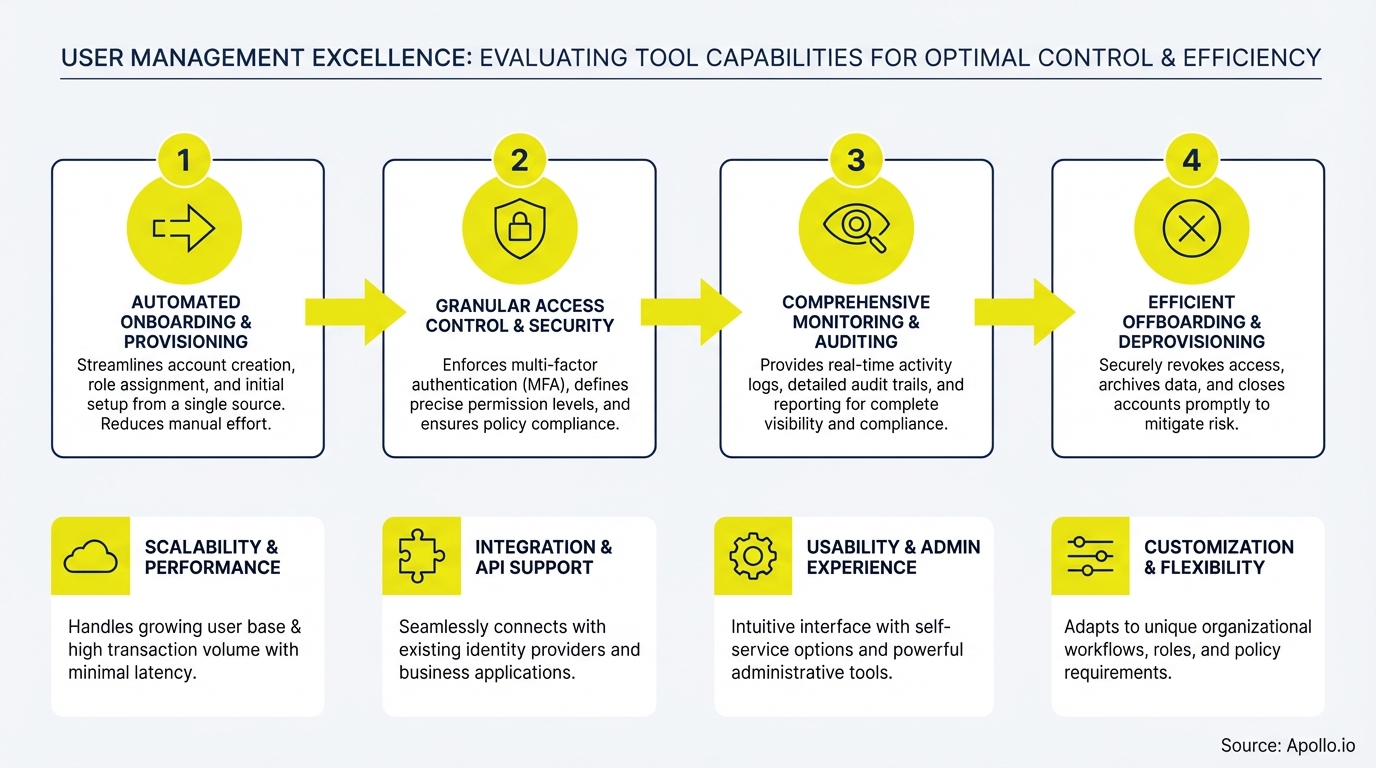
User management in B2B SaaS refers to the full lifecycle of controlling who has access to a platform: provisioning new users, assigning roles and permissions, enforcing authentication policies, and deprovisioning access when someone leaves. Strong user management goes beyond an admin panel.
It includes automated provisioning via SCIM, role-based access control (RBAC), multi-factor authentication (MFA) enforcement, delegated admin capabilities, and exportable audit logs for compliance evidence.
Historically called "admin controls" or "account management," the category has expanded significantly. Buyers in 2026 expect their CRM, MAP, and sales intelligence platforms to integrate cleanly with identity providers like Microsoft Entra or Okta, not just offer a standalone user list.
Why Is the SCIM Provisioning Gap a Problem in 2026?
The SCIM provisioning gap is a problem because the vast majority of SaaS tools still require manual user management even when SSO is in place. An analysis of 721 SaaS apps found 98.8% either lack SCIM support entirely or restrict it to premium tiers, meaning admins must manually add, update, and remove users across every tool in the stack.
This creates direct risk for RevOps and IT teams:
- Orphaned accounts: Former employees retain access after offboarding because no automated deprovisioning exists.
- Audit exposure: Manual processes leave gaps in evidence trails required for SOC 2 or ISO audits.
- Admin overhead: Ops teams spend time on access tickets instead of revenue-generating work.
- Pricing friction: SCIM is increasingly gated behind enterprise tiers, making "best user management" partly a total cost of ownership question.
When SCIM is unavailable, practical alternatives include API-based lifecycle automation, group-based RBAC mapped through your IdP, and offboarding verification checklists tied to HR system triggers. The key is eliminating manual steps wherever possible.
What Is the Three-Layer User Management Scorecard?
The best framework for evaluating user management quality uses three layers: Identity, Authorization, and Evidence. Each layer maps to a concrete set of features you can score during vendor evaluation.
| Layer | What to Evaluate | Minimum Bar |
|---|---|---|
| Identity | SCIM support, SSO compatibility, MFA enforcement, IdP group mapping | Native SCIM + SSO on mid-tier plans or below |
| Authorization | RBAC granularity, delegated admin, least-privilege defaults, approval workflows | At least 3 distinct role levels; approval gates for sensitive actions |
| Evidence | Audit log completeness, export format, retention period, admin activity visibility | Exportable logs with 90-day minimum retention; admin action timestamps |
Score each layer 1–3 (1 = manual/absent, 2 = partial/gated, 3 = automated/included). A total score of 7–9 indicates enterprise-ready user management. Scores below 5 signal meaningful lifecycle risk.
Struggling to manage your pipeline alongside user access across too many tools? See how Apollo's unified GTM platform simplifies your revenue operations.
Turn Funnel Guesswork Into Real Pipeline
Pipeline forecasting a guessing game because marketing leads never convert? Apollo surfaces high-intent buyers before they stall, so your team fills the funnel with opportunities that actually close. Join 600K+ companies building predictable revenue.
Schedule a Demo →How Do RevOps Leaders Evaluate User Management Tools?
RevOps leaders evaluate user management tools by asking whether the platform reduces admin burden, integrates with their existing IdP, and produces audit evidence without custom engineering. The question has shifted from "does this tool have a user screen?" to "can Entra or Okta fully automate joiner-mover-leaver workflows for this platform?"
Key evaluation criteria RevOps teams apply in 2026:
- IdP-first compatibility: Does the tool accept group-to-role mapping from Entra/Okta, or does every role assignment require a manual click in the app?
- Deprovisioning reliability: Can access be revoked automatically within minutes of an HR event, or does it depend on a ticket queue?
- Governance for approvals: Review, editing, and approval workflows represent the top compliance bottleneck for content and sales operations teams alike, so tools that embed approval gates into role assignments score higher.
- Pricing transparency: SSO and SCIM features gated behind enterprise pricing inflate total cost and slow security posture improvements for growing teams.
For teams evaluating B2B marketing and sales tools, user management maturity is increasingly a procurement gate, not just an IT checkbox.

Which Categories of Tools Offer the Strongest User Management?
Dedicated identity and access management (IAM) platforms offer the strongest user management capabilities, followed by enterprise CRM and sales intelligence platforms that have invested in governance features. According to Okta's 2024 Gartner Magic Quadrant recognition, Okta was named a Leader for the eighth consecutive year in Access Management, with Ping Identity also named a Leader in the same report, reflecting the maturity of the dedicated IAM category.
For B2B GTM teams, the practical question is different: you need user management that is good enough to pass a security review and automated enough to not slow down your ops team, inside the tools you already use for prospecting, engagement, and pipeline. Platforms that consolidate those functions reduce the total number of admin consoles to manage and the total number of IdP integrations to maintain.
Research from Stratview Research places the IAM market at USD 21.1 billion in 2025, projected to reach USD 24.3 billion in 2026, a 15.1% year-over-year increase. That growth reflects how seriously buyers across all segments are taking identity and access investment.
How Does Apollo Handle User Management for Sales Teams?
Apollo provides role-based access controls, team-level permissions, and admin governance features designed for multi-seat B2B GTM teams. For SDRs, AEs, and RevOps leaders operating inside one platform, this means managing who can view, export, or act on contact data without toggling between separate security consoles.
The consolidation advantage matters here. As Cyera noted, "Having everything in one system was a game changer." When your prospecting data, engagement sequences, pipeline tracking, and team permissions live in one workspace, you eliminate the provisioning sprawl that comes from stitching together five separate tools.
Predictable Revenue put it directly: "We reduced the complexity of three tools into one."
For teams building or auditing their AI sales tool stack, Apollo's unified platform means fewer integration points to govern, fewer audit gaps to close, and fewer vendor admin panels for your ops team to maintain.
Managing too many disconnected sales tools? Consolidate prospecting, outreach, and pipeline into one platform with Apollo.

How Should You Choose the Best User Management Tool for Your Team?
Choose the best user management tool by matching your governance requirements to the three-layer scorecard above, then factoring in total cost and consolidation opportunity. Start with your highest-risk systems: the platforms that hold the most sensitive prospect, customer, or revenue data.
A practical decision checklist:
- Does the tool support SCIM provisioning on your current pricing tier, or is it gated?
- Can your IdP (Entra, Okta, Google Workspace) push group-to-role mappings directly?
- Are audit logs exportable, timestamped, and retained long enough for your compliance requirements?
- Does the tool offer approval workflows for sensitive actions, not just role assignment?
- How many separate admin consoles does your team currently manage? Could a consolidated platform reduce that number?
For growing GTM teams, the answer to the last question often drives the most value. Fewer tools means fewer provisioning gaps, fewer credential rotation burdens, and a cleaner security posture overall. Reviewing your current setup is a good starting point, alongside evaluating your data enrichment tools and broader pipeline infrastructure for similar consolidation opportunities.
Conclusion: Which Tool Offers the Best User Management?
The best user management tool for your team is the one that automates provisioning, enforces least-privilege access, and produces audit evidence without creating new admin overhead. Dedicated IAM platforms lead on pure identity governance.
For B2B GTM teams, the stronger bet is often a consolidated platform that handles user management alongside the sales and marketing workflows your team runs every day.
Use the three-layer scorecard (Identity, Authorization, Evidence) to evaluate any tool objectively. Prioritize SCIM support, IdP compatibility, and exportable audit logs as non-negotiable.
Then look for consolidation opportunities that reduce the total number of provisioning integrations your ops team maintains.
Apollo gives revenue teams a unified workspace for prospecting, outreach, and pipeline management with built-in role-based access and team governance. Less stack complexity means fewer access gaps and more time selling. Get Leads Now and see how Apollo consolidates your GTM stack.
Prove Pipeline ROI With Apollo
ROI pressure killing your next budget approval? Apollo delivers measurable pipeline impact from day one — not quarter three. Leadium 3x'd their annual revenue. See your numbers move faster.
Schedule a Demo →Don't miss these
Revenue Operations
Top Market Intelligence Tools for B2B Teams in 2026
Revenue Operations
Sales Operations Analyst Salary: 2026 Compensation Guide and Benchmarks
Revenue Operations
Sales Compensation Software: How to Automate Commission Management
See Apollo in action
We'd love to show how Apollo can help you sell better.
By submitting this form, you will receive information, tips, and promotions from Apollo. To learn more, see our Privacy Statement.
4.7/5 based on 9,690 reviews
