
Which Tool Has the Best Business Phone Number Accuracy in 2026?
Stop chasing vendor accuracy claims. Most "98% accuracy" badges are self-reported and measured against different standards, different geographies, and different verification timestamps. The real question isn't which tool claims the best accuracy — it's which tool delivers the highest connect rate when your SDRs pick up the phone. If you're evaluating sales intelligence tools for outbound calling, this guide gives you an honest, framework-driven answer.

Scale Pipeline Without the Manual Grind
Tired of your reps burning hours verifying contact info instead of selling? Apollo delivers 230M+ verified contacts so your team hits the ground running. Nearly 100K paying customers have already made the switch.
Start Free with Apollo →Key Takeaways
- No single vendor has been independently audited to a shared accuracy standard — all "accuracy %" claims are self-defined and should be treated as starting points, not conclusions.
- Phone data decays fast: business phone numbers change at approximately 18% per year, meaning a "verified" list degrades meaningfully within months without continuous re-verification.
- Connect rate — not raw accuracy percentage — is the business KPI that actually predicts revenue outcomes for SDRs and AEs.
- Waterfall enrichment (chaining multiple data sources) is now the standard approach for teams serious about phone data quality.
- Apollo consolidates prospecting, enrichment, and engagement in one platform, eliminating the need to stitch together separate data and dialer tools.
Why Is Business Phone Number Accuracy So Hard to Measure?
Business phone number accuracy is hard to measure because every vendor defines, tests, and timestamps accuracy differently. One tool may verify numbers against a carrier database weekly; another checks annually.
One measures "number is live" (validity); another measures "right person answered" (right-party contact). Without a shared standard, a 98% claim and an 83% claim may not be measuring the same thing at all.
According to IndustrySelect, a study of 1,000 business cards found that 42.9% of contacts acquired new phone numbers within just 12 months. That means even freshly verified data starts decaying immediately after export. Research from Landbase puts the annual phone number change rate at approximately 18% per year — a persistent, compounding decay problem that no single-source vendor solves alone.
The business cost is real. Data from Integrate, citing IBM research, reports that U.S. businesses lose $3.1 trillion annually due to poor data quality. For RevOps leaders, bad phone numbers aren't just a sales friction issue — they're a P&L issue.
What Are the Four Dimensions of Phone Number Accuracy?
Phone number accuracy breaks into four distinct dimensions, each measuring something different. Treating them as one metric is where most vendor comparisons go wrong.
| Dimension | What It Measures | Why It Matters |
|---|---|---|
| Validity | Is this a real, active phone number? | Eliminates dead lines and format errors |
| Right-Party Contact (RPC) | Does this number reach the intended person? | Determines actual sales conversation rate |
| Reassigned-Number Risk | Has this number been reassigned to someone else? | Reduces compliance exposure and wasted dials |
| Reachability / Answer Rate | Will someone actually pick up? | The real connect-rate driver for SDRs |
Most vendor "accuracy" figures measure only validity. RPC and reachability are the dimensions that predict whether your SDRs book meetings — and those are rarely disclosed. For context on how this plays out in practice, see our breakdown of cold calling tips that maximize connect rates.
How Do Leading Tools Compare on Phone Data Quality?
No tool dominates across all four accuracy dimensions in every market. Here's an honest comparison based on publicly available and user-reported data.
| Tool | Claimed Accuracy | Verification Approach | Notable Limitation |
|---|---|---|---|
| Apollo | 97% email accuracy (published); phone accuracy via waterfall enrichment | Multi-source waterfall enrichment + continuous refresh across 230M+ contacts | Phone-specific accuracy % not separately published |
| Cognism | Claims up to 98% for Diamond Data phone-verified mobile numbers | Manual phone verification tier (Diamond Data) | Independent testing in May 2025 showed regional variance: EU 91%, US 83%, APAC 76% |
| ZoomInfo | Not publicly displayed for phone specifically | Proprietary data network and contributor model | Direct dial accuracy estimated lower than overall contact quality score |
According to MarketBetter, Cognism's Diamond Data claims up to 98% accuracy for phone-verified mobile numbers. However, a Global Sales Operations Manager's independent testing in May 2025 — documented on Reddit — found regional accuracy ranging from 91% (EU) to 76% (APAC). That gap between vendor claims and real-world results is exactly why a test-first evaluation matters more than marketing materials.
Tired of wasting dial time on stale numbers? Apollo's waterfall enrichment keeps your contact data continuously refreshed across 230M+ verified business contacts.
Turn Weak Funnels Into Pipeline Power
Quota stress keeping you up at night? Apollo surfaces high-intent prospects the moment they're ready to buy, turning stalled funnels into predictable revenue. Nearly 100K paying customers stopped guessing and started closing.
Start Free with Apollo →How Do SDRs and RevOps Teams Actually Evaluate Phone Data Quality?
SDRs should evaluate phone data quality by running a structured 7-day test before committing to any vendor. RevOps leaders should build a governance framework that treats data freshness as an ongoing process, not a one-time list purchase.
7-Day Vendor Test Framework for SDRs:
- Pull 200 contacts from each vendor using identical ICP filters (same title, industry, geography).
- Dial all numbers within 48 hours of export to minimize decay impact.
- Track: valid number rate, right-party connect rate, and number of meetings booked per 100 dials.
- Compare results side by side — not vendor claims, but your actual outcomes.
For RevOps Leaders:
- Implement triggered re-verification: validate phone numbers at point of export, not at point of import.
- Use waterfall enrichment to chain multiple sources — single-source dependence amplifies decay risk.
- Check DNC suppression: with over 258 million active registrations on the National Do Not Call Registry, suppression isn't optional.
- Track phone data health as a RevOps KPI alongside pipeline coverage and conversion rates.
For AEs managing named accounts, pairing phone accuracy with firmographic context dramatically improves relevance. Apollo's prospecting tools combine verified contact data with 65+ filters so AEs reach the right person at the right company — not just a live number.

Why Is Waterfall Enrichment the New Standard for Phone Accuracy?
Waterfall enrichment improves phone accuracy by querying multiple data sources sequentially until a verified result is found, rather than relying on a single provider's dataset. Teams using waterfall enrichment reduce the impact of any one vendor's coverage gaps or decay rate.
Apollo's waterfall enrichment queries multiple verified sources to surface the most current business contact information available — combining coverage breadth with recency in a single workflow. This approach addresses the core problem: no single source has complete, always-fresh phone data for every prospect.
The market has moved in this direction because single-source dependence creates compounding risk. As phone numbers change at approximately 18% annually, a list purchased from one vendor six months ago may already have material inaccuracies. Waterfall workflows catch what single-source datasets miss. Explore how this fits into a broader B2B marketing tool stack for 2026.
What Should SDRs Actually Demand From a Phone Data Vendor in 2026?
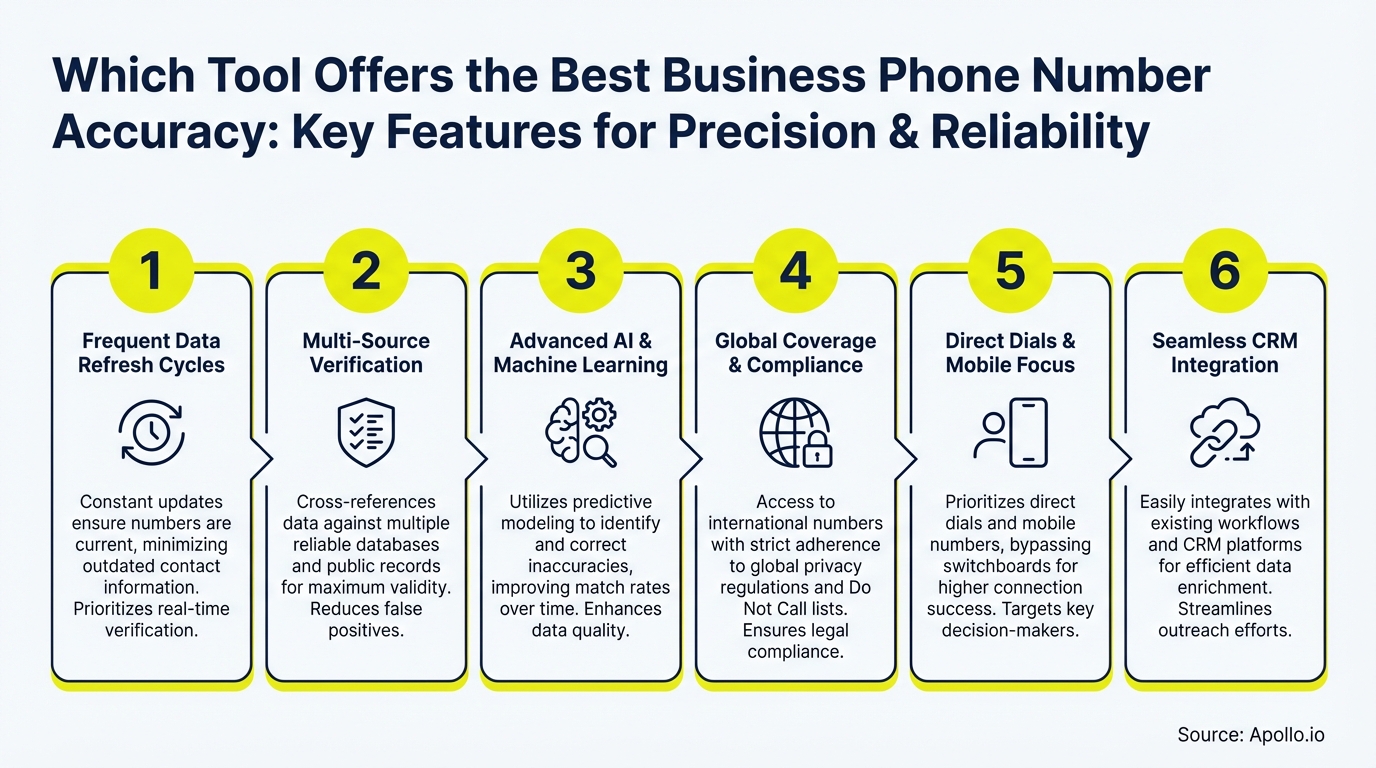
SDRs and sales leaders should demand four things from any phone data vendor: disclosed verification methodology, timestamp transparency, waterfall or multi-source enrichment, and DNC suppression built into the workflow.
- Verification methodology disclosure: How was this number verified? Carrier lookup? Human verification? Crowdsourced signals?
- Timestamp on last verification: A number verified 18 months ago carries meaningfully more risk than one verified last week.
- Multi-source enrichment: Single-source tools amplify any gaps in their own dataset.
- DNC suppression: Built-in suppression protects teams from compliance exposure without requiring a separate workflow.
- Connect rate data, not just accuracy %: Ask vendors for outcome data — meetings booked per 1,000 dials — not just how they define "accuracy."
Apollo meets these criteria within a unified platform that also handles sequences, dialing, and deal management — so teams aren't stitching together a separate data tool, dialer, and engagement platform. As Cyera put it: "Having everything in one system was a game changer." See how AI sales tools are reshaping outbound in 2026.

Which Tool Should You Choose for Business Phone Number Accuracy?
The best tool for business phone number accuracy in 2026 is the one your team tests against your ICP — not the one with the highest self-reported claim. That said, Apollo's combination of a 230M+ contact database, waterfall enrichment, 97% email accuracy, and integrated engagement platform makes it the strongest all-in-one choice for B2B GTM teams that need verified contact data and outreach in a single workspace.
For teams prioritizing EMEA mobile coverage, Cognism's phone-verified tier is worth testing alongside Apollo — but use the 7-day framework above to validate real-world results in your target market before committing. For enterprise teams with existing CRM infrastructure, Apollo's integrations connect verified contact data directly into existing workflows without adding another tool to manage.
The bottom line: stop asking vendors for accuracy percentages. Start measuring connect rate, right-party contact rate, and meetings booked per 100 dials. That's the data that actually predicts revenue. Start a free trial with Apollo and run your own accuracy benchmark against your ICP today.
Prove ROI Before Budget Season Hits
ROI pressure killing your tool renewal conversations? Apollo delivers measurable pipeline impact from day one — so you walk into budget reviews with proof, not promises. Leadium 3x'd their revenue. You're next.
Start Free with Apollo →Don't miss these
Sales
Inbound vs Outbound Marketing: Which Strategy Wins?
Sales
What Is a Sales Funnel? The Non-Linear Revenue Framework for 2026
Sales
What Is a Go-to-Market Strategy? The 2026 GTM Playbook
See Apollo in action
We'd love to show how Apollo can help you sell better.
By submitting this form, you will receive information, tips, and promotions from Apollo. To learn more, see our Privacy Statement.
4.7/5 based on 9,690 reviews
