
Which Software Discovers the Most Complete Contact Info in 2026?
No single B2B contact-discovery platform wins across every ICP, region, and field type. The honest answer is that "most complete" depends on what fields matter to your workflow, how fresh those fields need to be, and whether your team can act on the data without switching tools. According to Landbase, approximately 70% of CRM data is currently outdated, incomplete, or inaccurate, which means the platform question matters less than the verification and enrichment process behind it. Understanding how contact data enrichment drives ROI is the foundation for making a smarter vendor choice.

Research Less, Connect More With Apollo
Tired of burning hours verifying contact info that's already outdated? Apollo delivers 97% email accuracy so your team spends time selling, not searching. Over 600K companies have already made the switch.
Start Free with Apollo →Key Takeaways
- "Most complete" is field-specific: email, direct dial, mobile, title, and company hierarchy have different decay rates and coverage gaps across vendors.
- Database size claims (230M, 300M, 500M contacts) are vendor-reported and not independently benchmarked at the field level.
- Data decay is accelerating: a 2026 study found annualized B2B contact decay at 67%, making freshness more important than raw record count.
- The winning evaluation method is a 14-day field-level bakeoff against your actual ICP, not a vendor demo.
- Platforms that combine verified contact data with engagement tools in one workspace reduce data degradation between handoffs.
What Does "Most Complete Contact Info" Actually Mean?
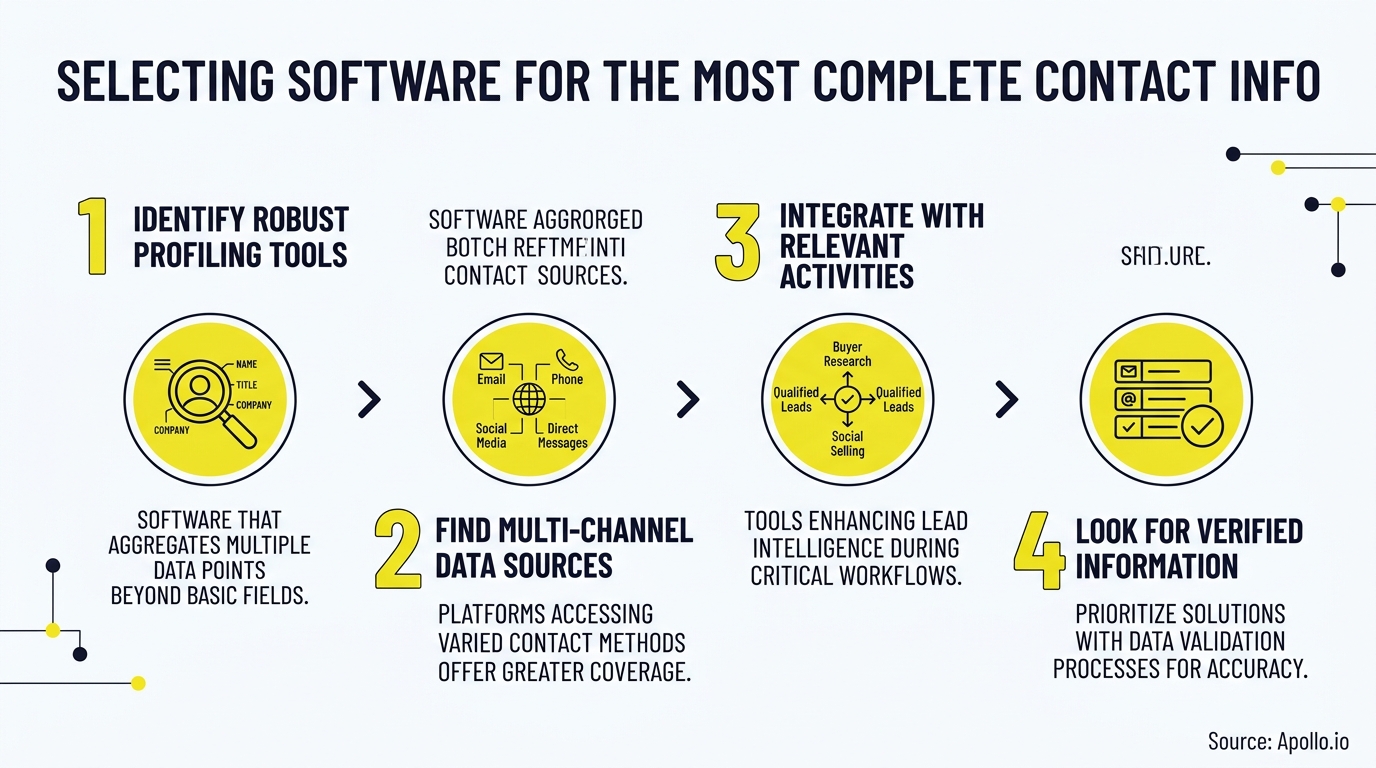
Complete contact info means having verified, usable data across every field your team needs to reach a buyer: work email, direct dial, mobile number, job title, seniority level, company hierarchy, and firmographics. Each field has a different decay rate. Research from Landbase shows that while 18% of phone numbers change each year, 23-30% of email addresses become outdated annually. That gap matters when you're deciding whether to prioritize a platform's email coverage versus its phone data.
Completeness is also ICP-dependent. A vendor strong in U.S. mid-market SaaS titles may have thin coverage in EMEA manufacturing or early-stage startups.
Before comparing any platforms, define your required field set: which fields are mandatory, which are nice-to-have, and what minimum fill rate is acceptable for each.
- Email: Work email with domain verification and catch-all detection
- Phone: Direct dial vs. switchboard vs. verified mobile
- Title and seniority: Current role, not last known role
- Company data: Employee count, revenue band, tech stack, parent-child hierarchy
- Signals: Hiring surge, funding, executive movement, intent
Why Is Data Freshness More Important Than Database Size in 2026?
Data freshness is now a stronger buying trigger than raw record counts because contact decay has accelerated significantly. A 2026 study by Cleanlist re-verified 5,000 CRM contacts weekly for 13 weeks and found an annualized B2B contact-data decay rate of 67%, far above older 30% benchmarks. Vendors claiming hundreds of millions of contacts may still deliver poor field-level fill rates if those records aren't continuously re-verified.
The productivity cost is real. Data from Datamaticsbpm shows sales representatives lose approximately 27.3% of their time, roughly 500-546 hours per year, due to bad or incomplete prospect data. That's the business case for prioritizing freshness and field-level accuracy over database scale when evaluating vendors.
Struggling to keep your prospect data current? Enrich your contact records automatically with Apollo's 230M+ verified database.
How Do SDRs and RevOps Teams Run a 14-Day Contact Completeness Bakeoff?
SDRs and RevOps teams evaluate contact completeness most effectively by running a structured 14-day field-level test against a sample of their actual ICP, not a vendor-provided demo list. This is the only method that produces a usable-record rate specific to your target market.
Step 1: Build your test sample. Pull 200-500 target accounts that match your ICP by industry, company size, geography, and seniority. Use the same list for every vendor you test.
Step 2: Score each field independently. For each vendor, record the fill rate per field (email found, direct dial found, mobile found, title current, company data present).
Don't average across fields. A vendor with 95% email fill and 20% mobile fill should be evaluated differently than one with 70% across both.
Step 3: Validate with outreach. Send a controlled email sequence and measure bounce rate.
Run calls on the direct dials and measure connect rate. These are the metrics that reflect real completeness, not record count.
| Field | Minimum Acceptable Fill Rate | Validation Method |
|---|---|---|
| Work email | 80%+ | Bounce rate under 5% |
| Direct dial | 50%+ | Connect rate on live calls |
| Mobile | 30%+ | Number validation check |
| Current title | 90%+ | Manual spot-check sample |
| Company firmographics | 95%+ | CRM match rate |
For Account Executives managing enterprise deals, add a company hierarchy and org-chart fill rate to your scorecard. Reaching the wrong contact at the right company is as costly as missing the contact entirely. See how market intelligence tools extend this evaluation beyond basic contact fields.

How Does the 2026 Contact Discovery Landscape Compare Across Platforms?
The 2026 market has split into two models: single-vendor databases and multi-source waterfall enrichment. Neither is universally superior.
The right choice depends on your ICP coverage needs and workflow.
Platforms like Apollo, ZoomInfo, and Lusha offer owned databases with proprietary verification. In June 2026, ZoomInfo launched GTM.AI, positioning its contact graph as a context layer for AI agents across tools like Salesforce Agentforce and HubSpot Breeze.
Waterfall tools like Clay query 150+ databases sequentially to fill gaps single vendors miss, which is useful when your ICP spans multiple geographies or niche verticals.
| Platform Type | Strength | Limitation | Best For |
|---|---|---|---|
| Single-vendor database (Apollo, ZoomInfo, Lusha) | Speed, integrated engagement, consistent verification | Coverage gaps in niche ICPs or specific regions | Teams with a defined ICP and need for workflow consolidation |
| Waterfall enrichment (Clay) | Maximum field coverage across multiple sources | Added complexity, separate enrichment and engagement tools needed | RevOps teams optimizing coverage for diverse ICPs |
| All-in-one GTM platform (Apollo) | Prospecting, enrichment, and outreach in one workspace | Single-source coverage for highly niche verticals | SDRs, AEs, and RevOps teams wanting one tool for the full workflow |
Apollo's approach combines a 230M+ person database with sales automation software and built-in engagement tools. That consolidation reduces data degradation that occurs when contact records pass between separate prospecting, enrichment, and outreach platforms. As Cyera put it: "Having everything in one system was a game changer."
Turn Weak Funnels Into Pipeline Gold
Pipeline forecasting a guessing game because marketing leads never convert? Apollo surfaces high-intent prospects before your competitors do. Over 600K companies now run predictable pipeline — not wishful thinking.
Start Free with Apollo →What Is the Completeness Scorecard Buyers Should Use in 2026?
A completeness scorecard is a structured rubric that scores each vendor on field-level fill rate, data freshness, and workflow fit for your specific ICP. Use it during your 14-day bakeoff to produce a side-by-side comparison based on your actual targets, not vendor marketing claims.
| Scorecard Dimension | Weight | What to Measure |
|---|---|---|
| Email fill rate + bounce rate | 25% | % of ICP sample with verified email; bounce rate under 5% |
| Phone/direct dial fill rate | 20% | % with direct dial; connect rate on live calls |
| Title and seniority accuracy | 20% | Spot-check current role vs. professional networks or company page |
| Company data completeness | 15% | Revenue, headcount, tech stack, parent company present |
| Data freshness signal | 10% | Last verified date; re-verification cadence |
| Workflow integration | 10% | CRM sync, export format, engagement tool connection |
Weight the dimensions based on your team's channel mix. A team running high-volume cold calling should weight phone fill rate higher. An outbound email-first team should weight email fill rate and bounce rate. RevOps leaders building lead lists that actually convert use this kind of field-weighted scoring to avoid paying for database size they can't use.
Need verified contact data that covers email, direct dial, and firmographics in one search? Search Apollo's 230M+ contacts with 65+ filters to build your test list today.
What Else Should Buyers Evaluate Beyond Contact Fields?
Beyond field-level fill rates, buyers should evaluate AI readiness, CRM integration depth, and workflow consolidation potential. As AI agents enter prospecting workflows, stale or incomplete contact data scales errors at machine speed.
ZoomInfo's GTM.AI launch in June 2026 explicitly frames verified contact data as the "context layer" for AI agents, and that framing applies to any platform feeding AI-assisted outreach.
Key checklist items for the final vendor decision:
- CRM sync: Does enriched data write back to your CRM automatically, or is it a manual export?
- Engagement integration: Can you act on contact data in the same platform, or do you need a separate tool?
- Waterfall enrichment option: Does the platform support multi-source fallback when its own database misses a field?
- Re-verification cadence: How often are records re-verified? Monthly? Continuously?
- Compliance posture: Does the platform support delete requests and maintain records for business contacts in compliance with applicable regulations?
For founders and sales leaders evaluating outbound sales software, the consolidation question is increasingly central. Census reported "We cut our costs in half" after consolidating their stack, and Predictable Revenue noted "We reduced the complexity of three tools into one." A platform that covers contact discovery, enrichment, and engagement in one workspace eliminates the data handoff gaps that degrade completeness between tools.

Which Software Gives B2B Teams the Most Complete Contact Info in 2026?
The software that discovers the most complete contact info for your team is the one that scores highest on your field-level completeness scorecard against your specific ICP, not the vendor with the largest database claim. Run the 14-day bakeoff.
Score field by field. Measure bounce rate and connect rate on real outreach.
Apollo combines a 230M+ person database with 97% email accuracy, 65+ search filters, built-in enrichment, and a full sales engagement layer in one unified workspace. That means SDRs, AEs, and RevOps teams can discover, enrich, and act on contact data without the degradation that happens when records move between separate tools.
Apollo has earned recognition as a G2 2026 Best Software Award winner and the 2026 MarTech Breakthrough Award for Best AI-Powered Sales Solution.
Stop guessing which vendor has the data your team needs. Try Apollo free and run your own field-level completeness test against your ICP today.
Apollo Ramps New Reps Faster
ROI pressure killing your next tool approval? Apollo gives every rep the same playbook, contacts, and workflows from day one. Teams like Leadium 3x'd revenue — without adding headcount.
Start Free with Apollo →Don't miss these
Sales
Inbound vs Outbound Marketing: Which Strategy Wins?
Sales
What Is a Sales Funnel? The Non-Linear Revenue Framework for 2026
Sales
What Is a Go-to-Market Strategy? The 2026 GTM Playbook
See Apollo in action
We'd love to show how Apollo can help you sell better.
By submitting this form, you will receive information, tips, and promotions from Apollo. To learn more, see our Privacy Statement.
4.7/5 based on 9,690 reviews
