
Which Sales Intelligence Platform Has the Lowest Bounce Rates in 2026?
The honest answer: no single sales intelligence platform can claim the universally lowest bounce rate. Bounce rate is a workflow outcome, not a platform feature. The platform you choose matters far less than how you verify, refresh, and govern the data before it hits a send queue.
That said, some platforms give you significantly better tools to achieve low-bounce outcomes. This guide breaks down what actually drives bounce rates, what thresholds matter, and how to build a workflow that keeps you in the "excellent" zone.

Get Verified Contacts That Actually Connect
Tired of burning hours verifying contact info that bounces anyway? Apollo delivers 97% email accuracy across 230M+ contacts so your team spends time selling, not searching. Start building pipeline that moves.
Start Free with Apollo →Key Takeaways
- No audited, independent study ranks sales intelligence platforms by bounce rate head-to-head. Platform choice is one factor; verification cadence and data freshness are bigger levers.
- Bounce rates under 2% are considered excellent for outbound. Anything above 5% risks domain reputation damage and deliverability blocks.
- B2B contact data decays at roughly 22.5% annually, meaning even freshly sourced lists degrade quickly without re-verification.
- "Lowest bounce rate" in 2026 is a stack outcome: data source + real-time verification + governance policy, not a single vendor badge.
- Apollo's 97% email accuracy and waterfall enrichment workflow are designed to keep bounce rates in the excellent tier, with beta data reporting materially lower bounce rates tied to 2025 verification improvements.
Why Does Bounce Rate Matter More Than Ever in 2026?
Bounce rate is a leading indicator of domain reputation and pipeline health. Google and Yahoo tightened bulk-sender authentication requirements in early 2024, and Microsoft followed with additional inbox changes in 2025, making high bounce rates more costly than they were in prior years.
According to Nexus Scale, healthy cold email campaigns should aim for a bounce rate under 2%, with anything above 5% risking damage to the sender's domain reputation and potentially triggering vendor blocks. For SDRs and BDRs running high-volume sequences, a single bad batch of contacts can damage the sending domain for weeks.
The practical implication: bounce rate is now a governance KPI, not just a deliverability metric. RevOps leaders should treat it like a pipeline health signal.
What Actually Drives Bounce Rates in B2B Outreach?
Bounce rates are driven primarily by data decay, not by which platform's UI you prefer. Research from Landbase shows that B2B contact data decays at an average rate of 2.1% per month, translating to approximately 22.5% annually. A list that was clean six months ago may already have significant bounce risk without re-verification.
The four core drivers of bounce in B2B outreach:
- Data age: Contacts change jobs, get reorgs, and abandon email addresses constantly.
- Catch-all domains: Servers that accept all email but silently bounce or discard unknown addresses inflate apparent deliverability.
- Verification timing: "Verified" at time of database entry is not the same as verified at time of send.
- List hygiene practices: Suppression lists, re-verification cadence, and hard-bounce removal policies all determine outcomes.
Tired of contacts going stale before you can reach them? Keep your records fresh with Apollo's continuous data enrichment.

What Are the Bounce Rate Benchmarks SDRs and RevOps Should Target?
Bounce rate thresholds for B2B outbound break into four operational tiers. SDRs should treat these as sequence-level SLAs, and RevOps should enforce them as policy.
| Tier | Bounce Rate | What It Means | Action Required |
|---|---|---|---|
| Excellent | < 2% | Clean data, strong hygiene | Maintain current practices |
| Good | 2%–5% | Acceptable for most outbound | Review list age and catch-all handling |
| Acceptable | 5%–8% | Reputation risk building | Pause sequences, run re-verification |
| Poor | > 8% | Domain damage likely | Halt sends, audit data source, re-verify all contacts |
A recommended RevOps policy: configure sequences to pause automatically when a campaign exceeds 5% bounce. Require any new data source to pass a bounce-rate pilot (100–200 sends) before full deployment.
This turns bounce rate from a lagging metric into a leading guardrail.
Turn Funnel Gaps Into Pipeline Wins
Pipeline forecasting a guessing game? Apollo surfaces in-market buyers the moment they're ready, so your team stops chasing cold leads and starts closing real opportunities. Over 600K companies trust Apollo to build pipeline that actually converts.
Schedule a Demo →How Do Sales Intelligence Platforms Compare on Data Quality?
No independent, audited head-to-head benchmark ranks platforms by live bounce rate on comparable ICP segments. What exists are vendor claims, user-reported outcomes, and accuracy figures on specific data subsets.
Buyers should treat any platform's bounce-rate claims as starting points for their own pilot tests, not final verdicts.
| Platform | Email Accuracy Claim | Verification Approach | Notable Caveat |
|---|---|---|---|
| Apollo | 97% email accuracy | Multi-source verification + waterfall enrichment; beta data shows materially lower bounce rates with 2025 updates | Vendor-reported; results vary by ICP segment |
| Cognism | Claims 98% accuracy on Diamond Data (phone-verified mobile numbers) | Quality-first positioning with verified email tier | Diamond Data is a subset; email accuracy on full exports may differ |
| Lusha | 3% bounce rate reported in a 250-lead test | Database verification | Small sample; user reports show 85%–90% email accuracy in broader usage |
The critical distinction: platforms can report strong accuracy on their "verified" subset while users experience higher bounces on full exports. Always define which contacts are in scope when evaluating any accuracy or bounce-rate claim.
According to SuperAGI, inaccurate contact data leads to a decrease in sales productivity for 60% of businesses. The cost is not just bounces; it's lost rep time, damaged domains, and missed pipeline.
How Should RevOps Teams Build a Low-Bounce Workflow?
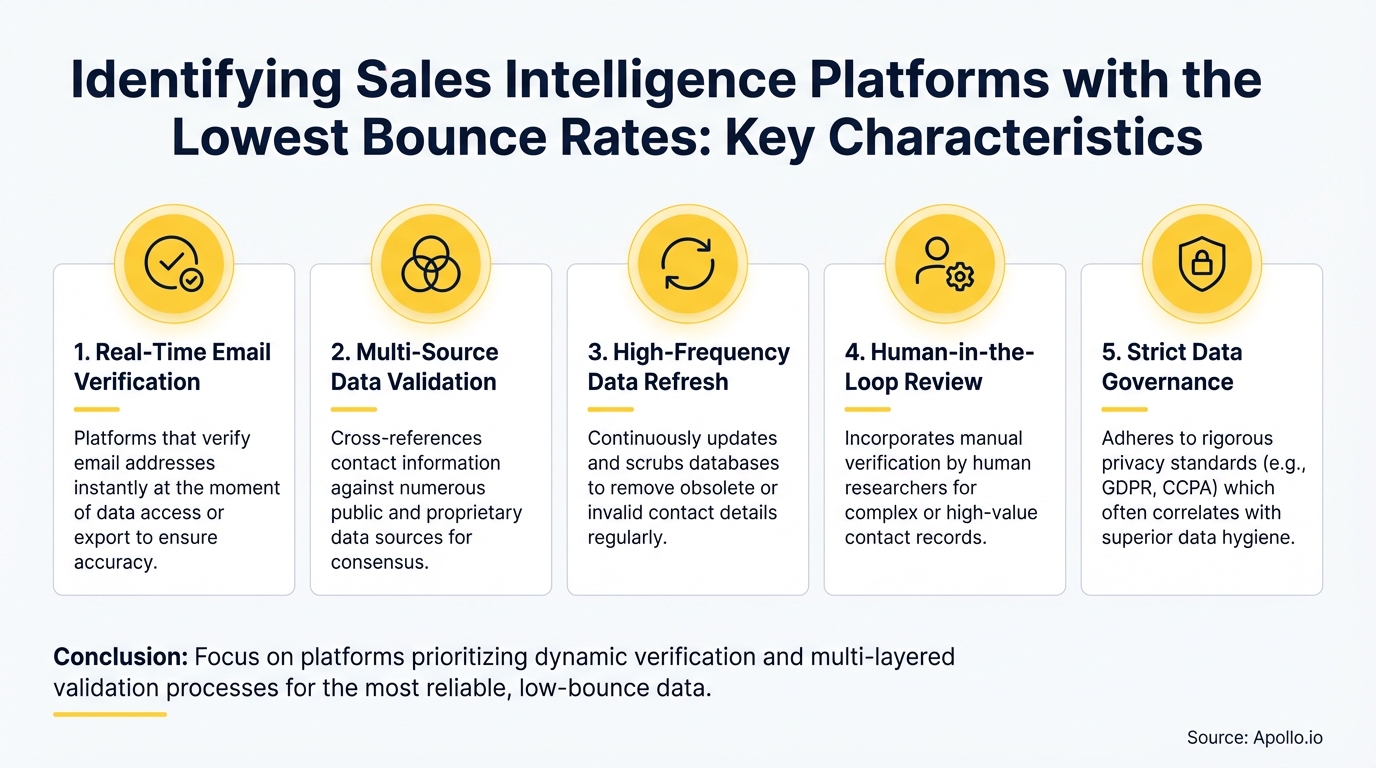
A low-bounce outcome requires a layered workflow, not just a better database. RevOps leaders building or auditing their outbound stack should implement these four layers in sequence.
- Layer 1: Source with verified data. Start with a platform that applies multi-source verification at the database level. Apollo's sales intelligence and lead database applies multi-layer verification across 230M+ contacts.
- Layer 2: Waterfall enrichment. Use multi-source routing to find the best available record for each contact, rather than relying on a single database's entry. Apollo's waterfall enrichment workflow routes across multiple data sources to maximize both coverage and quality.
- Layer 3: Pre-send re-verification. Re-verify contacts at or near send time, not just at import. Data that was clean 90 days ago may already have decayed.
- Layer 4: Governance policy. Set bounce-rate SLAs at the sequence level. Enforce suppression lists. Remove hard bounces immediately. Review catch-all domain handling.
Teams that consolidate data sourcing, enrichment, and engagement in one platform reduce the number of handoff points where data quality can degrade. As Census noted after replacing their previous sales tech stack with Apollo: "We cut our costs in half." Fewer tools also mean fewer gaps in data freshness between systems. See how the Census team replaced their stack with Apollo.
Struggling to keep your outbound sequences below the 5% danger zone? Run cleaner sequences with Apollo's verified data and built-in engagement tools.
How Do You Run a Fair Bounce-Rate Pilot Test Across Platforms?
A controlled pilot is the only way to get an honest, apples-to-apples bounce-rate comparison for your specific ICP. Generic benchmarks do not account for your target segments, domain types, or sending infrastructure.
Two-week pilot design for RevOps teams:
- Fix the ICP sample: Use the same title, industry, company size, and geography across all platforms being tested.
- Define bounce types: Separate hard bounces (invalid address) from soft bounces (temporary failures). Report both, but weight hard bounces more heavily in your scoring.
- Control the send environment: Use the same sending domain, mailbox, and sequence structure for all test groups.
- Set minimum sample size: At least 200 sends per platform to get statistically meaningful results.
- Report on all exported contacts: Not just the "verified" subset. Full-export bounce rate is the number that matters operationally.
This methodology surfaces real-world outcomes rather than relying on vendor-reported accuracy figures, which may be calculated on curated subsets. For a broader view of what sales intelligence tools actually measure and how to evaluate them, start with clear definitions before any vendor comparison.
Which Platform Gives SDRs and RevOps the Best Foundation for Low Bounce Rates?
For SDRs, AEs, and RevOps teams that need a unified platform to source, verify, enrich, and engage, Apollo provides the strongest combined foundation. Apollo's 97% email accuracy across 230M+ contacts, combined with waterfall enrichment and built-in multi-channel engagement, reduces the number of systems where data quality can degrade between sourcing and sending.
Apollo's 2025 feature updates reported materially lower email bounce rates in beta testing, alongside expanded phone coverage. These are vendor-reported figures, and your results will depend on your ICP and sending practices.
But the underlying architecture: continuous verification, multi-source enrichment, and an integrated engagement layer, directly addresses the four core drivers of bounce outlined above.
For teams managing sales performance and RevOps governance, Apollo consolidates data sourcing, enrichment, sequencing, and analytics into one workspace. As Cyera found: "Having everything in one system was a game changer."

Conclusion: Lowest Bounce Rate Is a Workflow You Build, Not a Platform You Buy
The sales intelligence platform with the lowest bounce rates in 2026 is whichever one you pair with rigorous verification, a re-verification cadence, suppression list discipline, and a governance policy that pauses sequences before domain damage occurs. Platform data quality is the foundation, but workflow is the structure built on top of it.
Apollo gives B2B GTM teams, from SDRs to RevOps leaders to enterprise sales organizations, a unified platform to source verified contacts, enrich continuously, and execute multi-channel outreach without stitching together three separate tools. The result is fewer handoff points, fresher data, and better deliverability outcomes.
Ready to build a low-bounce outbound workflow on verified data? Start Your Free Trial and see Apollo's verification and enrichment tools in action.
Prove Pipeline ROI Before Next QBR
Budget approval stuck on unclear metrics? Apollo surfaces measurable pipeline impact fast — so you walk into every review with numbers that close the conversation. Leadium 3x'd their revenue. Your turn.
Start Free with Apollo →Don't miss these
Sales
Inbound vs Outbound Marketing: Which Strategy Wins?
Sales
What Is a Sales Funnel? The Non-Linear Revenue Framework for 2026
Sales
What Is a Go-to-Market Strategy? The 2026 GTM Playbook
See Apollo in action
We'd love to show how Apollo can help you sell better.
By submitting this form, you will receive information, tips, and promotions from Apollo. To learn more, see our Privacy Statement.
4.7/5 based on 9,690 reviews
