
What's the Right Mix of Email, Phone, and Social Touches for a Mid-Market Outbound Sequence?
Most mid-market outbound sequences fail not because of too few touches, but because they rely on a single channel. Email-only cadences are getting harder to sustain as bulk-sender enforcement tightens, and cold calls without prior context rarely land. The teams winning in 2026 are running coordinated, omnichannel sequences built around how buyers actually behave. If you're building or refining your outbound sales cadence, the channel mix matters as much as the message.

Scale Outreach Without Scaling Headcount
Tired of watching your team burn hours on manual research instead of closing deals? Apollo standardizes your prospecting playbook and surfaces verified contacts instantly. Join 600K+ companies turning outbound chaos into predictable pipeline.
Start Free with Apollo →Key Takeaways
- A blended sequence of email, phone, and social outreach significantly outperforms single-channel approaches in engagement and conversion.
- For mid-market outbound, 10–18 touches across 4–6 weeks is the current benchmark range, spread across all three channels.
- The first five days of a sequence are the highest-leverage window: coordinate all channels early rather than spacing them out.
- Phone calls perform best after prior email or social context has been established, not as a cold-first motion.
- Deliverability pressure from Microsoft's bulk-sender rules in 2025 makes channel diversification a business necessity, not just a best practice.
Why Does Channel Mix Matter for Mid-Market Outbound?
Channel mix matters because mid-market buyers don't evaluate vendors through one channel. According to SalesO, combining email, phone, and professional social outreach in a multi-channel approach can boost engagement rates by 287% compared to single-channel efforts. That gap exists because each channel serves a different function: email delivers proof and context, phone creates urgency and conversation, and social outreach builds credibility before a rep ever sends a message.
Deliverability is now an additional forcing function. Microsoft's bulk-sender enforcement (active since mid-2025) requires DMARC authentication for high-volume senders and increases spam risk for email-heavy sequences.
Teams that relied on five or six emails per contact are now restructuring toward fewer, higher-quality emails supported by phone and social touches.
What Is the Recommended Touch Count and Timeline?
For mid-market cold outbound, the current benchmark is 10–18 total touches over 20–40 days. Research from SalesHive recommends 12–18 touches over 20–40 days for net-new cold outbound into mid-market or enterprise accounts. Data from Fundraise Insider puts the 2026 optimal range at 10–12 touches across four to six weeks for mid-market targets specifically.
| Channel | Recommended Touches (Mid-Market) | Primary Role in Sequence |
|---|---|---|
| 5–7 touches | Proof, context, self-serve assets | |
| Phone | 3–5 calls | Urgency, conversation, objection handling |
| Social (professional network) | 2–4 touches | Credibility, visibility, connection before DM |
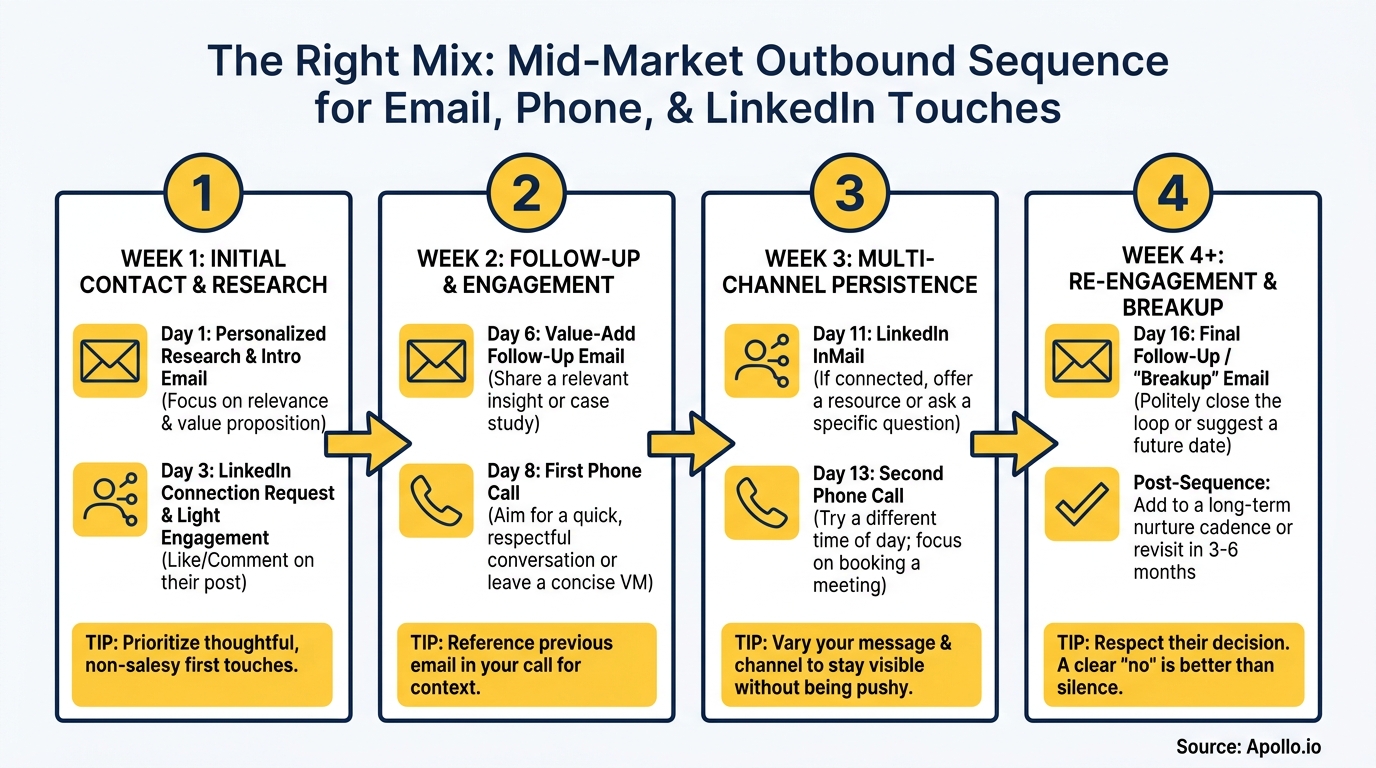
The total touch count matters less than the coordination. Front-load all three channels in the first five days rather than drip-feeding one channel at a time.

How Should SDRs Structure the First Five Days of a Sequence?
SDRs should treat the first five days as a multichannel burst, not a slow warm-up. The goal is to appear across channels before the buyer has made a shortlist decision. Research consistently shows that buyers often select their preferred vendor early in the process, making first-contact positioning critical for outbound prospecting success.
- Day 1: Send a personalized intro email with a specific reason for outreach (funding round, hiring signal, company news). Connect on the buyer's professional network profile.
- Day 2: Make the first call. Reference the email and connection request in your voicemail.
- Day 3: Follow up via social DM or comment on a recent post if the connection was accepted.
- Day 5: Send a second email with a relevant proof point or case study relevant to their industry.
Spending hours manually coordinating these touches? Automate your multi-channel sequences with Apollo's sales engagement platform and keep every touch coordinated in one workspace.
Turn Funnel Guesswork Into Closed Deals
Pipeline forecasting a guessing game because quality leads never materialize into opportunities? Apollo surfaces verified, in-market buyers so your funnel stays full and your forecast stays accurate. Nearly 100K paying customers stopped guessing and started closing.
Start Free with Apollo →When and How Should Phone Calls Fit Into the Sequence?
Phone calls work best after prior email or social context has been established, not as a cold-first motion. Calls placed after a prospect has seen your name in their inbox or social feed convert at meaningfully higher rates than blind cold calls.
This is why the phone should enter the sequence by day two, not day one, and should always reference a prior touch in the voicemail or opening line.
For effective cold calling in 2026, structure each call attempt around a specific trigger: a job change, a new product launch, or a recently published article. Generic calls without a "why now" angle add noise without moving the prospect forward. If a prospect opens an email but doesn't reply, that engagement signal is the ideal moment to escalate to a call the same day.
Calls also serve as a branching point. If a prospect picks up and engages, remove them from the automated cadence and move to a personalized follow-up track.
If they don't answer after two attempts, continue with email and social touches before making a final call attempt near the end of the sequence.
How Do Social Touches Build Credibility in an Outbound Sequence?
Social touches in a professional network context build credibility by creating visible familiarity before a direct message or call. Sending a connection request, engaging with a prospect's post, or commenting on shared content establishes social proof that a cold email alone cannot create.
This matters because buyers research the sellers reaching out to them, not just the products.
Social outreach is most effective when rationed to higher-fit, higher-value accounts. Connection requests have limits, and over-automation risks account throttling. For mid-market sequences, reserve social touches for accounts where you have a strong ICP match and a genuine reason to engage with their content. For social selling best practices, the goal is credibility before conversion, not volume.
A practical social touch sequence for a mid-market account looks like this:
- Touch 1: Send a connection request (no note, or a brief contextual note)
- Touch 2: Like or comment on a recent post once connected
- Touch 3: Send a DM referencing the email sequence and offering a specific resource
- Touch 4 (optional): Share relevant content directly if there is genuine alignment
What Makes a Mid-Market Outbound Sequence Adaptive vs. Linear?
An adaptive sequence changes the next touch based on prospect behavior, while a linear cadence sends the same touches regardless of engagement. Adaptive sequencing is now the standard for teams that measure results, because it reduces unsubscribes, preserves deliverability, and focuses rep time on warmer signals. This connects directly to how sales automation tools can be used intelligently rather than just at volume.
| Prospect Signal | Recommended Next Touch |
|---|---|
| Opened email, no reply | Call same day or next morning |
| Clicked a link | Follow-up email with related proof point |
| Viewed social profile | Send a personalized DM referencing shared context |
| Replied negatively | Remove from sequence, log reason, re-engage in 90 days |
| No engagement after 10 touches | Send a breakup email, pause for 60 days |
Research from Leadinfo found that companies combining cold calling with email and professional social outreach see 28% higher conversion rates, reinforcing that the adaptive, blended approach outperforms any single-channel motion.
How Can RevOps Teams Measure and Optimize the Channel Mix?
RevOps teams should measure channel-level reply rates, meeting conversion rates, and sequence completion rates separately for each channel to identify where the mix is underperforming. Tracking these metrics at the step level, not just the sequence level, reveals whether emails are generating opens without replies (a messaging problem) or calls are going unanswered (a timing problem).
Key metrics to track by channel:
- Email: Open rate, reply rate, unsubscribe rate, bounce rate
- Phone: Connect rate, conversation rate, meeting set rate per call
- Social: Connection acceptance rate, DM reply rate, profile view-to-reply ratio
For context on email benchmarks: data from Reachoutly shows cold email reply rates entering 2026 in the 3–5% range. If your sequence email reply rate is below that benchmark, the issue is likely personalization or targeting, not touch count. Adding more emails to a poorly targeted list won't close the gap. Struggling to identify the right contacts before you sequence? Find verified mid-market contacts using Apollo's 65+ search filters before you build your next sequence.
RevOps leaders using a unified platform also benefit from consolidated reporting. "Having everything in one system was a game changer" — Cyera. When sequence data, call recordings, and contact records live in one workspace, optimization becomes faster and less dependent on manual data pulls.

Build Your Mid-Market Outbound Sequence in Apollo
The right channel mix for a mid-market outbound sequence is 5–7 emails, 3–5 calls, and 2–4 social touches, coordinated across 10–18 total steps over 4–6 weeks. The sequence should front-load all three channels in the first five days and adapt based on engagement signals rather than running a fixed linear cadence.
Phone calls earn their place after context is established, not before it. Social touches build credibility for higher-fit accounts.
And email volume should be calibrated to deliverability health, not maximized.
Apollo gives SDRs, AEs, and RevOps teams a single platform to build, run, and optimize multi-channel sequences without stitching together separate tools. As Predictable Revenue put it: "We reduced the complexity of three tools into one." See how Apollo's sequences, dialer, and data enrichment work together in one unified workspace.
Prove Pipeline ROI From Day One
ROI pressure killing your next budget renewal? Apollo delivers measurable pipeline impact fast — so you walk into every review with hard numbers. Leadium 3x'd annual revenue. Your proof starts now.
Start Free with Apollo →Don't miss these
Sales
Inbound vs Outbound Marketing: Which Strategy Wins?
Sales
What Is a Sales Funnel? The Non-Linear Revenue Framework for 2026
Sales
What Is a Go-to-Market Strategy? The 2026 GTM Playbook
See Apollo in action
We'd love to show how Apollo can help you sell better.
By submitting this form, you will receive information, tips, and promotions from Apollo. To learn more, see our Privacy Statement.
4.7/5 based on 9,690 reviews
