
What Types of Data Does a Sales Intelligence Tool Provide?
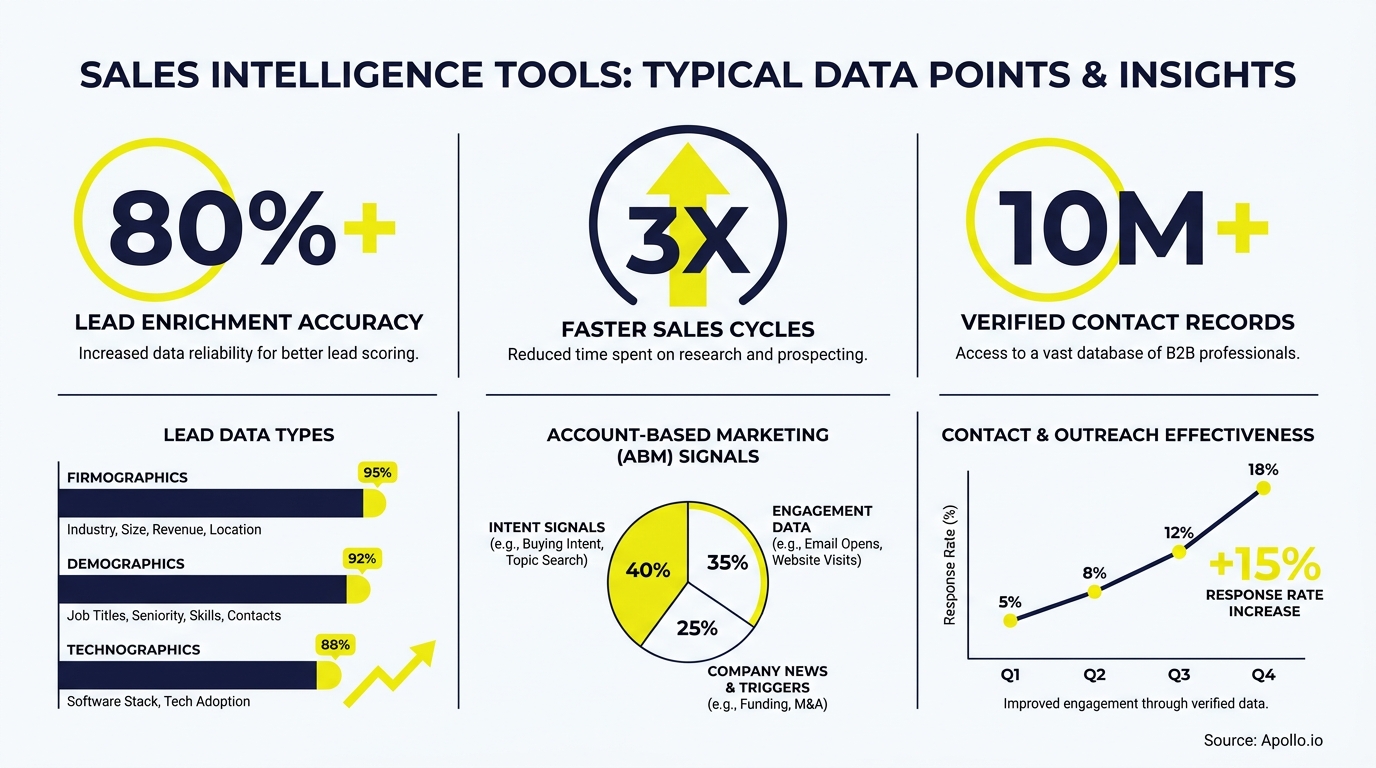
Sales intelligence tools provide far more than contact lists. In 2026, the data stack inside a modern sales intelligence platform spans firmographics, technographics, intent signals, buying-group maps, and AI-generated triggers — all designed to help GTM teams reach buyers before competitors do. According to MarketsandMarkets, this data is transformed into actionable insights to help sales teams identify high-quality leads, understand prospect behavior, personalize outreach, and ultimately close deals more effectively.
If you want to understand what a sales intelligence tool actually delivers, this breakdown maps every major data type to the workflows it powers.

Research Less, Close More With Apollo
Tired of burning hours verifying contact info that goes nowhere? Apollo delivers 230M+ accurate business contacts so your team spends time selling, not searching. Start building real pipeline today.
Start Free with Apollo →Key Takeaways
- Modern sales intelligence tools provide six core data categories: firmographics, technographics, contact data, intent signals, buying-group intelligence, and predictive scoring.
- Intent data is no longer a single signal — it now includes keyword-level, consumption-based, and engagement-behavioral subtypes that each map to different sales actions.
- SDRs and AEs who activate all six data types can reach active buyers well before a form fill ever happens.
- Compliance requirements (including California's Delete Act, operational as of August 2026) are reshaping which data fields vendors can source and retain.
- Apollo consolidates all six data types into one unified platform, eliminating the need to stitch together multiple tools.
What Types of Data Does a Sales Intelligence Tool Typically Provide?
A sales intelligence tool typically provides six categories of data: firmographic, technographic, contact, intent, buying-group, and predictive analytics data. Each category serves a distinct function in the sales workflow, from identifying your ideal account profile to timing outreach at peak buying interest.
| Data Type | What It Covers | Primary User |
|---|---|---|
| Firmographic | Company size, industry, revenue, location, headcount | SDRs, RevOps |
| Technographic | Tech stack, tools in use, integrations | AEs, SDRs |
| Contact Data | Verified emails, direct dials, job titles, org hierarchy | SDRs, BDRs |
| Intent Signals | Keyword research activity, content consumption, topic surges | Marketing, SDRs |
| Buying-Group Intelligence | Stakeholder maps, role detection, multi-contact account activity | AEs, Sales Leaders |
| Predictive Scoring | Lead scores, fit models, next-best-action recommendations | RevOps, Sales Leaders |
What Are Firmographic and Technographic Data?
Firmographic data describes a company's core profile — industry, size, revenue, location, and employee count — while technographic data reveals the specific tools and technologies that company uses. As noted by Martal, firmographic and technographic data allows for targeted segmentation and outreach by combining what a company is with what it runs.
Together, these two data types answer the foundational qualification question: does this account fit our ICP? RevOps leaders use firmographic filters to define territory and scoring models.
SDRs use technographic data to identify accounts already using adjacent tools — a strong buying signal for complementary solutions.
As noted by Precedence Research, tools also use job posting filters to identify growth indicators that signal potential buying opportunities — a firmographic trigger that modern platforms surface automatically.

What Is Intent Data and Why Does It Matter in 2026?
Intent data captures behavioral signals showing which companies are actively researching topics relevant to your solution — before they ever contact you. In 2026, intent is no longer a single data type.
It now includes keyword/topic intent, web consumption signals, account-level engagement patterns, and AI-detected email activity.
This matters because buyers are largely invisible until late in their decision process. The shift from static lists to near-real-time signals means SDRs and AEs can engage accounts during active research phases, not just after a demo request. For a deeper dive on activating this data, see what intent data is and how it powers smarter B2B sales.
Struggling to prioritize which accounts to call first? Search Apollo's 230M+ contacts with 65+ filters including intent signals to surface accounts actively in-market right now.
Turn Funnel Guesswork Into Closed Deals
Pipeline forecasting a guessing game because quality leads never convert? Apollo surfaces in-market buyers with precision targeting so your pipeline reflects reality, not hope. Join 600K+ companies forecasting with confidence.
Start Free with Apollo →What Is Buying-Group Intelligence and How Do SDRs Use It?
Buying-group intelligence maps all the stakeholders involved in a purchasing decision at a target account, including their roles, seniority, and engagement activity. For SDRs and AEs, this data replaces single-contact outreach with coordinated multi-threaded campaigns that mirror how B2B buying actually works.
Most enterprise purchases involve multiple decision-makers across finance, operations, and the business unit. Buying-group data lets reps identify the economic buyer, champion, and technical evaluator simultaneously. Contact data enrichment tools surface org chart relationships and reporting lines that make multi-threading practical at scale.
For Account Executives managing complex deals, this data type is the difference between a stalled single-thread and a deal with broad internal sponsorship.
What Are Predictive Analytics and Lead Scoring in Sales Intelligence?
Predictive analytics and lead scoring use historical data, AI models, and behavioral signals to rank accounts and contacts by likelihood to buy. According to DemandFarm, these tools forecast outcomes based on historical data, prioritize ideal customers, and recommend next-best actions.
RevOps leaders use predictive scoring to ensure reps focus on the highest-fit accounts rather than working through flat lists. This capability also feeds pipeline velocity metrics — a core RevOps KPI alongside win rate optimization and revenue per interaction. Pair predictive scoring with sales analytics to connect lead scores to actual revenue outcomes.
What Data Governance and Compliance Requirements Apply in 2026?
Sales intelligence data sourcing is subject to expanding privacy regulations, and 2026 brings a concrete milestone: California's Delete Act requires data brokers to process deletion requests through a centralized mechanism starting August 1, 2026. This directly affects which contact fields vendors can retain and activate.
When evaluating a sales intelligence vendor, GTM teams and RevOps leaders should ask about data sourcing provenance, opt-out handling, field-level retention policies, and auditability. Market and competitive intelligence delivered by these platforms, as noted by Research Nester, includes perceptions into customer behavior, market trends, and potential for expansion — all of which must be sourced responsibly. For a broader view of data enrichment tools and how they handle data quality, evaluate vendors on both accuracy and compliance posture.
How Does Apollo Consolidate All These Data Types in One Platform?
Apollo provides all six sales intelligence data categories — firmographic, technographic, contact, intent, buying-group, and predictive — inside a single unified platform, eliminating the need to manage separate tools for each data type. As Cyera's team put it: "Having everything in one system was a game changer."
Apollo's database covers 230M+ people and 30M+ companies, with 97% email accuracy and 65+ search filters that combine firmographic, technographic, and intent signals in a single query. Apollo's prospecting and enrichment platform connects data discovery directly to sequenced outreach, so SDRs move from signal to sent message without switching tools. Predictable Revenue's team captured the consolidation benefit directly: "We reduced the complexity of three tools into one."
Spending time managing five different data subscriptions? Consolidate your data stack with Apollo's verified B2B contact and company database and run your entire GTM workflow from one workspace.

Conclusion: Match the Right Data Type to the Right Workflow
Sales intelligence tools in 2026 provide a layered data stack — each type serves a specific workflow, from ICP segmentation with firmographics to multi-stakeholder deal management with buying-group maps. The teams that win are those who activate all six data types in sequence, not just pull a list and blast it.
The most efficient path is a unified platform that houses all these data types together. Explore which AI sales tools actually close more deals to see how intelligence and engagement combine, or start a free Apollo trial and put every data type to work today.
Prove Pipeline ROI With Apollo
Budget approval stuck on unclear pipeline metrics? Apollo delivers measurable wins fast — 46% more meetings with AI, +10% win rates, +10% ACV. Stop justifying spend and start showing results.
Start Free with Apollo →Don't miss these
Sales
Inbound vs Outbound Marketing: Which Strategy Wins?
Sales
What Is a Sales Funnel? The Non-Linear Revenue Framework for 2026
Sales
What Is a Go-to-Market Strategy? The 2026 GTM Playbook
See Apollo in action
We'd love to show how Apollo can help you sell better.
By submitting this form, you will receive information, tips, and promotions from Apollo. To learn more, see our Privacy Statement.
4.7/5 based on 9,690 reviews
