
What SLA Should You Expect From a B2B Data Provider on Email Verification and Bounce Rates
Your B2B data provider promises "verified" emails, but your bounce rate tells a different story. Before you sign any contract, you need to know exactly what SLA benchmarks to demand, how verification quality should be measured, and what remediation looks like when a vendor falls short.
This guide gives SDRs, RevOps leaders, and sales managers the specific numbers to negotiate with confidence.
Struggling with bounces from a low-quality contact list? Start free with Apollo's 230M+ verified business contacts and see the difference verified data makes from day one.

Let Apollo Find Your Next Buyer
Tired of burning hours verifying emails and chasing dead contact info? Apollo delivers 230M+ accurate business contacts so your team spends time selling, not searching. Start building real pipeline today.
Start Free with Apollo →Key Takeaways
- A credible B2B data provider should commit to hard bounce rates below 1% on verified contacts, with bounce rates above 2% signaling list quality problems.
- SLAs must go beyond "accuracy rate" and include inbox placement, spam rate thresholds, and destination-segmented benchmarks (Office 365 vs. Google Workspace).
- Google's spam complaint threshold of 0.3% is now a compliance benchmark, not just a best practice. Your vendor SLA must align with it.
- Data decay is accelerating. Demand a freshness SLA specifying how recently contacts were verified, not just that they were verified.
- Remediation terms matter as much as the SLA targets. Credits or replacements for breached thresholds protect your sender reputation and ROI.
What Bounce Rate SLA Should You Expect From a B2B Data Provider?
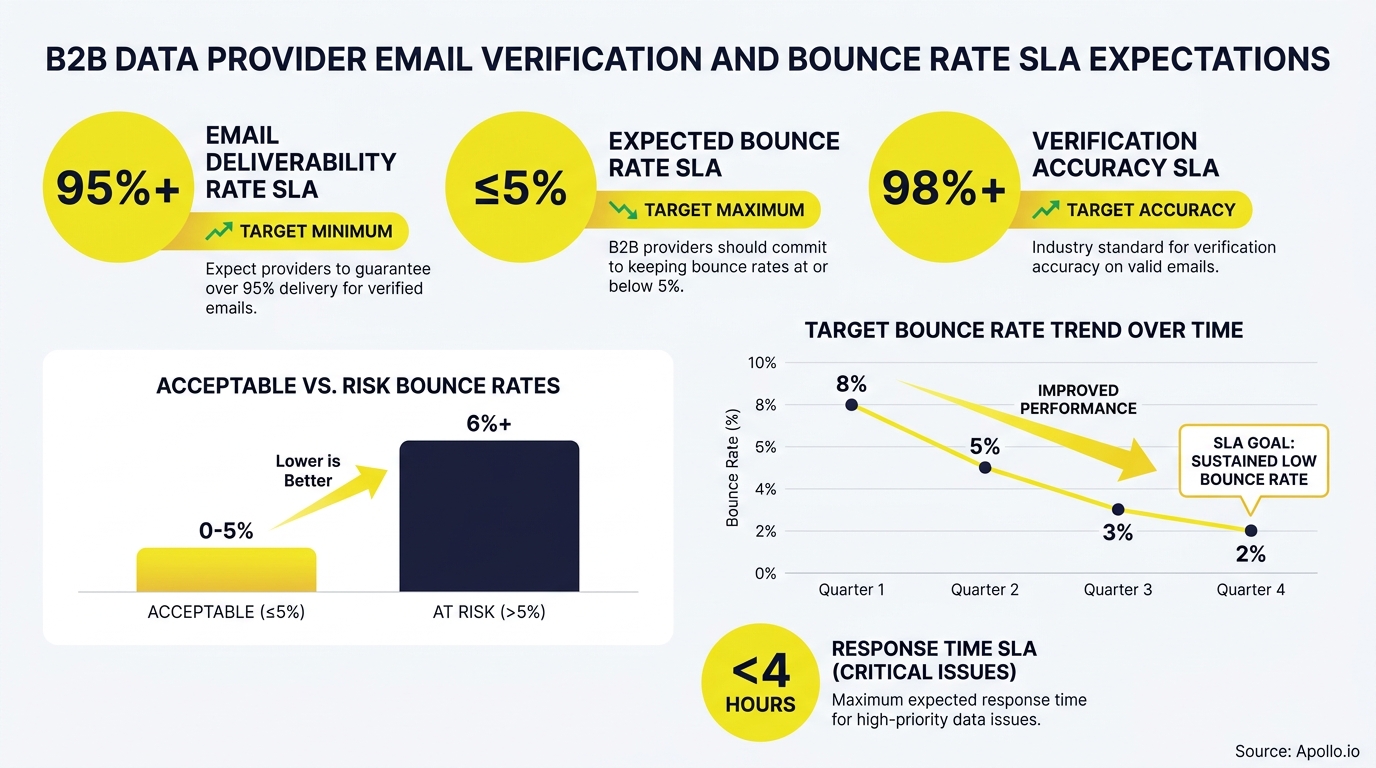
A high-quality B2B data provider should guarantee hard bounce rates below 1% on delivered verified contacts. According to Landbase, high-quality B2B data providers should deliver over 97% accuracy with email bounce rates below 1%. This is the baseline standard for any vendor claiming to offer "verified" data.
For context, the industry average tells a different story. Research from Powered by Search shows the average bounce rate for B2B email marketing is around 2.48%. If your provider's data is landing near that average, you are not getting a premium verified dataset. As ActiveCampaign notes, a bounce rate exceeding 2% may signal issues with list quality.
| SLA Tier | Hard Bounce Rate | What It Signals |
|---|---|---|
| Best-in-class | <1% | Strong verification + freshness |
| Acceptable | 1%–2% | Moderate hygiene, monitor closely |
| Below standard | >2% | List quality issue, escalate or switch |
| Critical risk | >5% | Sender reputation at risk |
What Should a Complete Email Verification SLA Include?
A complete SLA for email verification in B2B covers five measurable components, not just a single accuracy percentage.
- Hard bounce rate: Emails rejected as permanently undeliverable. Target: below 1%.
- Soft bounce rate: Temporary delivery failures. Target: below 0.5%.
- Inbox placement rate: The share of sent emails reaching the inbox (not spam, not missing). This is distinct from "delivered" rate.
- Spam placement rate: Emails landing in spam folders. Keep below 0.3% to align with Google's bulk sender compliance threshold.
- Missing mail rate: Emails accepted by the mailbox provider but never reaching inbox or spam. Often overlooked, but a key quality signal.
- Verification freshness: How recently the contact was verified (e.g., within 30, 60, or 90 days).
- Measurement window: How often performance is reported (weekly, monthly) and minimum sample size for SLA evaluation.
Vendors that only report "deliverability" as SMTP acceptance are obscuring real performance. Demand inbox placement data in your contract.

How Does Destination Environment Affect Your SLA Benchmarks?
Deliverability performance differs materially depending on whether recipients use Microsoft Office 365 or Google Workspace, and your SLA should reflect this. Office 365 holds the majority of the B2B market and shows different inbox placement characteristics than Google Workspace environments.
An SLA that reports a single blended number can mask underperformance in one environment.
When negotiating, ask your provider to report bounce rates and inbox placement broken out by recipient MX environment. This segmentation makes it far harder for underperformance to hide in aggregate numbers. For B2B email marketing teams running high-volume sequences, this distinction directly affects deliverability outcomes.
Turn Funnel Guesswork Into Real Pipeline
Pipeline forecasting a guessing game because marketing leads never convert? Apollo surfaces high-intent prospects already showing buying signals. Top revenue teams close more with less time wasted at the top of the funnel.
Schedule a Demo →How Do RevOps Leaders and SDRs Protect Against Data Decay?
RevOps leaders and SDRs face a specific risk: even verified data goes stale quickly. Data from RevenueBase shows B2B email decay reached 3.6% in November 2024 alone, significantly higher than the traditional 1.5–2% monthly rate. That means contacts verified 60–90 days ago may already have a meaningful error rate.
Your SLA should address decay with explicit freshness commitments:
- Verification timestamp: Each contact record should carry a "last verified" date.
- Re-verification cadence: The provider should re-verify records on a defined schedule (monthly or quarterly at minimum).
- Suppression list updates: Bounced and unsubscribed contacts must be removed from future exports automatically.
- Catch-all domain handling: The SLA should explicitly state how the provider classifies catch-all domains and whether they are included in accuracy guarantees.
For teams doing continuous B2B data enrichment, a freshness SLA is as important as the initial bounce rate guarantee.
What Remediation Terms Should Be in Your SLA?
Remediation terms define what happens when a vendor breaches SLA targets. Without them, an SLA is just a promise. Negotiate for at least one of the following remedies:
- Credit or replacement contacts: If hard bounce rate exceeds the SLA threshold on a verified batch, the provider replaces the bounced records at no cost.
- Partial refund: A pro-rated credit against future invoices based on the breach volume.
- Root cause report: Written analysis of what caused the breach and steps to prevent recurrence.
- Exit clause: If the provider breaches SLA targets in two consecutive measurement periods, you can exit the contract without penalty.
Also confirm that your SLA aligns with Google's sender guidelines, which state that bulk senders with a user-reported spam rate above 0.3% become ineligible for mitigation support. A vendor whose data pushes you past that threshold creates direct compliance risk for your sending domain.
Tired of bounced emails damaging your sender reputation? Enrich and verify your contact data with Apollo to keep your lists clean and your deliverability protected.
What Verification Methodology Should You Require Disclosure On?
The verification method behind the SLA determines how reliable the guarantee actually is. Ask every vendor these questions before signing:
- SMTP verification: Does the provider ping mail servers to confirm address existence without sending?
- Catch-all domain handling: How are domains that accept all emails classified? Are they included or excluded from accuracy commitments?
- Risky domain logic: How does the provider handle disposable, role-based, and high-turnover domains (e.g., software/IT roles)?
- Seed testing and panel data: Does the provider use inbox seed tests or panel-based measurement to verify inbox placement, not just SMTP acceptance?
- Verification frequency: Are records verified once at ingestion or on a rolling basis?
SLAs are shifting from static "accuracy rate" claims to outcome-based transparency. A vendor that cannot answer these methodology questions cannot credibly back their SLA commitments. For teams managing a B2B email database, methodology disclosure is non-negotiable.
B2B Data Provider SLA Buyer's Checklist
Use this checklist when evaluating any B2B data provider's SLA for email verification and bounce rates.
| SLA Component | Minimum Standard | Best Practice |
|---|---|---|
| Hard bounce rate | <2% | <1% on verified contacts |
| Soft bounce rate | <1% | <0.5% |
| Spam complaint rate | <0.3% | Aligned with Google sender threshold |
| Inbox placement reporting | Reported monthly | Segmented by M365 and Google Workspace |
| Verification freshness | Within 90 days | Within 30 days with continuous re-verification |
| Catch-all domain disclosure | Disclosed | Excluded from accuracy guarantee or flagged separately |
| Remediation terms | Credit for breached batches | Replacement + root cause report + exit clause |
| Methodology disclosure | SMTP verification confirmed | SMTP + seed testing + risky domain logic documented |

How Apollo Approaches Data Verification and Deliverability
Apollo maintains a 97% email accuracy rate across its database of 230M+ business contacts, with continuous enrichment and verification built into the platform. Rather than requiring separate tools for prospecting, verification, and outreach, Apollo consolidates the full workflow in one place.
As Cyera noted, "Having everything in one system was a game changer."
Apollo's B2B data network combines multi-source verification with ongoing data enrichment, helping GTM teams maintain list quality without managing separate verification subscriptions. For teams exploring data enrichment tools that can replace fragmented workflows, Apollo provides prospecting, verification, engagement, and pipeline management in a unified platform. As Census put it: "We cut our costs in half."
Ready to stop negotiating SLAs with underperforming vendors? Schedule a Demo and see how Apollo's verified contact data protects your sender reputation and pipeline.
Prove Pipeline ROI From Day One
ROI pressure killing your next tool approval? Apollo delivers measurable pipeline impact fast — with 35% more bookings from AI-powered messaging. Join 600K+ companies that justified the investment.
Start Free with Apollo →Don't miss these
Sales
Inbound vs Outbound Marketing: Which Strategy Wins?
Sales
What Is a Sales Funnel? The Non-Linear Revenue Framework for 2026
Sales
What Is a Go-to-Market Strategy? The 2026 GTM Playbook
See Apollo in action
We'd love to show how Apollo can help you sell better.
By submitting this form, you will receive information, tips, and promotions from Apollo. To learn more, see our Privacy Statement.
4.7/5 based on 9,690 reviews
