
Personalization Strategies That Actually Improve Cold Email Reply Rates
Most cold emails fail before personalization even matters. With baseline reply rates in the low single digits, spray-and-pray outreach is a losing strategy in 2026.
The good news: the right personalization approach moves the needle measurably, while the wrong kind actively hurts deliverability.
This guide covers the evidence-backed personalization strategies that actually improve cold email reply rates, based on real send-volume data, not theory. Start with email personalization fundamentals for sales before applying these tactics.

Research Less, Close More With Apollo
Tired of your reps burning hours on manual lead research instead of selling? Apollo surfaces verified contacts instantly so your team spends time closing, not digging. Join 600K+ companies building pipeline faster.
Start Free with Apollo →Key Takeaways
- Situational relevance (why this person, why now) outperforms name-drop personalization in driving replies.
- Shorter emails with focused personalization outperform longer, heavily personalized messages.
- Targeting 1-2 contacts per account produces meaningfully higher reply rates than multi-threaded blasts.
- Tracking pixels and heavy link insertion can hurt inbox placement, erasing personalization gains.
- Trigger-based outreach tied to real buying signals is the highest-ROI personalization tactic available in 2026.
Why Is Cold Email Personalization Harder in 2026?
Cold email reply rates are declining even as personalization tools multiply.
According to Belkins, reaching out to just 1-2 contacts per company yields reply rates up to 7.8%, whereas contacting 10+ people at the same account drops it to 3.8%.
Buyers recognize templated outreach faster than ever, and AI-generated copy has flooded inboxes to the point where only genuinely relevant messages stand out.
The bar is not "personalized" vs. "generic" anymore. It is relevant and timely vs. everything else.
Basic mail-merge is now the lowest-performing approach, while tight ICP targeting combined with real context consistently outperforms.
What Personalization Strategies Actually Improve Cold Email Reply Rates?
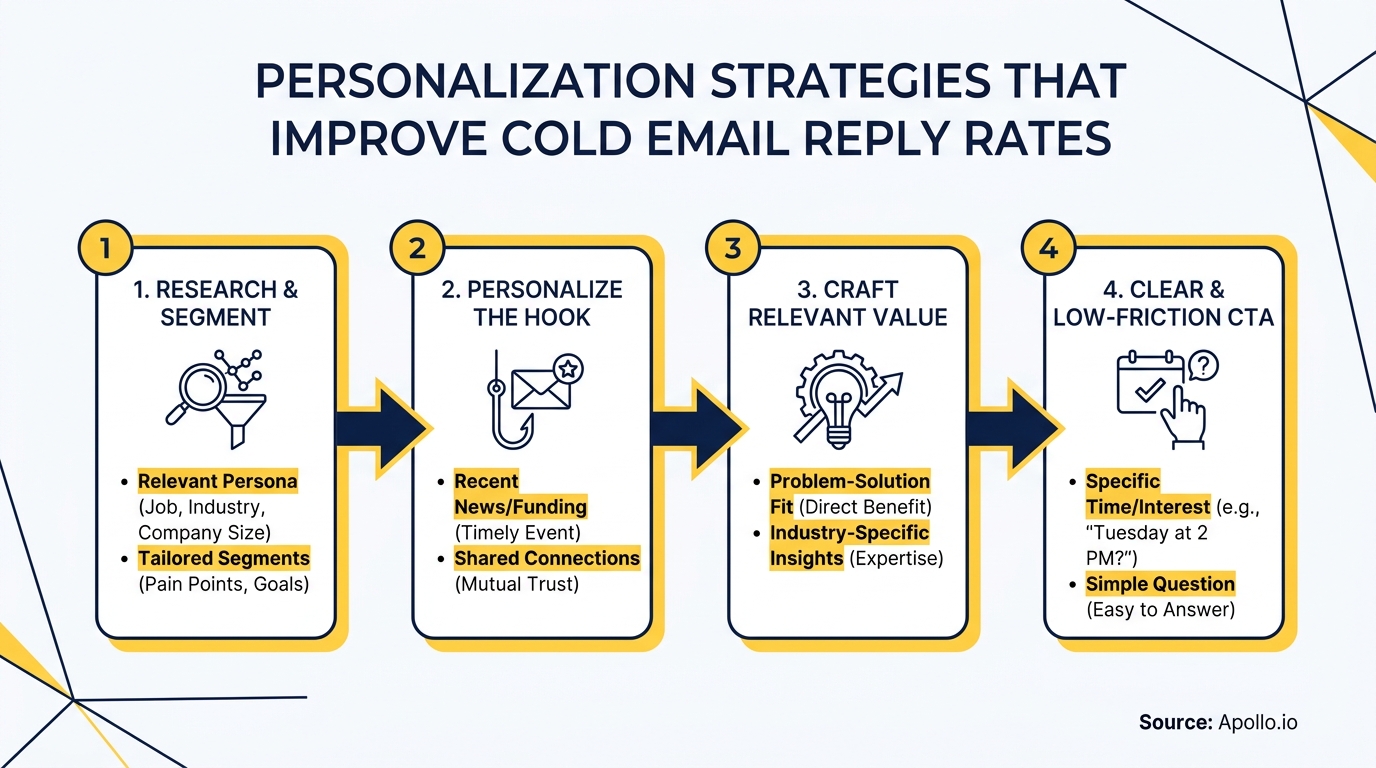
The strategies that measurably lift replies share one trait: they demonstrate situational awareness, not just demographic awareness. Here is what the data supports:
| Strategy | What It Is | Why It Works |
|---|---|---|
| Trigger-based outreach | Emailing after a funding round, job change, or product launch | Timing signals genuine relevance |
| Persona-specific pain framing | Leading with a problem specific to their role and company stage | Speaks to actual priorities, not assumed ones |
| Micro-list segmentation | Sending to tight ICP slices of 50 or fewer recipients | Smaller, targeted campaigns outperform large blasts |
| Offer personalization | Customizing the CTA or proof point to their industry or use case | Reduces friction, increases perceived value |
| Social/channel context | Referencing a post, interview, or company announcement | Proves the email is not automated |
Research from SalesS.io shows personalized email content increases average cold email response rates by 32.7%. But that lift depends on the type of personalization, not just the presence of it.
How Does Email Length Affect Personalization Performance?
Email length directly impacts whether your personalization gets read at all. The sweet spot is 6-8 sentences: enough to establish context and make an ask, short enough to be consumed in a mobile preview.
Emails that balloon to 13+ sentences see reply rates nearly cut in half even when personalization is present.
The implication for SDRs and BDRs: do not use the personalization line as an excuse to add length. One sharp, relevant sentence of context followed by a specific ask outperforms three paragraphs of background. Pair this with high-performing cold email subject lines to maximize open rates before personalization can do its work.
Turn Funnel Gaps Into Pipeline Gold
Tired of watching marketing leads stall before they ever reach your pipeline? Apollo surfaces verified, in-market contacts so your team hits the right buyers at right moment. 600K+ companies trust Apollo to turn funnel gaps into closed deals.
Start Free with Apollo →How Should SDRs and AEs Approach Account-Level Targeting?
SDRs should target 1-2 decision-makers per account rather than blasting every contact. Multi-threading an account with lightly personalized emails signals automation to buyers, collapsing reply rates.
The better approach is identifying the single highest-fit contact, personalizing to their specific role and context, and only expanding to a second contact after meaningful engagement or non-response over two weeks.
For Account Executives managing active deal cycles, personalization should reference deal-stage context: mutual connections, previous conversations, or specific objections raised. Generic nurture emails during an active cycle lose deals. Check your sender reputation regularly, since poor domain health can negate even excellent targeting.
Struggling to identify the right contacts at target accounts? Search Apollo's 230M+ contacts with 65+ filters to find your exact ICP.

Does Deliverability Undo Personalization Gains?
Yes. Personalization that relies on tracking-heavy tooling can produce a net-negative result if it harms inbox placement.
Open-tracking pixels, multiple redirected links, and HTML-heavy templates all increase spam filter risk.
A plain-text or near-plain-text email that lands in the primary inbox will outperform a beautifully personalized HTML email that hits promotions or spam.
Practical deliverability rules that protect personalization ROI:
- Set up SPF, DKIM, and DMARC on every sending domain before launching campaigns.
- Test with open tracking disabled on at least a portion of your sends.
- Limit links to one per email, ideally the CTA only.
- Warm new domains gradually before scaling volume.
- Review email deliverability best practices to audit your current setup.
What Are the Best Trigger Signals for Timely Personalization?
Trigger-based personalization is the highest-ROI approach because timing creates relevance without requiring deep research on every prospect. The best triggers to monitor and act on:
- Funding announcements: Companies that just raised are actively building and buying.
- Leadership changes: New executives re-evaluate vendor relationships in their first 90 days.
- Hiring signals: Job postings reveal technology gaps, growth areas, and strategic priorities.
- Product launches or expansions: Signals a company is in growth mode and open to new tools.
- Technology changes: Switching a core platform creates adjacent buying opportunities.
Reference the specific trigger in your opening line. "Congrats on the Series B, saw you're building out your sales team" beats any name-drop opener because it proves you did the work. Pair trigger identification with a strong sales messaging framework to convert that context into a compelling value statement.
How Do You Measure Personalization Lift?
Measuring personalization impact requires controlled testing. Run A/B tests where the only variable is the personalization type, keeping subject line, send time, and sequence structure identical.
Track reply rate (not just open rate) as the primary metric, since opens are increasingly unreliable with privacy protections.
A simple testing framework for RevOps teams:
- Segment a list of 100+ contacts into two equal, ICP-matched groups.
- Send Group A a generic value-prop email; send Group B a trigger-personalized version.
- Measure reply rate over 5 business days.
- Promote the winner, then test the next variable (offer, CTA, length).
Data from Sopro shows campaigns with advanced personalization have achieved reply rates up to 18%, compared to 9% for generic emails. That gap justifies the testing investment. For teams running high-volume outbound, Apollo's sales engagement platform makes A/B testing sequences and tracking reply rates straightforward without adding another tool to your stack.
What Should You Stop Doing to Improve Cold Email Replies?
Removing bad practices often lifts reply rates faster than adding new tactics. Avoid these common personalization mistakes:
- Fake familiarity: "I loved your recent post on [topic]" without specifics reads as automated and damages trust.
- Compliment openers: "Your company is doing amazing things" adds length without relevance.
- Over-researched intros that bury the ask: Three sentences of context before the value prop loses readers.
- Personalized subject, generic body: Mismatched personalization depth reduces conversion after the open.
- Blasting every contact at a target account: As noted above, this signals automation and suppresses replies.
For a complete picture of what actually works in B2B email marketing in 2026, combine these avoidance rules with the trigger-based and length-optimized tactics above.

Start Sending Emails That Actually Get Replies
The personalization strategies that improve cold email reply rates in 2026 share a common thread: they prioritize situational relevance over surface-level customization.
Shorter emails with one sharp insight, sent to the right one or two contacts at the right moment, consistently outperform longer, heavily templated messages.
Deliverability is not optional. Authentication, clean sending patterns, and minimal tracking are prerequisites for personalization to matter at all.
Test trigger-based approaches, measure reply rate as your north star, and cut what does not perform.
Apollo gives SDRs, AEs, and RevOps teams a unified workspace to find the right contacts, enrich them with buying signals, and run personalized sequences without managing five separate tools. Try Apollo free and see how consolidating your outbound stack changes what you can personalize at scale.
Prove Pipeline ROI From Day One
ROI pressure killing your next budget approval? Apollo delivers measurable pipeline impact fast — 46% more meetings, trackable from week one. 600K+ companies justify every dollar with Apollo's results.
Start Free with Apollo →Don't miss these
Sales
Inbound vs Outbound Marketing: Which Strategy Wins?
Sales
What Is a Sales Funnel? The Non-Linear Revenue Framework for 2026
Sales
What Is a Go-to-Market Strategy? The 2026 GTM Playbook
See Apollo in action
We'd love to show how Apollo can help you sell better.
By submitting this form, you will receive information, tips, and promotions from Apollo. To learn more, see our Privacy Statement.
4.7/5 based on 9,690 reviews
