
Key Metrics That Separate High-Performing AI SDR Deployments from Poor Ones
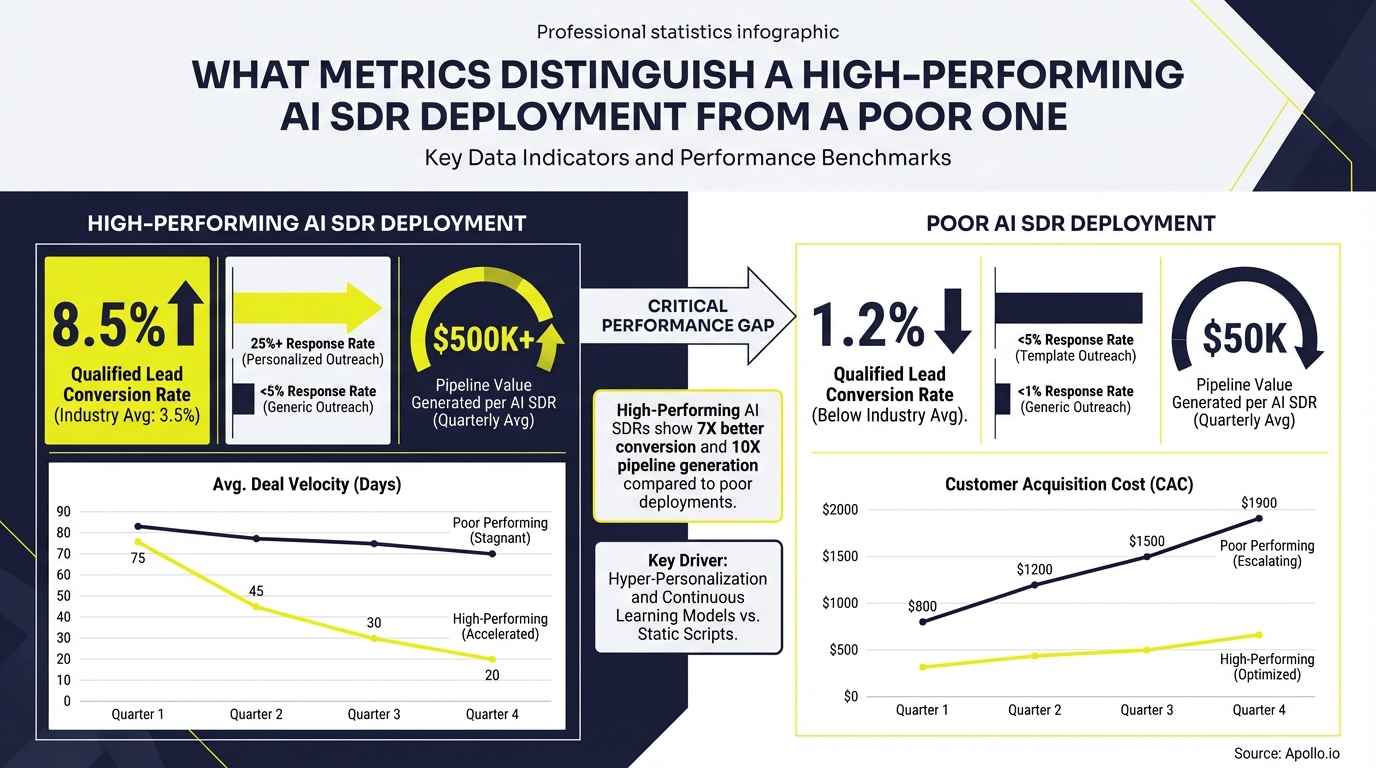
Most AI SDR deployments look identical on paper: sequences running, emails sending, meetings appearing on calendars. The difference between a program generating real pipeline and one burning your sender reputation shows up in a specific set of metrics most teams never track. Tools like Apollo's AI Sales Assistant are built to move the needle on the metrics that actually matter, from ICP-matched list building to signal-based sequence personalization. But first, you need to know which numbers to watch.
This framework covers the KPIs that separate high-performing AI SDR deployments from poor ones in 2026, organized by the layers where performance actually diverges: pipeline quality, speed, deliverability, and handoff integrity. For deeper context on the metrics landscape, see KPIs, Attribution, CAC, and Marketing ROI.

Research Less, Pipeline More With Apollo
Tired of burning hours verifying contact info that goes nowhere? Apollo surfaces accurate, ready-to-work leads so your reps spend time selling — not researching. Join 600K+ companies building predictable pipeline.
Start Free with Apollo →Key Takeaways
- High-performing deployments measure pipeline quality and stage velocity, not just emails sent or meetings booked.
- Speed-to-lead is a top separator: qualification outcomes drop sharply when response time extends beyond minutes.
- Deliverability metrics are now gating constraints for scale. Programs that ignore sender health see inbox placement collapse before pipeline does.
- Meeting-to-opportunity rate and handoff quality distinguish AI programs that create revenue from those that just create calendar events.
- Predictive intelligence adoption and automation coverage are leading indicators of deployment maturity, not vanity outputs.
What Is the North-Star KPI Framework for AI SDR Deployments?
The north-star framework for AI SDR performance tracks five metric layers: speed, qualification quality, pipeline creation, deliverability health, and handoff integrity. Most poor deployments only measure the first two, then wonder why pipeline doesn't materialize.
| Metric Layer | High-Performing Threshold | Warning Signal |
|---|---|---|
| Speed-to-Lead | Under 5 minutes for inbound | Over 1 hour average |
| Meeting Booking Rate | 12–25% of qualified outreach | Below 6% |
| Meeting-to-Opportunity Rate | Above 40% | Below 20% |
| Spam Complaint Rate | Below 0.1% | Above 0.3% |
| Automation Coverage | ICP targeting + scoring active | Manual list building only |
According to Martal, high-performing AI SDRs achieve meeting booking rates of 12–25%, more than double the traditional 6–12% benchmark. That gap is the first measurable signal of a strong deployment.
Turn Funnel Guesswork Into Pipeline Wins
Tired of watching marketing leads stall before they ever reach your pipeline? Apollo surfaces high-intent prospects and arms your team with real buying signals. 600K+ companies stopped guessing and started closing.
Start Free with Apollo →Why Does Speed-to-Lead Separate High Performers from Poor Ones?
Speed-to-lead is the single most impactful operational metric for AI SDR programs because it directly controls qualification outcomes. Poor deployments treat inbound response as a workflow task.
High-performing deployments treat it as a revenue SLA.
The gap between a 5-minute response and a next-day response is not incremental. For SDR teams managing inbound volume, this is where AI creates its clearest structural advantage over purely human processes: consistent, sub-minute response regardless of time zone or queue depth.
Struggling to qualify inbound leads fast enough? Apollo's AI sales automation handles inbound qualification instantly, at scale.
What Pipeline and Velocity Metrics Distinguish Strong AI SDR Programs?
Pipeline metrics distinguish strong deployments because they measure output quality, not activity volume. The key shift in 2026 is from "meetings booked" as the north star to a downstream chain: meeting held rate, meeting-to-opportunity conversion, and cost-to-pipeline.
- Meeting held rate: What percentage of booked meetings actually occur? Low rates signal poor ICP targeting.
- Meeting-to-opportunity rate: High-performing programs convert meetings to qualified opportunities at a higher rate, reflecting better pre-qualification by the AI.
- Cost-to-pipeline: Total program spend divided by pipeline created. This is the metric RevOps leaders should require before expanding any AI SDR program.
- Sales-stage velocity: How fast do AI-sourced leads move through the funnel compared to other sources?
Research from UserGems shows teams leveraging AI-powered lead generation report 50% more sales-ready leads and a 60% drop in acquisition costs. The implication for RevOps is clear: measure cost-to-pipeline, not cost-per-send. For a deeper look at how these metrics connect to revenue, see B2B Marketing Metrics That Drive Revenue Growth.
How Do SDRs and RevOps Leaders Measure Qualification Quality?
SDRs and RevOps leaders measure qualification quality through predictive scoring accuracy, ICP match rates, and false-positive reduction. These metrics reveal whether the AI is surfacing the right accounts or just filling sequences with volume.
A high-performing deployment uses AI lead scoring as a filter before outreach, not after. Apollo's Scores feature automatically generates ICP-match ratings (Excellent, Good, Fair, Not a Fit) so SDRs prioritize outreach on the accounts most likely to convert. Ian Kistner, Head of Sales Development at Crusoe, puts it directly: "We're using Apollo's AI Assistant to score and tier accounts, which makes it much easier to prioritize outbound in a quickly expanding market."
Data from Optif.ai shows AI predictive lead scoring achieves 89% accuracy compared to 60–68% for traditional models, resulting in a 40% reduction in false positives. Poor deployments skip scoring entirely and let volume substitute for targeting precision. For guidance on building better prospect lists, see What Are Buyer Leads? And How to Find Better Ones.
Why Are Deliverability Metrics Now Gating Constraints for AI SDR Scale?
Deliverability metrics are gating constraints because AI SDR programs can scale send volume faster than human programs ever could, and that speed destroys sender reputation when not controlled. A program with strong activity metrics but degraded deliverability is generating false signals: reply rates mean nothing if messages land in spam.
The failure pattern in 2026 is well-documented: AI SDR increases volume, domain reputation degrades, inbox placement collapses, and pipeline gaps appear weeks later. By then, the damage is done. High-performing deployments instrument deliverability as a leading indicator, not a trailing one.
- Spam complaint rate: Keep below 0.1%. Above 0.3% triggers inbox placement penalties from major providers.
- Authentication hygiene: SPF, DKIM, DMARC, and one-click unsubscribe must be active before scaling.
- Inbox placement rate: Track separately from open rate. Opens from the spam folder inflate opens and mask real deliverability problems.
- Domain warm-up compliance: New sending domains require gradual ramp-up. AI programs that skip this step see early collapse.
Worried your AI outreach is burning your sender domain? Apollo's sales engagement platform includes deliverability controls built into every sequence.

What Automation Maturity Metrics Predict Long-Term AI SDR Performance?
Automation maturity predicts long-term performance because AI SDR programs that rely on manual steps in their workflow hit ceilings that fully automated programs do not. The maturity markers are process automation coverage and predictive intelligence adoption.
High-performing deployments automate the full prospecting-to-sequence workflow: ICP filtering, contact enrichment, scoring, sequence enrollment, and follow-up. Poor deployments automate only the email send step and manually manage everything else. Apollo's Outbound Copilot runs end-to-end: it finds ICP-matched prospects, adds them to sequences, and sets automation cadence with manual approval controls built in.
For teams building their first structured outbound system, What Is a Sales System and How Do You Implement One? provides a useful operational foundation.
How Should SDR Leaders Evaluate Message Quality in AI Outreach?
SDR leaders should evaluate message quality by measuring positive reply rate, not just reply rate, along with meeting-acceptance rate as a proxy for message relevance. In 2026, with 94% of B2B buyers using AI in their research process, message specificity and proof density also determine whether outreach survives AI-assisted buyer research workflows.
Poor AI SDR deployments generate high-volume, low-specificity messages that get filtered or ignored. High-performing deployments ground every message in account-specific signals: recent funding, job changes, tech stack, and ICP-relevant pain points. Apollo's AI Content Center grounds messaging in your value proposition, ICP pain points, and real-time account research so outputs are specific by default, not by exception.
Erik Fernando Nieto, BDR at JumpCloud, describes the practical impact: "Apollo's AI Assistant filters and cleans prospect data for me, so I can find the right people faster and run better searches. It saves me about an hour per prospecting session." Message quality starts with targeting quality, and targeting quality starts with clean, enriched data. See Demand Gen Metrics That Drive Revenue for how these signals connect upstream.
How Do You Build a Measurement System That Captures All These Metrics?
Building a complete AI SDR measurement system means connecting activity data, pipeline data, and deliverability data into one view, reviewed on a weekly cadence. Most teams track these in silos, which is why they miss the deliverability-pipeline connection until it's too late.
The practical setup:
- Weekly: Deliverability health check (spam rate, inbox placement, authentication status)
- Weekly: Funnel conversion review (reply rate, positive reply rate, meetings booked, meetings held)
- Monthly: Pipeline quality audit (meeting-to-opportunity rate, cost-to-pipeline, stage velocity by source)
- Quarterly: Automation maturity review (coverage gaps, scoring adoption, enrichment completeness)
Apollo's unified platform consolidates prospecting, engagement, enrichment, and analytics so RevOps doesn't need to stitch together separate reporting tools. As Tory Kindlick, Head of Revenue Ops at RapidSOS, describes it: "Work that would've taken me hours was done before I even got off the train." Learn more in the Apollo AI Overview.

Start Measuring What Actually Moves Pipeline
The metrics that distinguish a high-performing AI SDR deployment from a poor one are not the ones most dashboards show by default. Pipeline quality, speed-to-lead, meeting-to-opportunity conversion, deliverability health, and automation maturity are the real dividers.
Teams that measure activity volume and stop there will always struggle to explain why their AI SDR program isn't generating the pipeline it should.
Apollo gives SDRs, RevOps leaders, and sales managers a unified platform to run, measure, and optimize every layer of this framework, without stitching together point tools. Start Your Free Trial and see which metrics your current deployment is missing.
Prove Pipeline ROI With Apollo
ROI pressure killing your tool budget? Apollo delivers measurable pipeline impact your leadership can see — fast. Teams like Leadium 3x'd annual revenue after making the switch. Start free today.
Start Free with Apollo →Don't miss these
Sales
Inbound vs Outbound Marketing: Which Strategy Wins?
Sales
What Is a Sales Funnel? The Non-Linear Revenue Framework for 2026
Sales
What Is a Go-to-Market Strategy? The 2026 GTM Playbook
See Apollo in action
We'd love to show how Apollo can help you sell better.
By submitting this form, you will receive information, tips, and promotions from Apollo. To learn more, see our Privacy Statement.
4.7/5 based on 9,690 reviews
