
What Is Workflow Automation and How Can You Set It Up in 2026?
Workflow automation is the practice of using software to execute repetitive, rule-based tasks without manual intervention. As Celigo describes it, workflow automation is driven by triggers, rules, and data, connecting applications like CRM, ERP, and finance software to execute repeatable tasks reliably. For B2B GTM teams, this means fewer dropped leads, faster follow-up, and a sales process that scales without adding headcount. Understanding how sales automation works is the foundation for any workflow automation strategy.
According to cflowapps.com, the global workflow automation market was valued at $26.5 billion in 2024 and is projected to exceed $78 billion by 2030. The opportunity is clear. The question is how to set it up the right way.

Research Less, Pipeline More With Apollo
Tired of your reps burning hours verifying contact info instead of selling? Apollo delivers 230M+ accurate contacts so your team skips the research and gets straight to booked meetings. Start building pipeline today.
Start Free with Apollo →Key Takeaways
- Workflow automation connects your CRM, outreach, and enrichment tools through triggers and rules, eliminating manual handoffs.
- Design your process before selecting tools: map the workflow, define triggers and owners, then choose software.
- Data quality is the most critical setup step in 2026: bad CRM data breaks every automation built on top of it.
- Governance matters: some workflows need human review before firing, especially customer-facing outreach and pricing.
- SDRs, RevOps, and AEs each have distinct automation use cases that deliver measurable pipeline impact when set up correctly.
What Is Workflow Automation and How Is It Different from a Tool?
Workflow automation is a governed operating model, not a single software feature. A tool executes a task. A workflow connects multiple tools through a defined sequence of triggers, conditions, actions, and ownership rules. The automation "stack" for most B2B teams looks like this:
| Layer | What It Does | Example |
|---|---|---|
| Trigger | Fires when a condition is met | Form submitted, intent signal detected |
| Action | Executes a task automatically | Enrich record, assign to rep, send email |
| AI/Agent | Makes decisions or drafts content | Personalize outreach, score lead, summarize call |
| Human Review | Approves before high-stakes output | Enterprise outreach, pricing, legal terms |
This distinction matters because most teams skip straight to tools and never define the workflow. That is why aiworkflowdesigner.com reports that as of 2025, over 65% of global businesses have implemented some form of workflow automation, yet adoption at the process level remains immature.
How Do You Set Up Workflow Automation? (Step-by-Step Playbook)
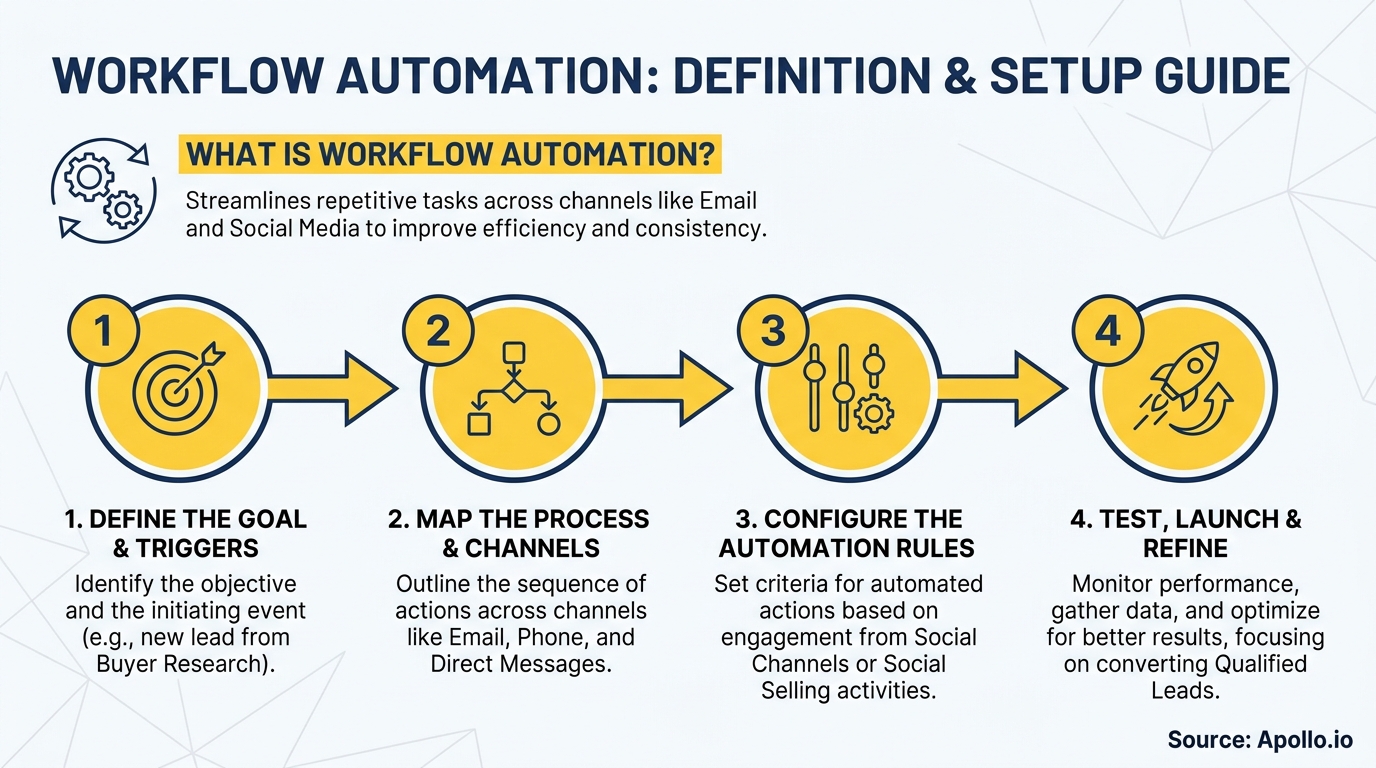
Setting up workflow automation starts with mapping the process, not selecting a tool. Follow this six-step playbook:
- Map the process: Document every manual step, handoff, and decision point in the workflow you want to automate.
- Define triggers and actions: Identify what event starts the workflow (trigger) and what should happen next (actions).
- Assign owners and SLAs: Every automated step needs a human owner and a time-bound SLA for fallback handling.
- Clean your data first: Audit CRM fields, lifecycle stages, duplicate records, and lead sources. Automation built on dirty data produces wrong outputs at scale.
- Choose tools and connect them: Select a workflow engine that integrates with your CRM, outreach, and enrichment stack. See the Sales Workflow Automation and CRM Automation capabilities Apollo offers.
- Add governance and measure ROI: Define which actions require human approval, set audit trails, and instrument conversion metrics from day one.
Spending hours on manual outreach while prospects go cold? Automate your multi-channel sequences with Apollo's sales engagement platform and let triggers handle the follow-up timing.
What Should You Automate vs. Keep Human?
Not every task should be automated. The right framework separates routine, low-risk steps from high-stakes, judgment-heavy decisions.
| Automate | Keep Human |
|---|---|
| Contact enrichment and deduplication | Enterprise pricing and contract terms |
| Lead scoring and routing | First outreach to named strategic accounts |
| Meeting scheduling and reminders | Customer escalations and complaints |
| Internal task creation and CRM updates | Legal commitments and SLA changes |
| Follow-up sequences after demos | Sensitive re-engagement after churn |
Gartner predicts over 40% of agentic AI projects will be canceled by the end of 2027 because of escalating costs, unclear business value, or inadequate risk controls. The takeaway: automate routine workflows, use agents for decision-heavy work, and always define where human review is required.

How Do SDRs and RevOps Teams Benefit from Workflow Automation?
SDRs and RevOps leaders see the most direct impact from workflow automation because their daily work is built on repetitive, data-intensive tasks. For SDRs, automation handles lead enrichment, sequence enrollment, task creation, and follow-up timing automatically after a prospect takes a qualifying action.
That means more time on live conversations and less time on CRM hygiene.
For RevOps, workflow automation creates a single, governed source of truth across sales, marketing, and customer success. Revenue operations teams use automation to enforce routing rules, maintain data standards, and track funnel conversion without manually pulling reports. Data from Utmost Agency shows sales teams using automation report 27% higher close rates and up to 20% increases in pipeline conversion.
For Account Executives, Apollo's workflow engine can fire pre-meeting research briefs, trigger deal-stage updates, and alert AEs when intent signals spike on target accounts, all without opening a separate tool.
Struggling to keep enrichment and prospecting in sync? Apollo's AI sales automation consolidates prospecting, enrichment, and outreach into one workspace, so your team stops switching between tools and starts closing more deals.
Turn Funnel Gaps Into Qualified Pipeline
Pipeline forecasting a guessing game because marketing leads never convert? Apollo surfaces high-intent prospects at the exact moment they're ready to buy. Top revenue teams use Apollo to build pipeline that actually closes.
Schedule a Demo →What Is a Workflow Automation Checklist for B2B Teams?
Use this checklist before launching any new workflow automation in your GTM stack:
- Process mapped with every manual step documented
- Trigger event clearly defined (form, signal, stage change, date)
- CRM data audited: no duplicate records, complete required fields
- Owner assigned for each action step
- SLA defined for fallback if automation fails
- Human review gate added for customer-facing or high-stakes outputs
- Conversion metric identified to measure workflow ROI
- Audit trail enabled in your workflow tool
- Pilot run completed on a small segment before full rollout
- Review date scheduled (30 days post-launch)
This design-first approach directly addresses the gap identified by research: most teams skip governance and measurement, then wonder why automations break or produce bad outcomes. See how automated lead generation systems apply this same structured approach to top-of-funnel workflows.
How Do You Measure Workflow Automation ROI?
Workflow automation ROI is measured by tracking conversion speed, error rate, and rep capacity across the automated process. Define your baseline before launch, then measure after 30 days.
- Speed-to-lead: Time from trigger event to first rep contact
- Sequence reply rate: Percentage of prospects who respond after automated enrollment
- Pipeline conversion: Leads entering the workflow vs. advancing to next stage
- Task completion rate: Percentage of automated tasks completed without manual override
- Data quality score: Percentage of records with complete, accurate fields post-enrichment
McKinsey's 2026 B2B research found that market leaders embed AI into commercial workflows to connect personalization, sales follow-up, and digital buying journeys across an average of 10 buyer channels. Teams without measurement architecture cannot replicate that model because they have no signal on what is working. Building a structured demand generation strategy alongside automation creates the attribution clarity needed to prove ROI to leadership.

How Does Apollo Help B2B Teams Automate Their GTM Workflows?
Apollo is an all-in-one GTM platform that consolidates prospecting, enrichment, outreach, and workflow automation into a single workspace, eliminating the need to stitch together multiple point solutions. Teams like Predictable Revenue have noted: "We reduced the complexity of three tools into one." Census reported: "We cut our costs in half." And Cyera found: "Having everything in one system was a game changer."
Apollo's sales workflow automation layer connects contact data, intent signals, and multi-channel sequences through a visual workflow engine. Triggers can fire on form fills, intent spikes, stage changes, or inbound signals. Actions include contact enrichment, sequence enrollment, task creation, CRM updates, and AI-drafted outreach. The result is a governed, measurable automation stack that scales from SDR teams to enterprise RevOps without requiring separate tools for each layer.
Trusted by nearly 100K paying customers across 600K+ companies, Apollo gives B2B GTM teams the data, engagement, and automation infrastructure to build workflows that actually reach production and deliver measurable pipeline results.
Ready to build your first governed workflow? Request a Demo of Apollo and see how SDRs, AEs, and RevOps teams run their entire GTM motion from one platform.
Prove Pipeline ROI From Day One
Budget approval stuck on unclear metrics? Apollo delivers measurable pipeline impact fast — with 35% more bookings from AI-powered messaging. Join 600K+ companies that close the loop on ROI.
Start Free with Apollo →Don't miss these
Sales
Inbound vs Outbound Marketing: Which Strategy Wins?
Sales
What Is a Sales Funnel? The Non-Linear Revenue Framework for 2026
Sales
What Is a Go-to-Market Strategy? The 2026 GTM Playbook
See Apollo in action
We'd love to show how Apollo can help you sell better.
By submitting this form, you will receive information, tips, and promotions from Apollo. To learn more, see our Privacy Statement.
4.7/5 based on 9,690 reviews
