
What Is the Impact on Your Sales Pipeline When You Update Deals in the CRM?
Every deal update in your CRM is a revenue signal, not a data entry task. When a rep changes a close date, moves a stage, or logs next steps, those edits cascade through forecasts, AI models, resource plans, and leadership dashboards. Getting those updates right, and getting them done consistently, determines whether your pipeline reflects reality or a wishful story. Learn how to connect your CRM integration with Salesforce and HubSpot so deal data flows cleanly from day one.

Research Less, Close More With Apollo
Tired of burning hours verifying contacts that go nowhere? Apollo delivers 230M+ accurate business contacts so your reps spend time selling, not searching. Start building real pipeline today.
Start Free with Apollo →Key Takeaways
- Accurate deal updates directly improve forecast reliability and reduce revenue planning errors.
- The fields that matter most for forecasting are close date, stage, deal amount, next step, and deal health signals.
- Stale or inaccurate CRM data does not just hurt dashboards — it degrades AI scoring, deal prioritization, and automated workflows.
- CRM hygiene is now a board-level discipline: pipeline truth affects hiring plans, marketing spend, and investor confidence.
- A structured update cadence reduces rep admin burden while protecting the signals that drive forecast accuracy.
How Does Updating Deals in the CRM Impact Your Sales Pipeline?
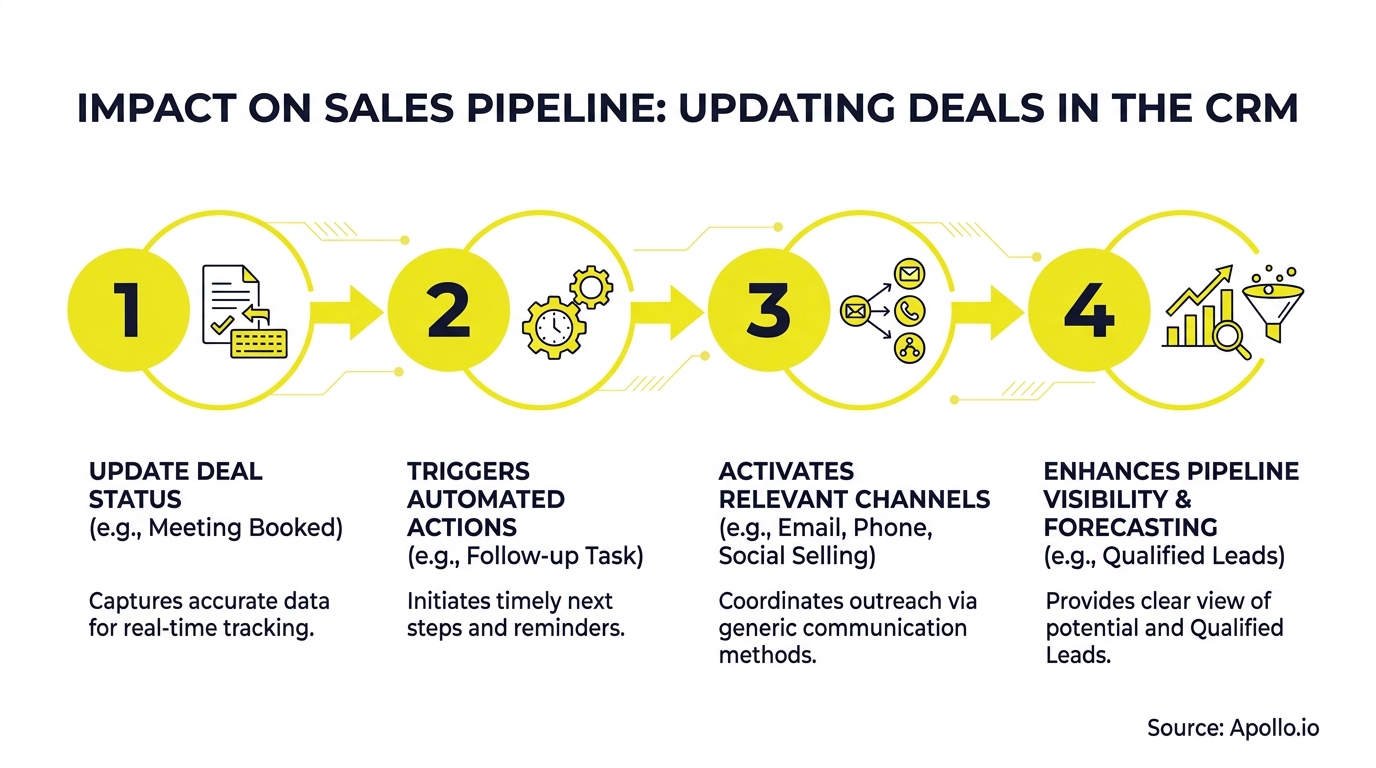
Updating deals in the CRM directly changes four pipeline outcomes: forecast accuracy, pipeline coverage visibility, deal inspection quality, and resource allocation decisions. When a close date slips and is not updated, the weighted pipeline overstates near-term revenue. When a stage stays at "Proposal" after a deal goes dark, coverage looks healthier than it is. According to Salesmotion, roughly 80% of CRM data is inaccurate, and 70% of revenue leaders do not trust their own CRM data.
The downstream effects compound quickly:
- Forecast calls become unreliable when stage and close date do not match actual buyer behavior.
- Deal inspection is wasted when managers review opportunities with outdated information.
- Marketing spend is misdirected when pipeline coverage looks sufficient but is built on stale deals.
- Capacity planning breaks when revenue projections are based on phantom pipeline.
Research from Teamgate found that 37% of CRM users report revenue losses due to poor data quality, and 76% admit that less than half of their CRM data is accurate and complete. The pipeline impact is not abstract — it shows up in missed targets and misallocated resources.
Which CRM Deal Fields Have the Biggest Pipeline Impact?
Not all deal field updates carry equal weight. Close date, stage, and deal amount are the three fields with the highest forecast exposure.
Next steps and deal health signals rank next. Here is a practical impact matrix for RevOps and sales managers:
| Deal Field | Forecast Model Effect | Business Risk If Wrong | Update Guidance |
|---|---|---|---|
| Close Date | Shifts weighted pipeline in/out of period | Over/understated quarterly revenue | Update at every buyer interaction |
| Deal Stage | Changes probability multiplier | False pipeline coverage, missed risk signals | Update on verified stage criteria, not optimism |
| Deal Amount | Alters total pipeline value | Capacity and quota planning errors | Revise after any scope or pricing change |
| Next Step | Signals deal momentum | Stalled deals invisible to inspection | Required field after every call or meeting |
| Deal Health / Risk | Feeds AI scoring and prioritization | AI suggests wrong next actions | Flag blockers and risks explicitly |
For Account Executives managing active deals, the close date and next step fields are the most important to maintain in real time. A deal without a logged next step is functionally invisible to AI forecasting tools and manager dashboards alike.
Struggling to keep pipeline data clean and actionable? Get complete pipeline visibility with Apollo's deal management tools.
Turn Funnel Gaps Into Qualified Pipeline
Tired of watching marketing leads stall before they ever reach your AEs? Apollo surfaces high-intent prospects so your team works deals that actually close. 600K+ companies trust Apollo to build predictable pipeline.
Start Free with Apollo →Why Do CRM Deal Updates Now Affect AI Sales Performance?
CRM deal fields now serve as input data for AI agents, deal scoring, forecasting models, and next-best-action recommendations — not just manager dashboards. Salesforce's 2026 State of Sales report notes that 46% of sales professionals using AI agents say data quality issues directly hurt their sales results, and 51% of sales leaders with AI say tech silos delay or limit AI initiatives.
The practical implication: a stale close date does not just distort a chart — it causes an AI model to deprioritize a real deal or trigger the wrong automated follow-up. Data enrichment and clean deal records are prerequisites for AI to work correctly, not optional hygiene tasks.
High-performing sales organizations understand this shift. Salesforce's 2026 report found that high performers are 1.5x more likely to prioritize data hygiene specifically for AI outcomes.
For RevOps leaders, this makes CRM update governance a revenue-critical function, not an admin concern.
What Is the Hidden Cost of Not Updating Deals?
The cost of stale deal data goes beyond inaccurate reports. According to S-Rocket, companies with inaccurate CRM data can lose up to 22% of manager time and 35% of potential revenue due to issues like duplicate contacts and outdated information.
Common failure modes that compound pipeline damage:
- Zombie deals: Opportunities that are functionally dead but still appear as open pipeline, inflating coverage metrics.
- Duplicate records: Two reps working the same account with no visibility into each other's activity.
- Expired close dates: Deals with past-due close dates that skew weighted pipeline calculations for the entire team.
- Missing next steps: No scheduled activity means no AI-flagged risk, no manager visibility, and no rep accountability.
- Optimistic stage inflation: Reps advancing deals before criteria are met, creating false confidence in forecast calls.
Norwest's 2025 B2B Sales and Marketing Benchmark Report found that only 16% of organizations report no major forecasting issues — meaning 84% are dealing with pipeline problems that trace back to inconsistent or outdated deal updates. See how job change alerts can turn CRM updates into pipeline wins by surfacing real-time signals that keep deal records current.

How Should RevOps Teams Set a CRM Deal Update Cadence?
RevOps leaders should design update cadence around forecast cycles and deal velocity, not arbitrary weekly reminders. The goal is protecting forecast-critical signals while minimizing rep admin time.
Here is a practical framework:
- After every buyer interaction: Update next step, close date (if discussed), and any new stakeholders or blockers.
- Weekly (pipeline review): Validate stage accuracy against defined exit criteria. Flag deals with no activity in the past 7 days.
- Monthly (forecast call prep): Audit close dates, amounts, and deal health fields for all commit and upside deals.
- Quarterly (hygiene audit): Archive zombie deals, merge duplicates, and review stage definition compliance across the team.
For SDRs and BDRs handing off opportunities, the stage and next step fields should be required before any deal transfer is accepted. A clean handoff prevents downstream forecast distortion and ensures AEs inherit accurate pipeline context. Review your CRM integration strategy to automate field validation and reduce manual update burden.
Want to build and manage pipeline from a single platform? Explore Apollo's AI-powered sales pipeline builder and consolidate your GTM motion into one workspace.
What Is the CRM Deal Update AI-Readiness Checklist?
Before deploying AI forecasting, deal scoring, or automated workflows, verify that your CRM deal data meets these minimum standards. Each item maps to a specific AI failure mode when missing:
- Close date is current and future-dated — AI forecasting requires valid period assignment.
- Stage matches defined exit criteria — Probability-weighted models break on subjective stage inflation.
- Deal amount reflects current scope — AI prioritization ranks deals by value; stale amounts distort rankings.
- Next step is logged with a date — Activity-based AI scoring requires scheduled future actions.
- No open duplicate records — Duplicate deals create conflicting signals and double-count pipeline.
- Contact and stakeholder records are current — AI enrichment and outreach automation depend on accurate contact data.
- Risk or blocker fields are populated on stalled deals — AI cannot surface risk it cannot see.
For sales leaders evaluating sales analytics tools, this checklist doubles as a data quality audit before any new platform deployment. Clean deal records are the foundation — everything else builds on top.

How Does Apollo Help Teams Keep Pipeline Data Accurate and Actionable?
Apollo consolidates prospecting, engagement, enrichment, and deal management into one unified platform, which means deal data stays current without reps toggling between multiple tools. "Having everything in one system was a game changer," said the team at Cyera. Apollo's native HubSpot and Salesforce integrations sync deal activity, contact updates, and engagement signals back to your CRM automatically, reducing manual update burden while keeping pipeline fields accurate.
For RevOps teams managing sales productivity across growing teams, Apollo's workflow engine triggers CRM updates based on real engagement activity — calls logged, emails opened, meetings booked — so deal records reflect actual buyer behavior rather than rep memory. Trusted by nearly 100K paying customers including Anthropic, Smartling, and DocuSign, Apollo gives B2B GTM teams the data foundation AI forecasting and deal inspection require.
Ready to turn accurate pipeline data into predictable revenue? Request a Demo and see how Apollo consolidates your sales tech stack into one source of pipeline truth.
Prove Pipeline ROI Before Next QBR
ROI pressure killing your tool adoption? Apollo delivers measurable pipeline impact fast — so budget approvals become a formality, not a fight. Leadium 3x'd their revenue. You're next.
Schedule a Demo →Don't miss these
Sales
Inbound vs Outbound Marketing: Which Strategy Wins?
Sales
What Is a Sales Funnel? The Non-Linear Revenue Framework for 2026
Sales
What Is a Go-to-Market Strategy? The 2026 GTM Playbook
See Apollo in action
We'd love to show how Apollo can help you sell better.
By submitting this form, you will receive information, tips, and promotions from Apollo. To learn more, see our Privacy Statement.
4.7/5 based on 9,690 reviews
