
What Is Sales Forecasting? Definition, Methods, and Best Practices
Sales forecasting has shifted from gut feelings to AI-powered precision. In 2026, teams using data-driven forecasting close deals faster, allocate resources smarter, and hit revenue targets consistently. According to Gartner, 60% of B2B sales organizations have transitioned to data-driven selling, integrating processes, applications, and analytics into a single operational practice. This guide shows you how modern B2B sales teams build accurate forecasts that drive predictable revenue.

Scale Your Team Without The Growing Pains
Tired of inconsistent processes slowing down your growing sales team? Apollo standardizes workflows and automates lead research so every rep performs like your top seller. Join 550K+ companies scaling predictably.
Start Free with Apollo →Key Takeaways
- Sales forecasting predicts future revenue using historical data, pipeline metrics, and AI-powered analysis
- AI and machine learning improve forecast accuracy by analyzing patterns humans miss
- Data quality and CRM integration are the foundation of reliable forecasts
- RevOps leaders use forecasting to align sales, marketing, and finance around shared revenue goals
- Modern forecasting platforms consolidate multiple tools into one unified workspace
What Is Sales Forecasting?
Sales forecasting is the process of estimating future revenue based on historical sales data, current pipeline health, market conditions, and rep performance. It answers the question: "How much revenue will we close this quarter?" Modern forecasting combines CRM data, AI analysis, and real-time pipeline visibility to generate accurate predictions. For revenue operations teams, forecasting provides the foundation for hiring plans, budget allocation, and strategic decisions.
Forecasting differs from guesswork. It relies on quantifiable metrics like deal stage, close probability, historical win rates, and sales cycle length.
Sales leaders use forecasts to identify gaps early, coach reps on at-risk deals, and adjust strategy before quarter-end surprises derail revenue goals.
Why Is Sales Forecasting Important in 2026?
Accurate forecasting drives three critical business outcomes: predictable revenue, efficient resource allocation, and strategic agility. Companies with reliable forecasts avoid last-minute scrambles, overhiring mistakes, and cash flow problems. Research by McKinsey shows generative AI could unlock $0.8 trillion to $1.2 trillion in productivity gains across sales and marketing functions.
For sales leaders, forecasting enables proactive pipeline management. Instead of reacting to missed targets, leaders spot trends early and intervene.
For finance teams, forecasts inform budgeting and investor communications. For Account Executives managing complex deals, forecasting tools highlight which opportunities need attention and which are tracking to close on time.
How Does Sales Forecasting Work?
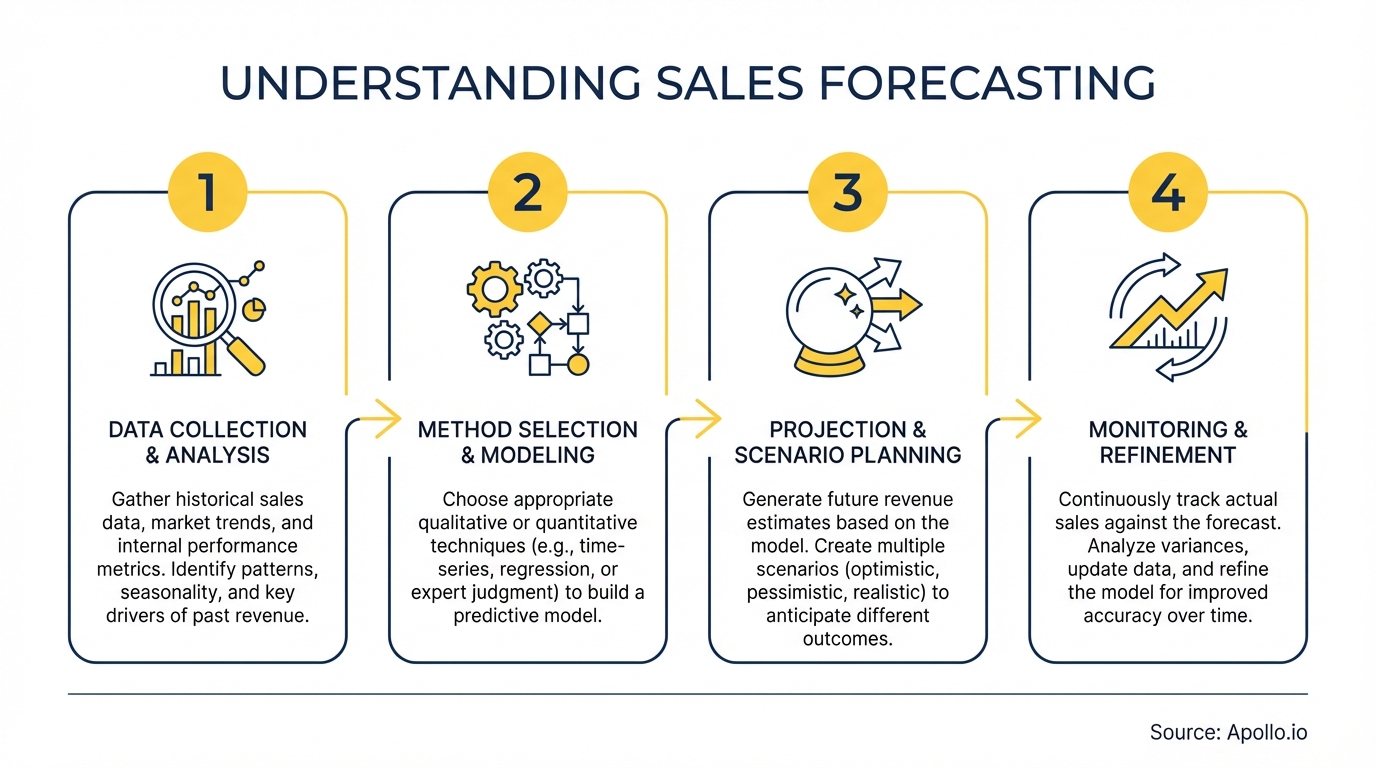
Modern sales forecasting pulls data from your CRM, analyzes pipeline health, applies probability models, and generates revenue projections. The process starts with clean data.
Every deal needs accurate information: deal size, close date, stage, and historical win rates for similar opportunities. AI models then analyze patterns across thousands of deals to predict outcomes.

Forecasting methods include:
- Opportunity stage forecasting: Multiplies deal value by stage-based close probability
- Historical forecasting: Projects future revenue based on past performance trends
- Pipeline forecasting: Analyzes current pipeline volume and velocity
- AI predictive forecasting: Uses machine learning to identify patterns and anomalies
The best forecasts combine multiple methods. A deal in "Negotiation" stage might have a 70% close probability based on stage, but AI analysis of communication patterns and buyer engagement could adjust that to 85% or 55%.
What Data Do Sales Leaders Need for Accurate Forecasting?
Accurate forecasts require five core data elements. First, complete pipeline visibility including every open opportunity, deal size, expected close date, and current stage.
Second, historical win rates broken down by rep, region, deal size, and industry. Third, sales cycle metrics showing average time in each stage.
Fourth, rep activity data including calls, emails, and meetings. Fifth, external signals like market conditions and buyer behavior trends.
Data quality matters more than volume. A forecast built on incomplete CRM records or outdated close dates produces garbage predictions. RevOps teams should audit data quality monthly, enforce CRM hygiene standards, and use enrichment tools to fill gaps. Can't trust your pipeline data? Start with Apollo's 224M+ verified business contacts to build accurate forecasts.
See Every Deal In Real Time With Apollo
Pipeline forecasting a guessing game? Apollo surfaces buying signals and tracks deal momentum across your entire funnel. Built-In increased win rates 10% with real-time visibility.
Start Free with Apollo →How Do RevOps Leaders Build Data-Driven Forecasts?
RevOps leaders transition from intuition-based to data-driven forecasting through a three-phase process. Phase one establishes data foundations: integrate CRM with forecasting tools, cleanse historical data, and define standard metrics.
Phase two implements AI models: train algorithms on historical deals, set probability thresholds, and validate predictions against actual outcomes. Phase three embeds forecasting into workflows: create rep-level forecast reviews, build executive dashboards, and tie forecasts to compensation.
Change management determines success. Reps resist forecasting when it feels like surveillance.
Frame forecasting as a coaching tool that helps reps prioritize high-value deals and identify risks early. Sales leaders managing teams should hold weekly forecast reviews that focus on pipeline health, not blame for missed predictions.
What Tools Do Sales Teams Use for Forecasting?
Modern AI sales tools consolidate forecasting, pipeline management, and deal tracking in one platform. Traditional setups require separate tools for CRM, sales engagement, conversation intelligence, and forecasting. That creates data silos, integration headaches, and higher costs. Companies report significant savings by consolidating their tech stack. As one customer shared: "We reduced the complexity of three tools into one."

Key forecasting capabilities include:
- AI-powered probability scoring for each deal
- Real-time pipeline dashboards with drill-down visibility
- Historical trend analysis and pattern recognition
- Rep-level and team-level forecast roll-ups
- Integration with CRM, email, and calendar data
- Automated alerts for at-risk deals and pipeline gaps
Struggling to track deals across multiple tools? Manage your entire pipeline in Apollo's unified platform.
How Can Sales Teams Improve Forecast Accuracy?
Improving forecast accuracy requires four actions. First, enforce CRM hygiene with mandatory fields, regular audits, and automated data validation.
Second, calibrate probability models quarterly using actual win rates. Third, incorporate multiple data signals including rep activity, buyer engagement, and deal progression velocity.
Fourth, review forecasts weekly with reps to identify risks and update predictions.
Common accuracy killers include optimistic close dates, inflated deal sizes, and stalled deals left in pipeline. Sales leaders should implement stage exit criteria that require specific actions before advancing deals.
For example, a deal can't move to "Negotiation" until a champion is identified and economic buyer is engaged. This creates realistic pipelines that generate accurate forecasts.
Conclusion: Build Forecasts That Drive Predictable Revenue
Sales forecasting in 2026 combines AI precision with human judgment. The most successful teams use data-driven forecasting to spot risks early, allocate resources efficiently, and hit targets consistently.
Start by cleaning your data, integrating your tools, and training your team on forecasting discipline. The payoff is predictable revenue, confident planning, and strategic agility.
Modern teams consolidate their forecasting, pipeline management, and sales performance tools into one platform. This eliminates data silos, reduces costs, and improves accuracy. As one customer put it: "We cut our costs in half." Ready to build forecasts that actually predict your revenue? Try Apollo free and see how 550K+ companies use our unified platform to hit their revenue goals.
Prove Apollo's ROI In Your First 30 Days
Budget approval stuck on unclear metrics? Apollo tracks every touchpoint from prospect to closed deal, showing exactly which activities drive revenue. Built-In increased win rates 10% and ACV 10% with full visibility.
Start Free with Apollo →Don't miss these
Sales
Inbound vs Outbound Marketing: Which Strategy Wins?
Sales
What Is a Sales Funnel? The Non-Linear Revenue Framework for 2026
Sales
What Is a Go-to-Market Strategy? The 2026 GTM Playbook
See Apollo in action
We'd love to show how Apollo can help you sell better.
By submitting this form, you will receive information, tips, and promotions from Apollo. To learn more, see our Privacy Statement.
4.7/5 based on 9,690 reviews
