
What Is Predictive Prospecting and How Does It Improve Lead Generation?
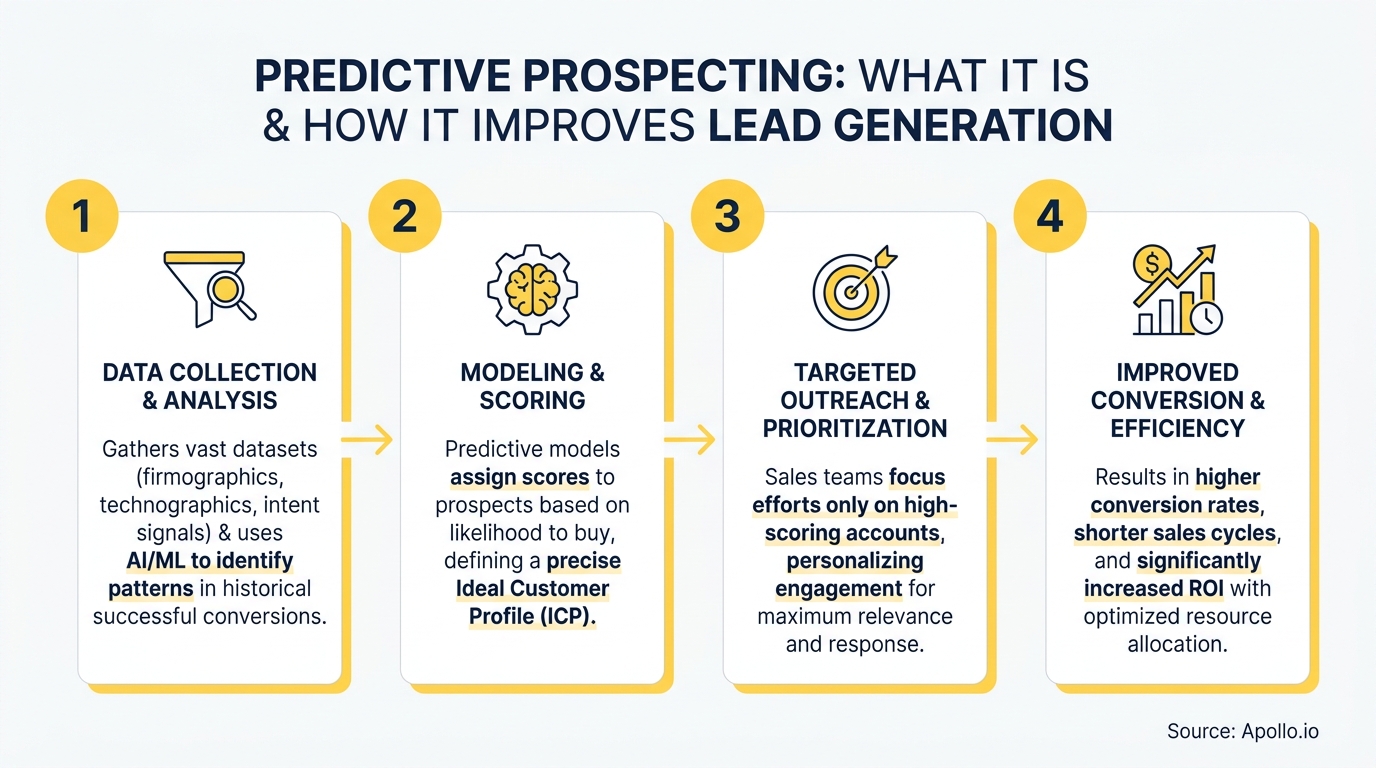
Predictive prospecting uses AI, historical data, and behavioral signals to identify which prospects are most likely to buy, and when, so your team focuses outreach where it actually converts. For SDRs, AEs, and RevOps leaders drowning in low-quality leads, this shift from volume to precision changes everything. If you want smarter sales prospecting strategies, predictive methods are the foundation.

Scale Smarter With Apollo's GTM Engine
Tired of manual research eating your selling time? Apollo surfaces verified contacts and automates outreach so your team spends every hour closing, not searching. Join 600K+ companies building predictable pipeline.
Start Free with Apollo →Key Takeaways
- Predictive prospecting uses AI and behavioral signals to prioritize high-intent accounts, not just build bigger lists.
- Gartner found 73% of B2B buyers actively avoid suppliers that send irrelevant outreach, making precision more critical than volume.
- Machine learning lead scoring reports 75% higher conversion rates compared to traditional methods, according to Landbase.
- Buying decisions now involve an average of 13 people across 2+ departments, requiring multi-threaded outreach, not single-contact campaigns.
- The shift from predictive scoring to agentic execution means modern tools don't just rank leads — they trigger outreach and qualify automatically.
What Is Predictive Prospecting?
Predictive prospecting is the practice of using AI and analytics to forecast which accounts and contacts are most likely to convert, then prioritizing outreach to those targets. As noted by dring.ai, this approach moves beyond traditional, often manual, lead qualification methods by predicting future buyer behavior based on historical data, engagement metrics, and various demographic and behavioral signals.
It's distinct from basic lead scoring (which assigns static points to attributes) and intent data (which captures third-party browsing signals). Predictive prospecting combines both, along with first-party CRM data, firmographics, and product usage signals, into a dynamic model that updates as behavior changes.
| Method | Input | Output |
|---|---|---|
| Traditional Lead Scoring | Static firmographic attributes | Fixed point score |
| Intent Data | Third-party browsing signals | Topic interest flags |
| Predictive Prospecting | Historical data + behavior + signals | Dynamic buy-probability ranking |
Why Does Predictive Prospecting Matter for Lead Generation in 2026?
Predictive prospecting matters because buyer attention is scarce and irrelevant outreach actively damages pipeline. Gartner research found that B2B buyers in complex purchases spend only 17% of their total buying time meeting with suppliers — approximately 5% per supplier when evaluating three vendors simultaneously.
Meanwhile, a Gartner survey of 632 buyers (fielded Aug–Sep 2024) found that 73% of B2B buyers actively avoid suppliers that send irrelevant outreach.
Forrester adds another layer: 86% of B2B purchases stall during the buying process, and the average buying decision involves 13 people across at least two departments. Predictive prospecting helps teams identify the right accounts and the right stakeholders before deals stall, not after.
A sales professional shared a firsthand perspective on Redditthat captures this well: "The biggest change for us was using AI to filter leads before they hit sales. Saved loads of time. Outreach alone didn't help much until qualification was sorted."
Struggling to find and qualify the right leads before they reach your reps? Search Apollo's 230M+ contacts with 65+ filters to surface high-intent prospects faster.
How Does Predictive Prospecting Improve Lead Quality?
Predictive prospecting improves lead quality by replacing gut-feel prioritization with data-driven scoring, so reps spend time on accounts that are actually ready to buy. According to Landbase, machine learning lead scoring reports 75% higher conversion rates compared to traditional methods, with high-performing companies achieving 6% conversion rates versus the 3.2% industry average.
The improvement comes from four signal categories working together:
- Firmographic fit: Company size, industry, tech stack, revenue range
- Behavioral signals: Website visits, content engagement, email opens, product usage
- Intent data: Third-party topic surges, job change alerts, funding events
- Conversation intelligence: Past call outcomes, objection patterns, deal velocity
Research from Demand Gen Report shows that Forrester indicates 83% of predictive analytics users have experienced a considerable or very high business impact, and 58% exceeded their marketing business goals with its help.
Turn Weak Leads Into Pipeline With Apollo
Tired of marketing leads that never become real opportunities? Apollo surfaces verified, in-market contacts so your team hits the funnel with buyers — not maybes. 600K+ companies trust Apollo to build predictable pipeline.
Start Free with Apollo →How Do SDRs and RevOps Teams Apply Predictive Prospecting?
SDRs use predictive prospecting to work a prioritized daily list instead of manually researching hundreds of accounts. RevOps leaders use it to build routing rules that send only qualified, scored leads to the right rep at the right moment.
For SDRs and BDRs:
- Start each day with a ranked account list based on intent signals and ICP fit
- Use AI-generated outreach rationale to personalize the first touch
- Sequence only accounts above a defined score threshold to protect sender reputation
For RevOps leaders:
- Define ICP scoring criteria in your CRM using first-party engagement and firmographic fit
- Set automated routing rules that trigger sequences when an account crosses a score threshold
- Review model accuracy quarterly and recalibrate on closed-won and closed-lost data
Timing matters as much as targeting. A sales professional wrote on Reddit that waiting two weeks before contacting leads, rather than calling immediately, produced measurably better contact ratios, appointment rates, and new client rates. Predictive models that factor in behavioral readiness, not just demographic fit, capture this timing advantage at scale.
This is also where sales automationand predictive scoring converge: automated sequences only deliver value when they're triggered by genuine buying signals, not arbitrary timelines.

What Does the 2026 Shift to Agentic Prospecting Mean?
The 2026 evolution of predictive prospecting moves from generating ranked lists to autonomous agents that monitor signals, research accounts, and trigger qualified outreach without manual intervention. This is the shift from predictive scoring to agentic execution.
Recent platform releases reflect this directly. Salesforce reported that using its Agentforce system on Salesforce.com produced 40% faster lead qualification and over 100,000 AI-powered conversations, according to Salesforce. Separately, a Forrester 2026 report highlights that AI-powered search is reshaping intent data signals, meaning teams need to validate signal quality and diversify data sources rather than relying on a single provider.
For GTM teams building or upgrading their approach, this means:
- Fusing first-party CRM data with third-party intent signals for more reliable prioritization
- Using AI agents that surface account risk, recommend next actions, and execute sequences
- Treating lead quality, not volume, as the primary KPI for outbound programs
For deeper context on how predictive approaches connect to broader pipeline strategy, see outbound prospecting best practices and how to build an automated lead generation system that runs on signals, not spreadsheets.
How Should You Start Building a Predictive Prospecting Workflow?
Building a predictive prospecting workflow starts with defining your ideal customer profile (ICP) precisely, then layering signal data on top to identify accounts that match the profile and are showing active buying behavior.
Five-step implementation framework:
- Audit your ICP: Use closed-won data to define the firmographic and behavioral attributes of your best customers
- Connect your data sources: Link CRM, marketing automation, intent data, and conversation intelligence into one scoring model
- Define score thresholds: Set clear cutoffs for MQL, SQL, and sequence-trigger actions
- Build multi-threaded sequences: Map outreach to each buying-group role (champion, economic buyer, technical evaluator)
- Measure and recalibrate: Compare predicted scores to actual outcomes monthly and adjust model weights
As diggrowth.com notes, the goal is to enhance the efficiency and effectiveness of B2B sales and marketing efforts by focusing resources on high-potential prospects, not spreading effort equally across an undifferentiated list.
For more on building the targeting foundation, explore how to find better buyer leads and review lead generation best practices for filling your pipeline with qualified opportunities.
Spending too much time on manual research before each sequence? Apollo's AI sales automation surfaces intent signals and triggers personalized outreach automatically, so your reps focus on conversations, not list-building.

Start Prospecting Smarter in 2026
Predictive prospecting is the difference between working harder and working on the right accounts. When buyers spend minimal time with any single vendor and actively filter out irrelevant outreach, precision is the only sustainable advantage.
Apollo gives SDRs, AEs, RevOps leaders, and marketing teams a unified platform to find, score, and engage high-intent prospects without stitching together five separate tools. Trusted by nearly 100,000 paying customers including Anthropic, Smartling, and Redis, Apollo consolidates your sales tech stack into one workspace.
As Census put it, "We cut our costs in half."
Start Prospecting free today and put predictive intelligence to work across your entire GTM motion.
Prove Pipeline ROI From Day One
ROI pressure killing your tool budget before it even starts? Apollo delivers measurable pipeline impact fast — with 46% more meetings using AI and real results teams can show leadership. Start free today.
Start Free with Apollo →Don't miss these
Sales
Inbound vs Outbound Marketing: Which Strategy Wins?
Sales
What Is a Sales Funnel? The Non-Linear Revenue Framework for 2026
Sales
What Is a Go-to-Market Strategy? The 2026 GTM Playbook
See Apollo in action
We'd love to show how Apollo can help you sell better.
By submitting this form, you will receive information, tips, and promotions from Apollo. To learn more, see our Privacy Statement.
4.7/5 based on 9,690 reviews
