
What Is Outbound Sales and How Does It Differ from Inbound?
Outbound sales is the practice of proactively reaching out to potential buyers before they raise their hand. Inbound sales is the opposite: prospects come to you. Understanding the distinction is essential for any B2B GTM team building a pipeline strategy in 2026, especially as buyer behavior shifts toward self-serve experiences. For a deeper look at how these motions connect to broader revenue strategy, see What Is Revenue Operations and How Does It Drive Growth?

Research Less, Close More With Apollo
Tired of burning hours manually verifying contacts that go nowhere? Apollo surfaces accurate, ready-to-engage prospects so your team spends time selling. Join 600K+ companies building predictable pipeline.
Start Free with Apollo →Key Takeaways
- Outbound sales means your team initiates contact; inbound means buyers find you first.
- Inbound leads convert at higher rates because prospects have already shown interest.
- Buyer preferences are shifting toward self-serve, making inbound infrastructure more critical than ever.
- High-performing teams run hybrid motions, using outbound to target high-value accounts while inbound handles self-serve demand.
- SDRs and AEs who automate non-selling work close the productivity gap and get more outbound at-bats per day.
What Is Outbound Sales?
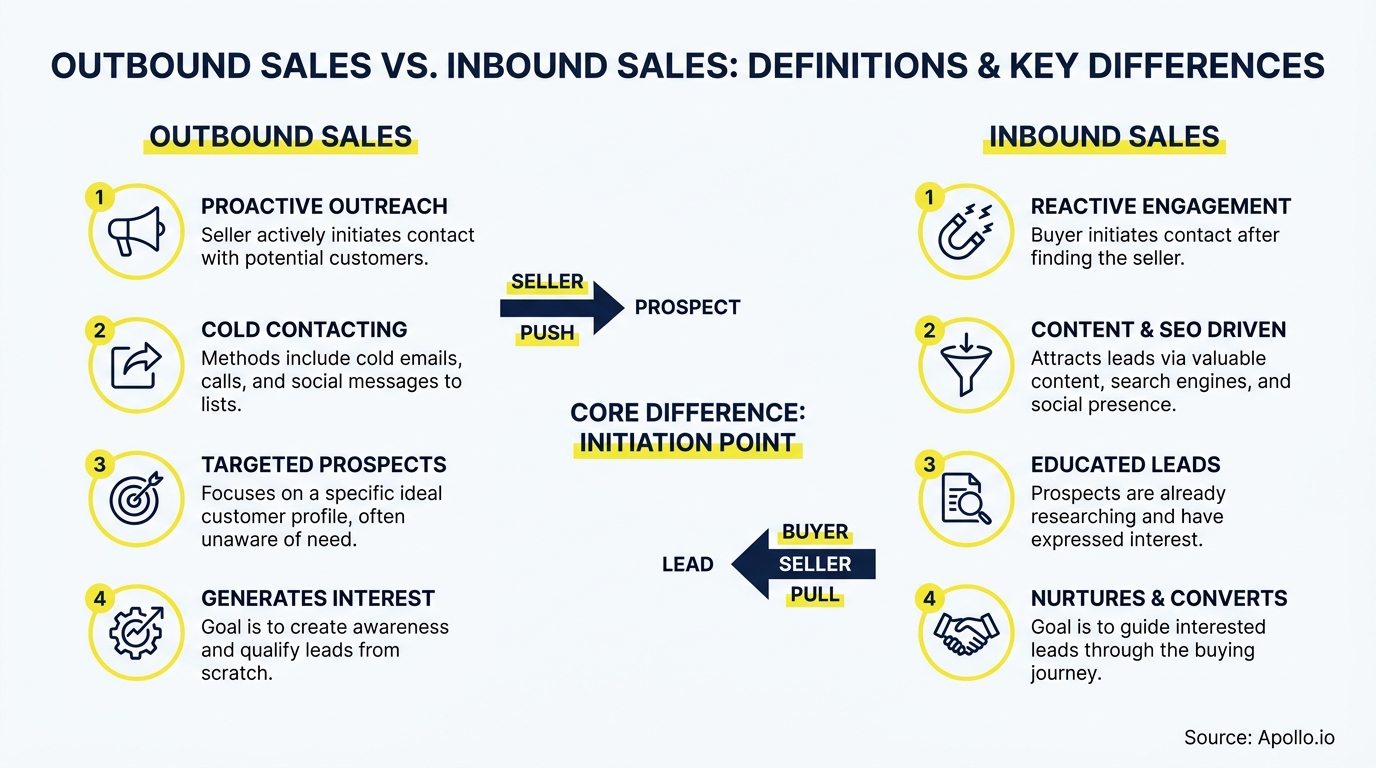
Outbound sales is a go-to-market motion where the sales team initiates contact with prospects who have not previously expressed interest. According to Salesforce, this method involves the sales team actively finding and approaching potential clients through channels such as cold calling, cold emailing, direct mail, and social selling.
Outbound is characterized by targeted outreach and often a higher volume of activities to reach prospects, as noted by Konsyg. The core advantage: you control who you target and when, making outbound ideal for entering new markets, pursuing high-ticket accounts, or launching a new product segment.
What Is Inbound Sales and How Does It Differ?
Inbound sales relies on the customer initiating contact, typically after engaging with content, search results, or product-led growth motions. As NetHunt explains, the fundamental difference is initiation: outbound sales involve the company initiating contact, while inbound sales rely on the customer initiating contact.
| Dimension | Outbound Sales | Inbound Sales |
|---|---|---|
| Who initiates | Sales team | Prospect/buyer |
| Lead temperature | Cold to warm | Warm to hot |
| Speed to pipeline | Faster (targeted) | Slower (content build-up) |
| Cost structure | Higher per lead (activity-driven) | Lower over time (compounding) |
| Control | High (you choose targets) | Lower (volume depends on demand) |
| Conversion rate | Lower (cold start) | Higher (intent-driven) |
Data from Default confirms that inbound sales can be more cost-effective over time, with initial investments in content and SEO yielding long-term benefits and lower ongoing costs. Meanwhile, OutboundSystem notes that inbound leads tend to be warmer and more qualified because they have already shown interest, leading to higher conversion rates.
Turn Funnel Guesswork Into Closed Deals
Pipeline forecasting a guessing game because quality leads never make it past the top of the funnel? Apollo surfaces in-market buyers with precision targeting so every rep works a pipeline that actually converts. Nearly 100K paying customers trust Apollo to make revenue predictable.
Start Free with Apollo →Why Does the Inbound vs. Outbound Distinction Matter in 2026?
Buyer behavior has fundamentally shifted, and understanding it determines how you allocate resources. Research from BookYourData found that approximately 75% of B2B buyers prefer a sales experience without direct interaction with sales representatives. That does not make outbound obsolete. It raises the bar for how targeted and relevant each outbound touch must be.
This shift also reshapes inbound strategy. Content, pricing transparency, and self-serve product experiences are now core pipeline assets, not marketing nice-to-haves. Teams that treat inbound as passive and outbound as their only growth lever leave significant pipeline on the table. For context on how inbound and outbound marketing interact with these sales motions, the distinction between sales-led and marketing-led pipeline becomes critical.

How Do SDRs Run Effective Outbound in a Self-Serve World?
SDRs running outbound in 2026 need precision over volume. Cold outreach at generic scale produces poor results, so segmentation and relevance are the primary levers. Struggling to find the right prospects fast enough? Search Apollo's 230M+ contacts with 65+ filters to build targeted outbound lists in minutes.
A practical SDR outbound framework:
- Define ICP tightly: Industry, company size, tech stack, growth signals, and job title.
- Use intent data: Prioritize accounts showing buying signals. See how intent data powers smarter B2B sales.
- Personalize at the account level: Reference a trigger event, a shared pain point, or a recent company milestone.
- Sequence across channels: Email, phone, and social touches coordinated over 10-15 business days.
- Automate admin, not conversation: Use automation for scheduling, follow-up reminders, and data entry. Keep the actual message human.
For Account Executives managing named accounts, outbound complements inbound by opening doors to stakeholders who would never find you through search. AEs who combine inbound signal (a content download, a pricing page visit) with a timely outbound touch see meaningfully higher connect rates than cold-first sequences. Understanding the difference between hot calls and cold calls helps AEs prioritize their outreach queue effectively.
What Is a Hybrid Selling Model and Should You Use One?
A hybrid selling model combines inbound and outbound motions into a single coordinated GTM strategy. Most high-growth B2B teams already operate this way, even if they do not label it formally.
The goal is to ensure that no qualified buyer falls through the cracks, whether they discovered you or you discovered them.
A practical hybrid framework:
- Inbound handles self-serve demand: Content, SEO, free trials, and product-led growth capture buyers who are actively researching.
- Outbound targets high-value accounts proactively: SDRs and AEs go after strategic accounts that match ICP but have not yet engaged.
- Handoffs are signal-driven: When an inbound lead hits a scoring threshold (job title, company size, page visits), outbound-style follow-up begins immediately.
- RevOps owns the measurement layer: Track pipeline by source (inbound vs. outbound), conversion rate by motion, and cost per opportunity for each channel.
RevOps leaders find that hybrid models reduce over-dependence on any single channel and create more predictable pipeline. Sales transformation at the operational level usually starts here: aligning inbound content investment with outbound targeting logic so both teams work from the same ICP definition.
Spending hours managing sequences across disconnected tools? Apollo's multi-channel sales engagement platform consolidates your outbound sequences, calls, and follow-ups in one workspace. As Predictable Revenue put it: "We reduced the complexity of three tools into one."
How Does Sales Automation Improve Outbound Productivity?
Sales automation improves outbound productivity by eliminating repetitive non-selling tasks so reps spend more time on actual conversations. The productivity gap in outbound is primarily an administrative problem, not a motivation problem.
Key automation opportunities in outbound:
- Automated sequence enrollment based on list criteria or CRM triggers
- AI-assisted message drafting tailored to prospect context and input
- Automatic task creation for call follow-ups and next steps
- CRM sync to eliminate manual data entry after every touch
- Meeting scheduling links embedded in outreach to remove back-and-forth
For sales analytics to surface which sequences and messages are working, automation must first capture consistent activity data. Teams that automate data capture get cleaner reporting and faster iteration cycles on their outbound messaging.
Should You Prioritize Inbound or Outbound Sales?
Neither motion is universally superior. The right balance depends on your stage, ICP, and resources.
Early-stage companies with no brand equity typically rely on outbound to generate initial pipeline while inbound assets are being built. Companies with established content and brand often find inbound generates lower-cost pipeline at scale, but outbound remains essential for strategic account penetration.
A practical decision framework:
- Choose outbound-first if: you are entering a new market, targeting a narrow ICP, or need pipeline faster than content can compound.
- Invest in inbound-first if: your buyers research independently, your deal cycle is long, or your product has strong organic search demand.
- Run both if: you have the team to support it and want predictable pipeline from multiple sources.
The sales acceleration formula reinforces this: pipeline volume, conversion rate, and deal velocity all improve when inbound and outbound are designed to reinforce each other rather than operate in silos. For handling objections that arise differently in each motion, reps need playbooks tailored to both cold-start and intent-driven conversations.

Start Running Smarter Inbound and Outbound in 2026
The inbound vs. outbound debate is less relevant than the question of execution quality. Outbound works when it is targeted, personalized, and timed correctly.
Inbound works when your content and product experience earn trust before a rep ever gets involved. The teams winning in 2026 run both, coordinated through a unified GTM platform.
Apollo gives SDRs, AEs, and RevOps teams a single workspace for prospecting, sequencing, calling, and pipeline management. No more juggling separate tools for each motion. Request a demo and see how Apollo consolidates your inbound and outbound GTM into one platform.
Prove Pipeline ROI From Day One
Budget approval stuck on unclear metrics? Apollo delivers measurable pipeline impact fast — so you walk into every renewal conversation with numbers that win. Nearly 100K paying customers already have.
Start Free with Apollo →Don't miss these
Sales
Inbound vs Outbound Marketing: Which Strategy Wins?
Sales
What Is a Sales Funnel? The Non-Linear Revenue Framework for 2026
Sales
What Is a Go-to-Market Strategy? The 2026 GTM Playbook
See Apollo in action
We'd love to show how Apollo can help you sell better.
By submitting this form, you will receive information, tips, and promotions from Apollo. To learn more, see our Privacy Statement.
4.7/5 based on 9,690 reviews
