
What Is Intent Data and How Can You Use It for Prospecting?
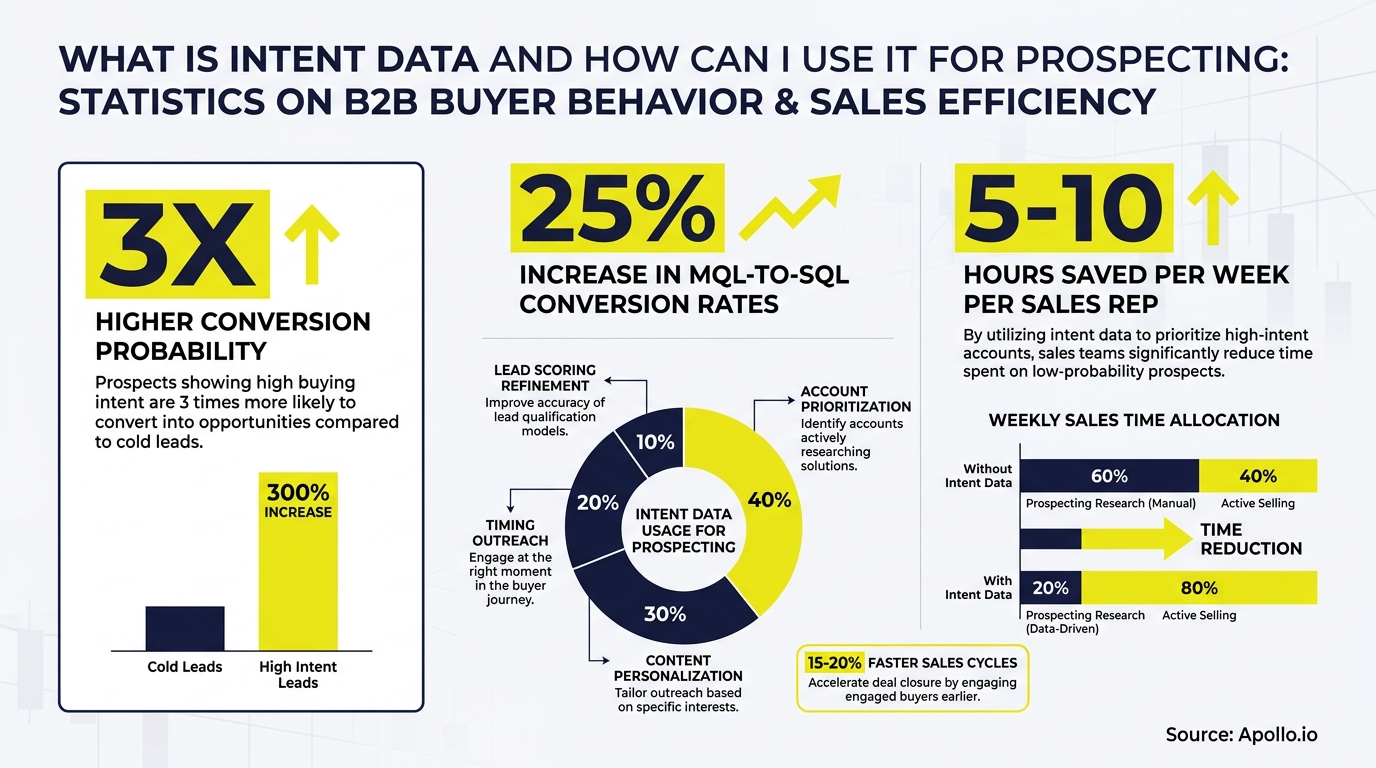
Most B2B buyers are already 70% through their buying journey before a sales rep ever contacts them, according to the 6sense 2024 Buyer Experience Report. That means cold outreach to random accounts is increasingly a losing bet. Intent data changes the equation by revealing which accounts are actively researching solutions like yours — right now. If you're building a smarter sales prospecting process, intent signals are the foundation.

Research Less. Pipeline More With Apollo.
Tired of your reps burning hours verifying contact info instead of selling? Apollo delivers 230M+ accurate business contacts so your team reaches real buyers fast. Start building pipeline today.
Start Free with Apollo →Key Takeaways
- Intent data identifies accounts actively researching your category, letting you prioritize outreach by timing rather than gut instinct.
- The most effective approach combines intent signals with concrete trigger events (funding, hiring, tech changes) — not intent alone.
- Recency and specificity are the two filters that cut the most noise: signals older than 72 hours lose value fast.
- Privacy signal loss is accelerating the shift toward first-party intent data and multi-signal approaches.
- Intent adoption is rising but remains operationally underutilized — teams that build tight signal-to-action playbooks gain a measurable competitive edge.
What Is Intent Data?
Intent data is behavioral signal information showing that a business or buying group is actively researching a specific topic, product category, or problem. It captures digital behaviors — content consumption, search activity, review-site visits, and web interactions — and aggregates them at the account level to indicate purchase readiness.
As Intentsify explains, this data helps businesses understand what prospective customers are actively researching, allowing for more targeted and effective engagement. Intent data falls into three primary types:
| Type | Source | Example Signals |
|---|---|---|
| First-party | Your own properties | Website visits, content downloads, pricing page views |
| Second-party | Partner data | Review site activity (G2, Capterra), community engagement |
| Third-party | Publisher networks | Topic surges across B2B content networks |
A key distinction: intent data is not a lead list. It is a prioritization layer that tells you when to reach out, not just who to reach out to. Learn more about how intent data is collected and used.
Why Is Intent Data Important for Prospecting in 2026?
Intent data matters because buyers now self-educate across far more channels before engaging sellers. A McKinsey 2024 B2B Pulse Survey found buyers use an average of 10 interaction channels in a single buying journey, up from 5 in 2016. Without intent signals, reps are guessing which accounts to prioritize across those channels.
The adoption gap also represents a real competitive window. According to Myshortlister, only about 25% of B2B businesses currently leverage intent data and monitoring tools. A Forrester report published in April 2026reinforces this: intent data adoption is rising, but it remains consistently underutilized — most teams have signals but fail to operationalize them into routing, prioritization, and messaging. That gap is an advantage for teams that act on it.
For SDRs and BDRs managing large prospect lists, intent signals cut through the noise by surfacing which accounts deserve immediate attention versus which can wait for a nurture sequence.

How Do SDRs and AEs Use Intent Data for Prospecting?
SDRs use intent data to prioritize their outreach queue by account-level buying signals rather than static firmographic lists. AEs use it to time re-engagement with stalled deals or competitive accounts showing research activity.
Both benefit from getting signals directly in their workflow — not buried in a separate dashboard.
The practical framework breaks into four steps:
- Filter by recency and specificity. A sales professional shared on Reddita simple rule: ignore signals older than 72 hours, and ignore anything not clearly tied to the problem you solve. That alone cuts roughly 80% of the noise.
- Layer intent on top of trigger events. Intent works best as a filter, not a standalone trigger. Combine it with concrete events — funding rounds, new hires in relevant roles, tech stack changes — to identify accounts that are both in-market and experiencing a relevant change.
- Personalize outreach to the signal. Reference the topic the account is researching, not generic pain points. This is where intent data supercharges B2B sales — messaging becomes relevant because it matches what the buyer is actively thinking about.
- Measure signal-to-meeting velocity. Track how quickly intent signals convert to booked meetings and pipeline, not just whether they generated an MQL.
Struggling to find which accounts are actually in-market? Apollo's buying intent data surfaces accounts researching your category so SDRs can prioritize outreach by timing, not guesswork.
Turn Funnel Gaps Into Pipeline Wins
Tired of watching marketing leads stall before they ever reach your AEs? Apollo surfaces in-market buyers with real-time intent signals so your team reaches the right prospects at right moment. Over 600K companies trust Apollo to turn funnel gaps into revenue.
Start Free with Apollo →What Is the Intent-to-Prospecting Playbook?
The intent-to-prospecting playbook maps specific signals to specific actions across channels. A single intent spike without a defined response is wasted signal.
| Signal Strength | SDR Action | Marketing Action | Content Type |
|---|---|---|---|
| High (recent + specific) | Personalized outreach within 24 hrs | Retargeting ads on relevant topic | ROI calculators, case studies |
| Medium (topic match, older) | Add to intent-triggered sequence | Targeted webinar invite | Benchmark reports, how-to guides |
| Low (broad topic, weak) | Monitor; no immediate outreach | Awareness ads | Short-form content, thought leadership |
A key insight from practitioner experience: reducing volume increases quality. A Reddit discussion on intent data ROI described cutting a hot-lead list from 47 accounts per week to 12-15 by using intent as a filter rather than a trigger — and seeing a dramatic improvement in response rates and conversation quality.
For RevOps leaders, the playbook also needs SLAs: how quickly must a rep act on a high-intent signal? Without defined response windows, intent data becomes a reporting artifact rather than a revenue driver.
How Do You Build a Privacy-Resilient Intent Data Strategy?
A privacy-resilient intent strategy relies less on third-party cookie-based signals and more on first-party behavioral data, consented interactions, and multi-signal scoring. This is no longer optional: the IAB's State of Data 2024 found that 95% of U.S. advertising and data decision-makers expect continued privacy legislation and signal loss.
Key design principles for a durable intent program:
- First-party signals first. Website behavior, product usage (for PLG teams), and gated content engagement are the most reliable and privacy-compliant signals you control.
- Multi-signal scoring. Combine topic intent with review-site activity, community mentions, and firmographic triggers. Single-source intent is noisy; corroborated signals are actionable.
- Contextual signals as a fallback. When identity resolution degrades, contextual targeting (matching ad content to topic context rather than user identity) preserves reach without privacy risk.
- Measure outcomes, not volume. Track intent-to-opportunity velocity and pipeline contribution, not just how many accounts showed intent. Leadership increasingly demands this accountability.
Pairing intent signals with enriched, accurate contact data is also critical. Stale or incomplete records undermine even the best intent playbook. Contact data enrichment ensures your CRM reflects current roles and contacts at the accounts intent signals surface.
How Does Apollo Help Teams Activate Intent Data for Prospecting?
Apollo brings intent signals, contact data, and outreach execution into a single platform — eliminating the gap between identifying an in-market account and reaching the right person at it. Instead of managing a separate intent tool, a separate database, and a separate sequencing platform, teams work from one unified workspace.
Apollo's buying intent data identifies accounts actively researching your category, while the 230M+ contact database lets you immediately find and verify the right contacts at those accounts. From there, Apollo's multi-channel sales engagement lets SDRs launch personalized sequences without switching tools. "Having everything in one system was a game changer," noted the team at Cyera.
This consolidation matters for RevOps. Fewer integrations mean cleaner data, faster signal-to-action time, and simpler attribution.
Trusted by nearly 100K paying customers including Anthropic, Smartling, and Redis, Apollo serves B2B GTM teams from startups through enterprise.

Start Prospecting with Intent — Not Guesswork
Intent data is not a silver bullet, but it is the clearest signal available that an account is in-market. The teams winning in 2026 are those that move quickly on high-quality signals, layer intent with trigger events, and measure pipeline impact — not MQL volume.
The competitive advantage belongs to teams that operationalize intent into their daily workflow. Apollo makes that straightforward by combining intent signals, verified contact data, and outreach automation in one platform. Start a free trial and see which in-market accounts you've been missing.
Apollo Delivers ROI You Can Prove
ROI pressure killing your tool adoption? Apollo surfaces pipeline impact fast — so you walk into every budget review with hard numbers, not gut feelings. Over 600K companies trust Apollo to make the case.
Schedule a Demo →Don't miss these
Sales
Inbound vs Outbound Marketing: Which Strategy Wins?
Sales
What Is a Sales Funnel? The Non-Linear Revenue Framework for 2026
Sales
What Is a Go-to-Market Strategy? The 2026 GTM Playbook
See Apollo in action
We'd love to show how Apollo can help you sell better.
By submitting this form, you will receive information, tips, and promotions from Apollo. To learn more, see our Privacy Statement.
4.7/5 based on 9,690 reviews
