
What Is B2B Sales? Definition, Process, and Modern Strategies
B2B sales in 2026 looks nothing like it did five years ago. Buyers now complete most of their research before talking to a rep, they expect AI-powered self-serve experiences, and they form vendor shortlists earlier than ever. Understanding what B2B sales means today requires recognizing this shift from persuasion to enablement.

Eliminate 4+ Hours Of Daily Research
Tired of spending hours hunting for contact info? Apollo delivers 224M verified contacts with 96% email accuracy. Join 550K+ companies who turned research time into selling time.
Start Free with Apollo →Key Takeaways
- B2B sales means selling products or services from one business to another, covering everything from software to manufacturing equipment
- The global B2B e-commerce market reached $32.11 trillion in 2025 and is projected to hit $36.16 trillion by 2026
- 61% of B2B buyers now prefer rep-free buying experiences, forcing sales teams to focus on buyer enablement over traditional pitching
- Modern B2B sales cycles average 10.1 months in 2025, down from 11.3 months in 2024 due to digital acceleration
- SDRs, AEs, and RevOps teams increasingly consolidate their tech stack into all-in-one platforms to reduce costs and improve efficiency
What Is B2B Sales?
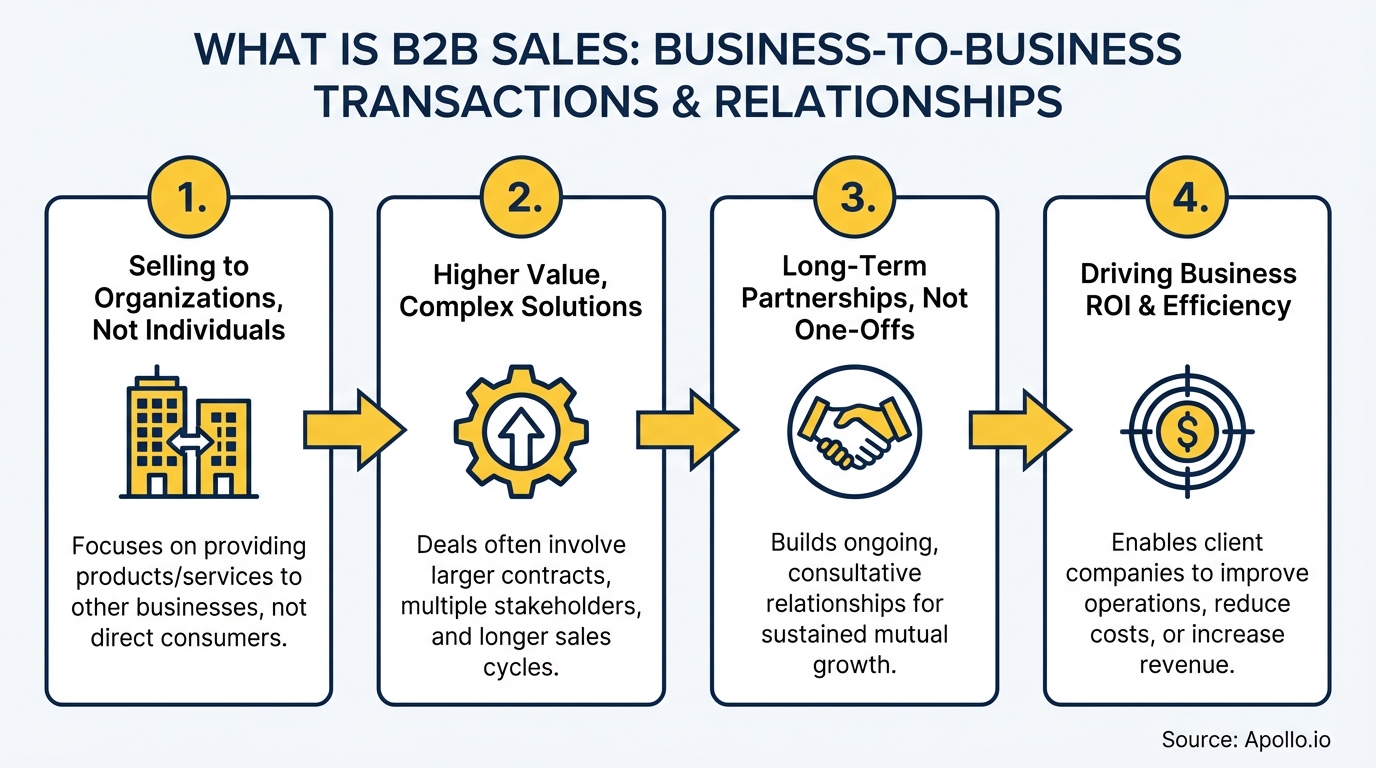
B2B sales is the process of selling products or services from one business to another business. Unlike consumer sales (B2C), B2B transactions involve longer sales cycles, multiple decision makers, and higher deal values. According to Landbase, the global B2B e-commerce market was estimated at $32.11 trillion in 2025 and is projected to grow to $36.16 trillion by 2026.
Research from Indeed shows B2B sales encompass various models, including wholesale/distribution, material sales for production, product sales (e.g., tools, equipment), and service/software sales. These transactions require relationship building, technical expertise, and the ability to demonstrate ROI to stakeholders across procurement, finance, and operations.
Turn Forecast Guesswork Into Revenue Certainty
Pipeline forecasting a guessing game? Apollo's real-time deal intelligence shows exactly where every opportunity stands. Built-In boosted win rates 10% with Apollo's signals and scoring.
Start Free with Apollo →How Does B2B Sales Work in 2026?
B2B sales in 2026 operates as a hybrid model balancing digital self-serve with strategic human engagement. Buyers now conduct extensive research independently before engaging sellers.
They use AI search tools, read peer reviews, and form vendor shortlists without sales contact.
The modern B2B sales process includes:
- Prospecting: Identifying target accounts using intent data and verified contact databases
- Qualification: Determining fit based on budget, authority, need, and timeline (BANT)
- Discovery: Understanding business challenges and mapping solutions to specific pain points
- Proposal: Presenting customized solutions with clear ROI and implementation plans
- Negotiation: Addressing objections and aligning on pricing, terms, and deliverables
- Closing: Securing contracts and transitioning to customer success teams
According to Corporate Visions, economic conditions shortened the average B2B sales cycle from 11.3 months in 2024 to 10.1 months in 2025, driven by digital acceleration and buyer urgency.

What Are the Main Types of B2B Sales?
B2B sales spans multiple transaction models, each requiring different sales approaches and expertise. Understanding these categories helps sales teams specialize and optimize their B2B sales techniques.
| Sales Type | Description | Examples |
|---|---|---|
| Wholesale/Distribution | Bulk product sales to retailers or distributors | Food suppliers, electronics distributors |
| Manufacturing/Materials | Raw materials and components for production | Steel, chemicals, semiconductor parts |
| Professional Services | Consulting, legal, financial, and advisory services | Management consulting, accounting firms |
| Software/SaaS | Cloud-based applications and enterprise software | CRM platforms, marketing automation tools |
| Equipment/Technology | Machinery, hardware, and tech infrastructure | Manufacturing equipment, servers, network gear |
Struggling to find qualified leads across these categories? Search Apollo's 224M+ contacts with 65+ filters to target the right accounts.
How Do SDRs and AEs Approach B2B Sales Differently?
SDRs (Sales Development Representatives) and AEs (Account Executives) play distinct but complementary roles in the B2B sales funnel. SDRs focus on top-of-funnel activities: prospecting, cold outreach, and qualifying leads before booking discovery calls. They prioritize volume, personalization at scale, and moving prospects from awareness to interest.
AEs take qualified opportunities from SDRs and guide them through evaluation, negotiation, and close. They conduct deep discovery, build business cases, navigate multiple stakeholders, and structure deals. For AEs managing complex enterprise sales, the focus shifts to executive relationships, ROI justification, and risk mitigation.
Both roles benefit from consolidated platforms. "We reduced the complexity of three tools into one," says Collin Stewart from Predictable Revenue, highlighting how modern sales teams eliminate inefficiencies by unifying prospecting, engagement, and pipeline management.
Why Is B2B Sales Becoming More Buyer-Led?
B2B buyers in 2026 control the sales process more than ever. Research from BuyYourData shows that by the end of 2025, 80% of B2B sales interactions between suppliers and buyers are expected to occur through digital channels. This shift forces sales teams to adapt from information providers to decision enablers.
Key drivers of buyer-led sales include:
- AI-powered research: Buyers use generative AI and conversational search to evaluate vendors independently
- Peer review reliance: G2, TrustRadius, and peer networks carry more weight than vendor claims
- Self-serve preferences: 61% of buyers prefer rep-free experiences for routine purchases
- Shortlist formation: Buyers select vendors earlier in the journey, often before sales outreach begins
For Sales Leaders and RevOps teams, this means investing in buyer enablement content, proof assets, and sales analytics that track engagement before traditional pipeline stages.
Spending hours on manual outreach? Automate your sequences with Apollo's multi-channel platform and focus on high-value conversations.

What Skills Do B2B Sales Professionals Need in 2026?
Modern B2B sales requires a blend of traditional relationship skills and digital-first capabilities. Top performers excel at consultative selling, where they diagnose business problems and prescribe tailored solutions rather than pitching features.
Essential skills include:
- Business acumen: Understanding buyer industries, financial models, and competitive landscapes
- Data interpretation: Using intent signals, engagement metrics, and predictive analytics to prioritize accounts
- Multi-threading: Building relationships with multiple stakeholders across buying committees
- Digital fluency: Leveraging CRM, sales engagement platforms, and AI tools effectively
- Change management: Helping buyers navigate internal approval processes and implementation challenges
For Founders and CEOs building sales teams, focusing on these skills accelerates ramp time and improves win rates. Organizations like Census report, "We cut our costs in half" by consolidating tools and training teams on unified platforms rather than juggling disconnected systems.
Start Closing More B2B Deals With Apollo
B2B sales in 2026 demands speed, precision, and buyer-focused execution. Whether you're an SDR building pipeline, an AE closing high-ticket sales, or a Sales Leader optimizing team performance, the right tools make the difference between hitting quota and falling short.
Apollo consolidates prospecting, engagement, and intelligence into one workspace. Access 224M+ verified contacts, automate multi-channel sequences, and track every deal stage without switching between platforms. Teams at Cyera, Census, and Predictable Revenue use Apollo to reduce tool complexity and drive measurable revenue growth.
Ready to simplify your sales stack? Start your free Apollo trial and see why 90K+ companies trust Apollo for their B2B sales operations.
Prove Apollo's Value In Your First Week
Budget approvals stuck on unclear metrics? Apollo tracks every activity to pipeline dollar—quantify time saved, meetings booked, and deals influenced. Built-In increased win rates 10% and ACV 10% with Apollo's signals.
Start Free with Apollo →Don't miss these
Sales
Inbound vs Outbound Marketing: Which Strategy Wins?
Sales
What Is a Sales Funnel? The Non-Linear Revenue Framework for 2026
Sales
What Is a Go-to-Market Strategy? The 2026 GTM Playbook
See Apollo in action
We'd love to show how Apollo can help you sell better.
By submitting this form, you will receive information, tips, and promotions from Apollo. To learn more, see our Privacy Statement.
4.7/5 based on 9,690 reviews
