
What Is a Sales Qualified Lead and Why Does It Matter?
In 2026, revenue teams face a harsh reality: most leads never convert. According to Landbase, the average conversion rate from Marketing Qualified Leads (MQLs) to Sales Qualified Leads (SQLs) across industries is around 13%. That means 87% of marketing's work evaporates before sales can act. Understanding what makes a lead truly sales-qualified separates high-performing teams from those burning budget on unqualified prospects. This guide shows you how to define, identify, and convert SQLs while cutting through the noise of data-driven prospecting.

Apollo Eliminates 4+ Hours Of Daily Research
Tired of spending 4+ hours daily hunting for contact info? Apollo delivers 224M verified contacts with 96% email accuracy instantly. Join 550K+ companies who turned research time into selling time.
Start Free with Apollo →Key Takeaways
- A sales-qualified lead meets specific criteria showing genuine buying intent and readiness for direct sales engagement
- Only 13-15% of MQLs convert to SQLs on average, making qualification criteria critical for pipeline efficiency
- Modern SQL definitions must account for buying groups (13+ stakeholders) rather than single contacts
- AI-driven scoring and clean data hygiene are reshaping how teams identify and route SQLs in 2026
- Clear SLAs between marketing and sales prevent the 84% leakage that kills most pipelines
What Is a Sales Qualified Lead?
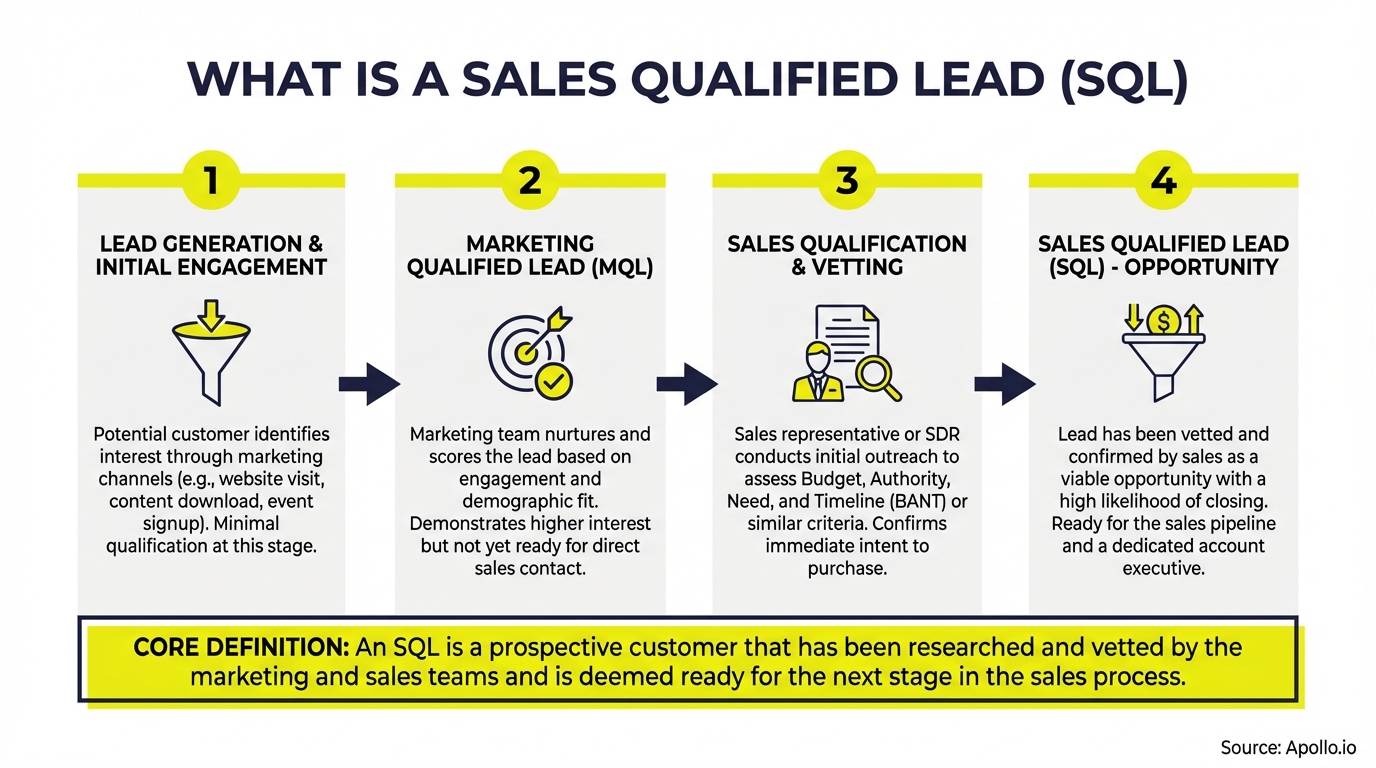
A sales-qualified lead (SQL) is a prospect who has been vetted by the sales team and meets specific criteria indicating readiness for direct sales conversations. Unlike marketing-qualified leads who show interest through content downloads or website visits, SQLs demonstrate clear buying intent and decision-making authority. Research from Zendesk confirms this stage is critical in the B2B sales funnel, as SQLs have moved beyond initial interest to demonstrate clear buying intent.
The distinction matters because it prevents sales teams from wasting time on tire-kickers. An SQL typically exhibits budget availability, timeline urgency, and organizational authority to make purchasing decisions.
In 2026, with AI agents handling initial qualification, the bar for SQL status has risen to include verified intent signals rather than simple demographic scoring.
How Does the MQL to SQL Conversion Process Work?
The journey from MQL to SQL involves multiple governance gates that most leads never pass. Here's the typical progression:
| Stage | Definition | Typical Conversion Rate |
|---|---|---|
| MQL | Marketing-qualified based on engagement scoring | Baseline (100%) |
| SAL | Sales-accepted after initial review | 34% of MQLs |
| SQL | Sales-qualified after discovery conversation | 47% of SALs (16% of MQLs) |
Data from MarketJoy shows conversion rates between 12-18%, with most organizations falling closer to the lower end. The massive drop-off happens because MQL criteria focus on engagement (downloads, page views) while SQL criteria demand business fit, budget, and buying timeline.
For SDRs and BDRs managing outbound prospecting, this means qualification questions must uncover pain severity, project timelines, and stakeholder involvement before passing leads to Account Executives.
Why Do Most Leads Fail SQL Qualification?
According to Martal, the MQL to SQL stage is often identified as the biggest drop-off point in the sales pipeline. Three primary blockers prevent progression:
- Buying group misalignment: The contact engaging with marketing is rarely the final decision-maker. In 2026, deals involve 13 internal stakeholders on average, meaning single-threaded relationships fail.
- Internal consensus friction: Procurement, IT, security, and finance teams each have veto power. Without multi-departmental buy-in, leads stall indefinitely.
- Premature qualification: Marketing scores on behavior (clicked email, attended webinar) rather than business readiness (approved budget, defined timeline, competitive evaluation stage).
Sales Leaders managing pipeline governance must establish clear acceptance criteria that account for buying committee coverage, not just individual contact quality. This shift from lead-centric to account-centric qualification is reshaping lead generation best practices across B2B.
Turn Forecast Guesswork Into Revenue Certainty
Pipeline forecasting a guessing game? Apollo's real-time deal tracking and lead scoring eliminate blind spots. Built-In boosted win rates 10% with instant visibility across every stage.
Start Free with Apollo →How Do SDRs Qualify Leads More Effectively?
SDRs using qualification frameworks like BANT (Budget, Authority, Need, Timeline) or MEDDIC (Metrics, Economic Buyer, Decision Criteria, Decision Process, Identify Pain, Champion) can double their SQL conversion rates. Here's what works in 2026:
- Multi-threading from first contact: Ask "Who else is involved in evaluating solutions like ours?" during discovery calls
- Timeline verification: Replace "Are you looking to buy?" with "What happens if you don't solve this by [specific date]?"
- Budget confirmation: Use "Have you allocated budget for this initiative?" rather than accepting vague "we have budget" claims
- Pain quantification: Get specific numbers on cost of inaction, current manual hours, or revenue at risk
Struggling to find qualified leads with verified contact data? Search Apollo's 224M+ contacts with 65+ filters to build targeted prospecting lists.

What SQL Criteria Should Sales and Marketing Agree On?
Clear service-level agreements (SLAs) between marketing and sales prevent the 84% leakage killing most pipelines. Define SQL criteria across three dimensions:
| Dimension | SMB Criteria | Enterprise Criteria |
|---|---|---|
| Fit | Company size 10-200 employees, target industry, tech stack match | 1000+ employees, strategic account list, multi-location presence |
| Intent | Demo request, pricing inquiry, competitor comparison search | RFP issuance, procurement engagement, executive briefing request |
| Engagement | 2+ stakeholders engaged, 3+ touchpoints across 14 days | 4+ buying committee members identified, cross-departmental involvement |
RevOps teams should track velocity metrics: how long leads spend in each stage, which sources produce highest SQL conversion rates, and where acceptance disputes occur between marketing and sales. This data drives continuous refinement of qualification thresholds.
How Should AEs Handle SQLs Differently Than Other Leads?
Account Executives managing SQLs should shift from education mode to evaluation facilitation. SQLs already understand their problem and potential solutions.
Your job is building consensus and de-risking the decision.
- Run multi-stakeholder discovery: Get finance, IT, and end-users in the same conversation early
- Build mutual action plans: Document decision criteria, evaluation steps, and timeline commitments from both sides
- Provide ROI business cases: Quantify outcomes in terms each stakeholder cares about (CFO wants payback period, IT wants integration complexity, end-users want ease of adoption)
- Identify and neutralize risk concerns: Proactively address security, compliance, and vendor stability questions before they become deal-killers
Can't track deal progression and stakeholder engagement effectively? Get complete pipeline visibility with Apollo's deal management platform.

What Tools Help Teams Identify and Convert SQLs?
Modern SQL workflows require integrated tech stacks that eliminate manual handoffs and data gaps. Essential capabilities include:
- Intent data platforms: Track buyer research behavior, competitive intelligence searches, and technology evaluation signals
- Conversation intelligence: AI call analysis identifies qualification gaps and buying committee members mentioned in discovery calls
- Lead scoring automation: Combine demographic fit, behavioral engagement, and intent signals into dynamic prioritization
- CRM workflow automation: Route SQLs based on territory, industry expertise, and current pipeline capacity
Companies like Customer.io increased SQLs by 70% after consolidating prospecting, engagement, and pipeline management into a single platform. This eliminates the data fragmentation that causes leads to fall through cracks between marketing automation and CRM systems.
Try Apollo Free
Sales teams in 2026 need more than lead lists. They need verified contact data, multi-channel engagement tools, and pipeline visibility in one workspace. Apollo consolidates the 3-5 tools most teams juggle, cutting costs while improving SQL quality. Start with 224M+ verified business contacts, 65+ search filters, and AI-powered sequences that convert prospects into pipeline. Try Apollo Free.
Prove Apollo's ROI In Your First 30 Days
Budget approval stuck on unclear metrics? Apollo tracks every dollar—from prospect to closed deal. Built-In increased win rates 10% and ACV 10% with measurable pipeline impact.
Start Free with Apollo →Don't miss these
Sales
Inbound vs Outbound Marketing: Which Strategy Wins?
Sales
What Is a Sales Funnel? The Non-Linear Revenue Framework for 2026
Sales
What Is a Go-to-Market Strategy? The 2026 GTM Playbook
See Apollo in action
We'd love to show how Apollo can help you sell better.
By submitting this form, you will receive information, tips, and promotions from Apollo. To learn more, see our Privacy Statement.
4.7/5 based on 9,690 reviews
