
What Is a Good Benchmark for Reply Rates in Cold Outreach?
Most B2B sales teams are benchmarking their cold outreach reply rates against outdated numbers. If you're targeting 10% and celebrating 5% as a failure, you're working with the wrong baseline. The real 2026 data tells a very different story, and understanding it is the first step to building a smarter outbound prospecting strategy.

Get Verified Contacts, Skip the Hunt
Tired of burning hours tracking down emails that bounce and numbers that go nowhere? Apollo delivers 230M+ verified contacts so your team spends time selling, not searching. Start building pipeline today.
Start Free with Apollo →Key Takeaways
- A 3%–6% reply rate is a normal, healthy benchmark for broad B2B cold email in 2026. Under 3% signals a targeting or deliverability problem.
- "Reply rate" is not one metric: total replies, positive replies, and meeting-booked rates are three distinct KPIs that require separate benchmarks.
- Smaller, more targeted campaigns consistently outperform high-volume blasts. Segmentation is your biggest lever.
- Deliverability failures now masquerade as messaging failures. Low reply rates may mean your emails aren't reaching the inbox at all.
- SDRs and BDRs who combine clean data, personalization, and multi-touch sequences consistently hit the upper end of the benchmark range.
What Is a Good Benchmark for Reply Rates in Cold Outreach?
A good cold outreach reply rate in 2026 falls between 3% and 6% for broad B2B email campaigns. Under 3% typically indicates a targeting or deliverability issue.
Above 6% reflects strong execution. Above 8% is exceptional and usually tied to tight ICP segmentation, buying signals, or prior familiarity with the sender.
Data from Belkins, based on an analysis of 16.5 million cold emails, reported an average reply rate of 5.8% in 2024, down from 6.8% in 2023. That 15% year-over-year decline reflects rising buyer resistance to irrelevant outbound and tighter spam filtering across major providers.
| Reply Rate | What It Signals | Primary Action |
|---|---|---|
| Under 3% | Targeting or deliverability problem | Audit ICP fit and inbox placement |
| 3%–6% | Normal for broad B2B cold email | Optimize messaging and follow-up cadence |
| 6%–8% | Strong execution | Replicate and scale winning segments |
| 8%+ | Exceptional, usually segment-specific | Identify what's driving it and protect it |
What Counts as a Reply? Total vs. Positive vs. Meeting-Booked
Not all replies are created equal, and conflating them is one of the most common benchmarking mistakes SDRs and RevOps teams make. There are three distinct reply-rate metrics, each with a different benchmark.
- Total Reply Rate: Any response, including opt-outs, "not interested," and out-of-office messages. This is the most commonly cited figure in reports.
- Positive Reply Rate: Responses that express genuine interest. Research from Sales.co, analyzing over 2 million emails in February 2026, found an average cold email reply rate of 2.09%, with only 14.1% of those being genuinely positive, yielding an interested reply rate of approximately 0.64%.
- Meeting-Booked Rate: Replies that convert to a scheduled call or demo. This is the metric account executives and sales leaders should care about most.
Exclusions to apply before calculating: Bounced emails, auto-replies, and spam filter rejections should be removed from your denominator. Counting them inflates your send volume and deflates your apparent reply rate.
How Does Campaign Scale Affect Reply Rate Benchmarks?
Smaller, more targeted campaigns produce higher reply rates than large-volume blasts, and the gap is significant. Segmentation is the single highest-leverage variable in cold outreach performance.
Studies cited by Martal indicate an average reply rate of 5.1% in 2024, down from approximately 7% the prior year, with tighter segments consistently outperforming broader sends. Meanwhile, Cleverly notes that the platform average for cold email reply rates in 2025–2026 sits at 3.43%, reflecting increased inbox competition and stricter spam filtering across major email providers.
The practical implication: benchmark by ICP segment, not by total database size. An SDR sending 50 highly targeted emails to companies that match a tight ICP should expect a different result than one blasting 5,000 generic emails. Struggling to reach the right contacts in the first place? Search Apollo's 230M+ contacts with 65+ filters to build tighter, higher-converting prospect lists.

How Do Follow-Ups and Personalization Impact Reply Rate?
Follow-ups and personalization both lift reply rates, but the relationship is more nuanced than "more is better." The data points in different directions depending on whether you're optimizing for total replies or pure reply rate.
What Does the Follow-Up Data Actually Show?
Research from Stripo found the first follow-up alone can add 40–50% more replies to a sequence. However, adding a third or fourth email introduces diminishing returns and, in some analyses, can actively lower per-email reply rates. The right approach: two to three touches for most B2B sequences, with each message adding new value rather than just nudging.
How Much Does Personalization Lift Reply Rates?
Specific, human personalization consistently outperforms generic templates.
For email personalization to move the needle, it needs to reference something genuinely relevant to the recipient.
Manually reviewed emails outperform fully automated sends, and emails with two or more custom attributes outperform non-personalized emails by a meaningful margin.
Generic AI-generated personalization is increasingly recognized by buyers and may actively hurt deliverability scores.
Turn Funnel Guesswork Into Pipeline Confidence
Pipeline forecasting a guessing game because your leads never convert? Apollo surfaces high-intent prospects that actually become opportunities. 600K+ companies use Apollo to build pipeline they can count on.
Start Free with Apollo →How Do SDRs Diagnose a Low Reply Rate?
SDRs and BDRs should treat a reply rate under 3% as a diagnostic signal, not just a performance number. The root cause is almost always one of three things: wrong audience, wrong message, or emails not reaching the inbox.
- Wrong audience: ICP definition is too broad, contact data is stale, or the list includes people outside the buying committee.
- Wrong message: Subject line fails to earn the open, the email leads with features instead of a relevant problem, or the CTA asks for too much too soon. Check your cold email subject lines first.
- Deliverability failure: Emails land in spam before a buyer ever sees them. Since 2024, Gmail, Yahoo, and Microsoft have tightened sender requirements. SPF, DKIM, and DMARC alignment are now baseline requirements, not optional hygiene.
A useful diagnostic: if your open rate is healthy but reply rate is low, the problem is your message. If open rate is also low, the problem is likely deliverability or subject line.
If you're not tracking opens at all, note that removing open tracking has been associated with higher reply rates in recent data.
For account executives preparing for outbound, pairing accurate contact data with a structured multi-channel sequence makes a measurable difference. Spending too much time manually building sequences? Automate your multi-channel sequences with Apollo's sales engagement platform and focus your time on the replies that matter.
What Are the Reply Rate Benchmarks for Multi-Channel Outreach?
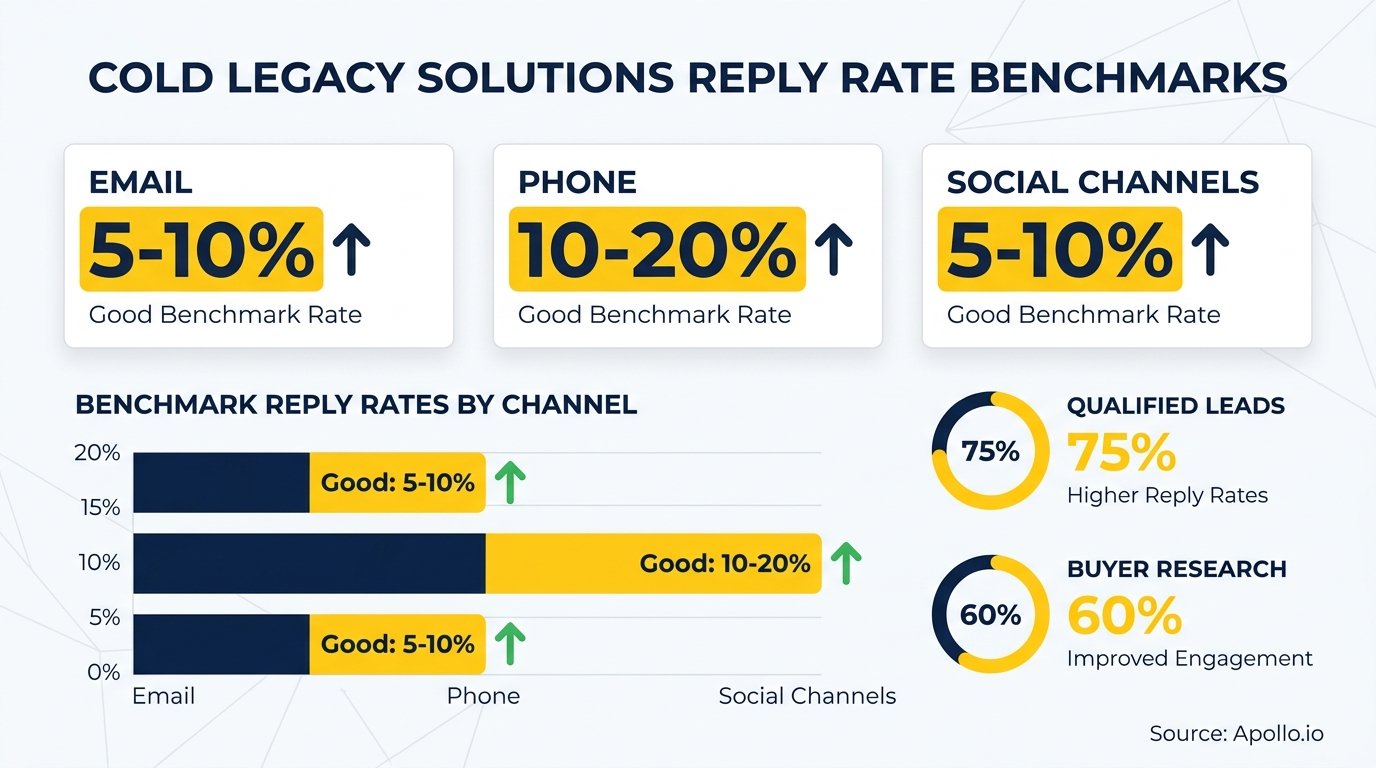
Cold email reply rate benchmarks should be evaluated alongside phone and social outreach, not in isolation. Multi-channel sequences that combine email, phone, and social touches consistently outperform single-channel approaches.
For cold calling benchmarks and techniques that complement email outreach, see best cold calling tips for 2026 and data-driven sales prospecting strategies. The key principle: use each channel at the right moment in the sequence rather than treating email as your only lever.
| Channel | Typical Reply/Response Rate | Best Use Case |
|---|---|---|
| Cold Email (broad B2B) | 3%–6% | Initial outreach at scale |
| Cold Email (tight ICP/intent) | 6%–15%+ | Signal-triggered or highly targeted campaigns |
| Cold Calling | Varies by connect rate | Follow-up after email touch or high-value accounts |
| Social Outreach | Higher per-message, lower volume | Warm-up before email or after connection |
How Can You Improve Your Cold Outreach Reply Rate in 2026?
Improving reply rates requires fixing the right variable. Use this prioritized checklist based on your current performance band.
- Under 3%: Fix deliverability first. Verify SPF, DKIM, and DMARC. Remove bounced contacts. Reduce list size and increase targeting precision. Confirm your spam complaint rate stays well below 0.1%.
- 3%–6%: Improve personalization. Reference a specific trigger, pain point, or signal relevant to the recipient. Tighten your ICP definition. Add one to two follow-up touches with new value in each message.
- 6%+: Identify what's driving performance. Is it a specific segment, message type, or channel combination? Replicate those conditions and protect your sender reputation as you scale.
Well-targeted, intent-led campaigns can reach significantly higher reply rates according to SalesHive, with some reporting 15–25% for tightly defined segments with strong buying signals. Those results require clean data, precise targeting, and a message that speaks directly to an active problem.

Conclusion: Set the Right Benchmark, Then Beat It
A good cold outreach reply rate in 2026 is 3%–6% for broad B2B campaigns, 6%–8% for well-executed targeted outreach, and 8%+ for intent-driven or highly segmented sends. Measuring total replies without separating positive replies and meeting-booked rates gives you an incomplete picture.
The teams consistently hitting the upper end of these benchmarks share three things: accurate contact data, tight ICP segmentation, and sequences that add value at each touch. If you're ready to build outbound that converts, start free with Apollo and run your entire outbound motion from prospecting to booked meeting in one unified platform.
Prove Pipeline ROI From Day One
ROI pressure killing your tool budget before it proves its worth? Apollo delivers measurable pipeline impact fast — 46% more meetings with AI Research Agent. See the numbers your leadership needs to say yes.
Start Free with Apollo →Don't miss these
Sales
Inbound vs Outbound Marketing: Which Strategy Wins?
Sales
What Is a Sales Funnel? The Non-Linear Revenue Framework for 2026
Sales
What Is a Go-to-Market Strategy? The 2026 GTM Playbook
See Apollo in action
We'd love to show how Apollo can help you sell better.
By submitting this form, you will receive information, tips, and promotions from Apollo. To learn more, see our Privacy Statement.
4.7/5 based on 9,690 reviews
