
What ICP and Persona Data Does an AI SDR Need to Personalize Outreach Effectively?
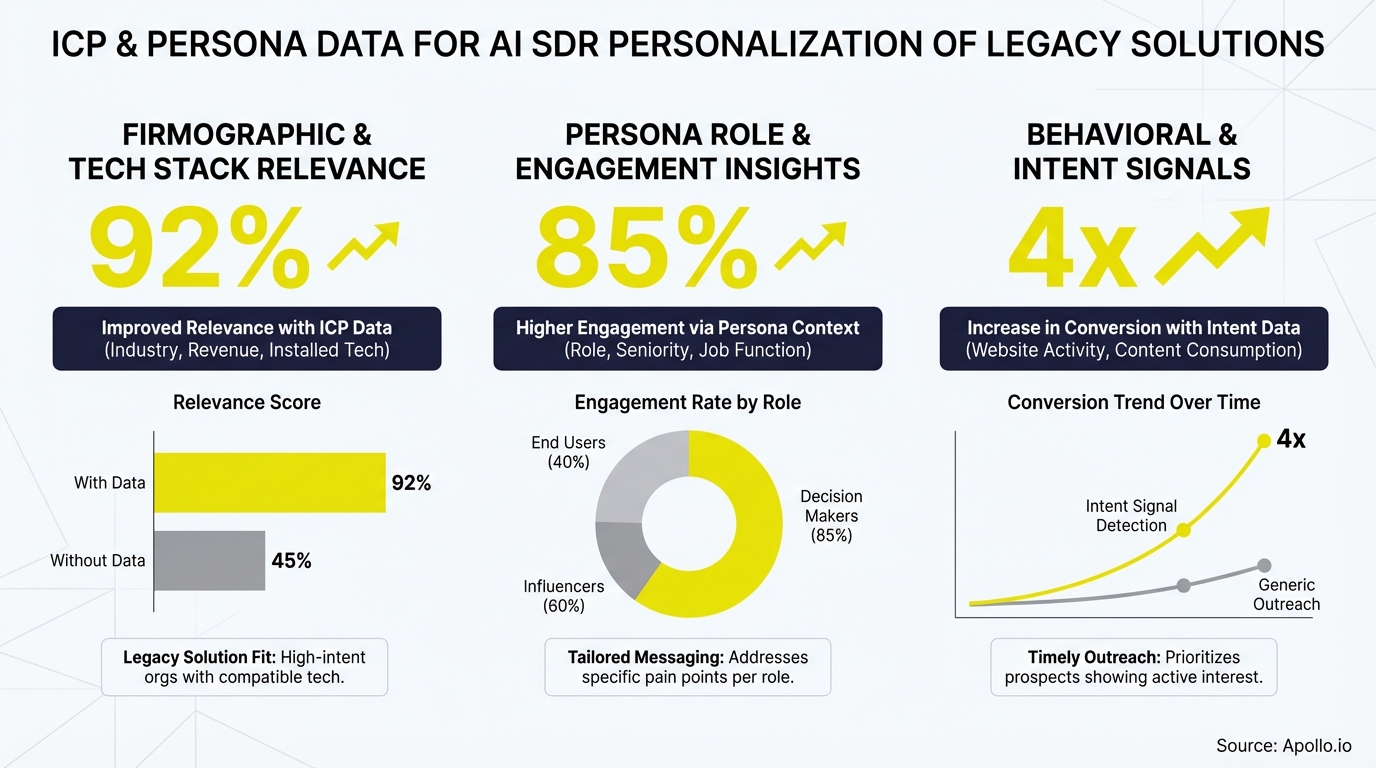
An AI SDR needs three layers of data to personalize outreach: firmographic ICP data to confirm fit, persona-level data to reach the right buyer, and real-time trigger signals to make the message timely. Miss any layer and your outreach reads generic, no matter how sophisticated the AI. Tools like Apollo's AI Sales Assistant are built around exactly this principle: grounding every message in verified account context before generating a single word of copy.
According to SuperAGI, 75% of B2B buyers now expect personalized experiences. The data requirements for AI SDRs aren't optional enrichments — they're the minimum viable fuel for any outreach that earns a reply.

Research Less, Close More With Apollo
Tired of your reps burning hours on manual lead research instead of selling? Apollo surfaces verified contacts instantly so your team spends time closing, not digging. Join 600K+ companies building pipeline faster.
Start Free with Apollo →Key Takeaways
- AI SDRs require three data tiers: ICP fit signals, persona-level context, and real-time account triggers.
- Data quality is the primary bottleneck — stale or incomplete fields produce generic outputs regardless of AI model quality.
- Personalization has a cognitive-load ceiling: prioritize one to two high-relevance signals per touchpoint rather than packing every data point into a message.
- Intent data and technographics are now first-class personalization inputs, not optional enrichments.
- Governance and privacy-by-design are becoming competitive differentiators in outbound data stacks in 2026.
What Is the Minimum Viable Personalization Data Schema for an AI SDR?
The minimum viable schema has three tiers. Tier 1 covers identity and ICP fit.
Tier 2 covers account context. Tier 3 covers real-time triggers.
All three are required for personalization that earns engagement.
| Tier | Data Category | Key Fields | Purpose |
|---|---|---|---|
| Tier 1: ICP Fit | Firmographic | Industry, headcount, revenue range, geography, business model | Confirm account is in-profile before investing AI credits |
| Tier 1: ICP Fit | Technographic | Current tech stack, known integrations, legacy systems | Qualify fit and identify displacement or integration angle |
| Tier 2: Account Context | Strategic Initiatives | Hiring trends, product launches, funding rounds, org changes | Anchor outreach to a real business moment |
| Tier 2: Account Context | Persona | Job title, seniority, department, tenure, inferred priorities | Match message to buyer's role-specific pain points |
| Tier 3: Triggers | Intent + Behavioral | Intent topics, job change events, website visits, content engagement | Time outreach to peak buying readiness |
Learn more about what ICP means in sales and how to build a framework that maps directly to revenue.
Why Does Data Quality Determine AI SDR Output Quality?
Data quality is the primary bottleneck for AI SDR personalization because AI models generate outputs constrained by the inputs they receive — incomplete or stale fields produce generic, low-relevance messages regardless of model quality. The growing trend toward grounded generation (RAG-style retrieval) makes this more acute: AI SDRs retrieve verified account facts first, then generate messaging constrained to those facts.
Garbage in, garbage out applies at every stage.
For SDRs and RevOps leaders, this means data readiness is not a nice-to-have. A practical readiness checklist includes:
- Verification cadence: Validate email and title fields on a defined schedule, not just at import
- Confidence scoring: Flag fields with low-confidence values so AI falls back to segment-level messaging instead of fabricating context
- Deduplication: Prevent AI SDR sequences from firing on duplicate records
- Enrichment triggers: Auto-enrich on job change or funding event signals to keep Tier 2 and Tier 3 fields fresh
Struggling to keep contact data clean and current? Apollo's data enrichment keeps 230M+ verified contacts updated so your AI SDR always has accurate inputs to work from.
Understand the full mechanics of keeping records current in the guide on what data enrichment is and how to do it right.
Turn Funnel Gaps Into Qualified Pipeline
Tired of watching marketing leads stall before they ever reach sales? Apollo surfaces high-fit prospects with real-time buying signals so your team reaches the right buyers first. 600K+ companies trust Apollo to build pipeline that actually converts.
Start Free with Apollo →How Do SDRs Use Trigger Data to Personalize at Scale?
SDRs use trigger data by mapping specific account events to pre-built outreach angles, then letting the AI SDR generate message variants grounded in those events. This approach shifts personalization from surface-level tokens ("I saw your post") to relevance personalization anchored in real business context.
High-value trigger types for AI SDR personalization:
- Job change: New VP or Director joins — outreach references the transition and fresh mandate
- Funding event: Series A or B close — message addresses scale or infrastructure challenges that follow
- Hiring surge: Rapid headcount growth in a department — signals investment in a specific function
- Intent surge: Account researching topics aligned to your category — time-sensitive outreach window
- Technographic change: Adoption or removal of a platform in your integration ecosystem
The Apollo AI Research Overview explains how AI Research templates pull these signals from the web and convert them into dynamic variables usable directly in sequence personalization.
For AEs managing named accounts, Apollo's pre-meeting research capability surfaces the same trigger data before calls.
See how intent data works and which providers lead in 2026 for a deeper look at integrating behavioral signals into your ICP model.

What Is the Cognitive-Load Rule for AI SDR Personalization?
The cognitive-load rule states that effective AI SDR outreach should lead with one to two high-salience signals per touchpoint, not every available data point. More personalization variables do not linearly increase engagement — they can overwhelm the reader and dilute the core message.
A practical relevance-ranking framework for each touchpoint:
- Score each available signal by recency (how recent is the trigger?) and relevance (how directly does it connect to your product's value prop?)
- Select the single highest-scoring signal as the primary hook
- Use a secondary ICP fit signal (role, tech stack) as supporting context
- Keep all other data fields in the record for AI scoring and routing, but exclude them from the message itself
Apollo's AI Content Center operationalizes this by grounding message generation in your configured value proposition and ICP context — so outputs stay focused on the most relevant angle rather than producing a data-dump email.
How Do RevOps Teams Govern ICP and Persona Data for AI SDRs?
RevOps teams govern ICP and persona data by defining which fields are required, which are allowed in AI-generated messaging, and which require human review before use. As data governance becomes a competitive differentiator in outbound stacks, formalizing these rules prevents both compliance exposure and message quality degradation.
Core governance decisions for RevOps:
- Allowed fields: Define which persona attributes (role, company initiative, tech stack) are approved for AI personalization versus which are restricted (inferred demographics, sensitive signals)
- Data provenance: Track the source and age of enriched fields so AI SDRs don't act on outdated or unverified context
- Fallback rules: When a required field is missing or low-confidence, specify whether the AI falls back to segment-level messaging or holds the record for manual review
- Opt-out and suppression logic: Ensure deliverability-aware inputs (prior opt-outs, engagement history, send-frequency caps) are part of the AI SDR's decision context
The data enrichment strategy guide outlines how to build these governance layers into your enrichment workflow from the start.
How Does Apollo Help AI SDRs Use ICP and Persona Data Effectively?
Apollo addresses the full AI SDR data stack in a single platform: verified contact and account data, enrichment, intent signals, AI research, and AI-generated sequences — all connected without stitching together separate tools. As Ian Kistner, Head of Sales Development at Crusoe, put it: "We're using Apollo's AI Assistant to score and tier accounts, which makes it much easier to prioritize outbound in a quickly expanding market."
The Outbound Copilot automatically finds prospects matching your ICP filters, adds them to sequences, and generates multi-channel outreach grounded in your AI Content Center context. The Scores feature assigns ICP-match ratings so SDRs prioritize the highest-fit accounts first.
Research by Twilio found that 89% of business leaders believe personalization is crucial to their business success over the next three years. Apollo consolidates the data, enrichment, and AI execution layer needed to deliver that personalization at scale, replacing multiple point tools with one workspace. "Having everything in one system was a game changer," noted the team at Cyera.
Spending too much time building lists and researching accounts manually? Search Apollo's 230M+ contacts with 65+ ICP filters and let AI research do the account-level work for you.

Start Personalizing Outreach with the Right Data
Effective AI SDR personalization starts with a clean, tiered data schema: firmographic ICP fit at the base, persona and account context in the middle, and real-time trigger signals on top. Data quality and governance determine whether your AI SDR produces relevant, timely outreach or generic noise.
The cognitive-load ceiling means more data in the record does not mean more data in the message — prioritize one to two high-salience signals per touchpoint.
Apollo brings the data, enrichment, AI research, and sequence execution together in one platform — so SDRs, AEs, and RevOps teams can stop stitching together tools and start running personalized outreach that earns replies. Schedule a Demo to see how Apollo's AI SDR capabilities work end-to-end.
Prove Pipeline ROI Before Next QBR
Budget approval stuck on unclear metrics? Apollo delivers measurable pipeline impact from day one — so you walk into every QBR with numbers, not excuses. Leadium 3x'd their revenue. You're next.
Start Free with Apollo →Don't miss these
Sales
Inbound vs Outbound Marketing: Which Strategy Wins?
Sales
What Is a Sales Funnel? The Non-Linear Revenue Framework for 2026
Sales
What Is a Go-to-Market Strategy? The 2026 GTM Playbook
See Apollo in action
We'd love to show how Apollo can help you sell better.
By submitting this form, you will receive information, tips, and promotions from Apollo. To learn more, see our Privacy Statement.
4.7/5 based on 9,690 reviews
